

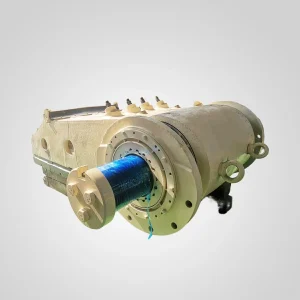
Eradicating Torsional Shear The Sandvik CJ815 402.4330-02 Forged Eccentric Shaft (2629.2kg)
OEM Part Number : 402.4330-02
Equipment Compatibility: Sandvik CJ815 Single-Toggle Jaw Crusher
Component Classification :Main Rotational Drive / Eccentric Shaft
Verified Mass :2629.2 kg
Base Metallurgy: 34CrNiMo6 (High-Tensile Forged Alloy Steel)
Core Hardness (Quenched & Tempered): 280 – 320 HBW
Technical Specifications: Sandvik CJ815 402.4330-02 Eccentric Shaft
| Technical Parameter | Engineering Specification |
|---|---|
| OEM Part Number | 402.4330-02 |
| Equipment Compatibility | Sandvik CJ815 Single-Toggle Jaw Crusher |
| Component Classification | Main Rotational Drive / Eccentric Shaft |
| Verified Mass | 2629.2 kg |
| Base Metallurgy | 34CrNiMo6 (High-Tensile Forged Alloy Steel) |
| Core Hardness (Quenched & Tempered) | 280 – 320 HBW |
| Tensile Strength | ≥ 1000 MPa |
| Yield Strength | ≥ 800 MPa |
| Bearing Journal Surface Finish | CNC Ground to Ra 0.4 μm |
| Journal Dimensional Tolerance | ISO IT6 (k6/m6 Fit Class) |
| Maximum Permissible Runout | ≤ 0.02 mm over total shaft length |
| Non-Destructive Testing (NDT) | EN 10228-3 Class 3 Ultrasonic Testing (100% Volumetric Scan) |
Managing Severe Torsional Kinetic Energy in Primary Crushing
A Sandvik CJ815 jaw crusher processing high-silica ore at maximum capacity transfers hundreds of kilowatts of kinetic energy directly through the longitudinal axis of its eccentric shaft. This rotational force is converted into the massive crushing stroke of the pitman assembly. The 402.4330-02 eccentric shaft, weighing an exact 2629.2kg, serves as the structural backbone of this operation. If a shaft lacks the necessary yield strength, the sudden kinetic spike generated by an uncrushable tramp iron event will permanently twist the journals out of phase, instantly destroying the internal bearings and locking the crusher solid.
Shaft failure in a 1500x1070mm primary crusher is an engineering disaster that halts an entire quarry for weeks. The 402.4330-02 prevents torsional shear through massive material volume and highly specific metallurgical conditioning, ensuring that the sheer rotational torque from the v-belt drive is efficiently transferred to the pitman without inducing flexural bending along the shaft’s central axis.
Metallurgical Forging Mechanics The 34CrNiMo6 Advantage
An eccentric shaft of this magnitude cannot be poured into a static mold; cast steel lacks the structural density required to survive continuous cyclical loading. The 402.4330-02 is manufactured from 34CrNiMo6, a premium nickel-chromium-molybdenum alloy steel. To achieve its final 2629.2kg mass, the steel ingot is subjected to thousands of tons of pressure under a hydraulic forging press. The manufacturing of premium jaw crusher parts demands strict adherence to longitudinal grain flow alignment. This forging process physically aligns the internal grain structure of the steel parallel to the shaft’s geometry, drastically enhancing its resistance to transverse fatigue cracking.
Following the forging process, the shaft undergoes a precise quenching and tempering thermal cycle to achieve a uniform core hardness of 280 to 320 HBW. This specific heat treatment locks in a tensile strength exceeding 1000 MPa and a yield strength of 800 MPa. The high nickel content ensures deep hardenability and exceptional impact toughness, allowing the shaft to absorb severe shock loads from the crushing chamber without experiencing brittle fracture.
Bearing Journal Tribology and Dimensional Micro-Tolerances
The operational lifespan of the massive spherical roller bearings inside the CJ815 is entirely dependent on the machining precision of the eccentric shaft journals. The 402.4330-02 shaft features main and eccentric bearing seating surfaces that are CNC ground to a mirror-like Ra 0.4 μm surface finish. If the surface finish is left rougher than specified, the microscopic peaks on the steel will aggressively bite into the inner race of the bearing during thermal expansion, causing the inner race to spin on the shaft—a failure mode that instantly generates extreme heat and friction welding.
Furthermore, the bearing journals are machined to strict ISO IT6 tolerances with a maximum permissible runout of less than 0.02 mm across the entire length of the 2629.2kg forging. If an aftermarket shaft presents with a runout of 0.06 mm, it forces the spherical roller bearings to run eccentrically. This unequal load distribution concentrates the entire multi-ton crushing force onto the outer edge of the bearing rollers, leading to cage fracture, spalling, and total bearing collapse within 500 operating hours.
Stress Concentration Eradication and Fillet Radiuses
The highest stress concentrations on any eccentric shaft occur at the transition points—the stepped areas where the shaft diameter changes between the main journals and the eccentric journals. The 402.4330-02 shaft utilizes highly calculated, precision-machined fillet radiuses at every transition step. These fillets are subsequently cold-rolled or shot-peened to induce a layer of residual compressive stress.
If an improperly manufactured shaft features sharp 90-degree transition corners, those corners will act as catastrophic stress risers. Under the immense cyclical bending forces of the CJ815 crushing stroke, microscopic fatigue cracks will initiate directly at these sharp corners and propagate inward, eventually resulting in the shaft snapping completely in half under load.
Volumetric Non-Destructive Testing (NDT) Protocols
Because visual inspection cannot verify internal structural integrity, the 402.4330-02 is subjected to 100% volumetric Ultrasonic Testing (UT) to EN 10228-3 Class 3 standards before it ever leaves the manufacturing facility. This Level II NDT procedure involves passing high-frequency sound waves entirely through the 2629.2kg forging to detect internal anomalies such as hydrogen flakes, inclusions, or forging bursts.
A microscopic void located deep within the center of a heavily loaded shaft will silently act as an internal stress multiplier. Over millions of crushing cycles, that internal void will spider-web outward. By demanding Class 3 UT certification, plant operators guarantee that the core of the eccentric shaft is solid, homogenous steel capable of surviving a decade of heavy primary crushing.
Total Cost of Ownership and Asset Predictability
Procurement teams must recognize that the eccentric shaft is the most critical and expensive rotating component within the primary circuit. While plant managers routinely schedule downtime for replacing Crusher Wear Parts, an eccentric shaft failure is an unscheduled catastrophic event that requires deploying heavy cranes, removing the entire pitman assembly, and frequently replacing cracked bearing housings.
Unlike consumable components, the premature failure of critical rotational jaw crusher parts necessitates a complete teardown of the primary circuit. The exact metallurgical chemistry, forged density, and IT6 machining tolerances of the 402.4330-02 ensure that the internal kinematics of the Sandvik CJ815 remain perfectly aligned. By investing in this rigorously engineered component, quarry operators eliminate the risk of mid-shift rotational failure, maximizing the long-term mechanical availability and financial return of their high-capacity primary crushing asset.
All manufacturer names, part numbers, model numbers, and descriptions are used for reference and identification purposes only, they are owned by the respective machine manufacturer, including but not limited to FLSmidth®, Metso®, thyssenkrupp®, and Sandvik®. All parts supplied are manufactured and warranted by yonsmen and are not manufactured by or purchased from the Original Equipment Manufacturer. yonsmen has no association with the OEM and does not intend to give this impression.
Reviews
There are no reviews yet.