
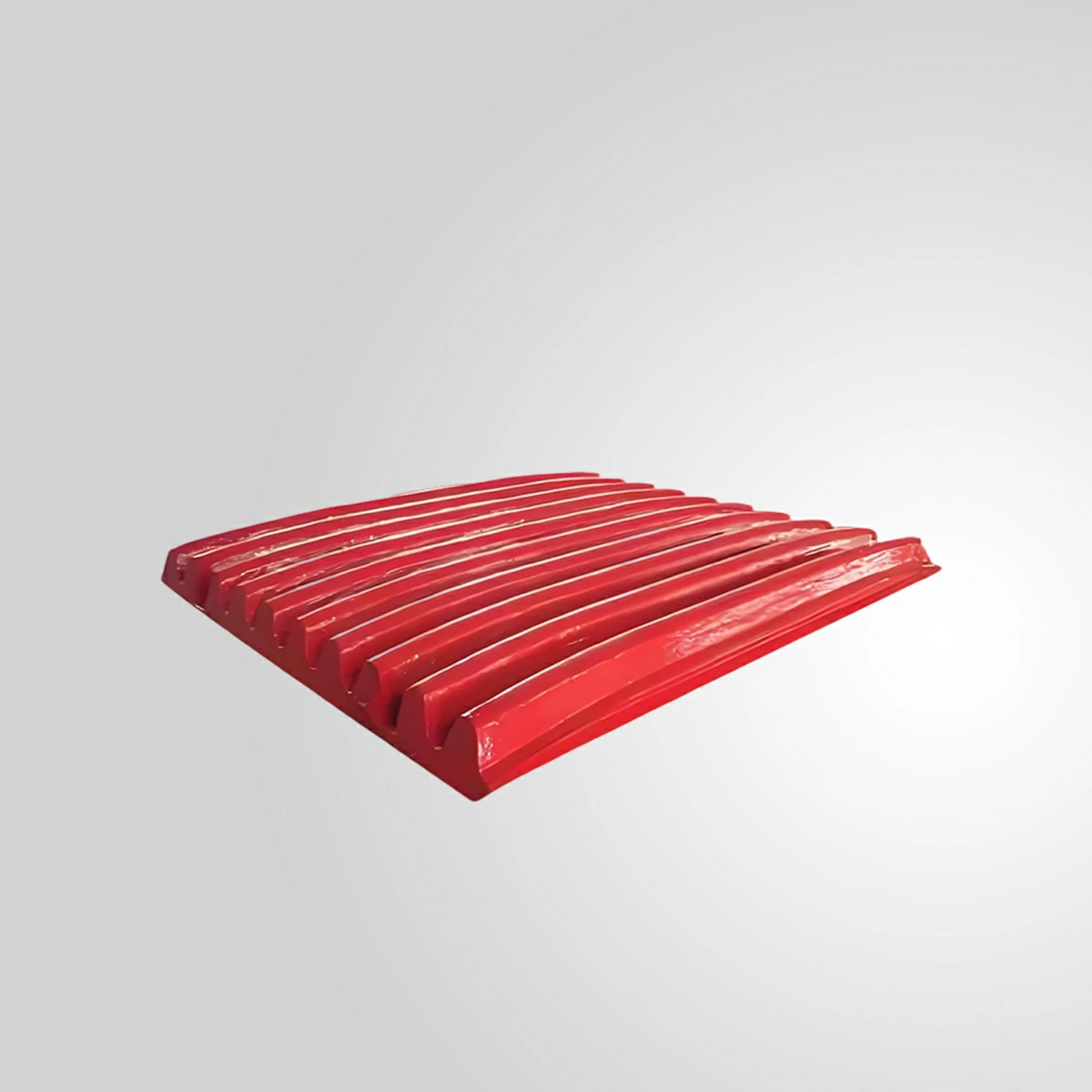
Metallurgical Standards and Installation Precision for Heavy-Duty wear Parts for ThyssenKrupp Jaw Crushers
Equipment Model: ThyssenKrupp NEB 12-10 Jaw Crusher
Product Category: Jaw Plate wear Parts for ThyssenKrupp
Material Specification:: High Manganese Mn18Cr2 (ASTM A128 Grade E-1)
Initial Hardness :210 – 240 HBW (As-Cast)
Operational Hardness :480 – 550 HBW (Work-Hardened)
Rear Surface Finish :Precision Machined Ra ≤ 1.6 μm
Dimensional Tolerance: ±0.05 mm on critical fit dimensions
Heat Treatment :Solution Annealing + Water Quench (1050°C-1100°C)
Technical Specifications and Engineering Parameters of NEB 12-10 Jaw Plates
| Equipment Model | ThyssenKrupp NEB 12-10 Jaw Crusher |
| Product Category | Jaw Plate wear Parts for ThyssenKrupp |
| Material Specification | High Manganese Mn18Cr2 (ASTM A128 Grade E-1) |
| Initial Hardness | 210 – 240 HBW (As-Cast) |
| Operational Hardness | 480 – 550 HBW (Work-Hardened) |
| Rear Surface Finish | Precision Machined Ra ≤ 1.6 μm |
| Dimensional Tolerance | ±0.05 mm on critical fit dimensions |
| Heat Treatment | Solution Annealing + Water Quench (1050°C-1100°C) |
| Yield Strength | ≥ 390 MPa |
| Tensile Strength | ≥ 750 MPa |
Mechanical Dynamics and Failure Mitigation in Primary Crushing Circuits
The operational reliability of a ThyssenKrupp NEB 12-10 primary crusher is intrinsically linked to the metallurgical integrity and dimensional fitment of the Jaw Plate wear Parts for ThyssenKrupp. In the unforgiving environment of high-tonnage mining, the failure of a jaw plate is rarely an isolated metallurgical defect; rather, it is frequently the culmination of improper energy absorption during the crushing stroke. When processing high-compressive strength materials such as basalt or taconite, the installed Jaw Plate wear Parts for ThyssenKrupp must withstand peak pressures that can exceed the plastic deformation limit of standard manganese alloys. If the material choice does not facilitate a rapid work-hardening rate, the tooth profile will suffer from “mushrooming” or plastic flow, which subsequently alters the nip angle and forces the crusher motor to draw excessive current to maintain throughput.
For senior maintenance engineers, the most significant pain point is often the structural damage to the crusher frame caused by loose-fitting liners. If the Jaw Plate wear Parts for ThyssenKrupp are not machined to a surface roughness of Ra ≤ 1.6 μm on the rear contact face, they will only achieve point-contact with the machine frame. Under the 450-ton crushing force generated by the NEB 12-10 eccentric shaft, these microscopic high spots collapse, creating an installation gap. This gap allows the plate to vibrate or “dance” within the chamber, leading to high-frequency impact loads that eventually shear the mounting bolts and initiate fatigue cracking in the main frame seat. Precision engineering and strict adherence to ASTM A128 standards are the only safeguards against such catastrophic mechanical failures.
Metallurgical Analysis: The Superiority of Mn18Cr2 in High-Impact Applications
Selecting the optimal alloy for Jaw Plate wear Parts for ThyssenKrupp requires a deep understanding of the work-hardening transition. While Mn13Cr2 is suitable for softer ores, the NEB 12-10 model typically operates in environments that demand the higher yield strength of Mn18Cr2. The specific chemical balance of Mn18Cr2 (ASTM A128 Grade E-1) ensures that the austenitic matrix remains ductile enough to absorb massive shocks without snapping, while the 2% Chromium addition improves initial yield strength and prevents the rapid erosive wear that occurs before the work-hardening effect is fully established.
In a controlled foundry process, these Jaw Plate wear Parts for ThyssenKrupp undergo solution annealing at temperatures between 1050°C and 1100°C to ensure all carbides are fully dissolved into the austenite. A high-velocity water quench follows this stage to “freeze” the structure. If the cooling rate is too slow, brittle carbides will precipitate at the grain boundaries, creating an “intergranular weak link” that makes the plate prone to fracture when encountering uncrushable tramp metal. By maintaining a Manganese-to-Carbon ratio of approximately 11:1, we ensure that the Jaw Plate wear Parts for ThyssenKrupp achieve a work-hardened surface of 500+ HBW, effectively extending the wear life by 25-30% compared to generic alternatives.
First-Person Field Insight: Solving the Problem of “Liner Dancing”
I recall a site visit to a gold mine in the Andes where the maintenance team was replacing their Jaw Plate wear Parts for ThyssenKrupp every 500 hours—significantly below the theoretical service life. Upon inspecting the discarded plates, I noticed a distinct “shining” effect and fretting on the rear mounting face. We measured the back-surface flatness and found deviations of up to 2.5 mm, far exceeding the ±0.05 mm engineering requirement. The liners were essentially unsupported in the center of the pitman. Every time a large rock entered the chamber, the plate would flex like a leaf spring, causing the mounting bolts to fail every few days. We replaced these with Mn18Cr2 Jaw Plate wear Parts for ThyssenKrupp featuring a precision-machined Ra ≤ 1.6 μm finish and used a high-compressive strength epoxy backing compound. The result was immediate: the vibration ceased, the bolt failures stopped, and the wear life increased to 850 hours. This experience reinforced that the quality of the machining is just as critical as the chemistry of the steel.
Field Installation Recommendations for NEB 12-10 Systems
The successful deployment of Jaw Plate wear Parts for ThyssenKrupp begins with a meticulous installation protocol. Even the highest-grade casting will fail prematurely if the mounting environment is compromised. Follow these professional steps to ensure maximum stability:
- Frame Cleaning and Inspection: Use a pneumatic grinder to remove all old backing compound, rust, and burrs from the frame seat and the pitman face. A flat foundation is mandatory to prevent localized stress risers on the new Jaw Plate wear Parts for ThyssenKrupp.
- Backing Compound Integrity: Always apply a high-quality epoxy backing compound. This material fills the microscopic voids between the jaw plate and the frame, ensuring 100% surface contact and acting as a vital shock absorber for high-frequency vibrations.
- Torque Management: Tighten the wedge bolts and mounting bolts using a calibrated hydraulic torque wrench to the manufacturer’s specified value (typically 1800-2200 Nm for the NEB series). Do not rely on impact guns for final tensioning, as they cannot guarantee consistent clamping force.
- The 8-Hour Settling Re-Check: Manganese steel is prone to initial “seating” as it begins to work-harden. It is vital to stop the crusher after the first 8 hours of feed to re-verify the bolt torque. In many cases, you will find the tension has dropped by 15% due to the material flowing slightly into the frame seat.
Preventive Maintenance and Wear Life Optimization
Achieving a low cost-per-ton requires proactive monitoring of the wear profile of the Jaw Plate wear Parts for ThyssenKrupp. The most efficient crushing occurs when the tooth profile is sharp and the nip angle is maintained within the 19-21 degree range. Once the tooth height has been reduced by 70%—the established wear limit—the crushing geometry becomes obtuse. At this point, the rocks begin to “slip” upward during the stroke, which generates massive amounts of heat and increases the abrasive wear rate exponentially.
Regularly measure the clearance between the jaw plates at the discharge point (the CSS – Closed Side Setting). If the wear is uneven across the width, it often indicates an issue with the feed distribution or a loose wedge. Rotating the fixed Jaw Plate wear Parts for ThyssenKrupp (top-to-bottom) when the bottom wear reaches 50% of the tooth depth is a highly effective way to balance the work-hardening stress and can extend the total service life by as much as 20%.
Frequently Asked Questions (FAQ)
- Q: Why is the Ra ≤ 1.6 μm finish critical for Jaw Plate wear Parts for ThyssenKrupp?
A: An as-cast surface provides only partial contact with the frame, creating localized stress points. The precision Ra ≤ 1.6 μm finish ensures full surface contact, which prevents the plate from flexing and protects the crusher’s structural integrity from fatigue cracking. - Q: How does the Mn18Cr2 alloy handle uncrushable tramp metal?
A: Mn18Cr2 (ASTM A128 Grade E-1) possesses a high elongation rate (≥ 20%), which provides the necessary ductility to absorb the sudden impact of tramp metal. This prevents the brittle snapping that is common in lower-manganese grades or poorly heat-treated castings. - Q: What are the shipping and storage requirements for these wear parts?
A: All Jaw Plate wear Parts for ThyssenKrupp must be shipped on reinforced wooden pallets with moisture-resistant coatings on machined surfaces. For long-term storage, the machined contact faces should be treated with a rust-preventative wax to maintain the Ra ≤ 1.6 μm surface integrity.
All manufacturer names, part numbers, model numbers, and descriptions are used for reference and identification purposes only, they are owned by the respective machine manufacturer, including but not limited to FLSmidth®, Metso®, thyssenkrupp®, and Sandvik®. All parts supplied are manufactured and warranted by yonsmen and are not manufactured by or purchased from the Original Equipment Manufacturer. yonsmen has no association with the OEM and does not intend to give this impression.
Reviews
There are no reviews yet.