

| Component Specification | Technical Data |
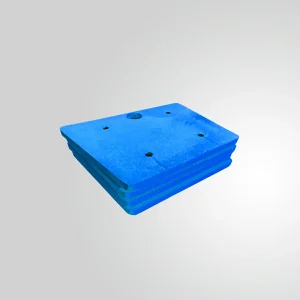
| Product Name | Metso C106 Tightening Bushing |
| OEM Part Number | 590220 |
| Base Material Structure | Seamless Forged Alloy Steel |
| Material Grade | 42CrMo4 (AISI 4140 Equivalent) |
| Core Hardness (Quenched & Tempered) | HRC 28-32 |
| Tensile Strength | > 1000 MPa |
| Yield Strength | > 850 MPa |
| Machining Precision Grade | ISO IT6 Tolerance |
| Concentricity Deviation | < 0.015 mm |
| Surface Finish (Tapered Mating Surfaces) | Ra 0.8 Micrometers |
| Estimated Component Mass | 42.5 kg |
| Flaw Detection Standard | 100% Ultrasonic Testing (UT) Passed |
Detailed Introduction
Pitman and flywheel slippage on the eccentric shaft of primary jaw crushers leads directly to catastrophic shaft shearing and immediate plant shutdown. The Metso C jaw crusher C106 tightening bushing 590220 is engineered specifically to lock the critical rotational components of the eccentric assembly under the immense torsional shock loads generated when crushing 200MPa+ compressive strength ores like granite and basalt. By utilizing a highly calibrated interference fit, this jaw bushing transfers the multi-ton rotational kinetic energy from the drive mechanism to the pitman without relying solely on the shear strength of safety keys, effectively eliminating the microscopic movements that initiate deep shaft fatigue cracking.
Standard cast iron or low-carbon steel locking components permanently deform under the cyclic radial stresses of primary volumetric reduction. To counter this severe metallurgical deficit, the 590220 tightening bushing is CNC-machined from a solid forging of 42CrMo4 chromium-molybdenum alloy steel. This specific heavy-duty material matrix undergoes a rigorous quench and temper heat treatment process to achieve a uniform core hardness of HRC 28-32. This targeted hardness profile is mathematically calculated to provide superior tensile strength—exceeding 1000 MPa—while strictly retaining the essential ductility required to expand and contract during the mechanical tightening sequence without fracturing the steel lattice under extreme hoop stress.
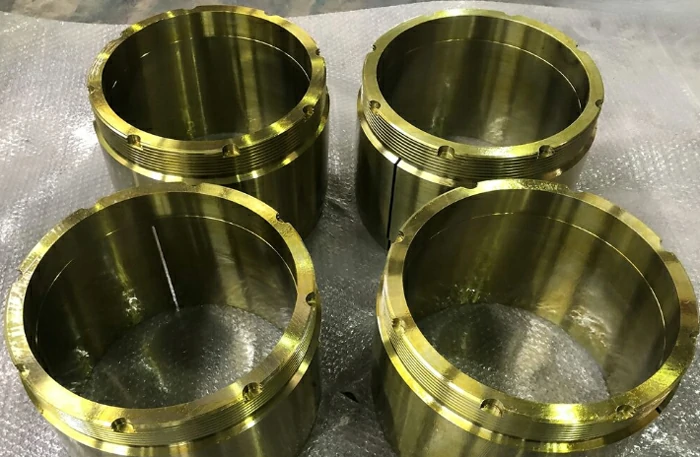
Securing heavy eccentric components rotating at 250 to 280 RPM requires absolute geometric precision. The 590220 tightening component is machined to a stringent ISO IT6 tolerance grade, featuring a diametral concentricity deviation of less than 0.015 millimeters. If a bushing exceeds this tolerance threshold, it induces dynamic radial runout, translating into severe harmonic vibrations that rapidly destroy the massive spherical roller bearings supporting the pitman. Furthermore, the internal and external tapered surfaces are precision-ground to a surface finish of Ra 0.8 micrometers. This exact surface texture guarantees a minimum of 85 percent actual surface contact area against the mating eccentric shaft, ensuring maximum frictional torque transmission and actively preventing fretting corrosion in microscopic surface voids.
The structural integrity of the main shaft assembly relies entirely on the dimensional stability of its locking elements. Utilizing unverified jaw crusher parts compromises the required interference fit, allowing microscopic axial and radial slippage during uncrushable tramp iron events. This continuous micro-slippage generates localized frictional heating, which permanently alters the metallurgical tempering of the eccentric shaft, eventually leading to sudden and catastrophic fracture. By maintaining the strict dimensional and metallurgical specifications of the 590220 model, operators secure the precise alignment of the pitman, optimizing the crushing kinematics and sustaining the engineered toggle angle for maximum aggregate throughput.
Identifying a technically competent Crusher Parts Manufacturer dictates the longevity and reliability of your primary crushing circuit. Inferior aftermarket bushings frequently utilize standard rolled steel tubing rather than seamless 42CrMo4 forgings, resulting in unseen internal metallurgical anomalies that collapse under high operational torque. The 590220 tightening bushing undergoes strict ultrasonic flaw detection (UT) prior to final CNC machining, ensuring the absolute absence of internal voids, slag inclusions, or subsurface micro-cracking. This mandatory non-destructive testing guarantees the structural density required to withstand the continuous, high-amplitude shock waves generated when choke-feeding large run-of-mine (ROM) materials directly into the C106 chamber.
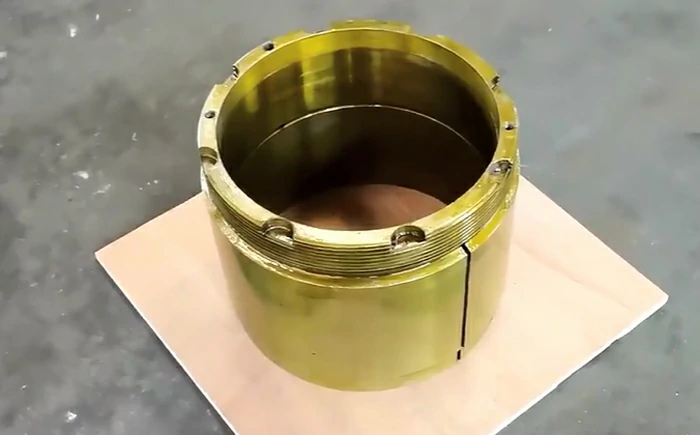
The thermal expansion coefficient of the tightening mechanism must identically match both the eccentric shaft and the pitman hub. During peak summer operations or under sustained heavy loads, the internal pitman assembly temperature can readily exceed 75 degrees Celsius. The forged 42CrMo4 matrix of this jaw bushing expands at a predictable, linear rate, ensuring that the locking friction does not degrade as the ambient and operational temperatures rise. If an incorrect alloy is utilized, the differential expansion rates will loosen the interference fit, causing the assembly to spin freely on the shaft, instantly shearing the positioning keys and galling both the shaft mounting surface and the internal bore.
The mechanical advantage provided by the tapered geometry of the Metso C jaw crusher C106 tightening bushing 590220 converts horizontal tightening torque into immense radial clamping force. This radial force essentially creates a cold-weld friction lock between the heavy steel components. To achieve this safely, the axial pull-up distance during installation must be strictly monitored with a precision dial indicator. A deviation of just 0.5mm in axial advancement can result in either a 20 percent loss of holding power or induce sufficient outward stress to crack the outer hub. Integrating exact-specification jaw crusher parts into your scheduled rebuilds guarantees that the factory tightening torques and axial advancement charts remain perfectly accurate, eliminating the dangerous guesswork that plagues maintenance crews using out-of-tolerance aftermarket copies.
Replacing a fatigued or yielding component with the 590220 tightening bushing actively prevents a cascade of severe mechanical failures in the primary circuit, including:
- Catastrophic shearing of the main eccentric shaft due to uncontrolled rotational slippage under heavy loads.
- Fretting corrosion and deep micro-welding between the pitman hub and the main shaft mounting surface.
- Harmonic drivetrain vibrations that drastically reduce the operational MTBF of the main spherical roller bearings.
Ultimately, the deployment of this precisely calibrated tightening element dictates the uptime of the entire C106 primary crushing station. The prevention of fretting wear, the elimination of shaft deflection, and the absolute security of the rotational mass translate directly to thousands of hours of uninterrupted rock reduction. By locking the eccentric kinematics exactly to the OEM baselines, the crusher maintains its calculated crushing stroke and optimal nip angle. This sustained geometric accuracy ensures highly efficient primary reduction, substantially lowers the amperage draw on the main electric motor, and protects the downstream secondary cone crushers from handling oversized, slabby materials that escape a failing primary jaw.
Reviews
There are no reviews yet.