
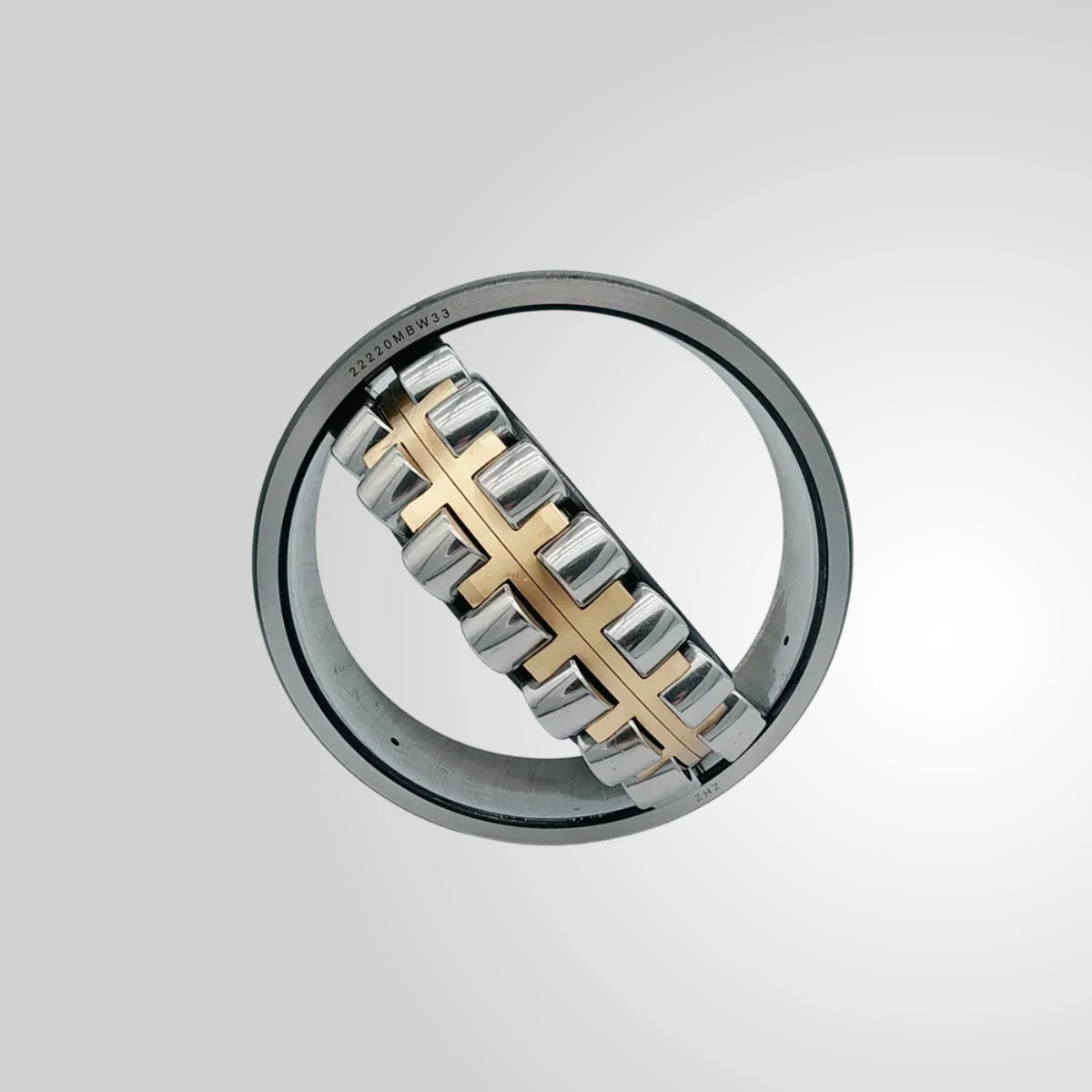
Krupp jaw crusher main shaft running under 180–220 MPa impact stress will quickly destroy a low-grade bearing. In one limestone quarry inspection I conducted, the original bearing showed severe spalling and raceway micro-cracking after only 1,200 operating hours because the internal clearance was incorrect and the cage strength was insufficient. Heavy mining equipment requires a bearing specifically engineered for shock loads, contamination, and continuous radial force. The NJ428 EM/C4 cylindrical roller bearing is designed precisely for this environment.This jaw crusher bearing uses high-purity chrome steel and a reinforced cylindrical roller structure to handle large radial loads generated by crushing rock, ore, and recycled concrete. With hardness maintained between 58–62 HRC and a controlled clearance class of C4, the bearing provides stable rotation under high temperature and high vibration conditions typically found in mining crushers.
Technical Specifications
| Parameter | Specification |
| Bearing Type | Cylindrical Roller Bearing |
| Model | NJ428 EM/C4 |
| Material | Chrome Steel |
| Hardness | 58–62 HRC |
| Structure | Single Row Cylindrical Roller |
| Load Direction | Radial Load |
| Alignment | Non-Aligning |
| Precision Grade | P0 / P6 / P5 / P4 / P2 |
| Internal Clearance | C4 |
| Cage Material | Brass / Steel / Nylon / Bakelite |
| Vibration Level | Z1V1 / Z2V2 / Z3V3 / Z4V4 |
| Seal Type | Open |
| Structure Feature | Separable Inner and Outer Ring |
| HS Code | 8482500090 |
Material and Metallurgy Performance
The performance of a mining crusher bearing depends heavily on the metallurgical quality of its steel. The NJ428 EM/C4 bearing uses high-grade chrome steel comparable to GCr15 / ASTM A295, which contains approximately 1.0% carbon and 1.5% chromium. This composition provides excellent wear resistance and fatigue strength under repeated impact loads.After vacuum degassing and precision heat treatment, the raceway hardness reaches 58–62 HRC. This hardness range is critical for resisting rolling contact fatigue. If hardness drops below 56 HRC, the bearing may experience plastic deformation known as mushrooming. Excessive hardness above 63 HRC may increase brittleness and lead to raceway cracking.The cylindrical rollers are ground to high precision and matched with raceways finished to a surface roughness typically below Ra ≤ 0.8 μm. This surface finish reduces friction and ensures uniform oil film formation during high-speed operation.
Why Cylindrical Roller Bearings Are Used in Jaw Crushers
Jaw crushers generate extremely high radial forces because crushing energy is transmitted directly through the eccentric shaft. Cylindrical roller bearings are selected because their roller-to-raceway contact line distributes load more efficiently than ball bearings.
Compared with spherical roller bearings, cylindrical roller bearings offer several advantages in crusher applications.
- Higher radial load capacity due to line contact design
- Lower friction coefficient and improved energy efficiency
- Better dimensional rigidity for heavy eccentric shafts
- Separable structure simplifies installation and maintenance
The NJ configuration allows the inner ring to move axially relative to the outer ring, which helps compensate for shaft thermal expansion during long crushing cycles.
[Pro-Tip] Field Installation Experience
During field installation of crusher bearings, improper mounting is one of the most common causes of early failure. In my experience supervising jaw crusher maintenance, I always recommend heating the bearing uniformly to 90–110°C using an induction heater before installation. This allows the inner ring to expand and slide smoothly onto the shaft.
For most jaw crusher shafts with diameters between 140 mm and 220 mm, the interference fit should remain within ±0.03 mm to ±0.05 mm. Excessive interference increases internal stress and reduces bearing life.
After installation, technicians should measure radial clearance using feeler gauges. The operational clearance should remain within the designed C4 tolerance range to accommodate thermal expansion during heavy load operation.
Lubrication and Oil Analysis Maintenance
Proper lubrication significantly extends bearing service life in mining crushers. The recommended lubricant for heavy impact crushers is a high-viscosity industrial gear oil with viscosity around ISO VG 220–320.
However, lubrication alone is not enough. Oil analysis provides valuable insight into early bearing wear. Maintenance teams should monitor the following parameters.
- Iron particle concentration indicating raceway wear
- Chromium trace levels indicating roller fatigue
- Water contamination percentage
- Oil viscosity changes due to thermal degradation
If iron particle levels exceed 100 ppm, it often indicates early stage spalling on the bearing raceway. Preventive replacement at this stage can avoid catastrophic crusher downtime.
Failure Modes in Crusher Bearings
Several failure modes commonly occur in heavy crusher bearings when installation or maintenance is inadequate.
- Spalling caused by rolling contact fatigue
- Galling caused by insufficient lubrication film
- Mushrooming caused by plastic deformation under overload
- Cage fracture caused by shock vibration
Using a reinforced brass cage significantly improves resistance to vibration and impact loads compared with lightweight polymer cages.
OEM Standard vs Low-Cost Aftermarket Bearings
Many mining operations attempt to reduce maintenance costs by purchasing low-cost aftermarket bearings. However, the total cost of ownership often increases due to shorter service life.
| Factor | Low-Cost Aftermarket | OEM Standard Bearing |
| Material Quality | Lower purity steel | High purity chrome steel |
| Heat Treatment | Inconsistent hardness | 58–62 HRC controlled |
| Average Service Life | 6–12 months | 18–30 months |
| Crusher Downtime Risk | High | Low |
| Total Cost of Ownership | Higher long-term cost | Lower lifecycle cost |
For large quarry operations where downtime can cost thousands of dollars per hour, investing in a high-quality crusher bearing significantly reduces operational risk.
Application Industries
The NJ428 EM/C4 cylindrical roller bearing is widely used in heavy industrial equipment where high radial load capacity and structural rigidity are required.
- Jaw crushers in mining and quarry operations
- Stone crushing plants
- Cement raw material crushers
- Construction waste recycling crushers
- Metallurgical ore processing equipment
The NJ428 EM/C4 cylindrical roller bearing is engineered for the demanding operating conditions found in jaw crushers. With hardened chrome steel raceways, reinforced cage options, and large internal clearance designed for thermal expansion, this bearing delivers reliable performance under heavy radial loads and severe vibration.By combining proper installation procedures, oil analysis monitoring, and high-quality materials, mining operations can significantly extend bearing life and reduce unexpected crusher downtime.

Reviews
There are no reviews yet.