

Technical Specifications: Sandvik CJ612 JM1211 402.4239-01 Upper Cheek Plate
| Technical Parameter | Engineering Specification |
|---|---|
| OEM Part Number | 402.4239-01 |
| Equipment Compatibility | Sandvik CJ612 / JM1211 Single-Toggle Jaw Crusher |
| Component Classification | Upper Cheek Plate (Lateral Frame Liner) |
| Certified Mass | 495.6 kg |
| Base Metallurgy | Mn13Cr2 (Austenitic Manganese Steel with 2% Chromium) |
| Initial Surface Hardness (As Quenched) | 220 – 240 HBW |
| Maximum Work-Hardened State | 450 – 500 HBW |
| Yield Strength | ≥ 380 MPa |
| Tensile Strength | ≥ 750 MPa |
| Mounting Face Flatness Tolerance | ≤ 1.0 mm per linear meter |
| Fastener Requirement | M30 Countersunk Heavy-Duty Bolts |
| Recommended Installation Torque | 850 – 950 Nm (Requires anti-seize compound) |
Defeating Lateral Chamber Gouging in High-Silica Applications
Operating a Sandvik CJ612 jaw crusher on high-compressive-strength ores like granite or quartzite introduces severe lateral abrasive forces inside the crushing chamber. While the primary crushing action occurs between the fixed and moving jaw plates, the massive lateral expansion of fractured rock exerts continuous, high-pressure gouging against the side frames. The 402.4239-01 upper cheek plate is explicitly engineered to act as a sacrificial, work-hardening barrier, preventing the destruction of the permanent structural side frames.

A worn or structurally inadequate side liner directly exposes the machined frame housing to abrasive flow. Once the rock begins eroding the frame material, the internal dimensions of the crushing chamber are permanently altered, leading to misalignment of the jaw dies and accelerated toggle seat wear. By deploying exactly 495.6kg of specifically alloyed steel, this component absorbs the extreme friction of the upper chamber, where large-diameter boulders are initially engaged and fractured.
Metallurgical Composition: The Mn13Cr2 Work-Hardening Mechanism
The survival of the 402.4239-01 upper cheek plate relies on strict metallurgical control. Cast from Mn13Cr2—an austenitic manganese steel alloyed with 2% chromium—this 495.6kg component exhibits a unique microstructural response to mechanical impact and heavy compression. In its initial, as-cast, and solution-annealed state, the plate possesses a baseline hardness of roughly 220 HBW. This relatively soft initial state is crucial because it gives the casting extreme internal toughness and a yield strength exceeding 380 MPa, allowing it to absorb severe shock loads without shattering.
As jagged rock surfaces scrape heavily against the cheek plate during the initial crushing stroke, the surface layer undergoes a rapid phase transformation. The intense mechanical pressure converts the localized austenite into hardened martensite, driving the surface hardness up to approximately 500 HBW. The continuous addition of 2% chromium prevents the rapid plastic deformation (mushrooming) often seen in standard Mn13 alloys, stabilizing the matrix and accelerating the work-hardening response. As the hardened outer layer microscopically wears away, the underlying alloy is instantly hardened by subsequent rock impacts. Properly manufactured jaw crusher parts leverage this exact phase-transformation cycle to continuously renew their wear-resistant surface throughout their lifecycle.
Dimensional Precision and Frame Interface Tolerances
Heavy machinery maintenance supervisors understand that heavy-duty wear components must fit seamlessly against their mounting surfaces. The rear face of the 402.4239-01 upper cheek plate undergoes rigorous surface machining to meet a flatness tolerance of less than 1.0 mm per linear meter. If a 495.6kg steel casting presents with casting warp or a concave rear profile, it will not seat perfectly flush against the CJ612 side frame.
When microscopic air gaps exist between the cheek plate and the frame, the compressive force of the crushing action causes the heavy plate to micro-flex against its mounting bolts. Over hundreds of hours, this cyclical micro-movement induces fretting corrosion on the permanent crusher frame and applies massive shear stress to the mounting hardware. Ensuring strict ISO 2768-mK dimensional tolerances guarantees total surface contact, transferring the shock load evenly directly into the crusher frame rather than isolating the force onto the fasteners.
Managing Shear Stress on Mounting Hardware
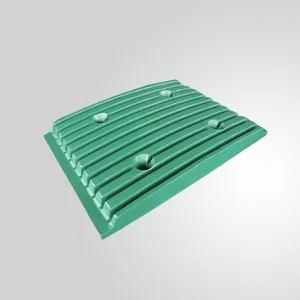
The upper cheek plate in the JM1211 chamber design is subjected to intense downward frictional forces. As the moving jaw drags material downward toward the nip angle, the ore heavily grips the side cheek plates. This downward drag attempts to shear the M30 countersunk retaining bolts. The 402.4239-01 cheek plate utilizes deep, precision-cast countersinks to protect the bolt heads from the abrasive rock flow.
If the countersink angles are improperly cast, the bolt heads will sit proud of the wear surface, leading to immediate abrasive shearing of the bolt head. Once a bolt head is removed by ore abrasion, the 495.6kg plate is held only by friction, drastically increasing the risk of the plate dislodging and causing catastrophic damage to the crushing chamber.
Wear Profiling and Preventative Replacement Protocols
Unlike jaw dies that wear predominantly in the lower crushing zone, the upper cheek plate experiences distinct wear patterns based on the feed material’s top size. Operations feeding oversized rock will observe aggressive scalloping in the upper third of the 402.4239-01 plate. Regular visual and ultrasonic thickness inspections are mandatory. Once the plate thickness in the primary wear zone degrades to 30% of its original dimension, replacement must be scheduled.
Pushing the cheek plate beyond its structural minimum thickness drastically reduces its ability to protect the countersunk bolt heads. Furthermore, upgrading to precision-cast Crusher Wear Parts minimizes the risk of structural frame deformation, ensuring that standard maintenance intervals are met without emergency downtime. The cost of a replacement cheek plate is mathematically negligible compared to the cost of line-boring, welding, and resurfacing a gouged Sandvik CJ612 main frame.
Total Cost of Ownership and Crushing Chamber Optimization
Procurement decisions in the aggregates and mining sectors heavily influence mechanical availability. Sourcing lower-grade alternatives to the 402.4239-01 specification often introduces porosity into the casting, leading to unpredictable spalling and premature failure. When a cheek plate fails mid-shift, the entire primary crushing circuit stops, bottlenecking the entire processing plant.
The exact 495.6kg mass and Mn13Cr2 metallurgy of this specific upper cheek plate provide a linear, predictable wear rate. This predictability allows maintenance planners to synchronize cheek plate replacements with routine jaw die flips or mantle changes. Reliable jaw crusher parts ultimately dictate the mechanical availability of the primary circuit, driving down the overall cost per ton of fractured rock and ensuring that the CJ612 asset meets its projected throughput targets without imposing collateral damage on the structural side frames.
Reviews
There are no reviews yet.