
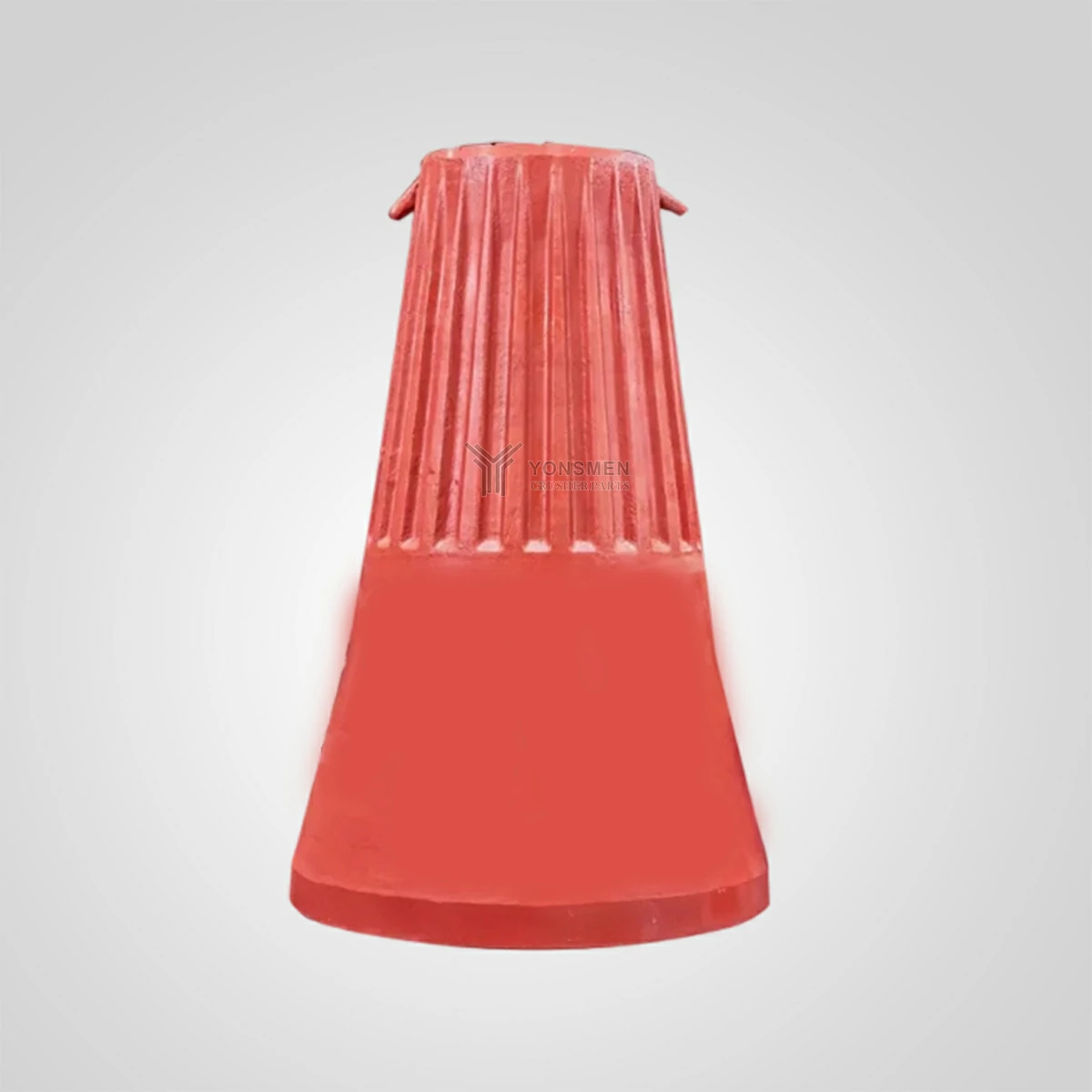
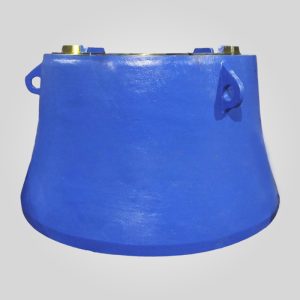
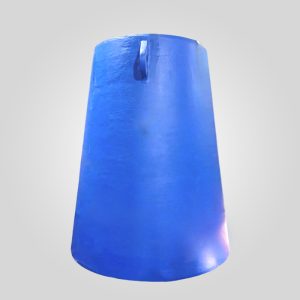
M18cr2 Mantle Suit 5475 Gyratory Crusher
Component: Primary mantle (crushing head liner)
Crusher Model: Metso Superior MKIII 54-75 primary gyratory crusher
Feed Opening: 1,370 mm / 54 inch (Metso Superior series application guide)
Mantle Diameter :1,905 mm / 75 inch (Metso Superior series application guide)
Mantle Assembly Weight Approx.: 38,560 kg / 85,000 lbs (Metso Superior series application guide, 54-75 size class)
Total Machine Weight (MKIII): Approx. 533,500 lbs / approx. 242,000 kg (authorized distributor data)
38,560 kg of Manganese Steel Standing Between Your Primary Circuit and an Unplanned Shutdown
The mantle on the Metso Superior MKIII 54-75 primary gyratory crusher is the single heaviest wear component in the crushing circuit. At approximately 38,560 kg (85,000 lbs) confirmed in Metso’s official Superior series application documentation, this gyratory crusher part defines the product size distribution, determines the effective throughput window, and sets the maintenance interval for the entire primary crushing plant. When it is correctly specified, correctly cast, and correctly installed, it runs to its design life and is replaced on a planned schedule. When any of those three conditions fail, the consequences propagate downstream: the secondary circuit sees coarser feed, circulating load rises, and the economic impact compounds at every tonne per hour the primary crusher operates off-setpoint.
The MKIII designation is significant for maintenance teams managing parts interchangeability. The Superior MKIII 54-75 was developed as the third generation of Metso’s Superior primary gyratory range, with increased speed, higher installed power — 800 hp versus earlier model ratings — and 30% greater capacity than predecessor Superior 54-75 configurations. The mantle profile and mantle assembly interface for the MKIII may differ from MKI and MKII machines in specific dimensional features, even though the nominal mantle diameter and crusher size designation appear identical. A gyratory crusher part supplier who cannot confirm MKIII-specific profile compatibility should not receive a production order for this component based on the size designation alone.
Confirmed Mantle Parameter Data — Metso Superior MKIII 54-75
The table below uses data confirmed from Metso’s official published documentation, including the Superior series wear parts application guide and authorized distributor technical publications. Parameters marked as “confirm per site configuration” require verification against the specific machine serial number and any engineering change records, since the MKIII generation introduced design updates that affect mantle interface geometry relative to earlier Superior models.
| Parameter | Confirmed Value / Source |
| Component | Primary mantle (crushing head liner) |
| Crusher Model | Metso Superior MKIII 54-75 primary gyratory crusher |
| Feed Opening | 1,370 mm / 54 inch (Metso Superior series application guide) |
| Mantle Diameter | 1,905 mm / 75 inch (Metso Superior series application guide) |
| Mantle Assembly Weight | Approx. 38,560 kg / 85,000 lbs (Metso Superior series application guide, 54-75 size class) |
| Total Machine Weight (MKIII) | Approx. 533,500 lbs / approx. 242,000 kg (authorized distributor data) |
| Crusher Maximum Capacity (MKIII) | Up to 7,500 MTPH |
| Installed Drive Power (MKIII) | 800 hp |
| Standard Mantle Material Grade | Mn13Cr2 (standard entry grade); XT710 recommended for medium and difficult ore conditions |
| Metso XT-Series Grade Options | XT510 / XT515 / XT520 / XT525 — general duty; XT710 — medium to difficult duty; XT750 / XT810 — difficult abrasive duty (contact Metso for application confirmation) |
| As-Cast Initial Hardness | 200–250 HB (austenitic manganese steel, all grades) |
| In-Service Surface Hardness (work-hardened) | 450–550 HBW typical at impact contact zone; hardened depth up to 18 mm |
| Mantle Profile Options | Smooth; partially corrugated; fully corrugated (Metso Superior application guide) |
| Mantle Configuration | Segmented assembly; individual segment weights require confirmation by Metso drawing |
| Gap Adjustment Method | Hydraulic main shaft adjustment (MPS system) |
| Generation Compatibility | MKIII features are retrofittable to MKI and MKII Superior crushers; mantle profile compatibility must be confirmed by serial number |
| Segment Part Numbers | Not publicly released by Metso — confirm via Metso parts system or authorized aftermarket supplier with documented pattern source |
Understanding Metso’s XT-Series Alloy System and Why Grade Selection Is Not Interchangeable
Metso’s XT-series proprietary alloys are modified austenitic manganese steel grades developed to extend service life beyond what standard Mn13Cr2 delivers in primary gyratory crusher applications. The grade numbering reflects alloy performance tiers rather than simple composition naming. XT710 is broadly comparable to the Mn18Cr2 class in terms of manganese and chromium content but is formulated and heat-treated to Metso’s internal specification, which controls not just chemistry but microstructure acceptance criteria. XT750 and XT810 represent higher-performance grades for difficult and highly abrasive feed conditions.
The Metso Superior series application guide provides a material selection matrix that maps ore difficulty and abrasiveness against grade performance tiers. For the 54-75 mantle, the selection logic is: XT710 is the preferred starting point for most medium-hard to hard ore applications; XT510 family grades are applicable where ore conditions are easier and capital minimization is the priority; XT750 and XT810 become the correct choice when the feed carries high silica content above 25%, a Bond Work Index above 16 kWh/t, or when the site is running the crusher at the upper end of its throw range to maximise throughput. Using an XT510-class grade in a difficult abrasive application to save liner cost produces a shorter service interval that, when the full changeout labor and downtime cost is accounted for, delivers a higher cost per tonne crushed than the XT710 or XT750 grade would have achieved.
Aftermarket suppliers who offer “XT710 equivalent” or “Metso XT710 grade” material without supplying a heat-specific chemical composition certificate and a microstructure acceptance report are not supplying a controlled XT710 equivalent. They are supplying a manganese steel casting with a marketing claim. The verification gap between a marketing claim and a certified XT710-equivalent microstructure is exactly where early mantle failures originate — not from incorrect profile geometry, but from the material performing like Mn13Cr2 in a duty that required XT710 toughness and work-hardening rate.
Industry Pain Point: The Mantle Changeout That Cost Three Times Its Planned Budget
An iron ore operation running a Superior MKIII 54-75 planned its mantle changeout on a 5,000-hour calendar interval established during the first year of operation with the OEM-supplied liner set. When the first replacement set was sourced from an aftermarket supplier at a 22% saving on the purchase price, the operation expected the same 5,000-hour service life. The replacement mantles reached the rejection wear limit at 3,200 hours. A second replacement was ordered. The second set failed at 2,800 hours, with visible surface cracking across three segments on the upper mantle.
Post-failure analysis on recovered segments from both aftermarket sets found as-cast hardness of 192–205 HB — below the 220–240 HB expected for the declared XT710-equivalent grade — and grain boundary carbide networks indicating incomplete solution annealing. Both certificates had reported hardness values in the 220–235 HB range, but the test results were from separately cast test bars, not from the actual segments. Test bars from large castings are not representative of the casting’s actual solidification rate and will typically read 10–20 HB higher than a direct casting measurement.
The three changeout cycles at 3,200, 2,800, and the eventual correct-specification replacement cost the operation more in crane time, labor, and lost throughput than six planned OEM-specification changeout cycles would have cost over the same period. The procurement saving of 22% on the liner purchase price was consumed by the first early failure. Every subsequent failure compounded the loss. The correct procurement decision — XT710-equivalent grade with direct casting hardness, microstructure report, and dimensional inspection against the MKIII profile — would have been more expensive per liner set and far less expensive per tonne crushed over a full operating year.
Pro-Tip: When evaluating an aftermarket mantle for the Superior MKIII 54-75, ask the supplier to provide the hardness test certificate with the test method stated — specify that results must come from the actual casting, not from a companion test bar. Request that the test location is described as a machined flat on the back surface or bore area of the casting itself. If the supplier cannot provide this, or if the certificate says “test bar” or “comparative sample,” treat the hardness data as unverified. On a 38,560 kg mantle assembly that determines the throughput of a 7,500 MTPH primary circuit, the cost of this single verification step is negligible relative to the cost of a single unplanned changeout cycle.
Mantle Profile Selection — Smooth vs. Corrugated for the 54-75 Application
Metso’s official documentation for the Superior series confirms three profile configurations for the 54-75 mantle: smooth, partially corrugated, and fully corrugated. The selection affects the crushing action, product gradation, and wear distribution across the mantle surface.
The smooth profile is the correct choice for hard, abrasive feed where the rock is competent and breaks cleanly under compressive load. Smooth profiles minimize the lateral component of crushing force, which reduces the tendency for the feed to “squeeze out” laterally rather than fracturing. In high-silica hard rock applications — copper porphyry, iron formation ore, or granite — a smooth mantle in XT710 or XT750 grade delivers the most consistent wear pattern and the most predictable replacement interval.
Partially and fully corrugated profiles provide increased grip on feed material with irregular shapes, high clay content, or materials that tend to pack or bridge in the feed zone. They increase the surface area in contact with feed and distribute impact load differently across the mantle surface. In practice, corrugated mantles often show faster wear on the ridge peaks than smooth mantles show on equivalent areas, but they reduce the frequency of bridging events that interrupt throughput. For operations where feed variability is high and bridging is a recurring operational problem, a partially corrugated profile in XT710 is typically the balanced solution.
Procurement Verification Checklist for the Superior MKIII 54-75 Mantle
Every gyratory crusher part supplier offering a replacement mantle for the Superior MKIII 54-75 should be evaluated against the following verifiable criteria before a production order is placed:
- Profile source confirmation — whether the mantle pattern is derived from an MKIII-specific drawing or profile measurement, not from a generic Superior 54-75 or a predecessor MKI/MKII profile
- Material grade declaration by specific alloy designation — not “XT710 equivalent” without supporting chemistry data
- Heat-specific chemical composition certificate with batch number, listing all alloying elements against declared limits
- Hardness test result measured directly on the casting, with test location described, reported in Brinell units
- Microstructure report confirming no carbides at grain boundaries, with photomicrograph at 100x magnification
- Dimensional inspection sheet with profile measurement against the drawing or confirmed reference segment
- Individual segment weights, within ±2% of drawing reference
- Packing documentation confirming mantle segments are protected from edge impact during transport — a 38,560 kg assembly ships in multiple segments, each of which can suffer localized damage in transit that does not affect dimensional inspection but creates a stress concentration under operational load
Frequently Asked Questions
Can a Superior MKIII 54-75 mantle be replaced with parts sourced for the MKI or MKII 54-75, or vice versa?
Metso confirms that MKIII features are retrofittable to MKI and MKII Superior primary gyratory crushers, which implies that certain mantle and concave interface features were designed for backward compatibility. However, “retrofittable” does not mean all mantle segments are dimensionally identical across generations. The MKIII generation introduced design changes to the shell, concave arrangement, and main shaft that affect the mantle seating interface. Before using MKI or MKII mantle stock in an MKIII machine, the specific segment part numbers and profile geometry must be verified against the MKIII drawing register for that machine’s serial number. Using an unverified predecessor-generation mantle segment in an MKIII machine introduces the risk of an incorrect seating contact or a profile mismatch that changes the crushing chamber geometry and shifts the product size distribution.
What is the correct OSS setting range for the Superior MKIII 54-75, and how does the hydraulic MPS system interact with mantle wear compensation?
The Superior MKIII 54-75 uses Metso’s Mechanical Piston Setting (MPS) system for hydraulic main shaft height adjustment. As the mantle and concave liners wear, the MPS raises the main shaft to restore the target open side setting. The effective adjustment range of the MPS system defines the maximum cumulative liner wear that can be compensated before liner replacement is required. The absolute OSS range for the 54-75 is application-specific and is set during commissioning based on the target product P80 and the downstream circuit capacity. The relationship between MPS position and actual OSS should be verified by direct measurement using a lead impression at each major inspection interval — not assumed from the digital display alone, because the digital reading reflects shaft position, not actual liner-to-liner distance after wear has occurred. Tracking the rate of MPS adjustment per 1,000 operating hours against feed hardness and throughput data provides a predictive wear model that allows the maintenance team to schedule the next mantle changeout within a defined planning window.
What documentation should be requested from an aftermarket gyratory crusher part supplier to verify that their 54-75 mantle meets the XT710 specification rather than a standard Mn18Cr2 substitute?
The critical distinction between XT710 and a standard Mn18Cr2 casting is not visible in the finished part and cannot be confirmed by hardness alone. XT710 is Metso’s proprietary specification that controls not only chemical composition but casting and heat treatment process parameters, and microstructure acceptance criteria that go beyond what a standard Mn18Cr2 specification requires. From an aftermarket supplier claiming XT710 equivalence, the documentation package must include: a chemical composition certificate with heat number showing the element-by-element composition of the specific batch cast; a direct casting hardness result in the 220–240 HB range; a microstructure report with a photomicrograph at 100x magnification confirming fully austenitic structure with no carbide networks at grain boundaries; and a statement of the heat treatment parameters used — specifically the austenitizing temperature and quench method, since incomplete austenitizing at below 1,050°C leaves residual carbides that the microstructure report will catch. A supplier who can provide all four documents is demonstrating process control at the level required for a primary gyratory mantle. A supplier who provides only a material certificate and a test bar hardness number is providing assurance language, not controlled metallurgy.
All manufacturer names, part numbers, model numbers, and descriptions are used for reference and identification purposes only, they are owned by the respective machine manufacturer, including but not limited to FLSmidth®, Metso®, thyssenkrupp®, and Sandvik®. All parts supplied are manufactured and warranted by yonsmen and are not manufactured by or purchased from the Original Equipment Manufacturer. yonsmen has no association with the OEM and does not intend to give this impression.
Reviews
There are no reviews yet.