
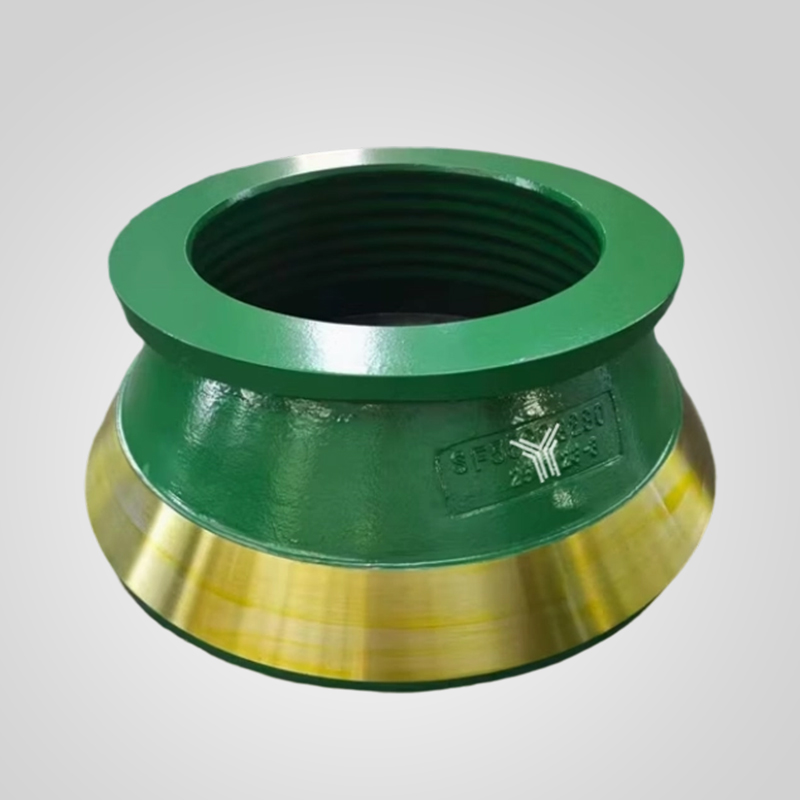
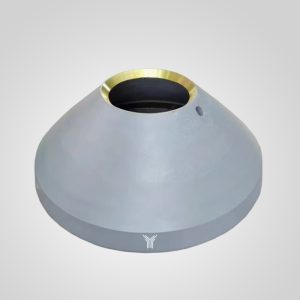
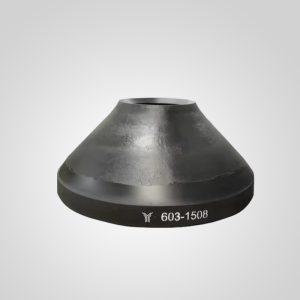
Structural Integrity and Work Hardening Characteristics of Mn18Cr2 Bowl Liner 1048300031 For HP400
Part Number :HP400 1048300031
Component Weight :1235.85 kg (Approximate)
Material Grade: Mn18Cr2 (ASTM A128 Grade C Equivalent)
Initial Hardness: 210 – 230 HBW
Work Hardened Hardness: > 500 HBW (Operation dependent)
Surface Finish (Machined): Ra ≤ 6.3 μm
Charpy Impact Value: ≥ 100 J/cm²
Dimensional Tolerance: ISO 8062-3 CT10
Engineering the Critical Interface The 1048300031 Bowl Liner
A mass of 1235.85kg rotating or oscillating under a crushing force of 400 to 600 MPa leaves no room for casting porosity or dimensional deviation. In high-capacity cone crushers, the bowl liner identified by part number 1048300031 is not merely a wear shield; it is a structural component that dictates the geometry of the comminution chamber. When processing ores with a Bond Work Index exceeding 16 kWh/t, the failure of a liner is rarely due to simple abrasion. Instead, catastrophic failures usually stem from plastic deformation (mushrooming) causing stress risers on the adjustment ring, or brittle fracture caused by improper heat treatment protocols.
For maintenance engineers and site superintendents, the selection of this component defines the maintenance interval of the entire tertiary circuit. This technical analysis dissects the metallurgy, installation physics, and lifecycle management required to extract maximum value from the 1048300031 replacement liner.
Metallurgical Specification Controlling the Austenite
The performance of the 1048300031 bowl liner is governed by its ability to transition from a ductile state to a hard, wear-resistant state under impact. We utilize a strictly controlled Mn18Cr2 (High Manganese with Chromium) alloy. Unlike generic Mn13, which often yields too early under modern high-pressure crushing, Mn18Cr2 offers a superior balance of yield strength and ductility.
The science lies in the heat treatment. The casting is water-quenched from 1050°C to maintain a fully austenitic structure. This ensures that the initial hardness sits between 210 and 230 HBW. Upon operation, the impact of the rock causes the surface lattice to deform, increasing the skin hardness to over 500 HBW (Work Hardening), while the core remains ductile to absorb shock loads from tramp iron.
Why Generic Liners Fail
We frequently analyze failed aftermarket liners sent to our lab. For the 1048300031 configuration, three failure modes are prevalent in lower-quality castings:
- Mushrooming (Plastic Flow): When the yield strength is insufficient (often due to low Carbon < 1.1%), the liner material flows radially outward. This expansion locks the bowl liner into the adjustment ring threads. Removing a “mushroomed” liner often requires air-arc gouging, risking damage to the permanent bowl frame.
- Spalling: If the Chromium content exceeds 2.5% without proper heat treatment, carbide precipitation occurs at the grain boundaries. Under high stress, large flakes of steel peel off the surface, reducing wear life by up to 40%.
- Vertical Cracking: This is often a result of “Cold Shuts” during the casting process—where two streams of molten metal meet but do not fuse causing a discontinuity. Our foundry uses simulation software to optimize gate placement, ensuring a continuous, turbulence-free pour for the 1235kg mass.
Managing 1235.85kg
Installing a liner of this weight class requires precision. The gravitational potential energy of a 1.2-ton liner means that even a 1mm gap in seating can generate destructive vibration.
The Seating Surface: The mating surface between the 1048300031 liner and the head/bowl must be verified to have a flatness tolerance of 0.1mm. Any high spots must be ground down. We recommend applying a thin layer of release agent to the bowl surface to facilitate future removal, but never grease, which can create hydraulic pressure pockets.
Backing Compound Application: For a liner of this volume, the backing compound is critical. It acts as a damper. The gap must be filled with a high-compressive strength epoxy (min 80 MPa). Calculate the volume carefully; running out of backing mid-pour creates a “cold joint” in the epoxy, which will shatter under load, leading to a loose liner.
Case
“We had a customer in the Pilbara region running iron ore. They purchased a batch of’budget’ 1048300031 liners. Within 200 hours, they noticed a spike in the crusher’s power draw variance. We pulled the bowl and found the liner had warped. The casting internal stress hadn’t been relieved. This warping changed the Closed Side Setting (CSS) unevenly around the chamber, effectively feeding coarse material to one side of the bearing. It nearly destroyed the eccentric bushing. We replaced it with our stress-relieved Mn18Cr2 liner, and the amp draw stabilized immediately.”
Technical Parameters
The following specifications ensure the 1048300031 liner meets the rigorous demands of 24/7 mining operations.
| Parameter | Specification Value |
|---|---|
| Part Number | 1048300031 |
| Component Weight | 1235.85 kg (Approximate) |
| Material Grade | Mn18Cr2 (ASTM A128 Grade C Equivalent) |
| Initial Hardness | 210 – 230 HBW |
| Work Hardened Hardness | > 500 HBW (Operation dependent) |
| Surface Finish (Machined) | Ra ≤ 6.3 μm |
| Charpy Impact Value | ≥ 100 J/cm² |
| Dimensional Tolerance | ISO 8062-3 CT10 |
Preventative Maintenance via Oil Analysis
The condition of your 1048300031 bowl liner can often be read in your oil reports. If the liner is loose or unevenly seated, it transmits shock loads directly to the bronze bushings.
- Lead (Pb) & Tin (Sn) Spikes: If you see rising levels of these elements, check the liner seating immediately. It suggests the eccentric bushing is suffering from edge-loading caused by uneven crushing forces.
- Silica (Si) Spikes: High silica often means the dust seal is compromised. A worn-out liner that has exceeded its life can allow rock dust to bypass the seal arrangement, turning your lubricating oil into a grinding compound.
Total Cost of Ownership (TCO) Calculation
Purchasing a bowl liner based solely on the lowest invoice price is a false economy. Consider a scenario where a standard liner costs $4,000 and lasts 400 hours, while a premium Mn18Cr2 liner costs $5,500 but lasts 600 hours.
The Hidden Costs of Short Life:
- Downtime: A liner change can take 8-12 hours. At a production rate of 500 TPH and a value of $5/ton, one change-out costs $20,000 in lost revenue.
- Labor & Crane: Crane rental and crew costs can exceed $3,000 per event.
- Risk: Every heavy lift of 1235kg introduces safety risks to personnel.
By extending the wear life of part 1048300031 by even 20%, the reduction in change-out frequency yields a net saving that dwarfs the initial purchase price difference.
Pro-Tip
“Always inspect the wedges or bolts when changing the 1048300031 liner. I’ve seen brand new liners fail because the holding hardware was fatigued. If the bolt threads are stretched or the wedges are rounded, they cannot apply the necessary clamping force. Replace the hardware every second liner change—it’s cheap insurance for a heavy-duty component.”
Frequently Asked Questions (FAQ)
Q1: What is the optimal backing compound thickness for the 1048300031 bowl liner?
The backing thickness is determined by the wear on the bowl seating surface, but generally, we aim for a nominal thickness of 6mm to 10mm. If the gap exceeds 15mm due to bowl wear, we recommend using a backing compound with higher viscosity or filling the void with steel shims before pouring to prevent excessive exothermic heat from cracking the epoxy.
Q2: Can I use this Mn18Cr2 liner for soft limestone applications?
You can, but it may not be the most efficient choice. Manganese steel requires high-impact stress to work harden. In soft limestone (low compressive strength), the 1048300031 liner may not reach its full hardness potential (500 HBW), leading to rapid abrasive wear. For soft, non-abrasive applications, specialized low-alloy steel or different cavity profiles might be more suitable. This part excels in hard, abrasive rock like granite, basalt, and iron ore.
Q3: How do I know when the 1048300031 liner is fully worn out?
Do not wait for the liner to crack. We recommend monitoring the liner profile using a template. Replacement should occur when the liner thickness at the wear zone is reduced to approximately 20mm-25mm, or when the weight of the liner has decreased by roughly 50%. Running it thinner risks the liner collapsing, which can damage the crusher head and bowl permanently.
All manufacturer names, part numbers, model numbers, and descriptions are used for reference and identification purposes only, they are owned by the respective machine manufacturer, including but not limited to FLSmidth®, Metso®, thyssenkrupp®, and Sandvik®. All parts supplied are manufactured and warranted by yonsmen and are not manufactured by or purchased from the Original Equipment Manufacturer. yonsmen has no association with the OEM and does not intend to give this impression.
Reviews
There are no reviews yet.