
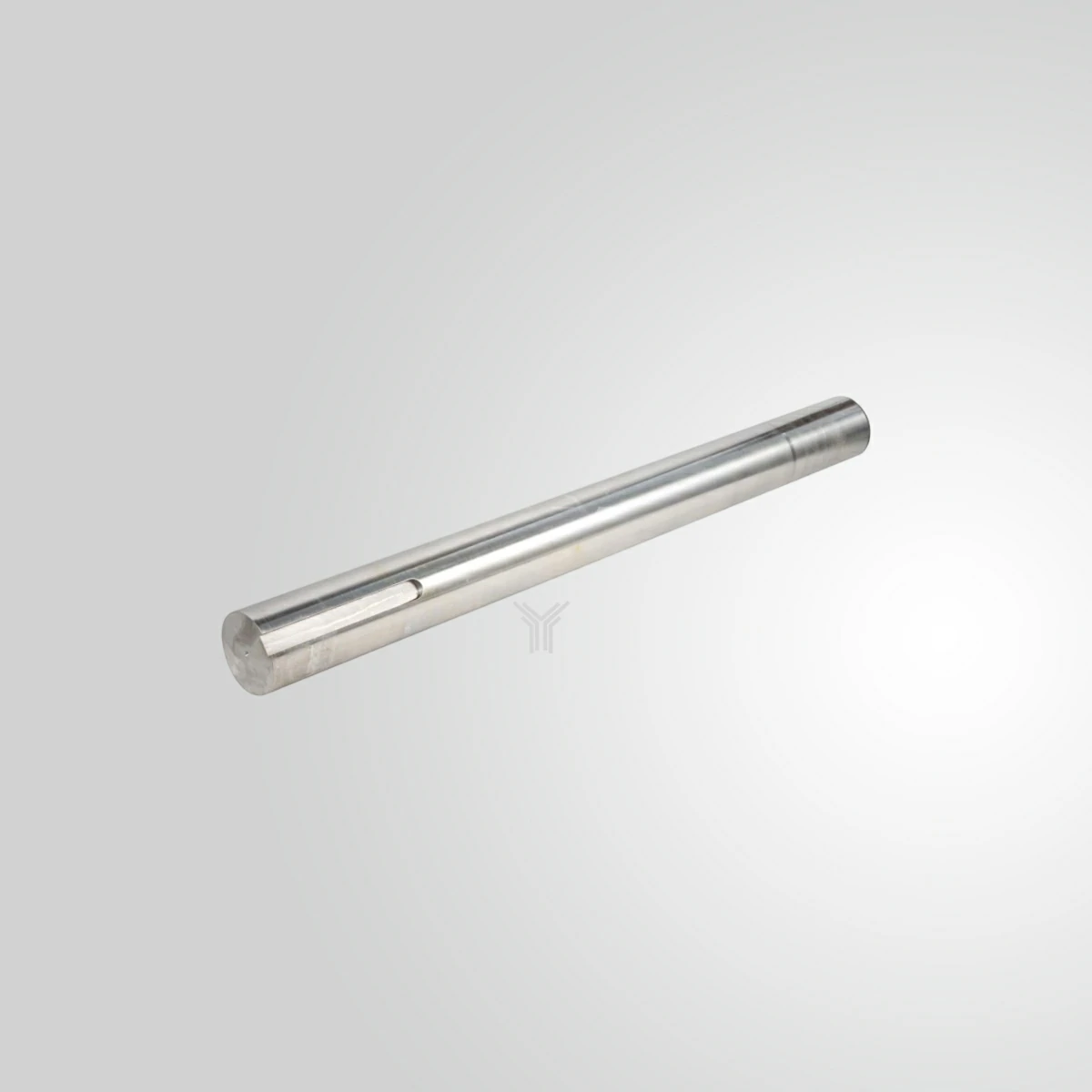
FLSmidth RXL304-0001 Cone Crusher Countershaft
Product Name Cone Crusher Countershaft
Compatible Model FLSmidth RXL304-0001
Material Grade AISI 4340 Vacuum Degassed Forged Alloy Steel (40CrNiMoA)
Forging Reduction Ratio \> 4:1 (Ensures longitudinal grain alignment)
Core Hardness (Q\&T) 280 \– 320 HBW (Optimized for high ductility)
Journal Surface Hardness 50 \– 55 HRC (Induction Hardened, 2.5mm-3.5mm case depth)
Surface Finish (Journals) Ra \≤ 0.8\μm (Critical for hydrodynamic lubrication)
Machining Precision Standard ISO 2768-mK
Engineered to resist catastrophic torsional shear under extreme shock-loading, the FLSmidth RXL304-0001 Cone Crusher Countershaft is manufactured from vacuum-degassed AISI 4340 forged alloy steel. Featuring a ductile core hardness of 280-320 HBW and precision induction-hardened bearing journals (50-55 HRC) to an Ra \≤ 0.8\μm finish, this critical drivetrain component ensures minimal deflection. 100% ultrasonically tested to ASTM A388 standards, it eliminates subsurface inclusions, guaranteeing continuous, vibration-free power transmission in high-tonnage gyratory applications.
Detailed Introduction
Mitigating Torsional Stress in the Power Transmission Artery
Preventing torsional fatigue and sudden shaft shear during uncrushable tramp iron events are critical priorities in high-capacity hard rock crushing circuits. The countershaft serves as the primary power transmission conduit, transferring massive kinetic energy from the drive motor to the internal eccentric assembly. The FLSmidth RXL304-0001 Cone Crusher Countershaft is engineered specifically to absorb severe radial and axial shock loads while maintaining rigid pinion-to-ring gear alignment. By utilizing ultra-pure steel forgings and adhering to a strict Total Indicator Reading (TIR) concentricity tolerance of 0.015mm, this component successfully eliminates the dynamic runout that typically accelerates bronze bushing wear and causes catastrophic gear spalling.
Metallurgical Integrity: Vacuum-Degassed AISI 4340 Alloy Steel
The operational longevity of a drivetrain component subjected to continuous alternating stress is dictated by its metallurgical purity and grain structure. The FLSmidth RXL304-0001 Cone Crusher Countershaft is forged from high-grade AISI 4340 alloy steel (equivalent to the European 40CrNiMoA standard). This specific Nickel-Chromium-Molybdenum matrix is selected for its exceptional deep hardenability and superior notch toughness. During the initial melting phase, the molten steel undergoes vacuum degassing to extract dissolved hydrogen and oxygen gases. This critical step prevents hydrogen embrittlement and ensures a dense, inclusion-free crystalline structure. Furthermore, the shaft is forged with a reduction ratio greater than 4:1. This aggressive forging process aligns the internal grain flow parallel to the longitudinal axis of the shaft, drastically increasing its resistance to transverse shear forces under peak operating torques.
Dual-Zone Heat Treatment and Hardness Profiling
A frequent failure mode in standard aftermarket countershafts is a mechanical imbalance between core ductility and surface wear resistance. A shaft that is through-hardened too deeply becomes brittle and is highly prone to snapping during sudden stalls, while a soft shaft suffers from rapid journal scoring. The FLSmidth RXL304-0001 resolves this engineering compromise through a highly controlled, dual-zone heat treatment protocol. Initially, the entire raw forging is quenched and tempered (Q\&T) to establish a homogenous, tough core hardness of 280-320 HBW. This specific core hardness provides the massive yield strength (minimum 850 MPa) required to transmit high horsepower while retaining the critical ductility needed to flex and absorb shock loads without fracturing.
Induction Hardening of Bearing Journals
Subsequent to the core treatment, the specific bearing journal surfaces—where the shaft rotates at high RPMs within the inner and outer countershaft bronze bushings—undergo precision induction hardening. This secondary thermal process elevates the localized surface hardness to 50-55 HRC to a controlled case depth of 2.5mm to 3.5mm. By creating this hardened, wear-resistant outer shell over a tough, shock-absorbing core, the FLSmidth RXL304-0001 Cone Crusher Countershaft heavily resists abrasive grooving caused by microscopic particulate contamination bypassing the oil filtration system. These hardened journals are then CNC ground to an exacting surface finish of Ra \≤ 0.8\μm, ensuring immediate compatibility with the hydrodynamic oil film and drastically reducing the coefficient of friction during cold startups.
Dimensional Accuracy and Gear Mesh Optimization
The primary mechanical function of the countershaft is to support the spiral bevel pinion gear and maintain optimal tooth contact with the main eccentric ring gear. The FLSmidth RXL304-0001 is machined to demanding ISO 2768-mK tolerances. The maximum allowable runout across the bearing journals and the pinion seat is restricted to just 0.015mm. This ultra-tight concentricity ensures that the pinion gear rotates on a perfectly true axis. Eliminating eccentric wobble at the pinion prevents localized, destructive point-loading on the gear teeth edge, extending the life of the entire bevel gear set and minimizing heavy vibration harmonics from propagating backward into the drive motor bearings.
Eliminating Stress Concentrators in Keyway Design
One of the most vulnerable points on any power transmission shaft is the machined keyway used to lock the pinion gear or the drive sheave. Sharp internal corners in a keyway act as severe stress multipliers, frequently serving as the initiation point for transverse propagation cracks. The FLSmidth RXL304-0001 Cone Crusher Countershaft addresses this mechanical vulnerability by incorporating a large, precision-machined fillet radius at the base of all keyways. This radiused design effectively dissipates torsional stress over a wider geometric area, significantly increasing the fatigue limit of the shaft. Additionally, the keyways are milled utilizing high-speed carbide tooling to prevent localized work-hardening of the immediate surface area, ensuring the structural integrity of the steel remains entirely uncompromised.
Non-Destructive Testing (NDT) Protocol
To guarantee zero catastrophic failures upon field commissioning, every FLSmidth RXL304-0001 Cone Crusher Countershaft undergoes rigorous Non-Destructive Testing (NDT) prior to final dispatch. The machined forgings are 100% ultrasonically tested in strict accordance with ASTM A388 (Class 2 or stricter). This deep-penetration acoustic scanning detects microscopic subsurface anomalies, such as cooling cracks, forging bursts, or non-metallic inclusions, which could silently act as stress concentrators. Furthermore, the induction-hardened journal surfaces and the keyways are subjected to Magnetic Particle Inspection (MPI) to verify the absolute absence of any superficial heat-treatment micro-fissures.
Installation Dynamics and Oil Flotation Management
Field installation of the FLSmidth RXL304-0001 requires strict mechanical discipline, particularly regarding the interference fit of the pinion gear and the management of return oil flow. Effective lubrication of the countershaft relies not only on oil pump pressure but also on the mechanical design of the shaft itself. The RXL304-0001 features precisely machined shoulders that interface with the countershaft box oil slinger. As the shaft rotates at operational speed, these machined tolerances ensure that return oil is efficiently evacuated from the box cavity, preventing oil churning. Churning leads to aeration and rapid fluid degradation, which critically reduces the load-carrying capacity of the hydrodynamic film. Proper alignment ensures a continuous flow of cool, uncontaminated ISO VG 150 or 220 gear oil across the bronze bushings, stabilizing operating temperatures during continuous 24/7 crushing cycles.
Technical Specifications
| Parameter | Specification / Standard |
| Product Name | Cone Crusher Countershaft |
| Compatible Model | FLSmidth RXL304-0001 |
| Material Grade | AISI 4340 Vacuum Degassed Forged Alloy Steel (40CrNiMoA) |
| Forging Reduction Ratio | \> 4:1 (Ensures longitudinal grain alignment) |
| Core Hardness (Q\&T) | 280 \– 320 HBW (Optimized for high ductility) |
| Journal Surface Hardness | 50 \– 55 HRC (Induction Hardened, 2.5mm-3.5mm case depth) |
| Surface Finish (Journals) | Ra \≤ 0.8\μm (Critical for hydrodynamic lubrication) |
| Machining Precision Standard | ISO 2768-mK |
| Maximum Radial Runout (TIR) | 0.015mm (Prevents gear spalling and vibration) |
| Minimum Tensile Strength | 1000 MPa |
| Minimum Yield Strength | 850 MPa |
| Non-Destructive Testing (NDT) | 100% Ultrasonic Testing (ASTM A388), MPI on keyways and journals |
| Keyway Design | Machined fillet radius to minimize stress concentration |
| Operating Lubrication | ISO VG 150 / ISO VG 220 EP Gear Oils |
All manufacturer names, part numbers, model numbers, and descriptions are used for reference and identification purposes only, they are owned by the respective machine manufacturer, including but not limited to FLSmidth®, Metso®, thyssenkrupp®, and Sandvik®. All parts supplied are manufactured and warranted by yonsmen and are not manufactured by or purchased from the Original Equipment Manufacturer. yonsmen has no association with the OEM and does not intend to give this impression.
Reviews
There are no reviews yet.