
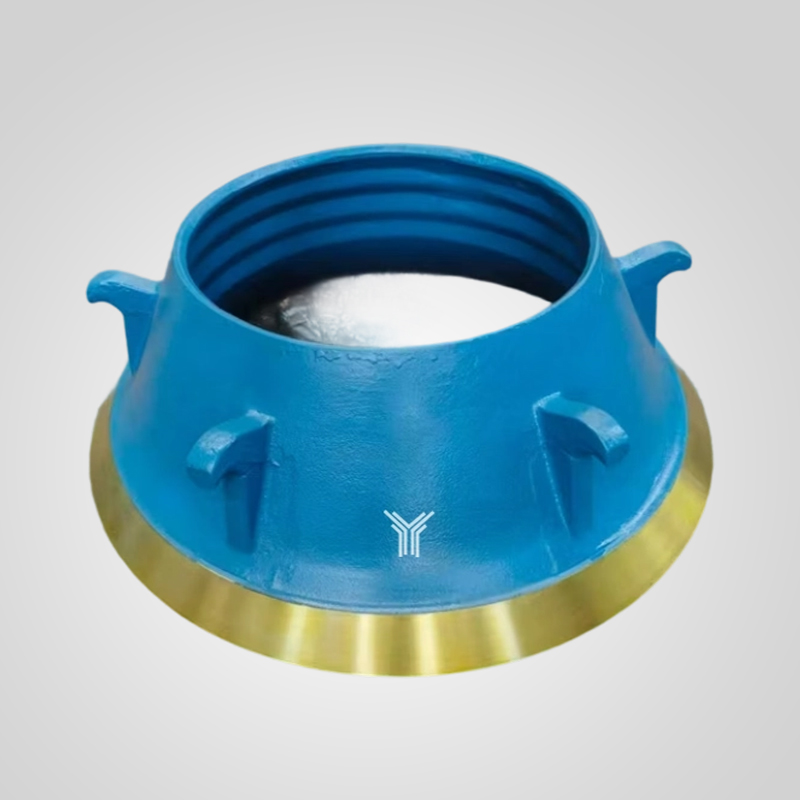
Mitigating Ring Bounce and Spring Fatigue in Cone Crushers with 127707316 Mn18Cr2 Bowl Liners
Restore crushing chamber geometry with high-grade Mn18Cr2 bowl liner 127707316. Engineered to prevent packing, reduce spring chatter, and extend wear life in hard rock applications.
Combating Abrasive Wear and Spring Chatter in Cone Crushers
Excessive “ring bounce” or spring chatter is not just an auditory nuisance; it is a mechanical scream indicating that your crushing chamber geometry has failed. When the feed material exceeds the chamber’s volumetric capacity due to a worn profile, the springs compress violently, lifting the adjustment ring and allowing uncrushed material to pass. This phenomenon, often caused by using a dimensionally compromised bowl liner 127707316, sends shockwaves exceeding 20G through the mainframe, cracking welds and destroying bronze bushings.
For operators of spring cone crushers, the replacement of the stationary bowl liner is the critical moment to reset the machine’s efficiency. This analysis details why upgrading to a precision-cast Mn18Cr2 alloy for part number 127707316 is the only viable defense against the high-pressure comminution of abrasive silica and basalt.
Metallurgical Specification
Standard ASTM A128 Grade A (Mn13%) steel was the industry standard for decades. However, in modern high-throughput circuits, Mn13 lacks the yield strength to resist deep-layer plastic flow. When a liner “mushrooms” or expands due to insufficient hardness, it exerts outward radial pressure on the adjustment ring threads, often seizing the bowl entirely.
Our manufacturing protocol for the 127707316 bowl liner utilizes a modified Mn18Cr2 (ASTM A128 Grade C) chemistry. This alloy increases the initial yield strength without sacrificing the Charpy V-Notch impact toughness required to handle tramp iron events.
| Property | Mn13Cr2 (Standard) | Mn18Cr2 (Premium 127707316) | Operational Benefit |
|---|---|---|---|
| Carbon Content | 1.10 – 1.20% | 1.15 – 1.25% | Optimized carbide solution for wear resistance. |
| Manganese Content | 11.0 – 14.0% | 17.0 – 19.0% | Deeper work-hardening zone (up to 550 HBW). |
| Initial Hardness | 180 – 200 HBW | 210 – 230 HBW | Resists initial gouging during break-in period. |
| Grain Size | ASTM 2-3 | ASTM 4-5 (Fine) | Reduces propagation of micro-cracks. |
Chamber Geometry and Nip Angle
The primary function of the 127707316 bowl liner is to work in tandem with the mantle to create a tapering crushing chamber. The angle formed between these two surfaces—the nip angle—dictates whether rock slides (causing abrasion) or breaks (causing crushing).
A generic or poorly cast liner often deviates from the OEM profile by 3-5mm. This slight deviation increases the nip angle. Once the angle exceeds roughly 22-24 degrees, the rock slips upward during the compression stroke rather than breaking. This slippage causes:
- Localized Gouging: Creating “bell-mouth” wear patterns.
- Reduced Throughput: Material recirculates instead of passing through.
- Heat Generation: Friction boils the lubricating grease on the threads.
Our 127707316 replacement parts undergo 3D laser scanning post-casting to ensure the profile tolerance stays within ±1.5mm of the OEM specification, guaranteeing an optimal nip angle from the first day of operation.
Case
“Last winter, we serviced a 4.25′ Standard Spring Cone at a quartzite quarry. The customer was complaining of broken spring bolts every three weeks. Upon inspection, we found they were using a’cheaper’ aftermarket bowl liner. The liner thickness at the choke point was 6mm thicker than spec, creating a choke-feed condition that the springs couldn’t handle. We installed a spec-compliant 127707316 Mn18 bowl liner. The result? The amp draw dropped by 15%, the spring chatter vanished immediately, and they haven’t broken a bolt in six months.”
Installation Best Practices: The Zinc vs. Epoxy Debate
In older spring cone crushers, molten zinc was the traditional backing material. However, zinc poses safety risks and cools unevenly, creating shrinkage gaps. For the installation of the 127707316 liner, we strictly recommend high-impact epoxy backing compounds.
Step 1: Preparation of the Bowl
The seating surface of the adjustment bowl must be cleaned to bare metal (SA 2.5). Any rust or old backing residue will act as a stress riser. We recommend using an angle grinder with a cup brush.
Step 2: Seating and Centering
The 127707316 liner must be centered perfectly. Use wooden wedges to maintain an even gap around the circumference. An off-center liner will cause the crusher to produce an elongated product on one side and fines on the other, unbalancing the eccentric bushing load.
Step 3: The Pour
Pour the epoxy backing until it is flush with the top of the liner hooks. Crucial: Ensure the backing compound has a compressive strength of at least 11,000 psi (76 MPa) after full cure. Weak backing will pulverize under the impact, leaving the liner unsupported and prone to vertical cracking.
“When you are tightening the wedge bolts or hook bolts on the 127707316 bowl liner, do not just torque them and walk away. Run the crusher under ‘ up, the assembly shifts slightly. That second torque check is often the difference between a liner that stays tight for 12 months and one that starts spinning in the bowl after a week.”
Preventative Maintenance and Wear Monitoring
Waiting for the production rate to drop is not a maintenance strategy. Operators should physically measure the wall thickness of the 127707316 liner weekly.
The “Cupping” Effect
Watch for cupping near the bottom of the liner. If the liner wears too thin at the discharge end while remaining thick at the feed opening, the crushing force vectors shift, putting excessive load on the socket liner. We recommend changing the liner when the thinnest section reaches approximately 20mm-25mm, or when the weight of the liner has reduced by 45-50%.
Oil Analysis Correlation
High Silica (Si) content in your lube oil analysis often correlates with a worn bowl liner. When the liner wears through or cracks, dust seals often fail, allowing abrasive dust to enter the oil reservoir. If your oil report flags Silicon > 50 ppm, inspect the 127707316 liner immediately for cracks or seal breaches.
Total Cost of Ownership (TCO) Analysis
Cheap castings are expensive to operate. A low-grade bowl liner might save $500 upfront but will cost thousands in lost productivity.
- Change-out Labor: A liner change requires a crew of 3 for 6-8 hours.
- Crane Rental: Often required for lifting the adjustment cap.
- Lost Aggregate: 8 hours of downtime at 250 TPH = 2,00
0 tons of lost production.
By utilizing our premium 127707316 liner with Mn18Cr2 chemistry, you extend the wear interval. If you can push the change-out from every 12 weeks to every 16 weeks, you eliminate one full maintenance shutdown per year. That single saved shutdown covers the cost of the premium liner three times over.
Frequently Asked Questions (FAQ)
Q1: Will this 127707316 bowl liner fit my Symons 3ft Standard crusher?
Part number 127707316 is a specific casting number. While many spring cone crushers share design lineage with the Symons/Nordberg style, verification of the casting number and the specific cavity profile (Fine, Medium, or Coarse) is essential. Please provide the serial number of your crusher or the dimensions of the seating flange to ensure 100% compatibility.
Q2: Why did my previous bowl liner crack vertically from bottom to top?
Vertical cracking is almost always a result of poor backing or “packing” the crusher. If the backing compound had voids (air pockets), the liner flexes into that void with every crushing stroke. Eventually, the metal fatigues and snaps. Ensuring a void-free epoxy pour is the prevention. Alternatively, feeding the crusher with material containing uncrushable debris (steel, wood) can cause instantaneous stress fractures.
Q3: What is the recommended torque for the wedge bolts on the 127707316 liner
?
Torque specifications vary by machine size, but for a standard spring cone of this class, it is typically between 350 and 450 Nm. However, the sequence is more important than the absolute value. Tighten in a star pattern (crisscross) to ensure the liner is pulled up evenly. Uneven tightening will leave the liner cocked, leading to rapid, uneven wear.
All manufacturer names, part numbers, model numbers, and descriptions are used for reference and identification purposes only, they are owned by the respective machine manufacturer, including but not limited to FLSmidth®, Metso®, thyssenkrupp®, and Sandvik®. All parts supplied are manufactured and warranted by yonsmen and are not manufactured by or purchased from the Original Equipment Manufacturer. yonsmen has no association with the OEM and does not intend to give this impression.
Reviews
There are no reviews yet.