
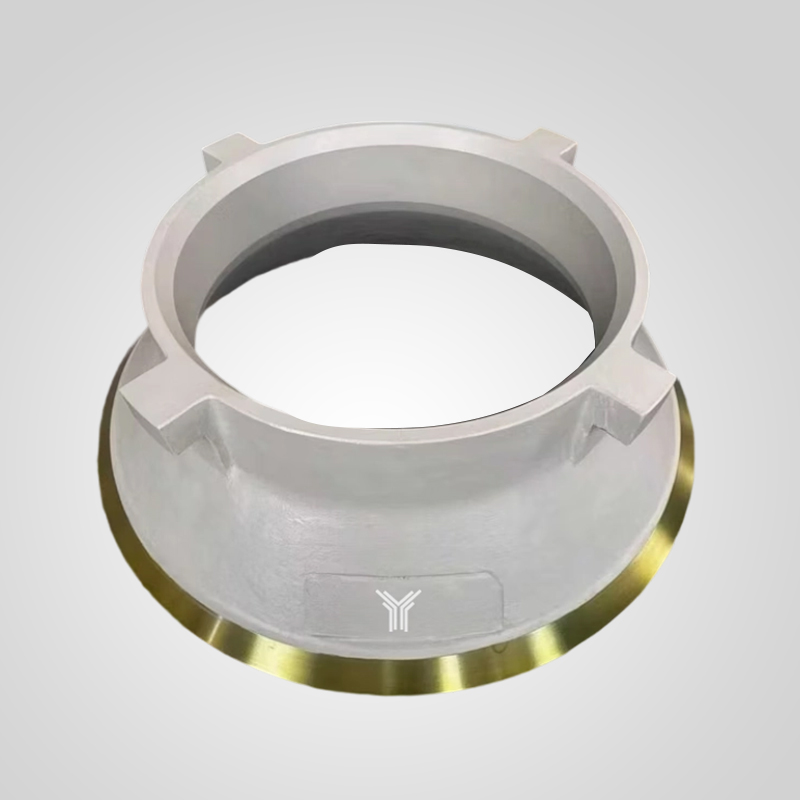
Preventing Bowl Float and Thread Seizing in HP 200 Crushers with N55208138 Mn18Cr2 Liners
OEM Part Number: N55208138
Crusher Model: HP 200
Cavity Profile : Standard Medium (STD M)
Casting Weight: 552.3 kg (± 2%)
Material Alloy : Mn18Cr2 (ASTM A128 Gr. C)
Yield Strength : ≥ 400 MPa
Elongation : ≥ 30%
Machining Tolerance: ISO 2768-m (Medium)
Stabilizing the HP 200 Secondary Circuit The N55208138 Solution
When an HP 200 cone crusher operates at a countershaft speed of roughly 1000 RPM, the kinetic energy transferred to the crushing chamber is immense. Under these high-speed conditions, a bowl liner that is even 2% lighter than the OEM specification or cast with porosity can lead to catastrophic “bowl float.” This phenomenon, where the crushing force overcomes the clamping pressure, hammers the adjustment ring threads and destroys the hydraulic tramp release system. For operators managing the N55208138 bowl liner, the focus must shift from simple price comparison to analyzing the metallurgical density and dimensional circularity of the 552.3kg casting.
The Standard Medium (STD M) cavity profile is the workhorse of secondary crushing. Maintaining this specific geometry is critical for preserving the nip angle. This technical dossier examines how upgrading to a precision-engineered Mn18Cr2 replacement for part N55208138 safeguards the structural integrity of the HP 200 mainframe while extending wear life.
Mn18Cr2 vs. Structural Failure
The primary failure mode for HP series liners is not abrasion, but structural fatigue leading to plastic deformation. Standard Hadfield steel (Mn13) typically has a yield strength of around 350 MPa. In contrast, the crushing force in an HP 200 often exceeds 450 MPa at the choke point. This differential causes Mn13 liners to “mushroom,” flowing metal into the relief gaps and welding the liner to the bowl.
Our replacement N55208138 component is cast using a vacuum-degassed Mn18Cr2 (Austenitic Manganese-Chrome) alloy. By increasing the manganese content to 18% and adding 2% Chromium, we achieve:
- Higher Yield Strength: Preventing the cold-flow that causes liners to stick in the bowl.
- Controlled Work Hardening: The surface hardness rapidly escalates from 220 HBW to >500 HBW upon impact, providing a self-renewing wear layer.
- Refined Grain Structure: Through a precise water quench at 1040°C, we eliminate carbide precipitation at the grain boundaries, which is the leading cause of spalling (flaking) in high-silica applications.
Chamber Geometry and Feed Analysis
The “STD M” designation for N55208138 indicates a specific intake capability. The profile is designed to accept feed sizes typically around 180-200mm (depending on the CSS). If a replacement liner has a casting deviation of +5mm in the upper chamber, it reduces the intake opening, causing feed bridging.
Conversely, if the liner is too thin, the nip angle increases. Once the nip angle exceeds 24 degrees, the rock is no longer crushed; it is ejected upwards. This “pop-corning” effect drastically reduces throughput and subjects the liner N55208138 to localized gouging rather than even abrasive wear. Our castings undergo 3D laser profiling to ensure the chamber angle remains within ±0.5 degrees of the OEM design.
Case
“I inspected an HP 200 at a river gravel plant in Oregon last year. The operator reported that the hydraulic clamping pressure kept dropping. We stripped the machine and found they had installed a’discount’ N55208138 bowl liner. The liner’s mounting flange was not machined flat—it had a 0.8mm warp. This gap allowed the liner to rock back and forth under load, fretting against the bowl seating surface. It eventually wore a groove into the permanent bowl assembly, costing them $18,000 in repairs. We installed a CNC-machined Mn18Cr2 liner with proper backing, and the hydraulic pressure stabilized immediately.”
Installation Protocol for the 552.3kg Component
Correct installation is as vital as the metallurgy. The HP 200 utilizes a thread-rotation mechanism for setting adjustment, making the concentricity of the liner paramount.
1. Surface Preparation
The contact surfaces on the bowl must be cleaned to SA 2.5 standards. Any rust scale or old backing compound will act as a fulcrum, causing the liner to crack vertically under the 200-horsepower crushing load.
2. Backing Compound Strategy
For the N55208138 liner, we recommend a high-impact epoxy backing. Unlike zinc, which shrinks, epoxy provides 100% contact.
Critical Step: You must calculate the volume accurately. For the HP 200 STD M cavity, insufficient backing leaves the top of the liner unsupported. When large feed material hits this void, the liner will snap at the unsupported section. We recommend pouring until the backing is level with the top of the casting hooks.
3. The “Burn Ring” Check
The torch ring (or burn ring) is essential for future removal. Ensure it is welded or positioned correctly before pouring backing. If this ring is misaligned, removing the worn N55208138 liner will require dangerous manual torch cutting inside the confined crushing chamber.
Total Cost of Ownership (TCO) Analysis
Procurement teams often evaluate the N55208138 based on price per kilogram. However, the true metric is Cost Per Ton of Crushed Material.
Consider the “Change-out Cycle”:
- Scenario A (Generic Liner): Costs $2,000, lasts 900 hours.
- Scenario B (Premium Mn18Cr2 Liner): Costs $2,600, lasts 1,300 hours.
While the premium liner costs 30% more, it delivers 44% more life. More importantly, it eliminates one entire change-out cycle per year.
The math: An HP 200 downtime event costs approximately $1,500 in labor and $8,000 in lost production (assuming 200 TPH at $5 margin). Saving just one change-out saves ~$9,500, far outweighing the $600 parts premium.
Technical Specifications Table
| Technical Parameter | Specification Value |
|---|---|
| OEM Part Number | N55208138 |
| Crusher Model | HP 200 |
| Cavity Profile | Standard Medium (STD M) |
| Casting Weight | 552.3 kg (± 2%) |
| Material Alloy | Mn18Cr2 (ASTM A128 Gr. C) |
| Yield Strength | ≥ 400 MPa |
| Elongation | ≥ 30% |
| Machining Tolerance | ISO 2768-m (Medium) |
Preventative Maintenance via Oil Analysis
The health of your N55208138 liner is directly linked to the health of your hydraulic and lubrication systems. We advise monitoring the return oil filter.
If you find Bronze flakes in the filter mesh, it is a red flag. It typically means the bowl liner is worn unevenly (cupping), causing the head to wobble and point-load the eccentric bushing. Replacing the liner before it reaches this “cupped” state preserves the expensive bronze components of the HP 200.
Pro-Tip
“Don’t just rely on the’closed side setting’ (CSS) numbers on the screen. The automatic setting system assumes the liner wears evenly. Every morning, do a physical lead check (drop a lead weight through the chamber). I’ve seen digital readouts say 12mm CSS when the actual gap was 18mm because the N55208138 liner had worn a ‘)
Q1: How do I know if I need the STD M (Medium) or STD C (Coarse) liner for my HP 200?
The choice between Medium (N55208138) and Coarse depends on your feed size. The Medium liner generally has a slightly smaller intake opening but a longer parallel zone for better shaping. If your feed size is consistently smaller than 170mm and you require a cubic product, the STD M is ideal. If your feed is larger (up to 190mm), switching to a Coarse liner prevents feed blockages at the intake mouth.
Q2: Why does my N55208138 liner loosen shortly after installation?
Liner loosening is almost always a backing issue. If the epoxy backing was poured too cold (< 15°C), it may not have flowed into the locking voids effectively. Alternatively, if the crusher was started under load before the backing fully cured (typically 12-24 hours depending on ambient temp), the uncured epoxy would have compressed, creating a gap. Always verify the cure hardness (Shore D) before startup.
Q3: Can I weld on the N55208138 liner to extend its life?
Absolutely not. Manganese steel (Mn18Cr2) is extremely sensitive to heat. Welding on the liner creates localized embrittlement (martensite formation) in the heat-affected zone. The next time the crusher takes an impact, the liner will crack catastrophically at the weld point. Once the wear profile is compromised, the only safe option is replacement.
All manufacturer names, part numbers, model numbers, and descriptions are used for reference and identification purposes only, they are owned by the respective machine manufacturer, including but not limited to FLSmidth®, Metso®, thyssenkrupp®, and Sandvik®. All parts supplied are manufactured and warranted by yonsmen and are not manufactured by or purchased from the Original Equipment Manufacturer. yonsmen has no association with the OEM and does not intend to give this impression.
Reviews
There are no reviews yet.