
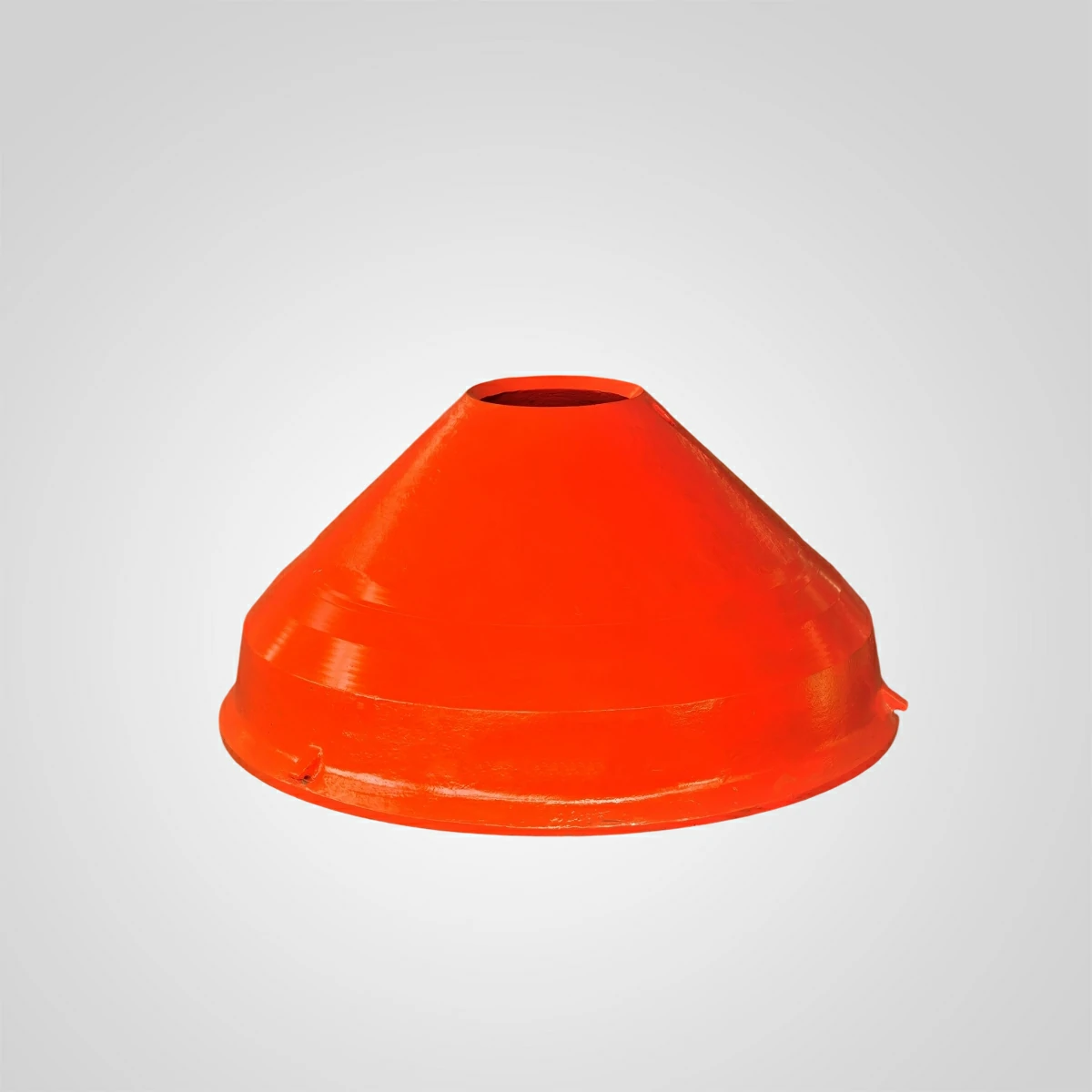
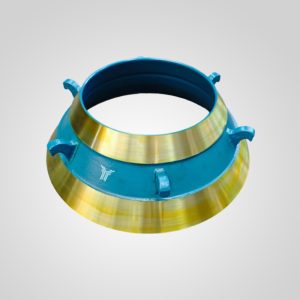
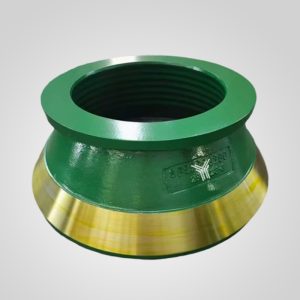
Raptor XL900 Crusher Parts mantle
Part Name : Mantle (movable inner crushing liner)
Crusher Model: FLSmidth Raptor XL900 cone crusher
Crushing Head Diameter : 1.8 m / 71 inches (FLSmidth official)
Installed Motor Power : 900 hp / 671 kW (FLSmidth official)
Maximum Throughput Capacity: Approx. 1,270 tonnes/h (1,400 TPH) in secondary duty (FLSmidth / WOMP industry reference)
Maximum Feed Size : 313 mm / 14.57 in (FLSmidth official)
A 900 hp Crusher Stopped by a Worn Mantle That Should Have Run Another 800 Hours
The Raptor XL900 cone crusher is designed around a 71-inch (1.8 m) crushing head, a 900 hp (671 kW) motor, and a throughput capacity of approximately 1,270 tonnes per hour in secondary duty. When that machine stops for an unplanned mantle replacement, the cost is not the price of the mantle. It is the value of every tonne that did not pass through the secondary circuit, plus the downstream cascade: stalled tertiary crushers, idle screens, partially loaded ball mills, and the production recovery program that follows. A published case study by ESCO Group on an XL900 installation documented that OEM mantle wear metal utilization reached only 77% before the part was rejected — meaning 23% of the manganese mass was removed from service while still usable, because the worn profile had migrated away from the design geometry at the critical contact zones. Optimizing the mantle design for that same machine recovered 30% more usable wear metal and extended the liner interval by a measurable fraction of the total operating schedule.
That gap — between what the liner was and what it could have been — is where the economics of Raptor XL900 crusher parts procurement are decided. It is not in the purchase price. It is in the design of the wear surface, the chemistry of the cast, and whether the replacement part was dimensionally verified against the correct XL900 profile before it was shipped.
Confirmed Parameter Data — Raptor XL900 Mantle
The table below uses data confirmed from FLSmidth’s official Raptor XL900 technical brochures, published case study documentation, and multiple independent industry sources. Mantle-specific individual weight figures are not published in FLSmidth’s publicly available XL900 brochures. Industry manufacturing tolerances for cone crusher liner castings at this size class are included from confirmed aftermarket industry standards. Any parameter not confirmed from a verifiable source is clearly identified.
| Parameter | Confirmed Value / Source |
| Part Name | Mantle (movable inner crushing liner) |
| Crusher Model | FLSmidth Raptor XL900 cone crusher |
| Crushing Head Diameter | 1.8 m / 71 inches (FLSmidth official) |
| Installed Motor Power | 900 hp / 671 kW (FLSmidth official) |
| Maximum Throughput Capacity | Approx. 1,270 tonnes/h (1,400 TPH) in secondary duty (FLSmidth / WOMP industry reference) |
| Maximum Feed Size | 313 mm / 14.57 in (FLSmidth official) |
| Minimum CSS — Standard Coarse | 30 mm / 1.18 in (FLSmidth Raptor brochure) |
| Feed Opening — Standard Coarse | 370 mm / 14.75 in (FLSmidth Raptor brochure) |
| Minimum CSS — Standard Medium | 25 mm / 0.98 in (FLSmidth Raptor brochure) |
| Clearing Stroke Travel | 150 mm / 5.89 in (FLSmidth XL900 dimension data) |
| Head Assembly Removal Clearance — Standard | 4,470 mm / 176 in (FLSmidth XL900 dimension data) |
| Head Assembly Removal Clearance — Short Head | 4,851 mm / 191 in (FLSmidth XL900 dimension data) |
| Bowl Liner Weight (Dry — without backing) | 2,631 kg / 5,800 lbs (FLSmidth Raptor brochure, ±5% casting tolerance) |
| Bowl Liner Weight (Wet — with backing compound) | 3,878 kg / 8,550 lbs (FLSmidth Raptor brochure, ±5% casting tolerance) |
| Mantle Individual Weight | Not publicly confirmed by FLSmidth for XL900 — confirm by weighing delivered part or requesting supplier documentation |
| Standard Mantle Material Grade | Mn13Cr2 (standard); Mn18Cr2 and Mn22Cr2 for harder, high-abrasivity ore |
| Chromium Content (Mn grades) | 2–3% Cr confirmed for standard grades |
| As-Cast Hardness | 200–250 HB (austenitic manganese steel, pre-service) |
| In-Service Work-Hardened Surface | 450–550 HBW at contact zone; hardened depth up to 18 mm |
| OEM-Referenced Mantle Wear Metal Utilization | 77% (documented in ESCO Group XL900 case study — 23% unused metal at rejection) |
| Optimized Design Wear Utilization Improvement | +30% on mantle vs. OEM (ESCO Group documented case study, same XL900 installation) |
| Manufacturing Profile Tolerance | ±2 mm on profile geometry; bore dimensions ±0.5 mm; weight ±5% casting tolerance (FLSmidth note) / ±2% (aftermarket industry standard) |
| Casting Allowance Note | FLSmidth Raptor brochure explicitly states: “Allowable casting weights vary ±5%” |
| Application | Secondary and tertiary hard rock crushing — mining (copper, gold, iron ore) and aggregate duty |
The High Pivot Point Geometry and Why It Changes How the Mantle Wears
The Raptor XL900 design uses a high pivot point combined with a large crushing stroke — two geometric parameters that distinguish the Raptor series from crushers where the pivot point sits lower in the assembly. The high pivot point means the crushing head gyrates with a motion that is more parallel-sided through the crushing zone than the tapered motion produced by a lower pivot point design. This creates broader, more distributed contact between the mantle surface and the incoming feed throughout the full height of the crushing chamber, rather than concentrating contact predominantly in the lower parallel zone.
The practical consequence for the mantle is that wear distribution across the full height of the liner is more uniform than in crushers with a lower pivot point — but the specific wear profile still depends on feed gradation, choke level, and material hardness. A mantle profile correctly designed for the XL900’s pivot geometry will distribute the available wear metal to match the expected contact pattern. A generic mantle cast to approximate dimensions without accounting for the XL900’s specific eccentric motion will develop asymmetric wear — faster in one axial zone — reducing utilization to the 77% range documented in the ESCO case study.
This is why the mantle among all Raptor XL900 crusher parts requires a profile drawing sourced specifically for this machine, not adapted from a similar-diameter crusher of a different design. The head diameter alone is not sufficient to define the mantle geometry.
Industry Pain Point: The Liner Change Budget That Ignored the Real Cost Multiplier
A copper concentrator operating Raptor XL900 crusher parts in secondary duty was evaluating three mantle suppliers for an annual contract. The incumbent supplier delivered mantles that achieved an average service life of 4,200 operating hours before rejection. The two challenger suppliers offered mantles at 18% and 24% below the incumbent’s price respectively. The plant purchasing manager awarded the contract to the lower-priced supplier based on purchase cost per unit.
The first set from the new supplier achieved 2,900 hours before rejection. The second set reached 3,100 hours. The third set failed at 2,600 hours due to surface cracking in the mid-chamber zone — a pattern consistent with incomplete solution annealing producing grain boundary carbides. The plant ran 11 mantle changes in the year under the new supplier versus 8 under the incumbent. Each additional mantle change cost approximately 14 hours of secondary circuit downtime — crane crew, rigging, liner removal and installation, and commissioning — at a production rate of 850 tonnes per hour in the secondary stage.
The three additional changeouts cost the operation 42 hours of secondary circuit production — at a copper ore value of approximately USD 12 per tonne throughput, representing USD 428,400 in lost throughput before accounting for primary circuit stranding and downstream SAG mill idle time. The “saving” on mantle unit price was approximately USD 38,000. The net cost of the procurement decision that prioritised purchase price over documented metallurgical control was negative USD 390,000 in the first year alone.
Pro-Tip: For the XL900 with its large 1.8 m head, measure mantle thickness at a minimum of eight angular positions and three axial heights at every planned inspection — not only at the lowest ring, which is the most accessible point. The high pivot point geometry means the mid-chamber and upper zones on an XL900 can reach rejection thickness before the lower parallel zone shows visible wear. A thickness measurement taken only at the discharge zone will consistently overestimate remaining liner life by 15–25%, leading to liner rejections that feel sudden but were predictable if the full measurement grid had been used from commissioning.
Material Grade Selection for the Raptor XL900 Mantle
Three standard manganese grades are confirmed for XL900 mantle production across multiple qualified suppliers. The selection depends on the ore Bond Work Index, silica content, and the crushing circuit position — secondary duty at large CSS versus tertiary duty at tight CSS with fine feed.
Mn13Cr2, with approximately 1.0–1.3% carbon and 13% manganese, is the standard grade for moderate applications: limestone, softer ores, and mixed aggregate feed with Bond Work Index below 12 kWh/t. In these applications, the crushing energy is sufficient to activate work-hardening at the contact zone without the higher-alloy grades being needed to resist deeper impact fatigue.
Mn18Cr2, with approximately 1.1–1.4% carbon and 17–20% manganese, is the recommended grade for the XL900 operating in secondary duty on hard copper porphyry, gold ore, or basalt with Bond Work Index in the 12–18 kWh/t range. The higher manganese fraction delivers deeper work-hardening and improved resistance to the impact fatigue that occurs when the XL900’s large stroke delivers repeated high-energy contacts at the upper mantle zone.
Mn22Cr2, with 20–24% manganese and elevated chromium at 2–3%, is specified for the most abrasive applications — high-silica iron formation ore, quartzite, and any feed where the silica abrasivity index is in the upper range for the XL900’s operating window. The ESCO case study that documented the 30% mantle wear improvement used a custom-engineered wear metal redistribution approach — moving manganese mass from zones that wore slowly to zones that wore rapidly — which is a separate optimization from grade selection but depends on the selected grade’s work-hardening properties being correctly matched to the application.
What Raptor XL900 Crusher Parts Suppliers Must Confirm Before Delivery
Procurement of the mantle from any aftermarket Raptor XL900 crusher parts supplier should require the following verifiable documentation as a condition of the purchase order:
- Profile source declaration — confirming the casting pattern was derived from the XL900 specifically, not from a generic 71-inch diameter cone crusher
- Heat-specific chemical composition certificate with batch number, listing C, Mn, Cr, Si, S, and P against declared grade limits
- Hardness test result measured directly on the casting — not from a companion test bar, which overestimates the actual casting hardness by 10–20 HB at this wall thickness
- Microstructure report confirming fully austenitic structure with no carbide networks at grain boundaries, with photomicrograph at 100x magnification
- Dimensional inspection sheet with profile measurements at the critical contact zones against the XL900 drawing reference
- Weight confirmation per casting, within ±5% as stated in FLSmidth’s own Raptor brochure for this size class
- Packing documentation — a mantle for a 1.8 m head diameter crusher requires protected transport; edge impact damage on the lower mantle ring produces a raised burr that creates a localized high-stress seating contact during commissioning
Frequently Asked Questions
The Raptor XL900 is rated at 900 hp — does the installed power affect which mantle grade should be specified, and does the XL900 run at different speeds for different applications?
The 900 hp motor rating of the Raptor XL900 delivers crushing force significantly higher than medium-duty cone crushers in the 400–600 hp class, and this affects mantle grade selection in two ways. First, higher crushing force at the same CSS produces more energy per contact event at the mantle surface, which means the work-hardening mechanism activates faster and to greater depth — which is beneficial for Mn18Cr2 and Mn22Cr2, whose work-hardening advantage over Mn13Cr2 depends on sufficient impact energy to drive the strain-induced transformation. In hard ore at full feed with the XL900 at maximum throw, Mn18Cr2 will work-harden effectively from the first operating hours. Second, the XL900’s eccentric speed can be selected to optimize for throughput, size reduction, product shape, or product yield — different speed settings change the frequency and duration of each impact cycle, which changes the thermal loading on the mantle surface. In tertiary applications running at higher speed for finer product, the thermal load per unit time is greater, and Mn22Cr2’s additional chromium content provides marginally better oxidation resistance at elevated surface temperature. For most secondary duty applications, Mn18Cr2 is the correct starting point and should be verified against the specific site’s ore characterization before committing to a full-year supply contract.
Can the mantle from an earlier Raptor XL900 series machine be used in a newer XL900, and how does the no-socket design change affect liner compatibility?
FLSmidth has updated the Raptor series design over several generations, including introducing a socketless design on newer Raptor models to improve access to critical bearings. Changes to the head assembly interface between generations can affect the mantle seating geometry, the head nut thread specification, and the torch ring interface dimensions, even when the nominal head diameter and part description remain the same. Before sourcing a mantle produced to a drawing revision earlier than the current machine configuration, the buyer must confirm the commissioning date and configuration revision of the specific crusher against the drawing revision used by the mantle supplier. An incorrect mantle seating on the XL900 head will not be detectable by visual inspection of the finished casting — it will be apparent only after installation when the mantle seats unevenly or the head nut torque cannot be correctly achieved. Any supplier claiming Raptor XL900 crusher parts compatibility should be asked specifically which drawing revision their pattern is based on.
What is the correct backing compound procedure for the XL900 mantle, and how does backing compound quality affect mantle service life?
The XL900 mantle is installed against the head assembly with a zinc-alloy or epoxy backing compound filling the interface between the back of the manganese casting and the steel head. The backing compound transmits compressive load uniformly across the full contact area between the mantle and the head — if the backing is absent, poorly mixed, or contains voids from incorrect pouring, the load transfers only at the high-contact points on the back of the mantle. Those points carry stress concentrations that initiate fatigue cracking in the mantle body within the first few thousand hours, regardless of the mantle’s surface chemistry and work-hardening performance. The correct procedure is to fill the interface with backing compound at the correct mixing ratio for the site’s ambient temperature — at temperatures below 15°C, the cure time for zinc-alloy backing extends significantly and the pour must account for thermal contraction of the compound before the mantle is loaded. At temperatures above 35°C, epoxy-based compounds may require active cooling to prevent premature gelling during installation. Suppliers offering Raptor XL900 crusher parts who do not include backing compound guidance in their installation documentation are omitting a factor that directly determines whether the new mantle performs to its material specification or fails from a structural cause unrelated to the manganese grade.
All manufacturer names, part numbers, model numbers, and descriptions are used for reference and identification purposes only, they are owned by the respective machine manufacturer, including but not limited to FLSmidth®, Metso®, thyssenkrupp®, and Sandvik®. All parts supplied are manufactured and warranted by yonsmen and are not manufactured by or purchased from the Original Equipment Manufacturer. yonsmen has no association with the OEM and does not intend to give this impression.
Reviews
There are no reviews yet.