

Selecting the Correct ZGMn18Cr2 Alloy for 100TPH Limestone Cone Crusher Wear Parts to Prevent Washout
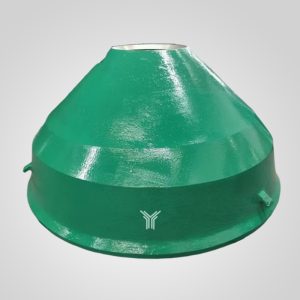
Enhance your 100TPH limestone circuit with precision-cast Mn13Cr2 and Mn18Cr2 concave bowl liners. Engineered for rapid work hardening and dimensional stability in secondary crushing applications.
Optimizing Wear Cycles in 100TPH Limestone Circuits
Processing 100 tons per hour of limestone seems deceptively simple due to the rock’s relatively low Mohs hardness (3-4). However, in a continuous 24/7 crushing circuit, the cumulative abrasion from silica inclusions often creates a “washout” effect where the liner surface wears away before it can sufficiently work-harden. This specific failure mode leads to a rapid loss of the closed side setting (CSS), forcing operators to adjust the bowl daily and resulting in a high percentage of oversized recirculation. For site managers, selecting the correct concave bowl liner is not about finding the hardest metal; it is about finding the alloy with the correct activation energy for the specific impact force of the crusher.
Whether you are operating a compound cone or a floating-shaft design, the interaction between the mantle and the concave defines your plant’s efficiency. This technical breakdown explores the metallurgical nuances of ZGMn13Cr2 versus ZGMn18Cr2 and the installation protocols required to ensure these wear spare parts deliver their rated service life.
ZGMn13Cr2 vs. ZGMn18Cr2
The input specifications highlight two primary austenitic manganese steel grades. Understanding the difference is critical for limestone applications.
ZGMn13Cr2 (Standard Modified Hadfield): containing 11-14% Manganese and 1.0-1.3% Carbon. This is the traditional choice for soft rock. In a 100TPH limestone application with low impact energy, Mn13 is often sufficient. It has a lower yield strength (approx 350 MPa), which allows it to deform slightly and initiate work-hardening even under moderate crushing loads.
ZGMn18Cr2 (High Manganese): containing 17-20% Manganese and 1.1-1.4% Carbon. This is the premium upgrade. The additional manganese serves as an austenite stabilizer, delaying the transformation to martensite until higher impact pressures are reached. However, for limestone containing chert or silica (abrasive contaminants), Mn18Cr2 offers superior wear resistance once hardened (up to 550 HBW). The addition of 1.7-2.4% Chromium in both alloys is non-negotiable; chromium forms hard carbides that resist the gouging wear typical of sharp limestone edges.
Our quality control utilizes high-frequency infrared carbon & sulfur analyzers to ensure the Carbon-to-Manganese ratio remains within the critical 1:10 to 1:14 window. If Carbon drops below 1.0%, the liner becomes too soft; if it exceeds 1.4%, brittle carbides form at the grain boundaries, leading to catastrophic cracking.
Technical Specifications and Chemical Composition
We strictly adhere to the following chemical composition standards to ensure casting integrity.
| Element | ZGMn13Cr2 (Standard) | ZGMn18Cr2 (Premium) | Function in Alloy |
|---|---|---|---|
| Carbon (C) | 1.0 – 1.3 % | 1.1 – 1.4 % | Determines initial hardness and yield strength. |
| Manganese (Mn) | 11 – 14 % | 17 – 20 % | Stabilizes austenite; enables work hardening. |
| Chromium (Cr) | 1.7 – 2.4 % | 1.7 – 2.4 % | Increases yield strength; prevents flow/mushrooming. |
| Silicon (Si) | 0.3 – 0.6 % | 0.3 – 0.6 % | Deoxidizer during casting fluidity. |
| Phosphorus (P) | ≤ 0.05 % | ≤ 0.05 % | Impurity; causes “Cold Shortness” (brittleness). |
Failure Modes in Limestone Applications
While limestone is not the hardest rock, it presents unique challenges for cone crusher equipment.
1. The “Washout” Effect
If the concave bowl liner is too hard initially (or if the crusher is choke-fed with too many fines), the rock slides against the metal rather than impacting it. This abrasion removes the metal surface before it can work-harden. The result is a wavy, polished wear pattern that destroys the chamber profile, reducing the 100TPH capacity to 70TPH due to slippage.
2. Plastic Deformation (Mushrooming)
Even in 100TPH units, the crushing force at the discharge opening can exceed 300 MPa. If the liner casting has low yield strength (often due to low Cr content), the metal flows plastically. This “mushrooming” closes up the stress relief gaps. When the liner eventually needs replacement, it is wedged tight into the bowl, often requiring hours of thermal lancing to remove.
Case
“I consulted for a cement plant in Vietnam running a 4.25′ Standard Cone on limestone. They were burning through a set of mantles every 3 weeks. They thought the rock was harder than tested, so they kept upgrading to harder alloys. I checked their dump pile and saw the liners were smooth as glass—no impact marks. The problem wasn’t hardness; it was the chamber profile. They were using a’Coarse’ cavity for a feed that was mostly < 50mm. The rock was just swimming in the chamber. We switched them back to a standard Mn13Cr2’Fine’ cavity liner. The nip angle improved, the rock started crushing instead of rubbing, and wear life extended to 7 weeks.”
Installation and Backing Protocols
To support the customization features and easy installation of our wear parts, strict adherence to backing procedures is required.
Backing Compound: We recommend a high-performance epoxy over zinc. Zinc poses health risks and has high shrinkage rates. The epoxy should have a compressive strength of at least 80 MPa once cured.
Pouring Temperature: Ensure the bowl and liner are between 15°C and 30°C. If it is too cold, pre-heat the metal with a torch. Cold metal sucks the heat out of the epoxy reaction, leading to a brittle, uncured layer against the steel.
Torque and Tightening:
The wedge bolts or locking nut must be torqued to OEM specification. For a typical 100TPH class machine, this is often around 380-450 Nm.
Re-Torque: Run the machine for 4 hours under load, then shut down and re-torque. The liner will settle into the backing compound. Failure to re-torque is the #1 cause of loose concaves.
Preventative Maintenance via Oil Analysis
Your lubrication oil tells the story of your liner health. In a limestone environment, dust ingress is the enemy.
- High Silicon (Si) > 30ppm: Indicates that limestone dust is bypassing the seals. This often happens when a bowl liner is worn past its limit, changing the geometry and exposing the seal arrangement to direct rock impingement.
- Iron (Fe) Particles: While some iron is normal, large jagged particles indicate that the liner may be spalling (flaking) due to improper heat treatment, sending metal shards into the return line.
Total Cost of Ownership (TCO)
When evaluating wear spare parts for a 100TPH operation, the purchase price is only 20% of the equation.
Consider the cost of a change-out:
1. Crane and Labor: $1,200 per day.
2. Production Loss: 100 tons/hr x $8/ton profit x 10 hours = $8,000.
A cheap liner that saves you $300 but fails 200 hours early actually costs you $9,000 in lost opportunity.
Our Mn18Cr2 liners are heat-treated to maximize the time between these expensive shutdown events, effectively lowering your cost per ton.
Pro-Tip
“Always measure the discarded liner. Don’t just throw it in the scrap pile. Weigh it. A well-utilized liner should have lost about 45-50% of its original weight. If you are throwing away a liner that has only lost 30% of its weight because it wore through in one spot (localized wear), you have a feed distribution problem, not a liner problem. Adjust your feed chute to center the material falling into the cone.”
Frequently Asked Questions (FAQ)
Q1: Can I use the Cr26 (High Chrome) material for my cone crusher bowl liner?
Generally, no. While Cr26 (High Chrome White Iron) has exceptional abrasion resistance, it is extremely brittle. In a cone crusher, the tensile stresses and shock loads can cause a Cr26 liner to shatter catastrophically, potentially destroying the crusher. Cr26 is typically reserved for impact crusher blow bars or chute liners where impact is controlled. For cone crushers, Mn13Cr2 or Mn18Cr2 is the safe, industry-standard choice.
Q2: How does the “Surface Treatment: Polishing” affect performance?
The polishing or grinding of the seating surfaces (the back of the liner) is crucial. It ensures a tight fit against the crusher frame or bowl. If this surface is rough (high Ra value), high spots will break down under the crushing load, causing the liner to loosen. Our liners feature machined/polished seating surfaces to ISO tolerances to ensure 100% contact with the backing compound.
Q3: My limestone feed has high moisture. Will this affect the liner wear?
Yes. Wet, sticky limestone can cause “packing” in the crushing chamber. This packing creates extreme hydraulic pressure spikes as the machine tries to compress incompressible mud. This doesn’t just wear the liner; it fatigues the steel, leading to vertical cracking. If processing wet limestone, consider a “Coarse” cavity liner which has a wider intake to allow sticky material to clear more easily.
All manufacturer names, part numbers, model numbers, and descriptions are used for reference and identification purposes only, they are owned by the respective machine manufacturer, including but not limited to FLSmidth®, Metso®, thyssenkrupp®, and Sandvik®. All parts supplied are manufactured and warranted by yonsmen and are not manufactured by or purchased from the Original Equipment Manufacturer. yonsmen has no association with the OEM and does not intend to give this impression.
Reviews
There are no reviews yet.