
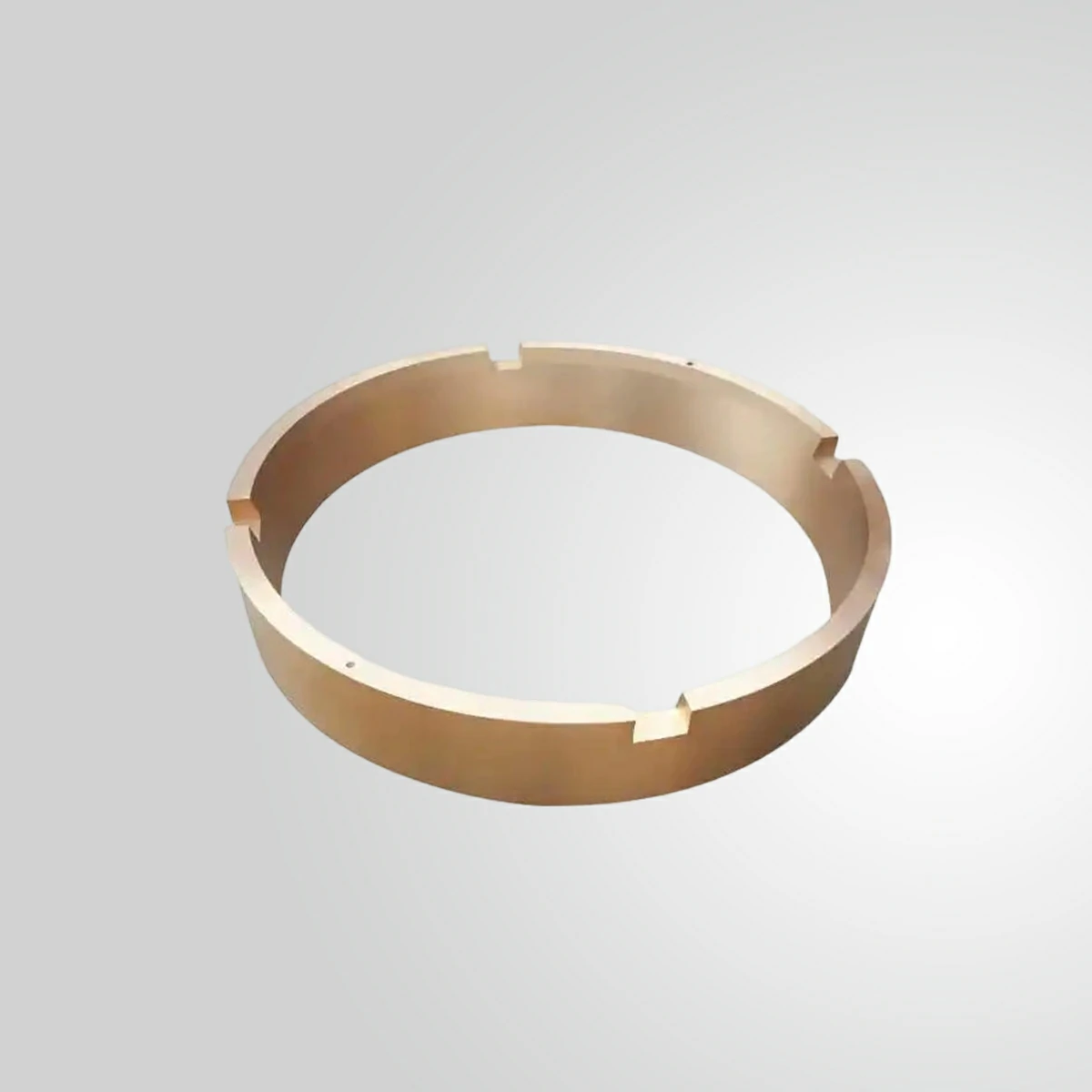
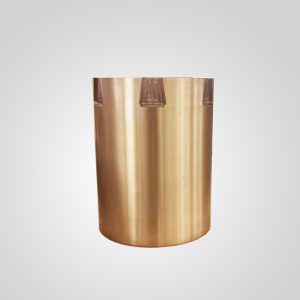
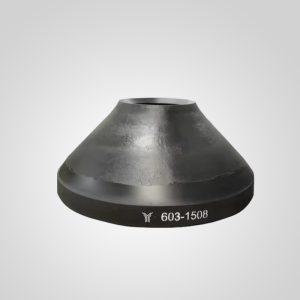
Upper Head Bushing Kinglink HP300 7015656200 for Crusher | C93800 Bronze Bearing with Precision Bore Control
Part Number: 7015656200
Suitable Equipment: HP300 cone crusher
Component Type: Sliding bearing / head support bushing
Base Material : Bronze
Recommended Bronze Grade : C93800 high-leaded tin bronze or equivalent copper alloy for crusher bushing duty
Typical Chemical Composition: Cu balance, Sn 6.3-7.5%, Pb 13-17%, Zn 2-5%, Ni max 1%, Fe max 0.7%
Typical Hardness : 65-85 HBW after casting and stress relief machining route
Microstructure Requirement: Uniform lead distribution, low porosity, no shrinkage cavity in working section
Machining Accuracy: Critical bore and mating dimensions typically controlled within ±0.05 mm
Surface Finish: Bearing surface Ra ≤ 1.6 μm; non-critical surfaces Ra ≤ 3.2 μm
| Product Name | Upper Head Bushing Kinglink HP300 7015656200 for crusher |
| Part Name | Upper Head Bushing |
| Part Number | 7015656200 |
| Suitable Equipment | HP300 cone crusher |
| Component Type | Sliding bearing / head support bushing |
| Base Material | Bronze |
| Recommended Bronze Grade | C93800 high-leaded tin bronze or equivalent copper alloy for crusher bushing duty |
| Typical Chemical Composition | Cu balance, Sn 6.3-7.5%, Pb 13-17%, Zn 2-5%, Ni max 1%, Fe max 0.7% |
| Typical Hardness | 65-85 HBW after casting and stress relief machining route |
| Microstructure Requirement | Uniform lead distribution, low porosity, no shrinkage cavity in working section |
| Machining Accuracy | Critical bore and mating dimensions typically controlled within ±0.05 mm |
| Surface Finish | Bearing surface Ra ≤ 1.6 μm; non-critical surfaces Ra ≤ 3.2 μm |
| Roundness | Reference target ≤ 0.03 mm |
| Concentricity | Reference target ≤ 0.05 mm relative to datum bore |
| Fit-Up Condition | Matched to head assembly seating geometry and lubrication passage alignment |
| Recommended Operating Temperature | Ambient oil circuit typically 35°C to 60°C; short-term bearing zone exposure depends on lubrication condition |
| Lubrication Requirement | Clean circulating crusher lubrication oil, ISO VG grade per ambient conditions and OEM lubrication practice |
| Suggested Cleanliness Target | ISO 4406 cleanliness control recommended to limit abrasive embedment |
| Inspection Before Delivery | Dimensional inspection, visual casting inspection, dye penetrant on critical areas if required, hardness spot check |
| Reference Weight Range | Varies by foundry route and final machining allowance; confirm against actual drawing revision |
| Installation Note | Check seating contact, oil groove orientation, and running clearance against mating shaft and head dimensions |
Detailed Introduction
Excessive head movement in an HP300 usually starts with a bearing surface problem, not with a dramatic mainframe failure. When the upper head bushing loses its geometry by only a few hundredths of a millimeter, the oil film becomes unstable, edge loading begins, and the operator starts seeing secondary symptoms: hotter return oil, unstable amperage, accelerated liner seating wear, and eventually an expensive unplanned shutdown. Upper Head Bushing Kinglink HP300 7015656200 for crusher is the component that sits right in the middle of that risk chain. Its job is simple on paper and unforgiving in the field: maintain alignment, support the rotating head under cyclic crushing load, and preserve an oil film strong enough to prevent bronze-to-steel contact.
For this duty, calling the material merely “bronze” is not enough. In practical crusher service, a sound target specification is C93800 high-leaded tin bronze or an equivalent alloy with proven sliding-bearing behavior. This alloy family is widely used because it combines embeddability, anti-seizure performance, and conformability. The lead phase helps absorb small contamination events without immediately scuffing the shaft surface. Tin contributes strength and wear resistance. Zinc supports castability and cost control. For an upper head bushing in an HP300 application, what matters on site is not theoretical alloy beauty but whether the material can survive mixed lubrication events during startup, shutdown, feed fluctuations, and short periods of elevated unit load.
A realistic composition window for C93800 is Sn 6.3-7.5%, Pb 13-17%, Zn 2-5%, with copper as the balance. When this chemistry is cast correctly, stress relieved, and machined with proper stock removal control, the finished bushing commonly falls in the 65-85 HBW hardness range. That hardness level is important. If the bronze is too soft, it will deform faster under head loading and the bore geometry can drift, increasing the risk of localized oil film collapse. If it is too hard and the microstructure is poor, the bushing loses some of the forgiveness that a crusher bearing needs in real contamination-prone mining conditions. A crusher does not operate in laboratory cleanliness, so the upper head bushing must be tough enough to carry load and soft enough to protect the mating steel from catastrophic scoring.
Machining precision is equally critical. A part may pass basic fit checks and still fail early if the bore finish and geometry are not controlled tightly enough for hydrodynamic lubrication. For this reason, a serious manufacturing target for Upper Head Bushing Kinglink HP300 7015656200 for crusher is critical dimension tolerance within ±0.05 mm, roundness within 0.03 mm, concentricity within 0.05 mm, and bearing surface roughness at Ra ≤ 1.6 μm. Those numbers are not decorative catalog values. They directly affect oil wedge formation. A rough or slightly eccentric bore tends to wipe oil film from high points, which increases frictional heat and speeds up adhesive wear. On a cone crusher running variable feed, that can turn into chatter marks, temperature spikes, and visible bronze transfer in a surprisingly short time.
The service life of this part depends on three linked disciplines: material integrity, installation accuracy, and oil condition. Material integrity starts at the foundry. The bushing should show low porosity, no shrinkage cavities in the loaded section, and uniform lead distribution through the working wall. Large segregated lead pools or hidden porosity zones can create weak spots that deform under load. From the maintenance side, installation has to prevent distortion before the crusher even starts. The seating area must be clean, burr-free, and checked for high spots. The bore and mating shaft or head journal should be measured at several clock positions to confirm actual running clearance rather than nominal clearance on paper.
In the field, I always recommend a dry fit inspection before final assembly. First, clean the housing and mating surfaces completely; old varnish, bronze smear, and embedded fines can change the seating contact enough to create misalignment. Second, verify oil passage orientation and any groove alignment before pressing or positioning the bushing. Third, record shaft diameter, bushing bore, and out-of-round values at ambient temperature. Fourth, confirm that contact pattern at the seat is even and that no rocking is present. Fifth, once the assembly is complete, rotate the head slowly by hand or with controlled assist to feel for tight spots. The goal is not just to install the part; the goal is to avoid building preload into a bearing that is supposed to run on oil, not on metal contact.
Lubrication management is the next line of defense. A bronze upper head bushing survives because an oil film carries the load most of the time. Once contamination or viscosity breakdown reduces film thickness, wear accelerates rapidly. For that reason, preventive maintenance should include structured oil analysis rather than waiting for noise or heat. A practical oil analysis program for HP300 service should track viscosity shift, particle count, copper content, tin content, lead content, iron content, water contamination, and oxidation. Copper and tin trends may indicate active bronze wear, while iron can point to damage on the steel mating surface or other rotating components. Water and silica are especially dangerous because they shorten the transition from normal polishing wear to abrasive wear.
When reviewing oil reports, trend direction matters more than a single number. A stable machine may show minor background copper, but a sharp increase together with higher particle count and rising temperature is a warning sign that the oil film is under stress. In that case, maintenance should not just change oil and move on. The team should inspect return line filters, confirm cooler efficiency, check for blocked passages, verify oil pressure stability during startup, and examine whether feed segregation or chamber overload is causing shock events that transfer abnormal load to the head assembly.
Failure modes in bronze bushings are usually readable if the damaged surface is examined carefully. Galling points to adhesive metal contact caused by lubrication failure, misalignment, or incorrect clearance. Spalling may suggest sub-surface defects, repeated overload, or poor support beneath the bushing seating area. Mushrooming at edges can indicate plastic deformation from concentrated loading, often tied to geometry error or partial contact. If the wear is heavily localized at one side, check alignment and concentricity before blaming only the oil. If scoring runs circumferentially with embedded hard particles, contamination control is the more likely root cause. Good failure analysis helps prevent the next shutdown instead of simply replacing parts on repeat.
From a procurement perspective, the difference between a low-cost aftermarket bushing and a properly controlled part is rarely visible in the photo. It becomes visible in total cost of ownership. A cheaper bronze grade, looser bore tolerance, or poor casting soundness may reduce purchase price, but it can also shorten service life, increase oil contamination, damage the mating shaft surface, and force unscheduled downtime. In a crusher circuit, one shutdown can cost more than the price difference of multiple bushings. OEM-standard dimensional control and verified bronze chemistry usually produce a better cost-per-operating-hour result, even when the invoice line is higher.
A realistic TCO comparison should include purchase cost, installation labor, expected service hours, lubrication cleanliness burden, risk to mating components, and downtime exposure. If a budget bushing lasts only 60-70% of the life of a well-made OEM-standard unit, and it also raises the chance of head journal scoring, the apparent savings disappear quickly. Procurement teams that evaluate only the unit price usually end up paying again through labor, lost tonnage, and collateral component wear. For HP300 service, the better question is not “Which bushing is cheapest today?” but “Which bushing protects crusher uptime over the full maintenance interval?”
Upper Head Bushing Kinglink HP300 7015656200 for crusher makes sense when the buyer needs a replacement part aligned with the operating realities of an HP300 cone crusher: cyclic load, dirty environment, limited shutdown windows, and high sensitivity to lubrication condition. The technical target should always be clear. The bushing must be produced from a bearing-grade bronze such as C93800 or equivalent, machined to consistent bore geometry, inspected for casting integrity, and installed with actual measured clearance rather than assumption. When those basics are executed correctly, the part supports stable head motion, lowers the risk of seizure, and helps the crusher hold its maintenance interval instead of consuming it.
For experienced engineers and plant managers, that is the real value of this component. It is not a decorative spare part in a warehouse list. It is a precision bronze bearing element that protects shaft surfaces, supports lubricant film stability, and converts proper material selection plus dimensional control into fewer stoppages at the crusher. In a production circuit where one bearing failure can halt the line, that is exactly the kind of detail that deserves attention before the machine is restarted.
All manufacturer names, part numbers, model numbers, and descriptions are used for reference and identification purposes only, they are owned by the respective machine manufacturer, including but not limited to FLSmidth®, Metso®, thyssenkrupp®, and Sandvik®. All parts supplied are manufactured and warranted by yonsmen and are not manufactured by or purchased from the Original Equipment Manufacturer. yonsmen has no association with the OEM and does not intend to give this impression.
Reviews
There are no reviews yet.