
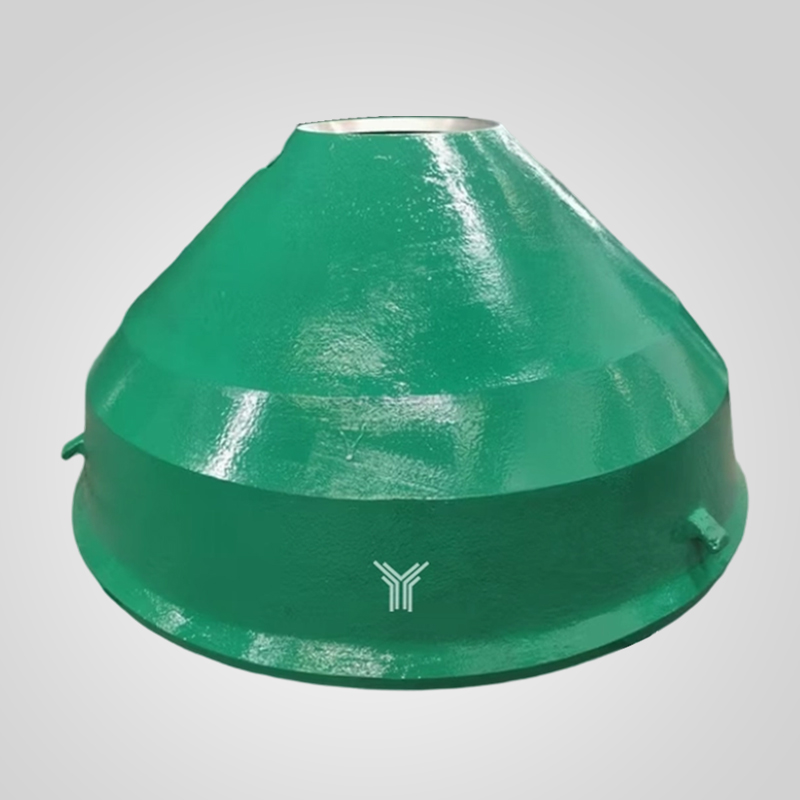
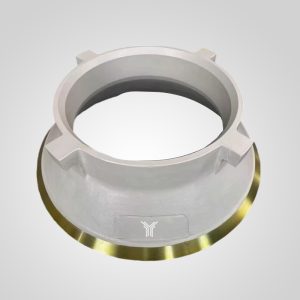
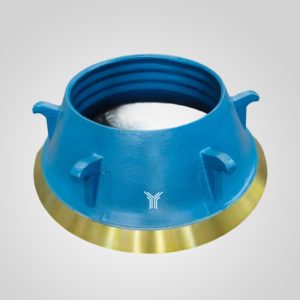
Optimizing the 779kg Wear Mass: Engineering Analysis of HP300 Bowl Liner N55208282
Engineering the Critical Interface: The N55208282 Bowl Liner
A hydraulic clamping pressure drop of just 15% during operation is often the first silent alarm that your bowl liner has structurally failed.
In an HP300 cone crusher, where the crushing force can exceed 350 tons, the bowl liner N55208282 acts as the stationary anvil against which rock is shattered.
If this 779.1kg component is cast from inferior Mn13 steel with a yield strength below 350 MPa, the metal does not just wear away; it flows.
This plastic deformation, or “growth,” forces the liner outward against the bowl, frequently locking the threads of the adjustment ring and turning a standard 4-hour liner change into a 3-day thermal lancing nightmare.
For maintenance leads and procurement officers, the selection of this component is the deciding factor in the reliability of the tertiary crushing circuit.
This engineering analysis dissects the metallurgy, installation physics, and lifecycle costs associated with the N55208282 replacement part.
Metallurgical Specification: The Mn18Cr2 Necessity
The HP300 series is designed for high-power density.
Standard manganese steel (ASTM A128 Grade A) cannot withstand the point-loading stress of hard granite or basalt without deforming.
Our replacement N55208282 liners are cast exclusively using a Mn18Cr2 (Austenitic Manganese-Chrome) alloy matrix.
The Carbide Solution:
The addition of 2% Chromium is non-negotiable.
Chromium precipitates hard carbides at the grain boundaries, raising the initial yield strength to >400 MPa.
This strength is critical for preventing the liner from expanding radially under the crushing load.
Without this chromium reinforcement, the liner would “mushroom” at the intake and discharge zones, permanently damaging the permanent bowl seating surface.
Work Hardening Kinetics:
The casting is delivered with a solution-annealed hardness of 210-230 HBW.
Upon exposure to the crushing impact, the surface layer transforms from austenite to martensite, reaching a hardness of over 550 HBW.
This self-hardening phenomenon ensures that while the skin resists abrasion from silica, the core remains ductile (Impact Toughness > 100 J/cm²) to absorb shock loads from tramp iron events.
Failure Mode Analysis: Protecting the Mainframe
We analyze discarded N55208282 liners to improve casting geometry.
The two most prevalent failure modes in non-OEM quality parts are:
1. Thread Locking (Plastic Flow)
When a low-carbon (< 1.1%) liner is subjected to the HP300’s clamping force, it elongates.
Since the liner is confined within the bowl, this growth exerts immense radial pressure.
This pressure distorts the bowl, causing the adjustment threads to seize against the adjustment ring.
Once seized, the automatic setting regulation (ASRi) fails, and the crusher cannot maintain a consistent Closed Side Setting (CSS).
2. Seat Galling
The 779.1kg mass must sit perfectly flush against the bowl.
If the machined backing surface of the N55208282 part has a roughness greater than Ra 6.3 μm or circularity deviation > 0.5mm, it will micro-move during operation.
This fretting motion grinds away the seating surface of the expensive bowl assembly, leading to costly machining repairs.
Case Snippet
“I was called to a quartzite quarry in Brazil running an HP300. The maintenance manager reported that they couldn’t rotate the bowl to adjust the setting. We inspected the machine and found they had installed a’budget’ N55208282 liner three months prior. The liner had mushroomed so badly at the upper flange that it had effectively press-fitted itself into the bowl. We had to cut the liner out in sections. The radial expansion had warped the bowl by 1.5mm out of round. We replaced it with a stress-relieved Mn18Cr2 liner, and the thread movement was restored.”
Installation Protocols: Managing 779.1kg
Installing a liner of this weight class requires precision to ensure hydraulic stability.
Step 1: Surface Preparation
The bowl seating surface must be cleaned to bare metal using a wire cup brush.
Any old backing compound or rust scale acts as a high spot, creating a stress riser that will crack the new liner vertically under load.
Apply a thin layer of release agent (lithium grease or specialized coating) to the bowl surface to facilitate future removal.
Step 2: Backing Compound Calculation
The N55208282 liner requires a high-compressive strength epoxy backing.
Crucial: The gap between the liner and the bowl must be completely filled.
For this specific cavity, you will typically require 25kg to 35kg of compound (depending on bowl wear).
If you leave a void behind the liner, the steel will flex into that empty space with every rotation, leading to rapid fatigue failure.
Step 3: The “Burn Ring” Verification
The torch ring (burn ring) at the top of the liner interface is critical.
Ensure it is not warped.
If the torch ring is damaged, the backing compound will leak out during the pour, leaving the top of the liner unsupported.
An unsupported top section will snap off when large feed material enters the chamber.
Preventative Maintenance via Oil Analysis
The health of your N55208282 liner is directly reflected in your lubrication system analysis.
- Copper (Cu) > 25 ppm: This is a red flag.
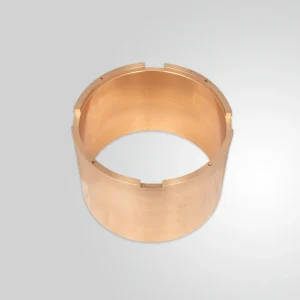
It indicates that the socket liner or eccentric bushing is wearing.
This is often caused by an unevenly worn bowl liner (oval wear) that forces the head to wobble (“nutation”), stripping the bronze components. - Silica (Si) Spikes: If the particle count for silica rises, inspect the dust seal.
A worn-out liner that has exceeded its wear life can damage the dust seal retainer, allowing crushed rock dust to enter the oil sump and destroy the bearings.
Total Cost of Ownership (TCO) Analysis
Procurement often focuses on the invoice price of the N55208282, ignoring the operational reality.
The Math of Downtime:
An HP300 processes approximately 300-350 TPH.
If a cheap liner fails or wears out 200 hours early, you lose production time for the change-out.
Scenario:
1. Economy Liner: $2,200. Life: 900 Hours. Cost/Hour: $2.44.
2. Premium Mn18Cr2 Liner: $3,000. Life: 1,400 Hours. Cost/Hour: $2.14.
Plus, the Premium liner saves one entire shutdown event (valued at ~$10,000 in lost production and crane costs) per year.
Technical Specifications Table
| Technical Parameter | Specification Value |
|---|---|
| Part Number | N55208282 |
| Crusher Model | HP300 (Cone Crusher) |
| Component Weight | 779.1 kg (Approximate) |
| Material Alloy | Mn18Cr2 (ASTM A128 Grade C) |
| Initial Hardness | 210 – 230 HBW |
| Work Hardened Hardness | > 500 HBW |
| Yield Strength | ≥ 400 MPa |
| Machining Tolerance | ISO 2768-m |
Pro-Tip
“When you pull the old N55208282 liner, look at the wear pattern on the inside. If you see’ribbing’ or distinct horizontal grooves, your crusher is running at the wrong speed or the feed is too coarse. Ribbing indicates the rock is slipping rather than being crushed. Before you blame the liner quality, check your drive belt tension and countershaft RPM. A slipping belt drops the eccentric speed, causing the rock to slide and wear the liner out 30% faster.”
Frequently Asked Questions (FAQ)
Q1: What is the correct backing pouring temperature for the N55208282 liner?
The ideal temperature range for pouring epoxy backing is between 15°C and 25°C.
If the ambient temperature is below 10°C, you must preheat the bowl and the liner using heating blankets or torches (carefully).
Pouring onto cold metal sucks the heat out of the exothermic reaction, resulting in a soft, gummy backing that will not support the 779kg liner under load, leading to immediate loosening.
Q2: Can I use this N55208282 bowl liner with any mantle profile?
No, cavity matching is critical.
The N55208282 is designed for a specific cavity profile (typically Fine or Medium).
It must be paired with the corresponding mantle to maintain the correct nip angle and volumetric throughput.
Mixing mismatched profiles (e.g., a Coarse mantle with a Fine bowl liner) will disrupt the crushing chamber geometry, causing feed bridging (“pop-corning”) and uneven wear.
Q3: How do I measure the wear on the bowl liner to know when to change it?
We recommend using a wear profile template supplied by the manufacturer.
Measure the thickness at the wear zone (usually the bottom third of the liner).
The discard point is typically reached when the liner thickness is reduced to approx 20mm-25mm.
Warning: Do not rely solely on hours. A change in feed hardness (e.g., hitting a silica pocket) can wear a liner out in 500 hours that usually lasts 800 hours.
All manufacturer names, part numbers, model numbers, and descriptions are used for reference and identification purposes only, they are owned by the respective machine manufacturer, including but not limited to FLSmidth®, Metso®, thyssenkrupp®, and Sandvik®. All parts supplied are manufactured and warranted by yonsmen and are not manufactured by or purchased from the Original Equipment Manufacturer. yonsmen has no association with the OEM and does not intend to give this impression.
Reviews
There are no reviews yet.