
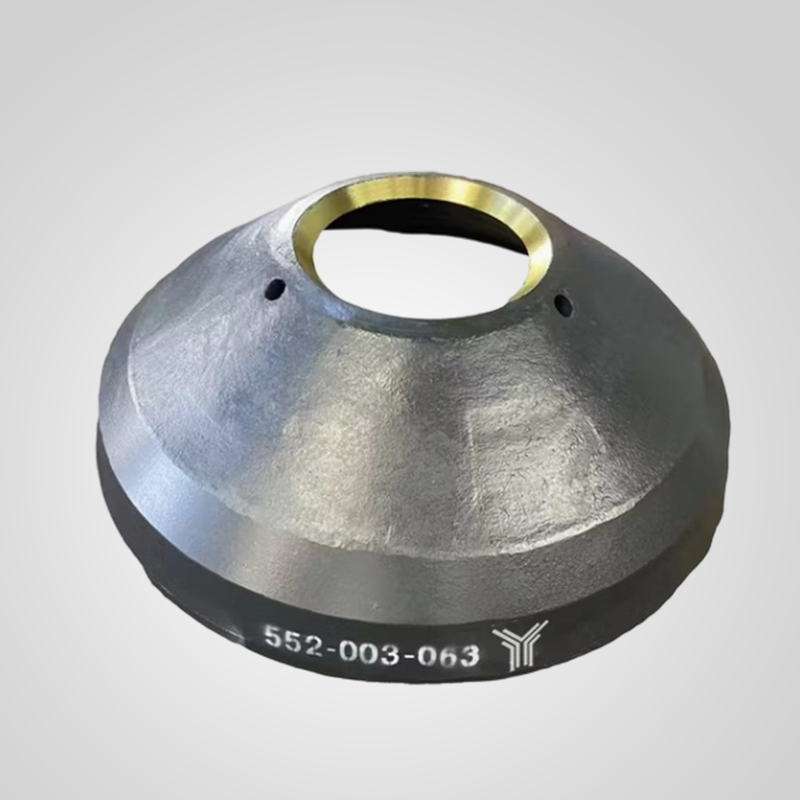
Optimizing Compressive Strength and Wear Life in GP550 Crushers with Mn18Cr2 Spare Part 552-003-063
Part Reference : 552-003-063
Machine Compatibility : GP550 Series (Cone Crusher)
Material Grade: Mn18Cr2 (ASTM A128 Grade C)
Yield Strength: ≥ 400 MPa
Initial Hardness: 210 – 230 HBW
Work Hardened Max: > 550 HBW
Backing Requirement: High-Impact Epoxy (Zero Void)
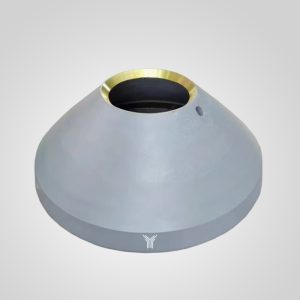
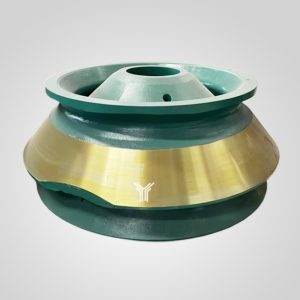
Component Type: Wear Part (Mantle/Concave)
Hydraulic Stability and Metallurgical Precision in GP550 Circuits
A GP550 cone crusher operating at a closed side setting (CSS) of 25mm generates a crushing force that can exceed 4500 kN.
In this high-stress environment, the factory GP550 cone crusher spare part is not merely a consumable; it is the primary interface between kinetic energy and rock.
When utilizing part number 552-003-063, operators are addressing a critical engineering challenge: maintaining the geometric integrity of the crushing chamber under immense hydrostatic pressure.
Failure to select a liner with the correct yield strength often results in “piston wobble”—where the main shaft oscillates unevenly, destroying the upper and lower bushings and leading to catastrophic mainframe failure.
For mining maintenance superintendents, the selection of this high performance spare part defines the plant’s availability.
This technical analysis explores the metallurgy, installation physics, and total cost of ownership associated with replacing the mantle and concave in these heavy-duty machines.
Metallurgical Specification: The Necessity of Mn18Cr2
The GP550 is a floating-shaft machine, meaning the mantle is supported by a hydraulic piston.
Because of this design, the wear parts must withstand not only abrasive wear but also high-frequency compressive shock loads.
In the mining machinery industry, standard Mn13 (Hadfield steel) often fails in this application because it lacks the initial yield strength to resist plastic flow.
Our specification for part 552-003-063 utilizes a modified Mn18Cr2 (Austenitic Manganese Steel with 2% Chromium) alloy.
The science behind this choice is specific:
- Initial Hardness (220 HBW): The casting is supplied with a ductile austenitic structure. This allows the liner to absorb the impact of tramp iron (drill bits, loader teeth) without shattering.
- Work Hardening (550+ HBW): Under the crushing load of the GP550 (often processing granite or basalt > 300 MPa), the surface lattice deforms, transforming austenite to martensite. This creates a sacrificial wear layer that is harder than the rock itself.
- Chromium Reinforcement: The 2% Chromium content precipitates hard carbides at the grain boundaries. This prevents the “scuffing” or adhesive wear that occurs when the rock slides rather than breaks.
Failure Mode Analysis: Avoiding the “Bell Mouth”
We frequently investigate failed liners from the field. For the GP550 configuration, the most common failure mode in non-OEM quality parts is “Bell Mouthing” or washout.
This occurs when the liner material wears away faster than it can work-harden.
If the mantle or concave is too soft (Carbon < 1.1%), the abrasive feed acts like a grinding wheel, carving a concave groove into the lower section of the chamber. This destroys the parallel zone. The result is a loss of product cubicity (flakiness index rises > 20%) and a drastic reduction in throughput as the effective nip angle increases beyond 25 degrees, causing rock to “boil” in the chamber rather than crush.
Case
“I was consulting for a copper mine in Peru running two GP550s. They tried to cut costs by buying a local aftermarket liner set for part 552-003-063. The foundry had used Mn13 instead of Mn18Cr2. Within 120 hours, the mantle had’mushroomed’ so badly at the bottom that it welded itself to the piston top plate. We had to use a thermal lance for 14 hours to cut it off. The heat damage required us to re-machine the piston seating surface, costing them $45,000 in repairs plus 3 days of downtime. We installed the proper Mn18Cr2 specification, and the unit ran for its full 850-hour cycle without deformation.”
Installation Protocols: The Floating Shaft Nuance
Installing wear parts on a GP550 differs significantly from fixed-shaft machines.
The fitment of part 552-003-063 is critical for hydraulic stability.
1. Surface Preparation
The seating surface on the piston (for the mantle) and the top shell (for the concave) must be cleaned to Ra 6.3 μm finish.
Any rust scale or old backing compound will create a high spot.
Under the 300-ton crushing force, this high spot will act as a fulcrum, causing the brittle manganese casting to crack vertically.
2. Backing Compound Strategy
Unlike some older crushers that use zinc, the GP550 requires a high-impact epoxy backing.
Critical Step: You must calculate the volume correctly. The gap behind the liner acts as a shock absorber.
If you leave voids (air pockets) behind the 552-003-063 liner, the steel will flex into the void with every rotation.
Metal fatigue will set in, and the liner will disintegrate.
We recommend a backing compound with a compressive strength of > 110 MPa after curing.
3. Torque Specifications
The head nut (mantle nut) on a GP550 keeps the assembly in compression.
While specific torque depends on the exact thread condition, the “burn ring” or burning ring must be positioned perfectly.
If part 552-003-063 is not seated fully before tightening, it will loosen once crushing begins.
Pro Procedure: Run the crusher for 2 hours with light feed, then shut down and re-tighten the head nut. The manganese will have “seated” into the backing, creating slack that must be removed.
Preventative Maintenance via Oil Analysis
The hydraulic and lubrication systems of the GP550 are your best diagnostic tools.
Routine analysis of the return oil can save your 552-003-063 investment.
- Lead (Pb) & Tin (Sn) > 15 ppm: This suggests the Babbitt lining of the bushings is wearing. This is often caused by a liner that is out of round (poor casting tolerance), creating an unbalanced eccentric load.
- ISO Cleanliness Codes: If the particle count (4/6/14 micron) spikes, check the dust seal. A worn mantle that has exceeded its wear life can damage the dust seal retainer, allowing rock dust to turn your oil into lapping compound.
Total Cost of Ownership (TCO) Analysis
Procurement decisions for the 552-003-063 part should be based on Cost Per Ton, not invoice price.
The Equation:
(Part Cost + Change-out Labor + Lost Production) / Total Tons Crushed
A “cheap” liner that costs $3,000 and lasts 400 hours versus a premium Mn18Cr2 liner that costs $4,200 and lasts 650 hours:
- Cheap Liner: Requires 2.5x more shutdowns per year.Each shutdown costs approx $15,000 in crane, crew, and lost tonnage (at 500 TPH).
- Premium 552-003-063: Reduces shutdown frequency.
By extending the wear life, you are effectively buying production days. The premium metallurgy pays for itself in a single prevented shutdown.
Technical Specifications
| Technical Parameter | Specification Data |
|---|---|
| Part Reference | 552-003-063 |
| Machine Compatibility | GP550 Series (Cone Crusher) |
| Material Grade | Mn18Cr2 (ASTM A128 Grade C) |
| Yield Strength | ≥ 400 MPa |
| Initial Hardness | 210 – 230 HBW |
| Work Hardened Max | > 550 HBW |
| Backing Requirement | High-Impact Epoxy (Zero Void) |
| Component Type | Wear Part (Mantle/Concave) |
[Pro-Tip]
“When changing the 552-003-063 mantle, never ignore the’burning ring’ or torch ring. I see crews try to reuse them to save $50. If that ring is warped, you will never get the mantle seated flat. The backing compound will leak out, and the mantle will rock on the shaft. Always install a new torch ring with every new mantle—it’s the cheapest insurance policy for your $200,000 main shaft.”
Frequently Asked Questions (FAQ)
Q1: How do I know when to replace the 552-003-063 wear parts?
Do not wait for the liner to wear through to the backing.
We recommend changing the liner when the wall thickness at the bottom 1/3rd of the chamber reaches approximately 20mm-25mm.
More importantly, monitor the crusher’s power draw.
If the amp draw is fluctuating wildly (spiking) but production is dropping, the liner profile is likely “washed out,” and you are losing crushing efficiency.
Q2: Can I weld on the Mn18Cr2 liner to add hard-facing?
Absolutely not. Manganese steel is heat-sensitive.
Welding creates localized heat zones that embrittle the steel (carbide precipitation).
The next time the crusher takes a hard impact, the liner will crack at the weld point.
If you need longer life, upgrade the alloy or check your feed distribution, but do not weld on the casting.
Q3: Why does my new liner cause the GP550 to vibrate?
Vibration after a liner change is usually due to one of two things:
1. Unbalanced Casting: If the part 552-003-063 wasn’t cast with proper weight distribution, it acts like an unbalanced tire on a car.
2. Poor Backing Pour: If the backing was poured too fast, creating a void on one side, the liner flexes, creating an elliptical motion that shakes the whole machine.
All manufacturer names, part numbers, model numbers, and descriptions are used for reference and identification purposes only, they are owned by the respective machine manufacturer, including but not limited to FLSmidth®, Metso®, thyssenkrupp®, and Sandvik®. All parts supplied are manufactured and warranted by yonsmen and are not manufactured by or purchased from the Original Equipment Manufacturer. yonsmen has no association with the OEM and does not intend to give this impression.
Reviews
There are no reviews yet.