

FLSmidth Raptor MANTLE-1000144933 with Optimized Strain-Hardening Matrix
Product Name Cone Crusher Mantle
Compatible Model FLSmidth Raptor MANTLE-1000144933
Material Grade ASTM A128 Grade C / Mn18Cr2 (Austenitic Manganese Steel)
Alloy Composition Mn: 17.0-19.0%, Cr: 1.5-2.5%, C: 1.05-1.35%
Initial Hardness (Solution Annealed) 200 \– 240 HBW (Optimized for maximum ductility)
Work-Hardened Surface Hardness \> 500 HBW (Achieved under crushing impact)
Thermal Treatment High-Temperature Solution Annealing \& Rapid Water Quench
Technical Specifications
| Parameter | Specification / Standard |
| Product Name | Cone Crusher Mantle |
| Compatible Model | FLSmidth Raptor MANTLE-1000144933 |
| Material Grade | ASTM A128 Grade C / Mn18Cr2 (Austenitic Manganese Steel) |
| Alloy Composition | Mn: 17.0-19.0%, Cr: 1.5-2.5%, C: 1.05-1.35% |
| Initial Hardness (Solution Annealed) | 200 \– 240 HBW (Optimized for maximum ductility) |
| Work-Hardened Surface Hardness | \> 500 HBW (Achieved under crushing impact) |
| Thermal Treatment | High-Temperature Solution Annealing \& Rapid Water Quench |
| Minimum Yield Strength | 380 MPa |
| Minimum Tensile Strength | 750 MPa |
| Machining Precision (Internal Taper) | ISO 2768-mK |
| Backing Material Compatibility | 100% Solids High-Impact Epoxy Backing Compound |
| Max Continuous Ambient Rock Temp | 130\°C (266\°F) – Constraint dictated by epoxy backing degradation limit |
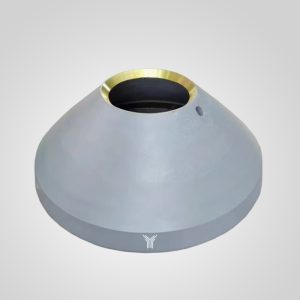
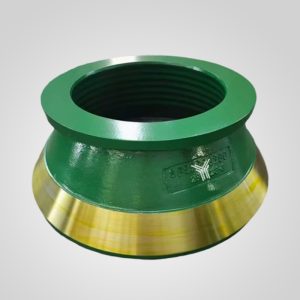
Engineered to withstand extreme abrasive wear and relentless compressive forces, the FLSmidth Raptor MANTLE-1000144933 Cone Crusher Mantle is cast from highly alloyed Mn18Cr2 austenitic manganese steel. Featuring a specialized high-temperature solution annealing and rapid water-quench thermal treatment, this critical dynamic wear liner provides an initial ductility of 220 HBW that rapidly strain-hardens under crushing impact to exceed 500 HBW. CNC-machined internal seating tapers ensure precise contact with the head center, eliminating localized stress multipliers and drastically preventing premature backing compound failure in severe hard-rock comminution circuits.
Detailed Introduction
Combating Abrasive Wear and Plastic Deformation in the Crushing Chamber
Premature wear liner failure and uncontrolled mantle stretching represent severe production bottlenecks in secondary and tertiary hard-rock crushing applications. Within the kinematic architecture of the cone crusher, the mantle acts as the dynamic, oscillating face of the crushing chamber. It is subjected to continuous, highly localized compressive stresses as it forces abrasive ore against the stationary bowl liner. The FLSmidth Raptor MANTLE-1000144933 Cone Crusher Mantle is engineered specifically to absorb these brutal alternating stresses while retaining its geometric profile. By utilizing a highly refined metallurgical matrix, this component resists the rapid plastic deformation (stretching) that typically causes lesser mantles to loosen on the head center, thereby preventing destructive internal vibration and catastrophic structural failure of the main shaft assembly.
Metallurgical Matrix: Mn18Cr2 Austenitic Manganese Steel
The operational longevity and wear profile of a crushing mantle are fundamentally dictated by its exact chemical composition and resulting crystalline structure. The FLSmidth Raptor MANTLE-1000144933 is cast from a premium grade of austenitic manganese steel, strictly conforming to the metallurgical limits of ASTM A128 Grade C, specifically optimized as Mn18Cr2. This precise alloying ratio incorporates 17.0-19.0% Manganese (Mn) and 1.5-2.5% Chromium (Cr).
While traditional Hadfield steel relies on a 12-14% manganese matrix, the elevated 18% manganese content in this FLSmidth Raptor MANTLE-1000144933 provides a significantly deeper capacity for plastic energy absorption before fracture. The strategic addition of 2% Chromium is critical; it fundamentally alters the yield strength of the casting. Chromium alloying delays the onset of macroscopic plastic flow, ensuring the mantle maintains its designed nip angle and closed-side setting (CSS) geometry for a significantly longer operational duration, directly translating to higher crushing efficiency and better product shape.
The Strain-Hardening Phenomenon and Impact Energy
The defining engineering advantage of the FLSmidth Raptor MANTLE-1000144933 Cone Crusher Mantle is its ability to dynamically alter its mechanical properties during operation. Upon initial installation, the mantle exhibits a relatively soft, highly ductile surface hardness of approximately 200 to 240 HBW. This initial ductility is mathematically necessary; it allows the massive casting to flex microscopically and safely absorb the immense shock loads generated by tramp iron or uncrushable materials without undergoing brittle fracture.
However, as the abrasive silica-rich ore is repeatedly pulverized against the mantle face, the compressive impact energy triggers a localized phase transformation in the crystal lattice. The austenitic grain structure at the extreme surface physically compacts and slips, transforming into a dense, highly wear-resistant martensitic structure. This work-hardened outer layer rapidly achieves a hardness exceeding 500 HBW. As this hard sacrificial layer slowly wears away, the continuous crushing impacts progressively harden the underlying austenitic material, creating a self-renewing armor that maximizes the overall tonnage processed per liner.
Thermal Processing: Solution Annealing and Water Quenching
Casting massive, thick-section manganese components introduces severe thermal challenges. If the molten steel is allowed to cool slowly in the sand mold, brittle carbide networks will precipitate along the grain boundaries, acting as internal fault lines that guarantee premature failure under load. To eliminate this critical vulnerability, the FLSmidth Raptor MANTLE-1000144933 undergoes a strict, highly controlled thermal processing regimen.
The rough casting is heated to an elevated solutionizing temperature of approximately 1050\°C (1920\°F) and held until all carbides completely dissolve into the solid austenitic solid solution. The mantle is then immediately extracted from the furnace and submerged in a highly agitated, high-volume water quench. This rapid cooling process effectively freezes the crystalline structure, locking the carbon within the austenite grains and completely preventing carbide precipitation. The resulting metallurgical matrix exhibits exceptional toughness, zero internal embrittlement, and guaranteed structural uniformity from the crushing face to the internal bore.
Machining Precision and Taper Fitment
A crushing mantle is only as reliable as its mechanical interface with the crusher’s head center. The internal taper of the FLSmidth Raptor MANTLE-1000144933 Cone Crusher Mantle is CNC machined to demanding ISO 2768-mK tolerances. This precise dimensional control ensures a uniform seating geometry across the entire contact surface.
A poorly machined taper creates point-loading, preventing the mantle from seating fully. Under the massive forces of the crushing stroke, a poorly seated mantle will inevitably rock on the head. This micro-movement pulverizes the internal epoxy backing compound, leaving the mantle completely unsupported. Once the backing compound fails, the thin sections of the manganese steel will fatigue and crack within hours. The strict machining tolerances of the FLSmidth Raptor MANTLE-1000144933 guarantee proper fitment, ensuring the compressive loads are transferred evenly into the heavy cast steel head center, protecting the entire dynamic assembly.
Backing Compound Dynamics and Thermal Constraints
The volumetric void between the internal taper of the FLSmidth Raptor MANTLE-1000144933 and the external taper of the head center must be completely filled with a 100% solids, high-impact epoxy backing compound. It is a critical engineering distinction that this compound does not act as an adhesive; it functions purely as an incompressible hydraulic shim that provides continuous 360-degree support to the manganese casting.
During installation, the ambient temperature and the core temperature of the mantle strictly govern the pourability and curing reaction of the epoxy. The epoxy reaction is highly exothermic. Proper pouring techniques, utilizing strategically placed venting risers, ensure that all trapped air is evacuated from the lower seating ring up to the locking nut. Ensuring a void-free epoxy backing layer is the absolute final step in guaranteeing the maximum operational lifespan of the mantle.
All manufacturer names, part numbers, model numbers, and descriptions are used for reference and identification purposes only, they are owned by the respective machine manufacturer, including but not limited to FLSmidth®, Metso®, thyssenkrupp®, and Sandvik®. All parts supplied are manufactured and warranted by yonsmen and are not manufactured by or purchased from the Original Equipment Manufacturer. yonsmen has no association with the OEM and does not intend to give this impression.
Reviews
There are no reviews yet.