
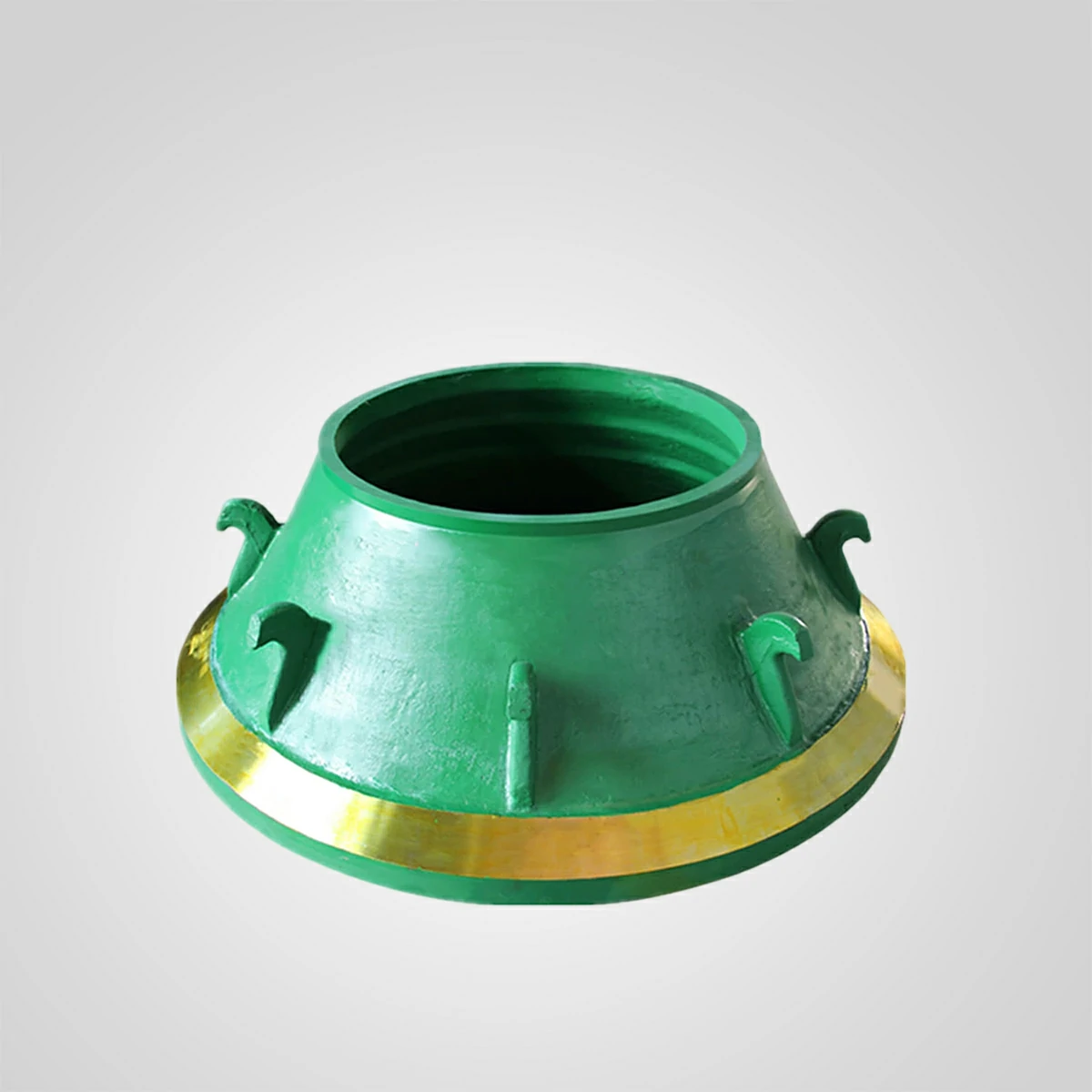
Technical Specification of Bowl Liner (Concave) for Spring Cone Crusher
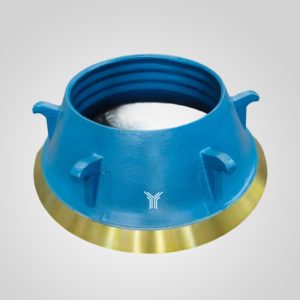
Part Name : Bowl Liner (Concave), stationary crushing surface
Applicable Machines :Metso HP Series, Sandvik CH/CS Series, MP800/MP1000, Symons 2′–7′ equivalents
Material Grades :Mn13Cr2, Mn18Cr2, Mn22Cr3 manganese steel (work‑hardening in service)
Weight Range (Example) :5 200 kg
| Parameter | Specification |
|---|---|
| Part Name | Bowl Liner (Concave), stationary crushing surface |
| Applicable Machines | Metso HP Series, Sandvik CH/CS Series, MP800/MP1000, Symons 2′–7′ equivalents |
| Material Grades | Mn13Cr2 |
| Weight Range (Example) | 5 200 kg |
| Profile Options | Extra Coarse (EC), Coarse (C), Medium (M), Fine (F), Extra Fine (EF) |
| Function | Forms fixed chamber surface, guides feed material with tapered inner profile |
| Casting Method | Resin sand / water glass sand casting with precision machining |
| Service Life | 2 000 hrs (dependent on material and operating conditions) |
| Mounting Features | Dovetail grooves, locating pins, bolt holes for secure seating |
The Bowl Liner, also referred to as the concave, functions as the stationary wear surface against which the mantle compresses feed material during operation. Proper dimensional conformity to OEM specifications is essential for chamber geometry, throughput, and product size control. Material grades such as Mn18Cr2 deliver optimal hardness and toughness under the cyclic compressive loads typical of secondary and tertiary crushing environments. Mn22Cr3 is used where maximum toughness is required in mining and shock‑intense applications. Selecting the correct cavity profile (C/M/F/EF, etc.) directly influences the crusher’s product size characteristics and throughput.
Design and Engineering Considerations for Bowl Liner Performance
Mismatch or improper sizing of the Bowl Liner can accelerate wear, increase energy consumption, and elevate maintenance costs. As a precision crusher part manufacturer, understanding the interplay between liner profile and crushing chamber dynamics is critical. The inner liner profile dictates the crushing trajectory and material flow; shorter profiles yield finer products but require higher feed homogeneity and choke feeding to achieve work‑hardening in manganese steel. Conversely, coarse profiles prioritize throughput and wear life in primary and coarse secondary crushing applications. Bowl liners are cast and heat‑treated to balance core toughness with surface wear resistance. The integration of parallel and tapered sections in the inner wear profile ensures controlled material residence time and consistent product gradation.
Frequent high‑impact conditions — such as oversized feed surges or tramp metal ingress — can induce cracking. In some severe duty cases, extended service life can be achieved with higher alloy grades or carbide‑enhanced inserts, provided adequate tramp metal control measures are in place upstream of the crusher. From an operational perspective, monitoring liner wear by tracking closed side setting (CSS) drift and chamber profile changes allows predictive maintenance planning and reduces unplanned downtime.
Operational Risks, Maintenance Strategies, and Value Optimization
Most field failures of Bowl Liners stem from two factors: starvation of the crushing chamber and shock loading events. Starvation — operating with an under‑filled chamber — prevents the manganese steel surface from work‑hardening, leading to glazed surfaces that wear rapidly. Maintaining the recommended choke‑fed condition (chamber fill of ~60 – 80 %) encourages work‑hardening, improving wear life and reducing liner change frequency. Regular dimensional checks can detect wear patterns early, allowing rotation or staged replacement to extend service life without compromising crushing efficiency.
Shock loading from oversized feed or tramp steel can cause linear cracking or localized spalling at high stress points. To manage this risk, install tramp metal detectors, use appropriate feed sizing screens, and inspect liners during routine shutdowns. Tracking wear life in operational hours and correlating with feed type and abrasiveness enables more accurate life forecasting and procurement planning — a key cost control factor for mining and aggregate operations. Prompt replacement of liners before severe wear modes develop can prevent frame damage and maintain consistent throughput, thereby controlling operating expense.
Frequently Asked Questions (FAQ)
1. What factors determine the service life of a Bowl Liner?
Service life is influenced by alloy grade, feed rock abrasiveness, chamber profile, and operational practices such as maintaining choke feed and proper CSS settings.
2. How do I select the right cavity profile for my crusher?
Choose profile types (EC, C, M, F, EF) based on desired product size and the stage of crushing. Fine profiles yield smaller products but demand consistent feed and choke feeding; coarse profiles maximize throughput in heavy crushing duties.
3. How often should Bowl Liners be inspected or replaced?
Inspect during scheduled shutdowns at least every few hundred operating hours, focusing on CSS drift, wear thickness, and signs of glazing or cracking. Replace before severe wear impacts crusher performance and energy efficiency.
All manufacturer names, part numbers, model numbers, and descriptions are used for reference and identification purposes only, they are owned by the respective machine manufacturer, including but not limited to FLSmidth®, Metso®, thyssenkrupp®, and Sandvik®. All parts supplied are manufactured and warranted by yonsmen and are not manufactured by or purchased from the Original Equipment Manufacturer. yonsmen has no association with the OEM and does not intend to give this impression.
Reviews
There are no reviews yet.