The Hidden Failure Point Below the Crushing Chamber
The mantle can look serviceable, the discharge belt can look normal, and motor current can remain inside its familiar band while the socket liner is already losing its oil film. Among critical crusher wear parts, this hidden bronze bearing surface deserves scheduled inspection. A worn or poorly lubricated socket liner can shift load, raise temperature, disturb head movement, and turn a planned maintenance task into an unplanned shutdown.
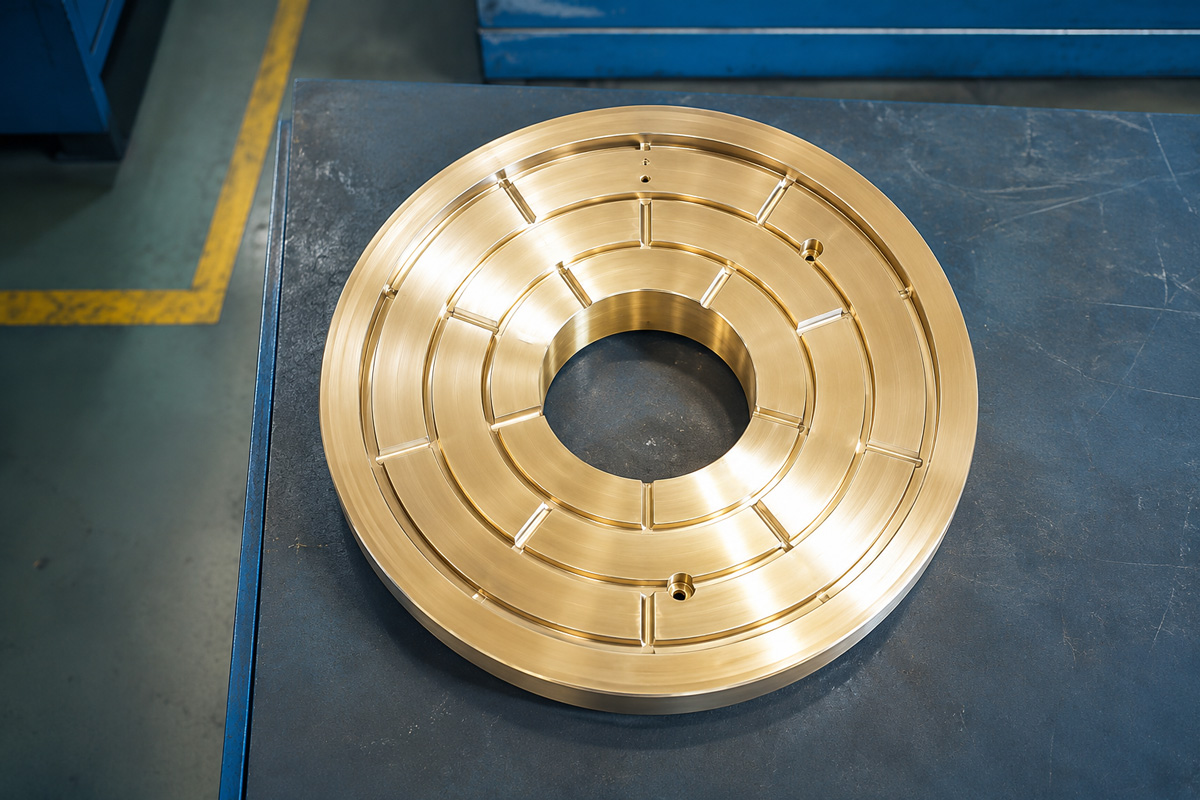
The socket liner does not break rock directly. It supports the spherical movement of the crushing head and helps maintain the geometry that allows the head to gyrate under load. Its condition influences contact pressure, lubrication distribution, heat removal, shaft alignment, closed side setting stability, and the life of adjacent bushings and seating surfaces.
Maintenance teams often give more attention to visible chamber components because their wear can be measured quickly. The hidden bearing surfaces receive less attention until oil temperature rises, bronze appears in the filter, or a knocking sound develops. By then, the problem may have progressed beyond one replaceable bronze component.
Why Crusher Wear Parts Need Hidden Socket Liner Checks
Socket liner failure is usually a process rather than a single event. Contamination scratches the bearing surface. Restricted oil flow weakens the film. Excessive clearance allows impact movement. Poor seating concentrates the load on a narrow contact band. An unstable feed pattern then adds repeated shock loading. Each condition makes the next one more severe.
For that reason, the maintenance plan should connect the socket liner with the full load path. The inspection must include the mating spherical surface, oil grooves, oil ports, main shaft support, lower contact area, eccentric assembly, filter condition, cooler performance, and return line. Replacing only the damaged bronze surface without checking the surrounding system can shorten the life of the new part.
What the Socket Liner Controls During Operation
Load Transfer and Head Movement
A correct contact pattern spreads repeated compressive and sliding loads across the intended bearing area. Edge loading raises local pressure and can smear or score the bronze.
Oil Film Formation
The oil film depends on running clearance, viscosity, speed, load, surface finish, groove geometry, temperature, and flow. Excessive clearance permits impact movement, while insufficient clearance restricts thermal expansion and lubrication. Use the approved model specific limit.
Heat Removal
A blocked groove, dirty cooler, low flow, unsuitable viscosity, or narrow contact band can raise temperature quickly. Compare supply oil, return oil, ambient temperature, and crusher load as a trend.
Technical Control Points for Planned Maintenance
The values below are practical reference ranges used for screening and trend building. They are not universal acceptance limits. Model specific OEM data, approved drawings, lubricant instructions, and site risk controls always take priority.
| Control Point | Practical Reference | Required Maintenance Response |
|---|---|---|
| Installed running clearance | Commonly around 0.10 mm to 0.30 mm on some cone crusher designs | Record the new installation value and compare every shutdown. Do not rely on hand movement alone |
| Diameter measurement pattern | At least three axial planes and four angular positions for twelve readings | Use the readings to identify taper, ovality, bell mouth wear, and local distortion |
| Bearing surface finish | Ra 0.8 micrometres to 1.6 micrometres is a common workshop reference | Confirm the approved drawing because groove design and alloy can change the requirement |
| Bronze hardness | Approximately 65 HB to 120 HB depending on alloy and machine duty | Match the material certificate and hardness report to the drawing revision and heat number |
| Oil temperature | Many systems operate near 40 degrees C to 60 degrees C | Investigate sustained operation near or above 65 degrees C unless the OEM states another limit |
| Oil filtration | Approximately 10 micrometres to 25 micrometres is common in demanding lubrication circuits | Verify filter rating, bypass condition, differential pressure, and contamination source |
| Oil sampling interval | Every 250 to 500 operating hours can be suitable for severe duty trend monitoring | Test viscosity, water, particle count, oxidation, and wear metals according to the site program |
Read the Lubrication System Before Opening the Crusher
A lubrication system gives early information about components that operators cannot see. Record supply temperature, return temperature, pressure, flow, filter differential pressure, motor current, and crusher load on the same sheet. Data separated across different logs is harder to interpret.
A useful site practice is to record steady state values every two operating hours and every fifteen minutes during the first hour after bearing work. A rising return temperature with stable ambient temperature and throughput deserves investigation.
Oil analysis is especially valuable because wear metal trends can reveal hidden damage. Rising copper, tin, or lead may point toward bronze bearing wear, although laboratory interpretation must consider the exact alloy used in the machine. Iron can come from shafts, gears, housings, or contamination. Silicon can indicate airborne mineral dust entering through seals, breathers, dirty transfer equipment, or poor storage practices.
- Inspect the breather and tank seal before blaming the lubricant supplier
- Check the cooler for external blockage and internal fouling
- Confirm the return line is not restricted by sludge or collapsed hose
- Open and inspect used filters instead of recording only the pressure reading
- Flush contaminated lines, cooler passages, and the tank before installing a new liner
Measure Clearance as a Trend Rather Than a Guess
A single bore measurement can miss the failure. Measure the installed liner at three axial levels and four positions around the circumference. Twelve readings create a basic map of the bore. Compare the map with the original installation report and the measured mating surface.
Use calibrated bore gauges, micrometers, radius gauges, and contact marking compound where permitted. Record actual values and tool identification rather than writing only acceptable.
Some maintenance teams use roughly twice the original installed clearance as an investigation or replacement trigger. That approach can be useful for planning, but it must not override model specific limits. The key decision should combine clearance growth, contact pattern, temperature trend, oil debris, vibration, sound, and condition of the mating surface.
Field Control Rule A new liner must never be approved from part number and weight alone. Verify material, heat number, hardness, overall dimensions, spherical geometry, groove position, surface condition, and installed clearance.
Inspect the Contact Pattern and Oil Grooves
The bearing surface should show distributed contact rather than a bright narrow band at one edge. Concentrated contact can indicate incorrect geometry, housing distortion, dirty seating, or mating surface wear.
Oil grooves are hydraulic features. Their width, depth, lead in, direction, deburring, and connection to oil ports determine how lubricant reaches the loaded zone. A groove that is blocked by sludge can starve the surface. A groove machined too wide reduces the effective bearing area. A raised burr can become a pressure point that starts scoring during the first loaded run.
The cone crusher socket liner should therefore be evaluated together with the supporting shaft and step components. The link between these parts is mechanical and hydraulic. Damage found on one surface is a reason to inspect the others before reassembly.
Build a Maintenance Schedule Around Failure Indicators
Every Operating Shift
- Record supply and return oil temperature under a known load condition
- Check pressure, flow indication, filter differential pressure, and leakage
- Listen for a new metallic knock during start up and feed changes
- Watch for unstable motor current, unusual vibration, and unexplained setting drift
Every 250 to 500 Operating Hours in Severe Duty
- Take a clean oil sample from the correct live sampling point
- Trend viscosity, water, particle count, oxidation, and wear metals
- Inspect the breather, seals, hoses, cooler, and filter condition
- Compare the data with the previous three samples rather than one isolated report
At Every Planned Internal Inspection
- Measure bore geometry at twelve or more locations
- Check the spherical mating surface for scoring, pitting, heat colour, and out of round wear
- Clean and verify every oil groove and connecting passage
- Inspect seating faces for dirt, raised metal, fretting, and rocking
- Photograph and map the contact pattern before cleaning away the evidence
Replacement Work Must Remove the Cause of Failure
Before installation, clean the tank, cooler, pump line, return line, filter housing, and connected passages. Fresh oil added to a dirty circuit becomes contaminated as soon as circulation begins.
Measure the component before and after installation. Press fit or housing interference can reduce the final bore. A liner that was correct on the bench may become too tight in the installed condition. Never strike the bearing surface directly. Use the approved fixture, heating method, pressing method, and seating checks for the machine.
For procurement, group socket liners, bushings, chamber liners, seals, filters, and related crusher wear parts by shutdown package rather than buying each item only after failure. This supports dimensional verification, material traceability, and planned delivery before the maintenance window opens.
Start Up in Stages After Socket Liner Work
Start the lubrication system before the crusher drive. Many maintenance procedures use about 60 to 120 seconds of prelubrication, or continue until pressure, flow, and return conditions meet the approved requirement. The actual sequence must follow the machine manual and site lockout controls.
Run without load first, then increase feed at 25 percent, 50 percent, 75 percent, and 100 percent of the normal target. Record temperature, pressure, current, vibration, sound, and leakage at each stage.
Stop and investigate a rapid temperature rise, falling pressure, restricted return flow, bronze debris, new knocking, or unstable current. A staged start costs less than allowing a new bearing surface to smear under full load.
Frequently Asked Questions
Can a Socket Liner Fail Without Triggering a Vibration Alarm
Yes. Early wear can appear first as oil temperature change, setting drift, bronze in the filter, or a different contact sound. Vibration may remain inside the alarm limit until clearance or surface damage becomes more severe.
How Often Should a Socket Liner Be Inspected
Review operating data every shift, sample oil on a condition based interval, and inspect the liner during every planned internal shutdown. Severe dust, high load, unstable feed, or a previous lubrication failure justifies shorter intervals.
What Oil Analysis Result Suggests Bronze Wear
Increasing copper, tin, or lead may indicate bronze component wear, depending on the alloy. Interpret the trend with particle count, viscosity, water, filter debris, temperature, and maintenance history rather than one metal value alone.
Can a New Liner Be Installed Against a Worn Mating Surface
It should not be approved without measurement and contact review. A worn or distorted mating surface can concentrate load on the new liner and reproduce the failure within a short operating period.
When Should the Socket Liner Be Replaced
Replace it when measured geometry, clearance, contact pattern, surface damage, or operating trends exceed the approved limit. Some sites investigate when clearance approaches twice the original installed value, but OEM criteria remain decisive.
Why Does a New Socket Liner Run Hot After Installation
Common causes include insufficient installed clearance, blocked oil passages, wrong oil viscosity, trapped contamination, poor seating, edge loading, low flow, cooler problems, or a damaged mating surface. Stop and diagnose before full load operation.
Planned Maintenance Is Cheaper Than Hidden Damage
The socket liner earns attention because it can damage parts that are larger, slower to obtain, and more expensive to repair. A disciplined crusher wear parts program combines shift data, oil analysis, dimensional mapping, contact inspection, clean installation, and staged commissioning.
The central maintenance principle is simple. Do not wait until the component becomes visible through failure. Establish the new condition, record the trend, investigate deviation, and schedule replacement while the surrounding shaft, eccentric, frame, and lubrication system are still serviceable.