Ten Years on the Crushing Floor, One HP200 Still Running
A Metso HP200 cone crusher on a mid sized aggregate site just passed its tenth year in continuous production. No rebuild from scratch, no premature retirement, just a documented cycle of part swaps and clearance checks that kept the machine inside its design tolerances. Operators who inherit an older HP200 often assume the frame is the limiting factor. In practice, the frame outlasts almost everything bolted inside it. What actually determines service life is how the wear surfaces are managed.

Why the HP200 Platform Still Holds Its Ground
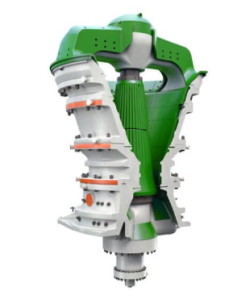
The HP200 uses a laminated eccentric drive layout that spreads crushing load across the frame rather than concentrating it on a single pivot point. Chamber design follows the standard Metso profile, giving predictable particle shape at reduction ratios between 3 to 1 and 5 to 1 depending on liner selection. None of this matters if the cone crusher part in direct contact with feed material has degraded past its metallurgical limit. Wear is not linear. A liner that looks acceptable at year one can lose structural integrity rapidly once the work hardened case layer is breached.
The Wear Components That Decide Uptime
Mantle, concave and bowl liner are cast from high manganese steel conforming to ASTM A128 Grade E-1, roughly 18 percent manganese and 2 percent chromium. As cast hardness sits around 200 to 230 HB. Under repeated impact loading the surface work hardens to 450 to 550 HB while the core stays tough and crack resistant. Minimum tensile strength for this grade is typically rated near 750 MPa with elongation above 35 percent, which is what allows the part to absorb shock loading without brittle fracture.
| Component | Material | Hardness Range | Typical Wear Life |
|---|---|---|---|
| Mantle | Mn18Cr2 manganese steel | 450 to 550 HB surface | 6 to 10 months |
| Concave | Mn18Cr2 manganese steel | 450 to 550 HB surface | 6 to 10 months |
| Bowl Liner | Cast alloy steel | 280 to 320 HB | 12 to 18 months |

Countershaft and Main Shaft Assembly
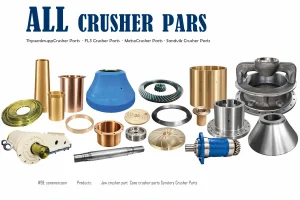
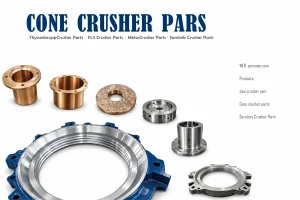
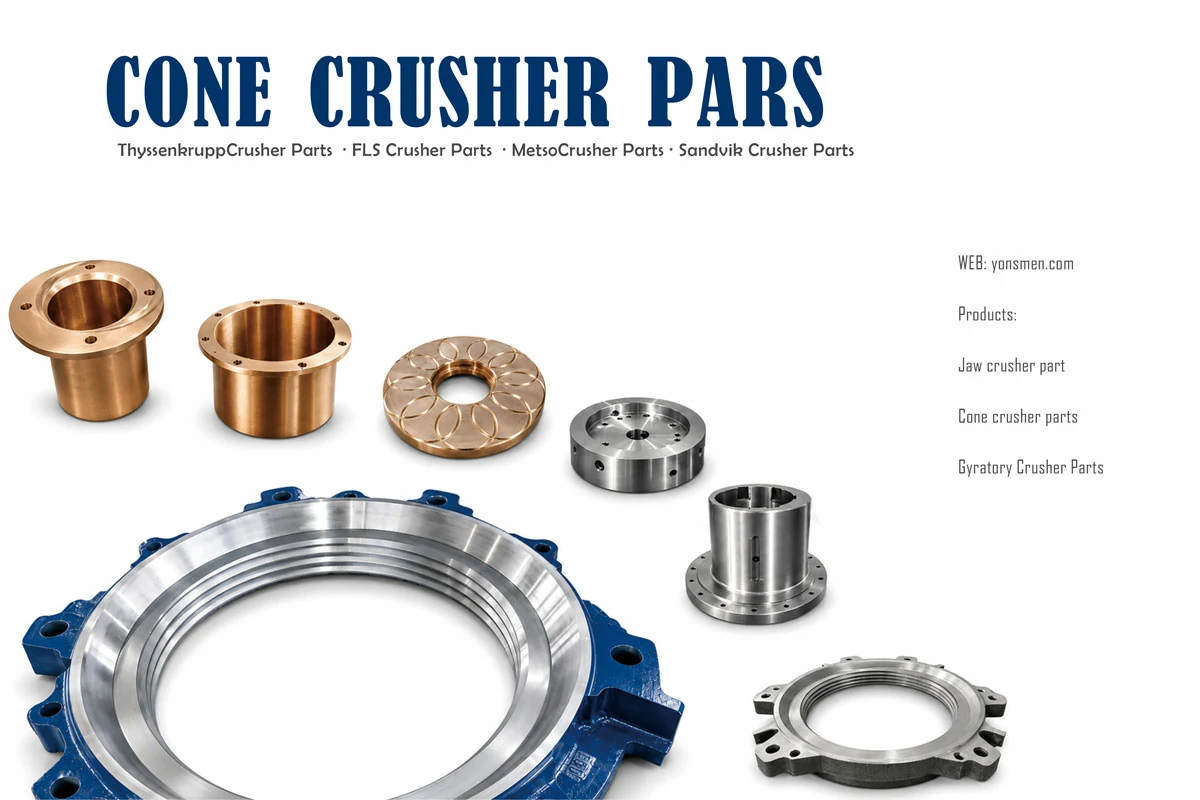
Below the crushing chamber, the Cone crusher countershaft and pinion gear see a different type of stress than the liners. These are forged from alloy steel such as 42CrMo, quenched and tempered to a core hardness of 260 to 300 HB, then ground on the journal surfaces to a roughness of Ra 1.6 micrometers. Straightness tolerance on the main shaft is held within 0.05 millimeters per meter of length. Eccentric bushing radial clearance is checked against a 0.15 to 0.25 millimeter window. Once clearance drifts outside that range, vibration increases and downstream bearings wear faster than the published service interval predicts.
Maintenance Rhythm That Extends Service Life
- Track liner thickness weekly using a fixed gauge point rather than visual estimate
- Rotate the mantle position before uneven wear exceeds 8 millimeters across the profile
- Check backing compound fill gap, typically kept between 3 and 5 millimeters, before each liner change
- Inspect countershaft bushing clearance every 2000 operating hours
- Replace seals and lubrication lines on the interval published in the OEM manual rather than waiting for visible leakage

Field Data After Ten Years
Over the full ten year period, the site logged nine mantle and concave changeouts and three bowl liner replacements. Downtime per liner change averaged under six hours, largely because the crew standardized torque values and backing compound cure time instead of improvising each time. Sourcing a reliable supplier for cone crusher parts also removed a major variable. Castings with inconsistent chemistry or incomplete heat treatment tend to show premature spalling well before the rated hardness range is reached, which throws off the entire maintenance schedule.

What This Case Actually Proves
Ten years of production from a single HP200 is not a metallurgical miracle. It is the result of buying properly specified cone crusher wear part castings, tracking clearances instead of guessing, and treating every cone crusher part replacement as a scheduled task rather than an emergency response. Machines built to this platform have the mechanical headroom to run this long. Whether they actually do comes down to how closely the wear budget is managed, one liner and one cone crusher wear part at a time.