A catastrophic failure of a 600mm diameter forged main shaft in a high-capacity FLSmidth jaw crusher often initiates at a microscopic level, typically at a fillet radius or a keyway where stress concentration exceeds 180MPa. When a main shaft snaps during primary crushing, the immediate result is not just the loss of the component, but a potential $250,000 unplanned shutdown encompassing lost production, crane rentals, and secondary damage to the pitman and bearings. These failures are rarely the result of a single overload event; they are the cumulative consequence of improper forging reduction ratios, inadequate quenching cycles, or residual stresses left behind by non-stabilized CNC machining processes.
Engineering a replacement main shaft for heavy-duty jaw crusher models requires more than just dimensional replication. It demands a rigorous adherence to metallurgical standards that prioritize fracture toughness and fatigue resistance. While some aftermarket suppliers may use basic carbon steel or inferior casting methods to reduce costs, a reliable forged main shaft must utilize high-tensile alloy steel such as 42CrMo4 (AISI 4140) or 34CrNiMo6 to handle the massive eccentric loads and cyclic vibration inherent in aggregate and mining operations.
Material Science: The Transition from 42CrMo4 Ingots to High-Strength Forgings
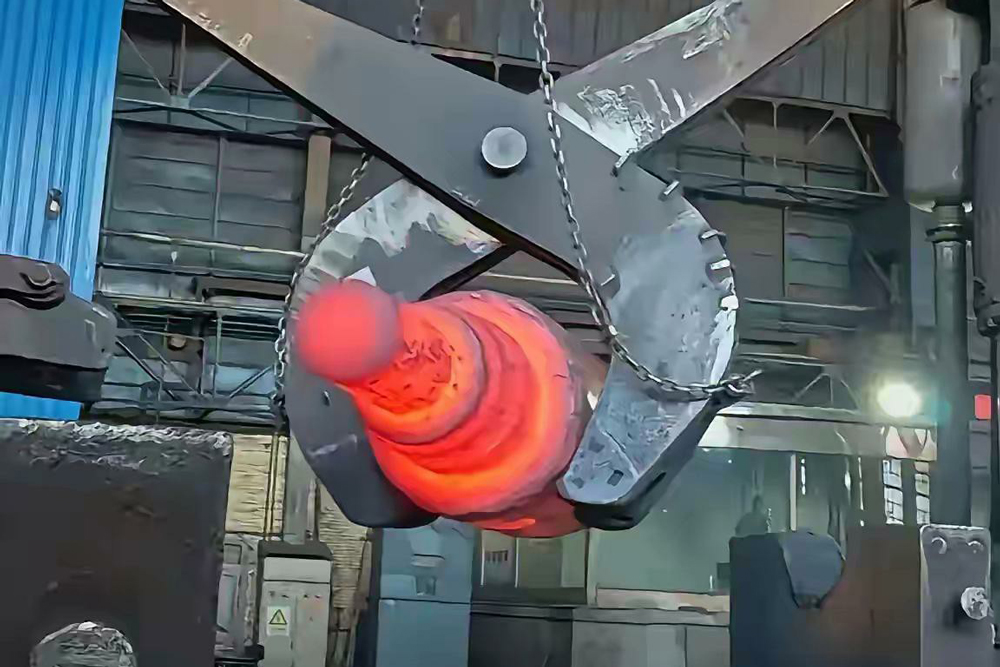
The journey of a high-performance jaw crusher spare part begins in the melt shop. For a main shaft capable of supporting the eccentric movement of a heavy pitman, 42CrMo4 alloy steel is the preferred medium. This material is chosen for its excellent hardenability and high fatigue strength. However, the raw chemistry is only the foundation. The forging process must achieve a minimum reduction ratio of 3.5:1 to ensure that the as-cast dendritic structure of the ingot is completely broken down and replaced by a refined, directional grain flow that follows the contours of the shaft.
| Element / Property | Target Specification (42CrMo4) | Impact on Performance |
|---|---|---|
| Carbon (C) Content | 0.38% – 0.45% | Balances hardness and weldability for potential repair. |
| Chromium (Cr) Content | 0.90% – 1.20% | Increases hardenability and wear resistance of bearing seats. |
| Molybdenum (Mo) Content | 0.15% – 0.30% | Prevents temper brittleness and enhances creep resistance. |
| Hardness after Q&T | 280 – 320 HBW | Optimizes the ratio between yield strength and ductility. |
| Yield Strength (Re) | ≥ 650 MPa | Ensures the shaft does not undergo plastic deformation under load. |
Critical Thermal Processing: The Necessity of Quenching and Tempering
The most vital stage in manufacturing any jaw crusher part subjected to dynamic stress is the heat treatment cycle. Without a controlled Quench and Temper (Q&T) process, the steel remains in a soft, pearlitic state, which is susceptible to rapid crack propagation. The forging is heated to an austenitizing temperature (typically 840°C to 880°C) and then rapidly cooled in a polymer or oil bath. This rapid cooling transforms the austenite into a hard, needle-like martensitic structure.
However, as-quenched martensite is too brittle for the high-impact environment of a jaw crusher. To achieve the required toughness, the shaft must undergo tempering at temperatures between 540°C and 680°C. This specific thermal window allows the carbides to precipitate and redistribute, resulting in tempered martensite. This structure provides the high yield strength necessary to support the eccentric bushing and bearings while maintaining the elasticity required to absorb the 150MPa+ shock loads during the crushing of hard granite or basalt.
Field Case Snippet: I once witnessed a catastrophic $50,000 failure on a primary jaw crusher simply because the site manager opted for a “normalized only” shaft to save 15% on upfront costs. Within 400 operating hours, a fatigue crack initiated at the shoulder of the bearing seat, where the lack of martensitic toughness allowed a micro-fracture to travel through the core of the 42CrMo steel like a lightning bolt.
CNC Machining and Surface Integrity: Achieving Ra ≤ 0.8 μm
Precision machining is where the metallurgical potential of the forging is realized. For a jaw crusher main shaft to interface correctly with high-performance bearings, the dimensional accuracy must be held to an IT6 or IT7 tolerance grade. This typically means a diametrical tolerance of ±0.03mm to ±0.05mm on the main bearing journals. Any deviation beyond these limits will result in an incorrect interference fit, leading to either bearing slippage or excessive heat generation that can ruin the expensive bronze components.
Surface finish is equally critical. The bearing seats must be ground to a surface roughness of Ra ≤ 0.8 μm. A rougher surface acts as a series of microscopic notches, which are perfect sites for stress concentration. During CNC machining, the use of high-stability lathes is mandatory to prevent tool chatter, which can leave waves on the shaft surface. These waves, even if invisible to the naked eye, prevent the 100% surface contact required for an effective oil film, leading to localized galling and eventual shaft seizure.
Detailed Installation Protocol for Optimal Component Alignment
Installing a jaw crusher main shaft is a precision engineering task that should never be rushed. The objective is to achieve a perfect interference fit without inducing mechanical damage to the polished journals. The following steps are recommended for high-load aggregate environments:
- Journal Inspection: Before assembly, verify all dimensions using a calibrated micrometer. Ensure the shaft temperature has stabilized with the ambient environment.
- Cleaning and Degreasing: Use a high-evaporation solvent like acetone to remove all shipping preservatives. Even a thin layer of oil can interfere with the friction requirements of a shrink-fit assembly.
- Thermal Shrinking: Most main shaft bearings require the shaft to be cooled or the bearing to be heated. When using dry ice for shaft cooling, allow sufficient time for the core temperature to drop. For an HP series shaft, this might take 4 to 6 hours.
- Alignment Check: Use a laser alignment tool to verify that the main frame bore and the pitman bore are perfectly concentric. A misalignment of even 0.1mm can double the cyclic stress on the shaft fillets.
- Fastener Torque: Secure all locking plates using a calibrated hydraulic torque wrench. For M36 bolts, a typical torque of 2800 N·m is required to ensure the assembly does not loosen under vibration.
Failure Mode Analysis: Mushrooming, Spalling, and Galling
Understanding why a jaw crusher part fails is essential for continuous improvement. On a main shaft and its associated components, we typically monitor three primary wear and failure modes:
- Galling (Adhesive Wear): This occurs when the oil film between the shaft and the bushing breaks down, causing metal-to-metal contact. The resulting heat welds microscopic particles of the bronze to the steel shaft. This is often caused by using the wrong ISO VG lubricant or a failure in the lubrication pump.
- Spalling (Fatigue Wear): Usually seen on the bearing surfaces, spalling is the result of cyclic subsurface stresses. Small pits form, eventually leading to large flakes of metal detaching. In forged shafts, spalling often points to an inclusion in the steel or an improper quenching depth.
- Mushrooming (Plastic Deformation): While more common in manganese steel jaw plates, mushrooming can occur on shaft shoulders if the material hardness is below 250 HBW and the crusher is subjected to extreme uncrushable tramp material.
Preventive Maintenance through Oil Analysis and NDT
A proactive maintenance strategy for any jaw crusher spare part depends on data, not guesswork. Oil analysis is the “blood test” for your crusher. By monitoring the levels of Copper (Cu), Iron (Fe), and Lead (Pb) in a 100ml oil sample, technicians can detect a failing bushing or a scoring shaft weeks before a breakdown occurs. For example, a sudden spike in Fe levels above 50ppm, combined with an increase in Chromium, is a clear indicator that the quenched surface of the main shaft is being compromised.
Non-Destructive Testing (NDT) should be performed during every major liner change. Magnetic Particle Inspection (MPI) is highly effective for detecting surface-initiated cracks in the fillet areas, while Ultrasonic Testing (UT) can scan the internal volume of the shaft for fatigue cracks that have not yet reached the surface. Investing in a $500 UT scan twice a year can save a $200,000 shaft replacement.
Pro-Tip: When installing a main shaft in a primary jaw crusher, if the ambient temperature exceeds 35°C, extend the cooling time by at least 2 hours. I have seen many engineers struggle with a “stuck” shaft halfway through the bore because the surface expanded faster than they could seat the component during a hot afternoon shift.
Total Cost of Ownership (TCO): Forged vs. Cast Aftermarket Options
The procurement of a jaw crusher part is often driven by the initial purchase price, but the real cost is measured in “Cost Per Ton” of crushed rock. A low-cost cast steel shaft may save $5,000 on the invoice, but its higher porosity and lack of directional grain flow increase the risk of a catastrophic snap by 400% compared to a forged 42CrMo4 shaft.
| Factor | Forged Alloy Steel (OEM Standard) | Low-Cost Cast Aftermarket |
|---|---|---|
| Expected Service Life | 15,000 – 25,000 Hours | 5,000 – 10,000 Hours |
| Fatigue Resistance | Superior (High reduction ratio) | Poor (Potential for internal shrinkage) |
| NDT Pass Rate | > 99.5% | 75% – 85% |
| Total ROI (5-Year View) | High (Minimal downtime) | Low (High risk of secondary damage) |
Conclusion: Precision is the Only Safety Margin
In the high-stress environment of primary crushing, the main shaft is the single most critical load-bearing component. Choosing a jaw crusher part that has been forged with a high reduction ratio, quenched to a precise martensitic structure, and machined to Ra 0.8 μm is not a luxury—it is a requirement for operational stability. By prioritizing metallurgical integrity and rigorous NDT protocols, mining operations can effectively eliminate the risk of shaft fatigue, ensuring that the only thing breaking in the jaw is the rock.
For technical inquiries regarding specific tolerances for FLSmidth compatible main shafts or to request a Material Test Report (MTR) for our current 42CrMo4 inventory, contact our engineering department. We specialize in providing high-confidence solutions for the world’s most demanding crushing circuits.