
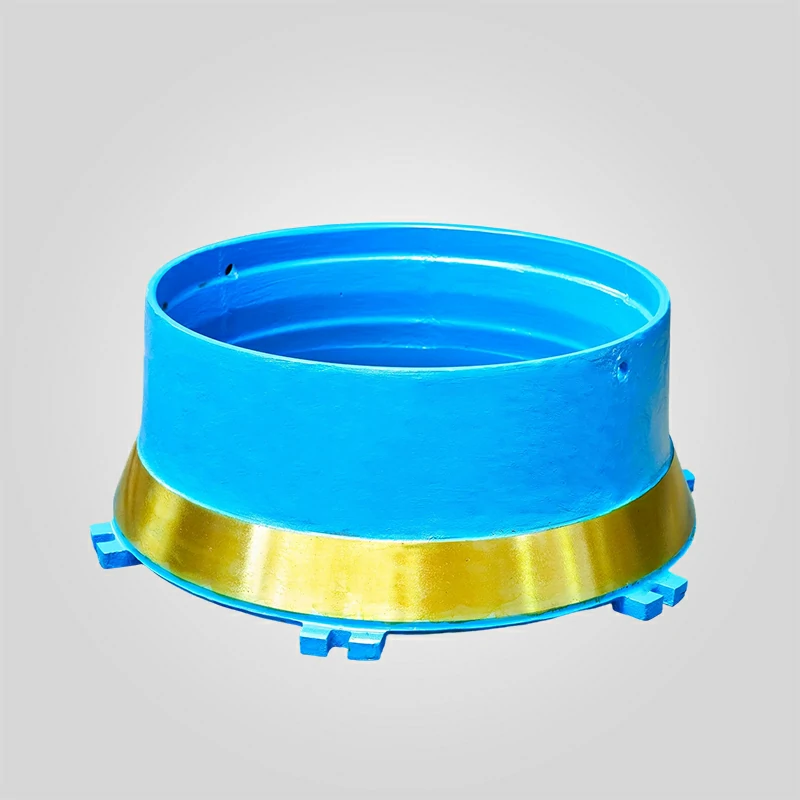
Bowl Liner for Cone Crusher Wear Chamber Replacement
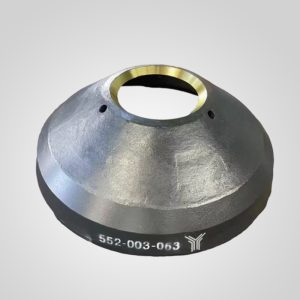
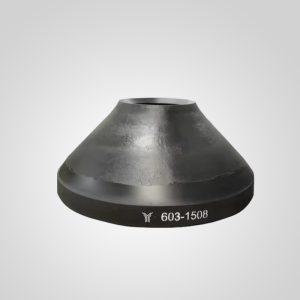
Product Name :Bowl Liner
Application :Cone Crusher Crushing Chamber, Fixed Wear Ring
Material Grade :High Manganese Steel Mn13 or Mn18Cr2 variant
Casting Process :Sand casting with water toughening heat treatment
As Cast Hardness :200 to 230 HB
Work Hardened Surface Hardness :450 to 500 HB
Tensile Strength :approximately 800 MPa
Elongation :35 to 40 percent
A Bowl Liner That Wore Unevenly and Nobody Noticed for Three Weeks
A mid-size aggregate operation running a standard cone crusher started producing an unusual amount of flaky, elongated product on one screen deck while the rest of the gradation looked normal. The maintenance team checked the mantle first since that is the more commonly inspected wear part, found it within tolerance, and moved on. The actual problem was the bowl liner, the stationary wear ring mounted inside the crusher bowl opposite the mantle, which had worn thinner on one side than the other due to a slightly uneven feed distribution pattern. That asymmetry had been quietly reshaping the crushing cavity for three weeks before anyone thought to measure the liner itself rather than just the mantle.
What the Bowl Liner Actually Does in the Crushing Cycle
Inside a cone crusher, the bowl liner is the fixed wear surface bolted into the upper frame or bowl assembly, working in direct opposition to the moving mantle mounted on the main shaft. Together these two components form the crushing cavity, and every reduction of rock passing through that cavity removes a small layer of material from both surfaces. Because the bowl liner is stationary, its wear pattern is driven almost entirely by feed distribution across the chamber, which is why uneven feeding, off-center distributor plates, or worn feed cones tend to show up first as asymmetric wear on the bowl liner rather than the mantle.
Material and Casting Specification
The bowl liner shown here is cast from austenitic manganese steel, the same base alloy family used across most cone crusher wear parts, selected for its ability to work harden under repeated impact rather than fracture under sustained loading. As cast, the material typically measures 200 to 230 HB, then work hardens at the exposed crushing face to a range of 450 to 500 HB once it has absorbed sufficient impact cycles in service.
| Item | Specification |
|---|---|
| Product Name | Bowl Liner |
| Application | Cone Crusher Crushing Chamber, Fixed Wear Ring |
| Material Grade | High Manganese Steel Mn13 or Mn18Cr2 variant |
| Casting Process | Sand casting with water toughening heat treatment |
| As Cast Hardness | 200 to 230 HB |
| Work Hardened Surface Hardness | 450 to 500 HB |
| Tensile Strength | approximately 800 MPa |
| Elongation | 35 to 40 percent |
| Mounting Style | Bolted flange with locking lugs, bottom slotted for bowl assembly bolts |
| Surface Coating | Anti-rust protective paint for transport and storage |
| Machining Tolerance | Seating diameter held within 0.5 mm of design dimension |
| Minimum Wear Limit | Wall thickness at crushing face should not fall below approximately one third of new casting dimension |
| Recommended Duty | Medium to hard rock, compressive strength up to 300 MPa |
| Inspection | Shot blasting and visual dimensional check prior to shipment |
| Packaging | Wooden crate or steel pallet, export grade |
Why Bowl Liner Wear Is Harder to Catch Than Mantle Wear
Because the bowl liner sits fixed inside the bowl assembly rather than rotating with the eccentric motion, its wear symptoms tend to be less obvious on a power meter than mantle wear. A worn mantle often shows up quickly as a change in amperage draw, while a worn bowl liner more often shows up first as a shift in product shape or gradation on one side of the discharge conveyor, exactly as happened in the case above. Technicians who only track amperage and closed side setting without physically inspecting the bowl liner can miss this failure mode for weeks.
Fitment and Locking Detail
The bottom flange of this casting carries a slotted lug pattern designed to seat into matching recesses in the bowl assembly, preventing the liner from rotating under load once the locking bolts are torqued down. Correct seating here matters as much as the crushing face condition, since a liner that is not fully indexed into its locking slots can shift slightly during operation, opening an uneven gap against the mantle on one side of the chamber.
Field Note From Bowl Liner Inspections
I make a habit of pulling the bowl liner for a visual check any time gradation drifts even slightly toward one side of the screen deck, rather than assuming the mantle is always the first suspect. In more than one case across different sites, the bowl liner had worn into an oval rather than a true circle, something that is easy to miss with a quick glance but obvious once you run a tape measure across two perpendicular diameters. That five minute check has saved more than one crew from chasing a phantom feed problem that was actually sitting in the crushing chamber the whole time.
Maintenance Recommendations
- Measure bowl liner wall thickness at multiple points around the circumference, not just at a single reference mark, to catch asymmetric wear early
- Confirm the locking lugs are fully seated in their recesses before torquing bolts, since a partially seated liner can shift under load
- Check feed distributor alignment whenever bowl liner wear is uneven, since off-center feeding is a common root cause
- Track wear rate alongside mantle wear rate rather than in isolation, since the two components should generally wear at a comparable pace under balanced feed conditions
Frequently Asked Questions
Is this bowl liner interchangeable across different cone crusher models
Bowl liners are cast to match a specific crusher frame and cavity profile, so fitment should be confirmed against the crusher model and bowl assembly dimensions before ordering, since mounting flange diameter and lug spacing vary between models.
Should the bowl liner and mantle be replaced together
Replacing both wear parts together is generally recommended once either component approaches its wear limit, since a new mantle paired with a significantly worn bowl liner will not maintain the intended crushing cavity geometry.
What causes the blue coating visible on new liner castings
The coating is a protective anti-rust paint applied after shot blasting to prevent surface corrosion during storage and transport, and it is expected to wear off quickly once the liner enters service inside the crushing chamber.
All manufacturer names, part numbers, model numbers, and descriptions are used for reference and identification purposes only, they are owned by the respective machine manufacturer, including but not limited to FLSmidth®, Metso®, thyssenkrupp®, and Sandvik®. All parts supplied are manufactured and warranted by yonsmen and are not manufactured by or purchased from the Original Equipment Manufacturer. yonsmen has no association with the OEM and does not intend to give this impression.
Reviews
There are no reviews yet.