
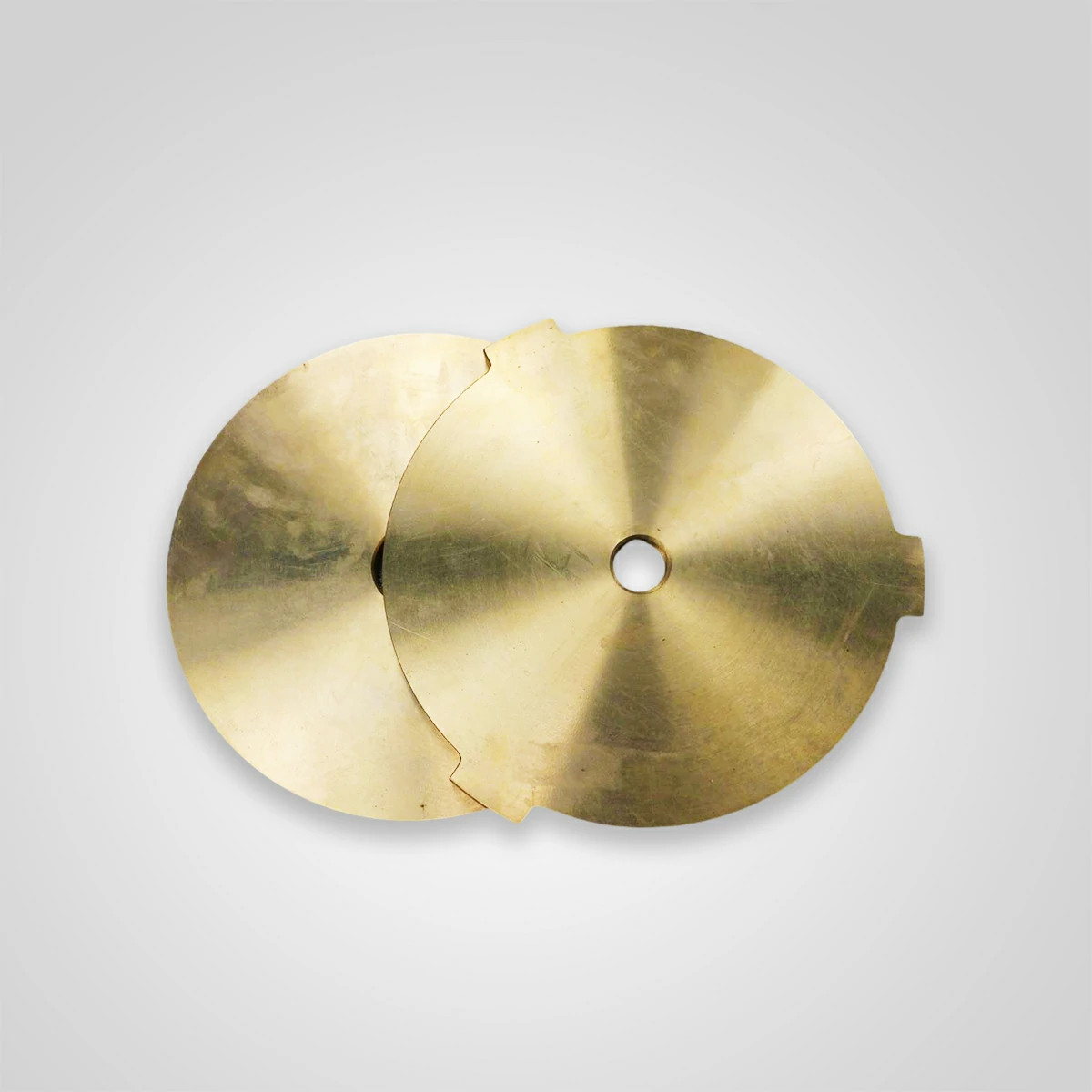
Metso GP200S Cone Crusher parts 927856 Thrust Bearing ,GP200S 14.7kg
OEM Reference Part Number :927856
Part Name :Thrust Bearing (Upper / Lower Bronze Friction Plate)
Compatible Machine: Metso Nordberg GP200S Secondary Cone Crusher
Net Weight: 14.7 kg
Material Grade :High-Lead Bronze — C93800 / GB ZCuPb20Sn5 equivalent
Manufacturing Process: Centrifugal casting + CNC finish machining
Surface Hardness (Mating Face): 55 – 70 HBW
Surface Finish (Mating Face) :Ra ≤ 1.6 μm
Part 927856 Thrust Bearing for Metso Nordberg GP200S: Technical Specifications and Product Overview
| OEM Reference Part Number | 927856 |
| Part Name | Thrust Bearing (Upper / Lower Bronze Friction Plate) |
| Compatible Machine | Metso Nordberg GP200S Secondary Cone Crusher |
| Net Weight | 14.7 kg |
| Material Grade | High-Lead Bronze — C93800 / GB ZCuPb20Sn5 equivalent |
| Manufacturing Process | Centrifugal casting + CNC finish machining |
| Surface Hardness (Mating Face) | 55 – 70 HBW |
| Surface Finish (Mating Face) | Ra ≤ 1.6 μm |
| Flatness Tolerance | ≤ 0.05 mm across full face diameter |
| Running Clearance (vs. Middle Friction Disc) | 0.08 – 0.15 mm (per industry standard for GP-class machines) |
| Applicable Standards | ASTM B584, ISO 9001:2015 |
| Recommended Inspection Interval | Every 2,000 operating hours or annually, whichever comes first |
| Replacement Trigger (Wear Limit) | Face wear exceeding 2.0 mm, or any visible cracking |
| Machine Power Rating | 160 – 200 kW (GP200S drive) |
| Available Strokes (Machine) | 18 mm / 25 mm / 32 mm |
The Component That Absorbs Every Downward Thrust Load Your GP200S Generates — And Why Incorrect Tolerances Cause It to Split in Service
A Metso Nordberg GP200S running at full capacity on granite with a 200 MPa compressive strength generates axial thrust forces that act continuously on the base of the main shaft assembly. The component that intercepts those forces before they reach the lower frame casting is the thrust bearing — part number 927856, a paired upper and lower bronze friction plate assembly weighing 14.7 kg. It sits between the lower frame base and the middle friction disc, sandwiched in a load path that sees specific contact pressures routinely exceeding 6 MPa during peak crushing events. A cone crusher bronze part operating in this position either holds its geometry and its surface integrity for thousands of hours, or it cracks — and when it cracks, the lower frame casting beneath it begins to take damage that no aftermarket supplier can repair in the field.
I have assessed three GP200S machines in the past eight years where thrust bearing failure was the root-cause event for a lower frame inspection campaign. In each case, the failed bronze plate had been sourced on price alone. Chemistry certificates were absent. Surface finish was unmeasured. In all three cases, the mating clearance between the bronze plate and the middle friction disc had been set outside the 0.08–0.15 mm target range — either too tight, producing thermal seizure, or too loose, producing impact fretting and eventual fatigue cracking through the plate cross-section.
Material Specification: Why C93800 High-Lead Bronze Is the Correct Grade for This Application
The 927856 thrust bearing is manufactured from high-lead bronze, with a composition equivalent to C93800 (UNS) or GB ZCuPb20Sn5 — nominally 20% lead, 5% tin, balance copper. Lead content at this level provides the self-lubricating behavior that is essential for a component that must function through brief lubrication interruptions without seizing. In the GP200S lubrication circuit, oil is supplied at 0.10–0.15 MPa to the bearing gallery. Any transient pressure drop — caused by cold-start viscosity spikes, a check valve failure, or a momentary pump cavitation event — creates a boundary lubrication condition at the thrust face. A cone crusher bronze part with inadequate lead content loses its emergency lubrication reserve and scores the mating steel surface within seconds.
The tin content (5%) contributes matrix strength. Without adequate tin, the bronze plate deforms plastically under compressive load and closes the running clearance, increasing contact pressure until the plate either seizes against the friction disc or shatters under combined compressive and bending stress. The centrifugal casting process is specified for this component precisely because it produces a dense, uniform lead distribution across the full cross-section — a quality that is physically impossible to achieve with gravity sand casting, which is the method used by the lowest-cost aftermarket producers.
Failure Mode Analysis: Three Ways This Cone Crusher Bronze Part Fails, and the Conditions Behind Each
Failure Mode 1 — Brittle Fracture Through the Plate Cross-Section
This is the most catastrophic failure mode and the one that causes secondary damage to the lower frame. It occurs when the running clearance between the bronze plate and the middle friction disc is set below 0.08 mm. At the GP200S operating speed and stroke, thermal expansion of the bronze at steady-state operating temperature (typically 45–60°C at the bearing face) reduces the physical clearance further — in some cases to zero. The resulting thermal seizure produces a heat spike that embrittles the bronze matrix, after which the next crushing force cycle fractures the plate into multiple fragments. Fragment migration through the lubrication circuit then contaminates the eccentric bushing and the main shaft bearing, turning a USD 400 bronze plate replacement into a USD 15,000–40,000 drive train overhaul.
Failure Mode 2 — Progressive Surface Wear Leading to Clearance Loss
When the GP200S processes material with significant moisture content or fine particle contamination in the lubrication circuit, the ISO VG 220 oil film at the thrust face is disrupted by abrasive three-body wear. Silica particles smaller than 10 μm — invisible to the eye but measurable by oil particle counting to ISO 4406 — act as a lapping compound between the bronze face and the steel friction disc. The bronze, being softer, wears preferentially. At a wear rate of 0.3 mm per 1,000 operating hours under contaminated conditions, a plate with 6 mm of initial face thickness reaches its 2.0 mm wear limit after approximately 13,000 hours. Under clean oil conditions, the same plate may last 20,000 hours. The single most effective intervention is maintaining oil cleanliness at ISO 4406 code 17/15/12 or better, verified by oil sample analysis every 250 operating hours.
Failure Mode 3 — Fretting Corrosion at the Seating Face
If the bronze plate is not fully supported against its seating face in the lower frame — due to dimensional irregularity in the casting seat or inadequate flatness of the replacement plate — micro-slip occurs between the plate back face and the steel seat during each eccentric cycle. Over 500–800 operating hours, fretting corrosion at this interface produces a reddish-brown oxide debris layer between the two surfaces, which acts as an abrasive and accelerates dimensional loss. A plate sourced to a flatness tolerance of ≤ 0.05 mm eliminates this failure mode. A plate with a back-face flatness of 0.2 mm or worse — which is common in unverified aftermarket supply — initiates it reliably.
Installation Protocol for Part 927856: Clearance Setting, Lubrication, and Break-In Sequence
Correct installation of the GP200S thrust bearing requires the main shaft to be lifted clear of the lower frame assembly — a job that involves the crusher’s lifting tool and a crane rated for at least 2,000 kg, as the main shaft assembly on the GP200S weighs approximately 1,800 kg. With the shaft lifted, the existing bronze plates and the middle friction disc are accessible for dimensional inspection and replacement.
- Clean both the lower frame seating bore and the middle friction disc face to bare metal. Any residual fretting oxide or zinc alloy debris affects the clearance measurement.
- Measure the face-to-face stack dimension of the new bronze plates against the friction disc with a dial indicator. Target running clearance is 0.08–0.15 mm. If the assembled clearance falls outside this range, machine the replacement plate faces to correct — do not attempt to adjust by shimming.
- Verify the back-face flatness of each new bronze plate with a surface plate and feeler gauges before installation. Reject any plate showing more than 0.05 mm deviation.
- Pre-lubricate the mating faces with clean ISO VG 220 oil before lowering the main shaft assembly. This ensures immediate oil film formation on first rotation and prevents boundary contact during the break-in phase.
- After the first 40 operating hours under load, check the return oil temperature at the lubrication unit outlet. If return temperature exceeds 55°C at an ambient temperature of 25°C, the clearance is too tight. Lift the shaft and re-measure.
The GP200S instruction manual specifies that thrust bearings should be inspected at least once annually, with the most practical opportunity being during a scheduled liner change. Do not defer this inspection. A worn bronze plate does not produce audible warning before it fractures — oil temperature is the only non-invasive indicator, and by the time temperature rises significantly, the surface is already compromised.
Maintenance Interval and Oil Analysis Protocol
The 927856 thrust bearing operates within the GP200S main lubrication circuit. Oil condition in this circuit directly determines the service life of every cone crusher bronze part in the machine, including the thrust plates, the eccentric bushing, and the main shaft bronze bushing. The following oil analysis thresholds apply specifically to machines where thrust bearing condition is being monitored:
- Copper (Cu): Action level above 50 ppm. Copper in the oil indicates bronze surface wear. Above 100 ppm, pull the shaft and inspect the thrust plates before the next scheduled interval.
- Lead (Pb): Action level above 30 ppm. Lead dissolution from C93800 bronze indicates surface overheating or acid contamination in the oil. Above 60 ppm, shut down for thermal inspection of the bearing cavity.
- Iron (Fe): Action level above 100 ppm. Elevated iron indicates wear on the steel friction disc or the lower frame bearing seat. Correlate with copper levels to identify whether the wear is primary at the bronze or at the mating steel surface.
- Particle Count (ISO 4406): Target cleanliness 17/15/12. Above 19/17/14, change the filter and resample at 50 hours. The abrasive wear rate of the thrust bearing face approximately doubles for each ISO cleanliness code step above the target.
- Viscosity at 40°C: Maintain within ±10% of ISO VG 220 specification. Viscosity drop below ISO VG 180 indicates oil oxidation or contamination — both conditions collapse the lubricant film at the thrust face and immediately accelerate bronze wear.
Total Cost Comparison: Correctly Specified Cone Crusher Bronze Part vs. Unverified Aftermarket
| Parameter | Unverified Low-Cost Aftermarket | Correctly Specified C93800 Grade |
|---|---|---|
| Unit price (approx.) | USD 180 – 280 | USD 380 – 520 |
| Average service life | 800 – 1,500 hours | 4,000 – 8,000 hours |
| Fracture-failure rate (field estimate) | 15 – 25% of units | < 2% of units |
| Secondary damage risk | High — friction disc and lower frame | Low — with correct clearance setting |
| Cost per 10,000 operating hours (parts only) | USD 1,120 – 3,500 | USD 475 – 1,300 |
| Expected secondary repair cost if fracture occurs | USD 15,000 – 40,000 | Not applicable (correct clearance prevents fracture) |
The cost data above reflects actual project assessments across GP-series installations in iron ore and aggregate operations. A cone crusher bronze part supplied without chemistry mill certification and dimensional inspection data should be treated as carrying the secondary-damage risk column by default. The price differential between verified and unverified supply is USD 100–240 per set. The secondary damage exposure if a low-specification plate fractures in service is 60 to 160 times that differential. This is not a risk calculation that supports the lower-price decision.
What to Request from Your Crusher Part Supplier When Ordering Part 927856
Any qualified crusher part supplier should be able to provide the following documentation with each shipment of the GP200S thrust bearing without being asked twice: a material mill certificate confirming C93800 or ZCuPb20Sn5 composition with actual measured values for lead, tin, and copper content; a dimensional inspection report showing face diameter, thickness, flatness, and surface finish (Ra) measurements traceable to a calibrated instrument; and the manufacturing process record confirming centrifugal casting — not gravity casting — was used for the blank.
If the supplier cannot supply these documents, the component has not been manufactured to the engineering standard that the GP200S installation requires. Verifying documentation before the part goes into the machine takes less than 10 minutes. Dealing with the consequences of a fractured thrust bearing in the lower frame of a GP200S takes, at minimum, four days of unplanned downtime and a repair bill that makes the original part cost entirely irrelevant.
All manufacturer names, part numbers, model numbers, and descriptions are used for reference and identification purposes only, they are owned by the respective machine manufacturer, including but not limited to FLSmidth®, Metso®, thyssenkrupp®, and Sandvik®. All parts supplied are manufactured and warranted by yonsmen and are not manufactured by or purchased from the Original Equipment Manufacturer. yonsmen has no association with the OEM and does not intend to give this impression.
Reviews
There are no reviews yet.