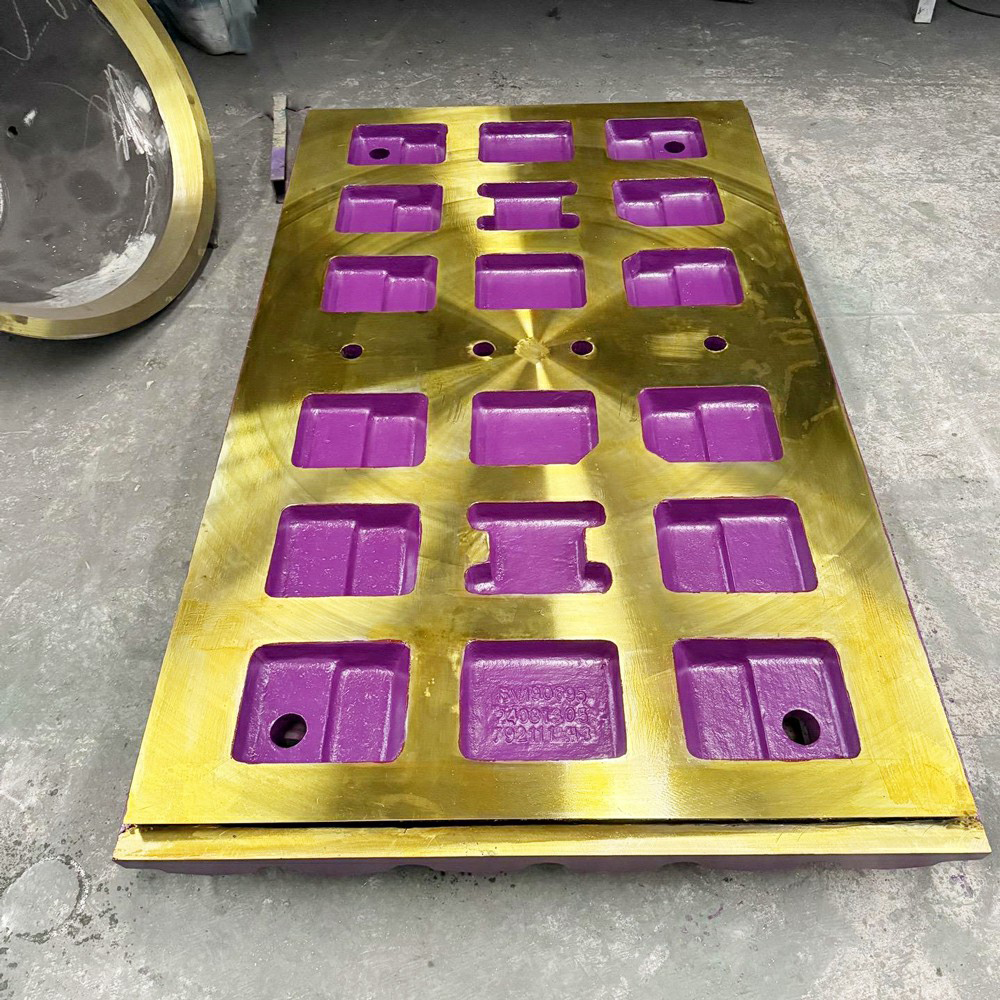
Replacing a jaw crusher plate on a mobile unit like the EB 12-10 requires more than just a dimensional match; it demands a metallurgical profile capable of sustaining cyclic loading without premature fracture. For this custom 1.2-meter class mobile jaw, the transition from standard OEM manganese to optimized Mn18Cr2 is the primary factor in extending mean time between replacements (MTBR) in abrasive basalt
For this customization, we bypassed the standard Mn13 (ASTM A128 Grade A) typically found in stock inventories. We utilized Mn18Cr2 (ASTM A128 Grade C equivalent) to handle the specific abrasive index of the customer’s feed material. The addition of 2% Chromium significantly improves the yield strength, preventing the “peening” effect where the manganese flows and locks the plate into the crusher frame, making removal impossible.
| Property | Standard OEM (Mn13) | Custom EB 12-10 (Mn18Cr2) | Field Consequence |
|---|---|---|---|
| Manganese Content | 11.0% – 14.0% | 17.0% – 19.0% | Higher work-hardening ceiling (>550 HBW). |
| Chromium Content | < 1.5% | 1.8% – 2.2% | Prevents plastic deformation/mushrooming. |
| Heat Treatment | Water Quench 980°C | Water Quench 1050°C | Ensures complete carbide dissolution for max toughness. |
| Flatness Tolerance | ± 2.0mm | ± 0.5mm | Essential for mobile unit stability. |
Installation SOP: EB 12-10 Mobile Jaw Plate
The following Standard Operating Procedure (SOP) is critical. Mobile crushers rely on the friction fit between the plate and the frame. Any gap >0.5mm allows the plate to “walk,” shearing the retention wedges.
Step 1: Surface Preparation & Verification
- Strip the Frame: Remove all traces of old backing compound or debris from the pitman face. Use a needle scaler to achieve a bare metal finish.
- Check Linearity: Place a straight edge along the back of the new EB 12-10 jaw crusher mobile jaw plate. The gap must not exceed 0.5mm at any point. If the casting is warped, reject it immediately. Installing a warped plate on a mobile unit will crack the pitman.
Step 2: Wedge and Cheek Plate Alignment
- Cheek Plate Inspection: Before seating the jaw die, measure the cheek plates. If they are worn more than 40%, they will not support the jaw die laterally. This lack of side constraint causes the jaw plate to shift horizontally during crushing strokes.
- Wedge Torque: Tighten the clamping wedges to the OEM specified torque (typically \~450-500 Nm for this size class, but verify against the specific EB 12-10 manual). Do not impact wrench to failure.
Step 3: The “Soft” Tightening Run
- Run the crusher empty for 15 minutes.
- Re-torque immediately: Manganese steel relaxes slightly as it settles. You will likely get another 1/4 to 1/2 turn on the wedge bolts. Failure to do this “hot torque” is the \#1 cause of loose plates.
Field Case Snippet (Failure Analysis): “I once inspected a failed jawstock on a mobile unit where the maintenance crew skipped the’hot torque’ step. The plate vibrated loose, hammered the toe of the pitman for three shifts, and eventually cracked the $45,000 casting. The cost wasn’t just the jawstock—it was the 3 weeks of production lost while waiting for a replacement.”
Wear Profile Customization
This custom order features a modified tooth profile. Unlike the standard “corrugated” profile, we applied a heavy-duty “Super Tooth” design. This increases the total weight of the plate by approximately 8%. This added mass acts as a flywheel, helping the mobile unit carry momentum through peak loads when crushing hard river stone or granite, reducing engine stall frequency.