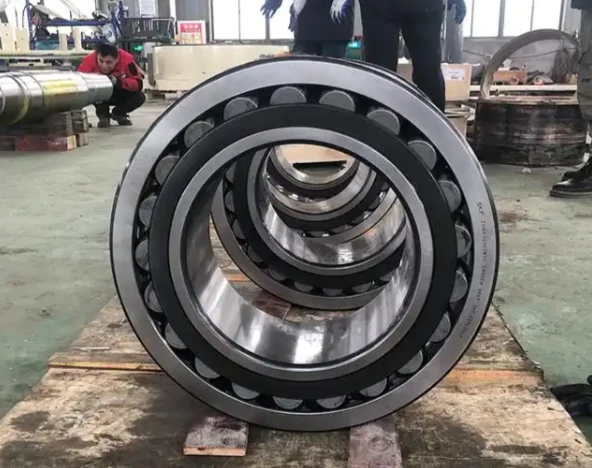
Metallurgical Realities: Why 100Cr6 Steel and Brass Cages Matter
A standard industrial bearing cannot survive in a pitman assembly. A high-performance jaw crusher bearing is manufactured from vacuum-degassed 100Cr6 (ASTM 52100) high-carbon bearing steel. Through precise heat treatment, the raceways and spherical rollers achieve a hardness of 58 to 62 HRC, providing the necessary fatigue resistance to handle cyclic impact loads.
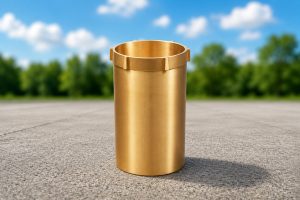
Equally critical is the cage material. Cheap aftermarket bearings often use stamped steel cages. Under the intense vibration of a crushing stroke, stamped steel flexes and micro-fractures. OEM-level bearings utilize machined brass cages (such as CuZn40Pb2). Brass provides a lower coefficient of friction against the steel rollers and possesses superior dampening characteristics, acting as a sacrificial shock absorber during extreme transient loads.
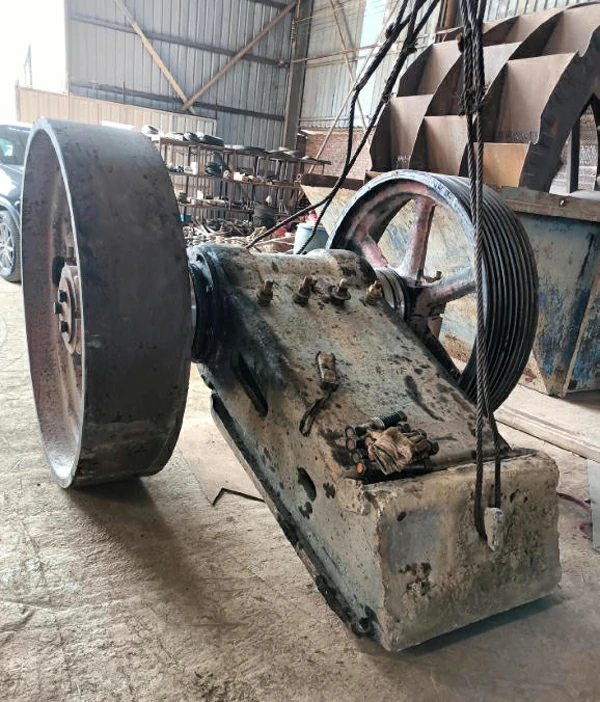
Decoding Failure Modes: Spalling, Galling, and Plastic Deformation
When analyzing a ruined jaw crusher bearing, the raceway surface tells the complete story of its demise. Spalling, or subsurface fatigue flaking, occurs when the Hertzian contact stress between the roller and the raceway exceeds the material’s yield strength, typically over 3000 MPa. This is almost always caused by edge loading due to shaft misalignment or loss of internal clearance.
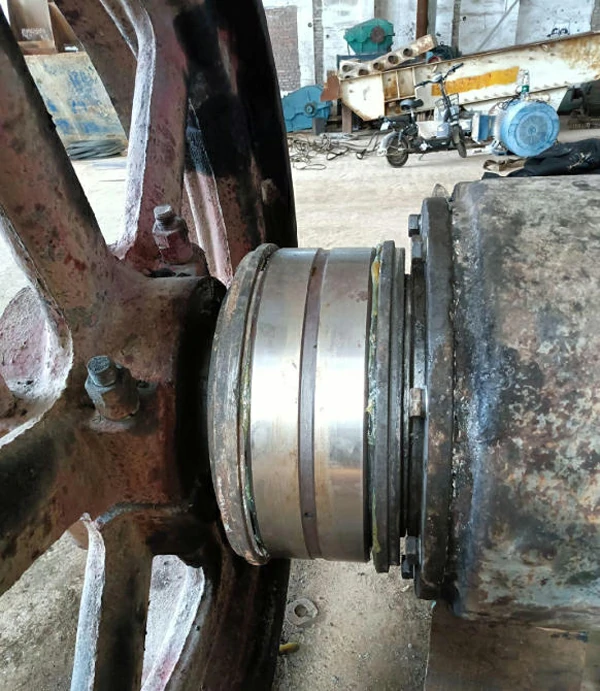
Galling, or smearing, represents a total breakdown of the elastohydrodynamic lubrication (EHL) film. When the oil or grease film thickness drops below 0.1 micrometers, metal-to-metal contact occurs. The friction generates localized microscopic welding, which is immediately torn apart by the bearing rotation, leaving a frosted, smeared appearance on the rollers. If left unchecked, galling rapidly escalates to thermal runaway and complete bearing seizure.
10 Root Causes of Abnormal Temperature Rise
Understanding why a jaw crusher bearing overheats requires analyzing the entire mechanical ecosystem of the crusher.
- Severe Wear and Cage Damage: As a bearing naturally degrades, its internal dimensions change. The clearance between the inner ring, outer ring, and rollers increases. This loss of running accuracy causes intense vibration and noise, rapidly elevating internal friction and temperature, eventually bending the eccentric shaft.
- Inadequate Original Clearance: Jaw crushers generate immense heat. If a bearing with standard C3 clearance is installed instead of the required C4 or C5 radial internal clearance, the thermal expansion of the inner ring will eliminate the free space. The rollers will pinch, causing immediate overheating.
- Axial Positioning Errors: If labyrinth seals or bearing end caps are not installed to exact tolerances, the eccentric shaft can drift axially. This side-to-side movement forcibly reduces the operating clearance, inducing severe thrust loads on bearings designed primarily for radial forces.
- Pitman Bore Coaxiality Errors: If the pitman housing bore is machined with a coaxiality error exceeding allowable limits, the two pitman bearings will not align perfectly. This forces the outer ring to sit at an angle, creating severe edge loading on the rollers and generating massive frictional heat.
- Eccentric Shaft Machining Defects: Similar to the pitman bore, if the shaft journals where the bearings seat have a coaxiality error or runout exceeding 0.05 mm, the inner rings will wobble. This geometrically chokes the bearing clearance during every rotation.
- Adapter Sleeve Slippage: Many jaw bearings are mounted on tapered journals using adapter sleeves. If the lock nut loses torque, the sleeve can move axially, instantly causing a loss of interference fit and internal clearance.
- Lubrication Failures: Blocked grease ports, dry operation, or ironically, over-greasing, are primary culprits. If grease fills more than 30 percent of the housing void, the rollers must constantly plow through the dense lubricant. This churning action generates immense heat that the cast iron housing cannot dissipate quickly enough.
- Housing Tolerance and Finish: The bearing housing bore must meet strict ISO tolerances (typically H7 or G7) and maintain a surface roughness of Ra ≤ 1.6 μm. An oversized bore causes the outer ring to spin and fret, while an undersized bore crushes the outer ring, eliminating running clearance.
- Incorrect Lubricant Viscosity: Using a grease with a base oil viscosity that is too low prevents the formation of a protective hydrodynamic film. Conversely, extreme high-viscosity lubricants increase internal molecular friction. A standard requirement is an extreme pressure (EP) grease with a base oil viscosity of ISO VG 220 or 320 at 40 degrees Celsius.
- Non-Bearing Friction Sources: Often, the temperature spike is misdiagnosed. If the pitman labyrinth seal rubs against the end cover, or if the frame bearing housing’s double-insert cover rotates with the main shaft, the resulting frictional heat transfers directly into the bearing zone.

[Option C: Field Case Snippet] During a shutdown at a basalt quarry in 2024, an operator complained of chronic overheating on the drive-side frame bearing of a 1200×1500 jaw crusher. They had replaced the bearing twice in three months. I brought out my dial indicators and feeler gauges. The problem wasn’t the bearing; it was the adapter sleeve. The previous maintenance crew had reused a stretched lock washer. Under heavy load, the lock nut backed off by just 2 millimeters. That tiny axial slip on the tapered shaft expanded the inner ring, dropping the operational clearance to zero. We replaced the sleeve, torqued the nut precisely using the drive-up method, and the temperature never exceeded 65 degrees Celsius again.
Precision Installation: The Drive-Up Method
Installing a jaw crusher bearing using a sledgehammer and a brass drift is a guaranteed path to premature failure. The inner ring must be driven up the tapered shaft (or adapter sleeve) to achieve a precise interference fit, which mathematically reduces the internal radial clearance.
You must measure the unmounted radial clearance using long feeler gauges before installation. For a large spherical roller bearing, this might be 0.250 mm. Using a hydraulic nut, drive the bearing up the taper until the clearance is reduced by the manufacturer’s specified amount (e.g., a reduction of 0.110 mm). The final mounted clearance must be verified across both rows of rollers to ensure the inner ring has not seated unevenly. The locking nut is then secured using the required torque parameters.
Predictive Maintenance via Oil and Grease Analysis
Waiting for a temperature alarm is a reactive strategy. Implementing a routine spectrometric analysis of the bearing grease provides a microscopic window into the component’s health. By taking samples every 500 operating hours, you can track metallic wear debris.
An elevated copper concentration (above 40 ppm) specifically indicates severe wear of the machined brass cage, pointing towards heavy vibration or starved lubrication. A sudden spike in iron or chromium levels signifies raceway or roller spalling. Tracking the Particle Quantifier (PQ) index alongside the elemental analysis allows maintenance planners to schedule bearing replacements during planned shutdowns rather than suffering catastrophic mid-shift failures.
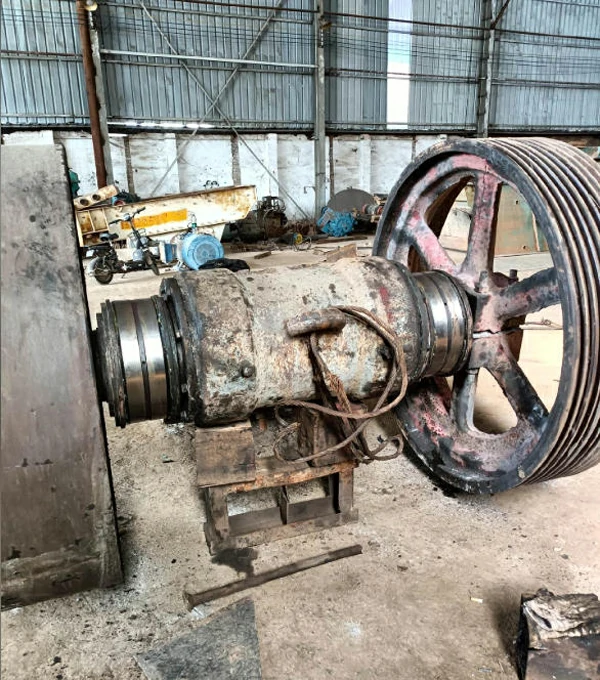
Total Cost of Ownership (TCO): Premium vs. Economy
Purchasing departments frequently opt for low-cost aftermarket bearings to save capital. A full lifecycle analysis proves this is a mathematically flawed strategy.
Consider an economy spherical roller bearing priced at $4,500. In a hard rock application, it survives for roughly 1,200 hours before thermal degradation requires replacement. A premium, OEM-standard bearing costs $11,500 but utilizes cleaner 100Cr6 steel, superior brass cages, and optimized roller profiling, allowing it to easily surpass 4,000 hours of service.
Every bearing change requires approximately $4,000 in specialized labor and crane time, plus an average of $30,000 in lost production downtime. Over a 4,000-hour production year, the economy bearing requires three replacements. The total cost equals $13,500 for parts, plus $102,000 for labor and downtime, totaling $115,500. The premium bearing requires zero mid-year replacements. Its total cost remains $11,500 plus the initial $34,000 installation footprint, totaling $45,500. The premium bearing yields an annual saving of $70,000 per bearing location.
| Engineering Parameter | OEM Standard Specification |
| Bearing Material Grade | 100Cr6 (ASTM 52100) |
| Raceway Hardness | 58 – 62 HRC |
| Radial Internal Clearance | C4 or C5 (Application Dependent) |
| Cage Material | Machined Brass (CuZn40Pb2) |
| Housing Bore Surface Roughness | Ra ≤ 1.6 μm |
| Journal Surface Roughness | Ra ≤ 0.4 μm |
| Base Oil Viscosity Requirement | ISO VG 220 to 320 (@ 40°C) |
| Typical Operating Temperature Limit | 85°C to 95°C (Alarm Threshold) |
Frequently Asked Questions
How much grease should I add to the bearing housing during routine maintenance?
Over-greasing is a leading cause of abnormal bearing temperature rise. Unlike a gearbox, a bearing housing should never be completely full of lubricant. When packing a newly installed bearing, the free space inside the bearing itself should be filled to 100 percent, but the free space within the surrounding cast iron housing should only be filled to 30 to 40 percent capacity. During routine weekly maintenance, strictly follow the manufacturer’s relubrication quantity formula, which is typically calculated based on the bearing’s outside diameter and width (e.g., Q = 0.005 x D x B). Adding 15 to 20 grams of fresh EP grease through the zerk fitting while the crusher is slowly rotating is generally sufficient to purge old oil and replenish the hydrodynamic film without causing thermal churning.