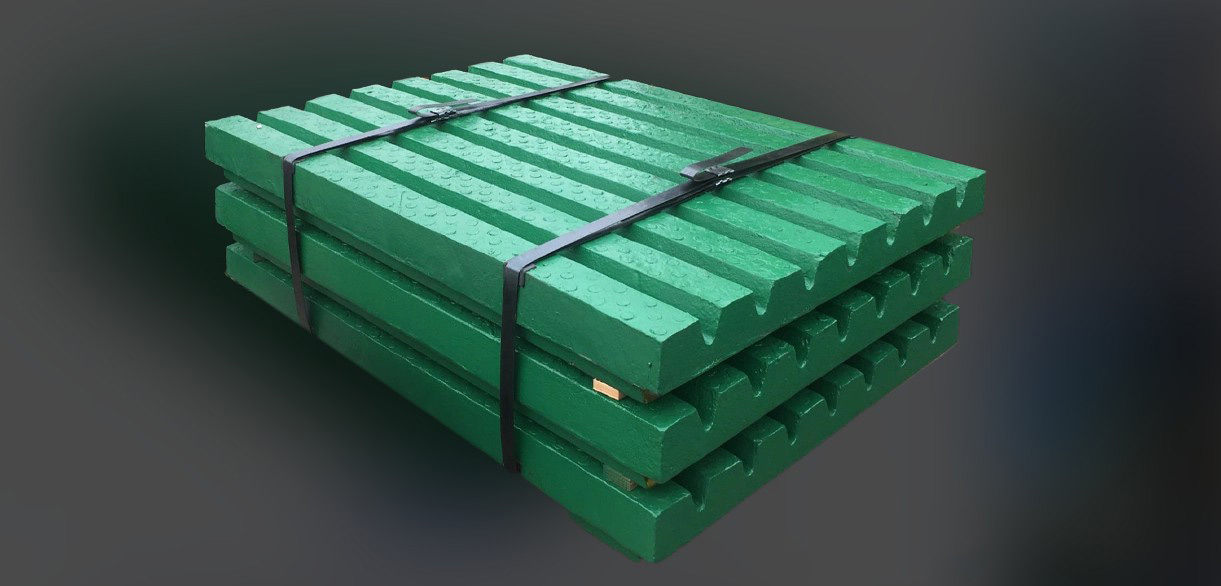
A 400-tonne-per-hour granite crushing plant running Metso C130 jaw crushers faces a specific and recurring problem. The Bond Work Index of the feed material sits above 18 kWh per short ton, and the silica content exceeds 65 percent. Standard Mn18Cr2 swing jaw plates last between 280 and 340 operating hours before the tooth profile wears flat and product gradation falls outside specification. At two liner changes per month and a direct material cost of approximately USD 7,800 per change cycle, the annual wear-part expenditure for a single crusher exceeds USD 180,000. This is the industrial context that drove the development of tungsten carbide insert casting as a practical solution — not a laboratory exercise, but a response to an economic pressure that standard austenitic manganese steel cannot resolve through alloy chemistry alone.
Why Standard Manganese Steel Reaches Its Limit in High-Abrasion Feed
Mn18Cr2 austenitic manganese steel performs through work hardening. Under compressive and impact loading, the initially soft austenitic matrix — sitting at HB 180 to HB 220 as cast — transforms its surface zone progressively toward HB 480 to HB 550 as the crusher processes material. This mechanism is highly effective in applications where impact energy is sufficient to drive the hardening reaction continuously across the full crushing face.
The failure mode in high-silica, high-abrasion feed is different. When the abrasion rate exceeds the rate at which the work-hardening layer can regenerate, micro-cutting and micro-fatigue remove material faster than the metallurgical transformation can compensate. The result is accelerated wear in the tooth root zones of the jaw plate, loss of tooth profile geometry, and — in extreme cases — thermal softening of the near-surface matrix from frictional heating. No adjustment to manganese or chromium content within the ASTM A128 specification window solves this problem at its root. A structural solution is required, which is precisely what carbide pin embedded casting provides.
The Tungsten Carbide Insert Casting Process
The process is not a surface treatment or a post-cast welding operation. It is a foundry-stage integration of two fundamentally different materials — a tough, deformable manganese steel matrix and a hard, wear-resistant tungsten carbide phase — into a single composite casting.
Pattern Preparation and Pin Placement
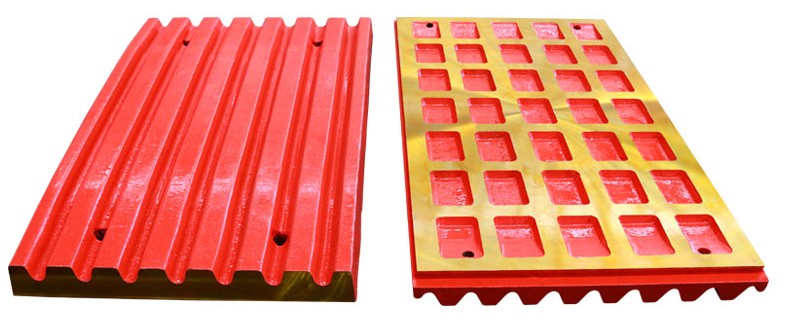
In the lost-foam casting variant of this process, a polystyrene foam pattern of the jaw plate is fabricated to the full geometric specification of the finished liner, including tooth profile. Holes are drilled at defined positions along the tooth flanks and crests — the zones of highest abrasive contact during crushing. Cut sections of YG20 tungsten carbide rod are press-fitted into these holes prior to casting. Pin diameter typically ranges from 8 mm to 20 mm depending on tooth geometry and application severity. Pin spacing is determined by a coverage calculation that balances wear protection area against the risk of stress concentration at the carbide-matrix interface.
In sand casting variants of the tungsten carbide insert casting process, the carbide pins or rods are held in position within the mold cavity using ceramic spacers or wire fixtures before the mold is closed. The geometry of pin placement follows the same zone-prioritization logic — highest density at the tooth tips and flanks, lower density toward the plate back where abrasive loading is minimal.
Carbide Grade Selection — YG20 vs YG8
The selection of carbide grade for pin embedded casting involves a direct trade-off between hardness and toughness. YG8 grade tungsten carbide, containing 8 percent cobalt binder and 92 percent WC by weight, delivers a hardness of HRA 89 to 90 and a transverse rupture strength of approximately 1,500 MPa. Its resistance to abrasive wear is outstanding, but its toughness under impact loading is limited.
YG20, containing 20 percent cobalt binder, sacrifices some abrasion hardness — falling to HRA 85 to 87 — in exchange for a transverse rupture strength of approximately 2,400 to 2,800 MPa and significantly improved resistance to fracture under impact. For jaw crusher applications, where each crushing cycle delivers a combination of compressive force and impact, YG20 is the standard selection. YG8 is reserved for applications where the loading is predominantly abrasive and impact energy is low, such as certain liner positions in vibrating screen decks or grinding mill liners.
The Metallurgical Bond — Why the Composite Holds Together
A common misconception about carbide pin embedded casting is that the bond between the tungsten carbide pin and the manganese steel matrix is purely mechanical — the steel simply shrinks around the pin during cooling and grips it by interference. The reality involves an additional metallurgical dimension that is critical to the long-term integrity of the composite.
During the casting pour, liquid Mn18Cr2 at approximately 1,420 to 1,480 °C contacts the solid carbide pins. A thin diffusion zone forms at the interface as tungsten and carbon migrate into the surrounding steel melt and iron and manganese diffuse into the near-surface layer of the carbide. This diffusion layer, typically 5 to 30 micrometers thick depending on contact time and temperature, creates a gradual compositional transition rather than an abrupt boundary between two incompatible materials. The result is a bond that resists both shear loading — which would push the pin out tangentially during abrasive wear — and tensile loading — which would pull it out radially under impact.
The thermal expansion mismatch between the two materials also contributes to retention. WC-Co alloys expand at approximately 5.5 to 6.0 × 10⁻⁶ per degree Celsius. Mn18Cr2 expands at approximately 18 × 10⁻⁶ per degree Celsius. During cooling from casting temperature, the manganese steel contracts more than the carbide, placing the pin under compressive prestress from the surrounding matrix. This residual compression reinforces the mechanical grip and counteracts the tensile stresses generated at the interface during impact loading in service.
Technical Parameter Comparison — Standard Mn18Cr2 vs WC Reinforced Composite Liner
| Parameter | Standard Mn18Cr2 Jaw Plate | WC Reinforced Manganese Steel Liner (YG20 Insert) |
|---|---|---|
| Matrix Material | Mn18Cr2 — ASTM A128 Grade E-1 | Mn18Cr2 — ASTM A128 Grade E-1 |
| Insert Material | None | YG20 WC-Co (80% WC, 20% Co) |
| Matrix As-Cast Hardness | HB 180 – 220 | HB 180 – 220 |
| Insert Hardness (YG20) | N/A | HRA 85 – 87 (HV ~1300 – 1500) |
| Insert Transverse Rupture Strength | N/A | 2,400 – 2,800 MPa |
| Insert Density | N/A | ~13.9 g/cm³ |
| Matrix Work-Hardened Surface | HB 480 – 550 | HB 480 – 550 (between inserts) |
| Wear Life vs Standard (high-silica granite) | Baseline — 280 to 350 hours | 600 to 1,000+ hours (2.0 – 3.0 × improvement) |
| Unit Cost vs Standard Liner | 100% | 180 – 250% |
| Cost per Tonne Processed (high-abrasion) | Baseline | 30 – 55% lower than baseline |
Where Carbide Pin Embedded Casting Delivers the Most Value
The economic case for WC reinforced manganese steel liners is strongest in three specific operating conditions. First, feeds with a silica content above 55 percent and a Bond Work Index above 15 kWh per short ton — typically including granite, quartzite, taconite, and high-silica iron ore. Second, crushing circuits with constrained maintenance windows, where each liner change requires significant downtime and labour coordination. Third, remote operations where logistics costs amplify the frequency penalty of short-lived standard liners.
In medium-hardness limestone and softer sedimentary rock applications with Bond Work Index values below 12, the improvement in wear life from composite liners is proportionally smaller — often only 30 to 60 percent above standard Mn18Cr2 — while the unit cost premium remains the same. In these applications, the cost per tonne processed advantage may be marginal or absent, and standard manganese steel remains the more economical choice.
Process Quality Indicators to Verify Before Purchasing
Not all composite liners produced by tungsten carbide insert casting are equal. The quality of the diffusion bond at the carbide-matrix interface, the consistency of pin placement geometry, and the post-cast heat treatment procedure all determine whether the finished liner performs as specified or fails prematurely through pin pullout or interfacial cracking.
- Request a cross-section metallographic report showing the interface zone between at least three carbide pins and the surrounding matrix. A well-executed diffusion bond shows a continuous transition zone of 10 to 30 micrometers with no cracking, porosity, or unbonded areas visible at 200× magnification.
- Confirm the solution annealing cycle applied after casting. Mn18Cr2 composite liners require solution treatment at 1,050 to 1,100 °C followed by water quenching to restore the austenitic matrix and relieve residual casting stress. Skipping or shortening this cycle leaves brittle carbide phases in the manganese matrix that accelerate fatigue cracking around the insert perimeter.
- Verify pin placement against a documented drawing that specifies coverage density in the high-wear tooth zones. Pin spacing in the tooth crest area should typically not exceed 25 to 35 mm center to center; wider spacing leaves unprotected matrix channels that allow rapid wear-through between inserts.
- Ask for field wear-life data from the same crusher model and feed type. A credible supplier should be able to provide tonnage-based wear records from at least two reference installations, not just laboratory abrasion test results.
Integration With Existing Crusher Maintenance Practice
Composite jaw liner installation follows the same procedure as standard Mn18Cr2 liner installation. The back profile, mounting hole pattern, and wedge or bolt retention geometry are identical to the OEM drawing specification. No crusher modification is required. The additional mass from the embedded carbide inserts — typically 3 to 8 percent above the standard liner weight depending on pin coverage density — falls within the dynamic balance tolerance of any standard jaw crusher flywheel assembly and does not require rebalancing.
The one procedural difference that maintenance teams must observe is in liner disposal. Standard Mn18Cr2 plates can be sent directly to steel scrap recyclers. Worn carbide pin embedded casting liners contain embedded WC-Co inserts that must be recovered separately for carbide recycling, as mixing cobalt-bearing scrap into a standard steel melt introduces trace contamination. Most suppliers of composite liners offer a worn-liner return and carbide recovery programme that offsets a portion of the unit cost through scrap credit.
The Decision Framework
Specifying a WC reinforced manganese steel liner is not a blanket upgrade from standard manganese. It is an engineering decision that requires three inputs — feed material abrasion index, annual crusher utilisation hours, and liner change logistics cost. When those three factors combine to produce a total cost of ownership that favours composite liners over standard material on a cost-per-tonne basis, carbide pin embedded casting is the correct specification. When the abrasion index is moderate and logistics costs are low, standard Mn18Cr2 remains the most cost-effective choice. The alloy chemistry and process technology to make the decision correctly are now well established; the variable that determines outcomes is whether the procurement team asks the right questions before placing the order.