At a granite quarry in Shandong Province, a 500 tph secondary crushing line went down after just 1,100 operating hours. The cause was not a design flaw in the machine—it was a concave liner sourced from a low-cost crusher parts supplier that had substituted Mn14Cr2 alloy for the specified Mn18Cr2 steel. The hardness on delivery was HB 197, but the manganese content came back at 13.4%—nearly a full percentage point below the minimum threshold for adequate work-hardening response. The plant lost eleven days of production and paid more in emergency freight for a replacement set than they had saved on the original purchase.
That case is not an outlier. In over two decades of working on cone crusher installations across aggregates, mining, and recycling applications, I have seen the same failure pattern repeat itself with predictable regularity: procurement prioritizes unit price, metallurgical compliance is assumed rather than verified, and the maintenance team absorbs the consequences. Extending cone crusher lifespan is ultimately a materials and process discipline, not a matter of luck or brand loyalty.
Understanding the Wear Mechanics Inside a Cone Crusher
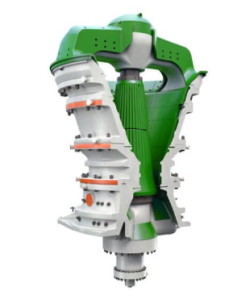
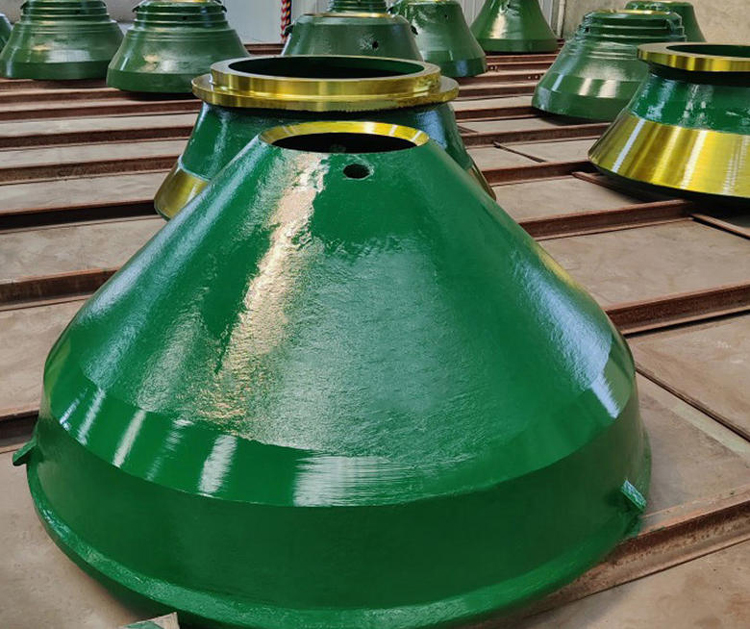
A cone crusher reduces rock by trapping feed material between a gyrating mantle and a stationary concave bowl liner. The crushing action is compressive and abrasive simultaneously. As the mantle precesses on the eccentric assembly, material is nipped and fractured in a continuously moving choke point. This means the liner surfaces do not wear evenly—the lower crushing zone, closest to the closed side setting (CSS), absorbs the highest compressive stress and experiences the most rapid thickness reduction.
The two dominant wear modes in cone crusher liners are abrasive wear and impact fatigue. Abrasive wear dominates in hard, siliceous feeds such as granite or quartzite, where silica content routinely exceeds 60% and Mohs hardness of individual grains reaches 7.0. Impact fatigue becomes critical when operators allow oversized or uncrushable material—tramp metal, wet clay slugs, or bridged rock—to enter the crushing chamber, generating impact loads that can exceed the liner’s impact toughness threshold. A properly specified liner in Mn18Cr2 steel carries an impact toughness of no less than 150 J/cm² per GB/T 5680 standard, which provides a meaningful safety margin against these transient overloads. A liner in plain Mn14 without the chromium addition will typically test between 120 and 135 J/cm²—adequate for softer feeds but marginal in hard-rock primary or secondary applications.
Material Specifications That Actually Matter
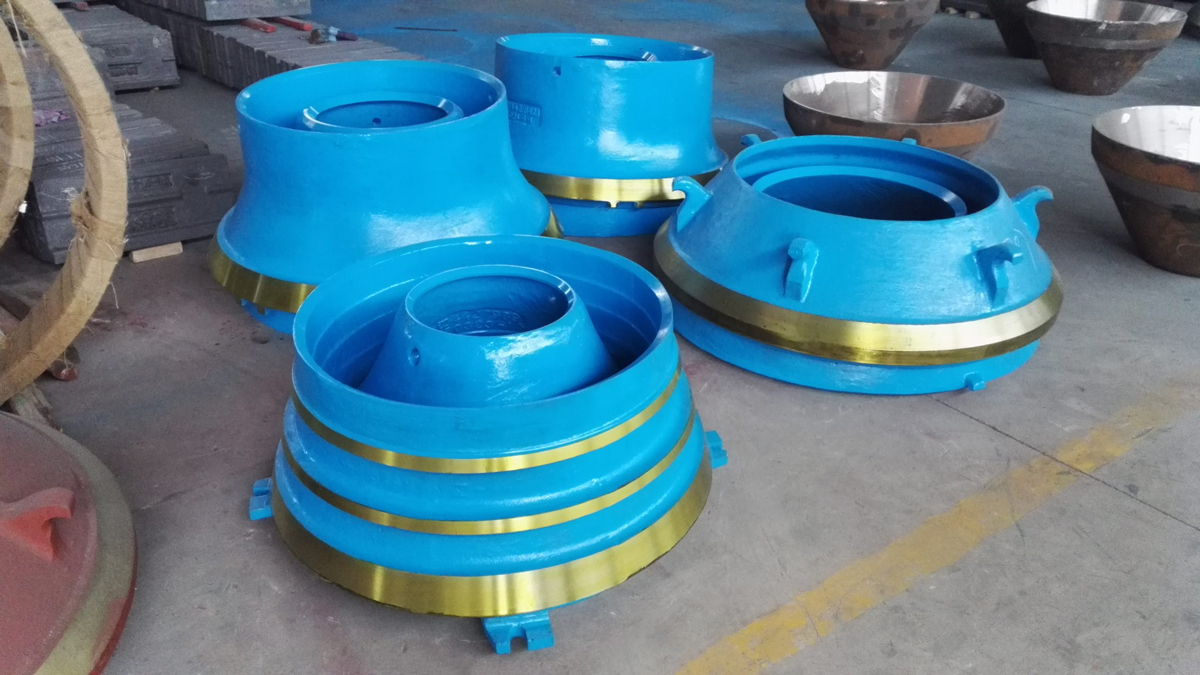
The mantle and concave bowl liner are the two crusher parts that define liner campaign length. Both are cast from austenitic manganese steel, a material that relies on work-hardening to develop its full wear resistance during service. The austenite structure, initially soft at HB 180–220 as cast, transforms progressively under repeated compressive loading into a hard, strain-hardened surface layer that can reach HB 500–550 in high-stress crushing applications. This transformation is the fundamental reason why manganese steel outperforms martensitic white iron in most crusher liner applications: the surface hardens where it is needed most, while the bulk of the casting retains its toughness.
For demanding applications, the preferred alloy is Mn18Cr2, with nominal chemistry of 1.0–1.35% carbon, 17–19% manganese, and 1.5–2.5% chromium. The chromium addition serves two functions: it refines the carbide distribution in the as-cast structure and improves the work-hardening rate during early service hours. A reputable crusher parts manufacturer will provide mill certificates showing tensile strength ≥735 MPa, yield strength ≥390 MPa, and elongation ≥35% per heat, in addition to the hardness and impact toughness values noted above. For less abrasive feeds or smaller crushers running lower CSS values, Mn14Cr2 remains a cost-effective and metallurgically sound choice—provided the actual composition is verified.
Beyond the liners, three other crusher parts have an outsized influence on machine longevity:
- Eccentric bushing: Typically machined from centrifugally cast tin bronze (Cu-Sn10-P or equivalent), the eccentric bushing maintains the precise radial clearance—nominally 0.15 to 0.35 mm depending on shaft diameter and manufacturer specification—that allows the main shaft to gyrate without metal-to-metal contact. When clearance opens beyond 0.50 mm due to wear or lubrication failure, fretting and scoring accelerate rapidly, and shaft replacement costs climb into the tens of thousands of dollars.
- Thrust bearing and socket liner: These components carry the full axial load of the crushing action. The socket liner, also in high-tin bronze, must maintain a surface finish of Ra ≤ 1.6 μm after machining to support the hydrodynamic oil film that prevents scoring under load. A crusher parts supplier that skips this surface finish specification during inspection is cutting a corner that will show up as premature socket wear within 3,000 hours.
- Main frame and adjustment ring: Both are structural steel castings, typically in ZG270-500 or equivalent grade, with tensile strength ≥500 MPa and yield strength ≥270 MPa. Frame cracks are almost always a consequence of operating the crusher outside design parameters—most commonly, running at a CSS tighter than the minimum specified or allowing tramp metal to pass through without activating the relief system. Inspect the frame and ring threads at every liner change for early crack indications.
The Maintenance Variable Most Plants Get Wrong
I have reviewed maintenance logs from more than sixty crusher installations across Southeast Asia and China, and the single most consistent finding is inadequate attention to lubrication oil condition. Most cone crusher OEMs specify ISO VG 150 or VG 220 mineral oil for the central lubrication circuit, with an operating oil temperature window of 38°C to 60°C and a supply pressure of 0.07 to 0.17 MPa at the pump outlet. These are not suggestions—they are engineering boundaries derived from the hydrodynamic film thickness requirements of the bronze bushings and the viscosity-temperature behavior of the specified lubricant grade.
In practice, what I routinely find is: oil that has not been changed at the OEM-recommended interval (typically every 1,000–1,500 hours or annually, whichever comes first), oil cooler fouling that pushes outlet temperatures above 65°C, and pressure gauge calibration that has not been checked in years. Operating with degraded or overheated oil is the fastest path to eccentric bushing failure, because the oil film collapses at elevated temperatures and the bearing operates in a boundary lubrication regime that dramatically accelerates wear.
Change the oil on schedule, verify cooler cleanliness quarterly, and calibrate the pressure and temperature instruments annually. These three actions alone extend bushing life by a measurable margin.
Where Campaigns Are Won or Lost Before the First Ton
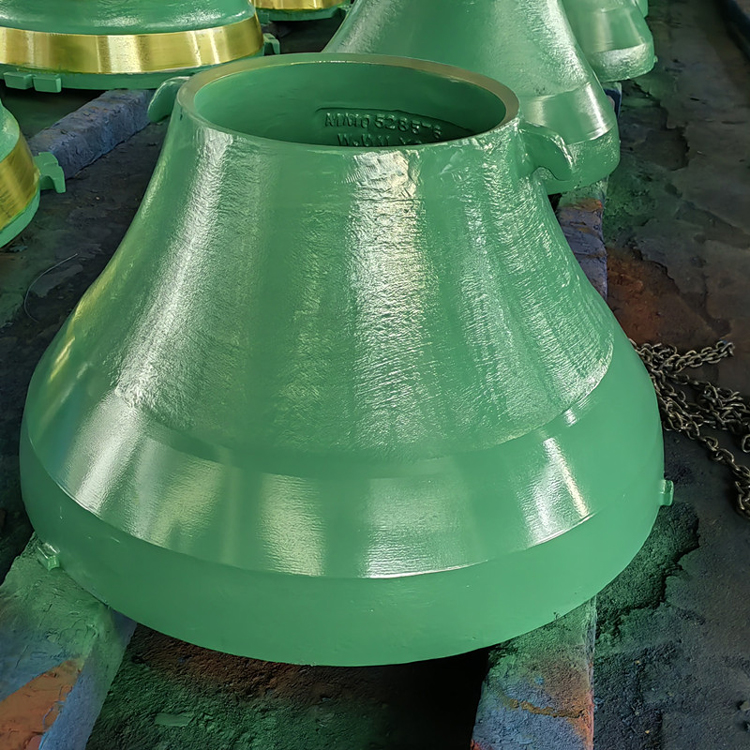
Proper liner seating is a pre-condition for the work-hardening mechanism to operate correctly. A mantle or concave that rocks during the first hours of operation will never develop a uniform hardened surface layer, because the contact stress distribution is irregular. The standard practice is to pour a zinc-alloy backing compound (typically Tenzaloy or equivalent, with a pour temperature of 340–370°C) between the liner and the supporting frame to eliminate voids and ensure 100% bearing contact.
In one incident I diagnosed at a limestone quarry in Guangdong, a crew had installed a new mantle without backing, relying on the zinc from the previous campaign that remained on the head. The old zinc was cratered and uneven, and the new mantle seated on high spots covering perhaps 40% of the intended contact area. Within 200 hours, the mantle had fractured at the feed opening—a failure that looked like a material defect but was entirely an installation error. Documenting your backing pour procedure and verifying zinc temperature with a contact thermometer before every pour is a five-minute step that prevents a five-figure failure.
How to Evaluate a Crusher Parts Supplier on Technical Grounds
Sourcing crusher parts from an unqualified supplier is one of the highest-risk procurement decisions a plant engineer can make, precisely because the consequences are delayed and the causal link is easy to deny. By the time a substandard liner fails, the procurement event is months in the past. The following criteria separate a credible crusher parts manufacturer from a commodity trader who happens to list crusher liners in a catalog:
- Heat-level material certification: A qualified crusher parts manufacturer issues a mill certificate for every cast heat, showing actual—not nominal—chemical composition, mechanical test results, and heat treatment records. Accept nothing less than heat-specific documentation. Batch-level certificates that cover multiple heats are not acceptable for high-wear components.
- Dimensional inspection reports: Critical dimensions—profile radius, thickness at defined measurement points, thread pitch and form for adjustment ring components—should be documented on a dimensional report that references your crusher model’s drawing. A crusher parts supplier with genuine manufacturing capability will have this as a standard deliverable, not an exceptional request.
- In-house heat treatment capability: Austenitic manganese steel liners must be solution heat treated at 1,050–1,100°C and water quenched to dissolve carbide precipitates and restore full toughness. Suppliers who outsource heat treatment have limited control over the critical quench rate, which directly affects as-delivered toughness. Ask for the heat treatment furnace certification and the quench cooling curve records.
- References from comparable applications: A credible crusher parts supplier can provide references from operations running the same crusher model in similar feed conditions—not just general testimonials. Ask specifically for liner campaign hours achieved with their product versus the previous supply source.
A Structured Maintenance Timeline for Extended Liner Campaigns
| Interval | Task | Acceptance Criteria |
|---|---|---|
| Every shift (8 hr) | Check lube oil supply pressure and temperature; inspect feed for tramp metal indicators | Pressure 0.07–0.17 MPa; outlet temp ≤ 60°C |
| Weekly (50–60 hr) | Inspect feed hopper wear plates; check CSS against production log baseline | CSS drift ≤ 2 mm from commissioned setting |
| Monthly (200–250 hr) | Measure liner thickness at four quadrants using ultrasonic gauge; check lube oil viscosity | Liner thickness ≥ 60% of new dimension; viscosity within ±10% of specified grade |
| Quarterly (750 hr) | Flush lube circuit; clean oil cooler; inspect eccentric bushing clearance with feeler gauge | Radial clearance ≤ 0.45 mm; cooler ΔT ≤ 10°C across core |
| Liner change interval | Replace mantle and concave; inspect head, socket liner, and main frame for cracks; re-pour zinc backing | No visible cracks in frame or ring threads; socket surface Ra ≤ 1.6 μm after dressing |
The Compounding Return of Getting It Right
A cone crusher running on correctly specified crusher parts, with a disciplined lubrication program and a competent installation procedure, will routinely achieve liner campaigns 40 to 60 percent longer than an equivalent machine running on commodity-sourced parts with reactive maintenance. In a 500 tph operation running two shifts, that differential translates directly to additional tons processed per liner set and fewer planned shutdowns per year.
The lesson from the Shandong failure at the beginning of this article is not that all non-OEM sources are unacceptable—it is that chemistry compliance, heat treatment verification, and dimensional documentation are non-negotiable prerequisites before any crusher parts manufacturer earns a place on an approved vendor list. The work of qualifying a supplier takes time upfront. The consequence of skipping that work arrives later, at the worst possible moment, and costs far more than the evaluation would have.
Every ton of material that passes through a properly maintained cone crusher is a testament to the decisions made months earlier in the procurement office and the maintenance planning room. Those decisions are where the real engineering happens.