
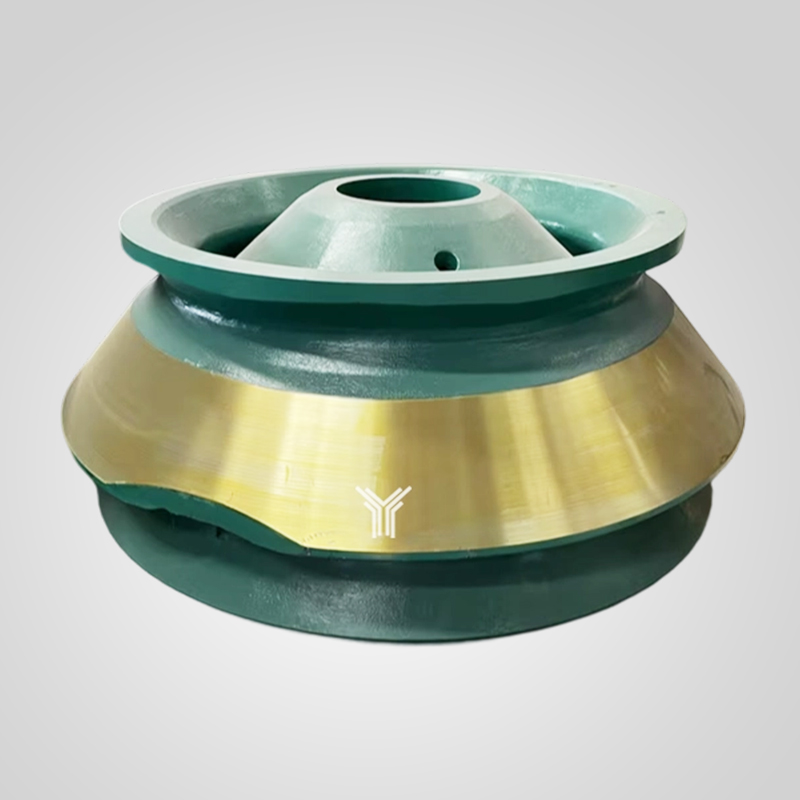
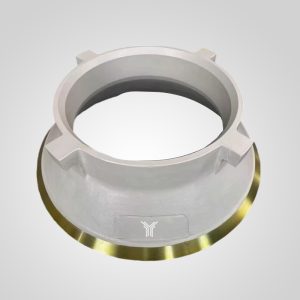
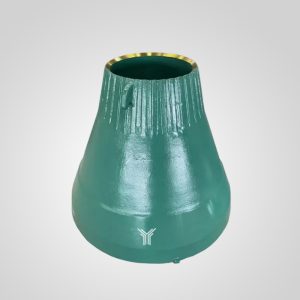
Engineering Analysis of MP1000 Replacement Part 1048315407 and Metallurgy for Hard Rock Crushing
Engineering the Ultimate Wear Lifecycle for MP1000 Cone Crushers
When an MP1000 cone crusher operates at full capacity, the internal crushing force can exceed 800 tons, subjecting the liners to immense compressive stress and gouging abrasion. Under these conditions, standard manganese steel often fails not due to wear, but due to structural incompetence—specifically plastic deformation (mushrooming) that locks the bowl or catastrophic cracking under tramp iron impact. For maintenance superintendents and procurement managers, selecting the replacement for part number 1048315407 is not just about dimensional fitment; it is about metallurgical stability under load.
The operational reality of a 1000 HP crusher means that even a 2mm deviation in the seating surface can lead to stress risers that fracture the main frame seat. This analysis explores the technical specifications, metallurgical composition, and installation protocols necessary to maximize the service life of replacement components for the MP1000 series.
Metallurgical Integrity: Beyond Standard ASTM A128
The performance of any manganese wear part hinges on its ability to work harden. The replacement component 1048315407 is cast using a modified Austenitic Manganese Steel. While standard Hadfield steel (Mn13) provides a baseline, high-stress secondary and tertiary crushing requires superior alloy grades.
Our casting protocol focuses on two primary alloy variations tailored to specific geology:
- Mn18Cr2 (Standard Heavy Duty): This alloy offers an initial hardness of approximately 210-230 HBW. Under impact, the surface lattice structure deforms, causing the skin hardness to spike to over 500 HBW while the core remains ductile (impact value > 100 J/cm²). This ductility is critical for preventing shattering during uncrushable events.
- Mn22Cr2 (Ultra-High Abrasion): For mining environments with high silica content or extremely abrasive ores, increasing the manganese content to 22% delays the onset of wear. This grade maintains a stable austenitic structure but provides a higher yield strength, effectively resisting the micro-ploughing caused by hard rock particles.
The casting process utilizes vacuum degassing to remove hydrogen and nitrogen, ensuring the finished product is free from gas porosity, which is the leading cause of premature liner cracking.
Technical Specifications and Tolerance Control
Fitment accuracy is the single most critical factor in preventing loose liners. A liner that moves during operation will destroy the mating surfaces of the head or bowl. We adhere to strict ISO tolerances for the 1048315407 component.
| Parameter | Specification Standard | Operational Impact |
|---|---|---|
| Initial Hardness | 210 – 240 HBW | Ensures ductility before work hardening occurs. |
| Dimensional Tolerance | ± 2.0 mm (Casting Profile) | Guarantees correct CSS (Closed Side Setting) calibration. |
| Machined Surface Ra | ≤ 6.3 μm | Ensures flush contact with backing material and head. |
| Phosphorus Content | ≤ 0.04% | Prevents cold shortness (brittleness) in the casting. |
Failure Modes and Preventative Design
Understanding why wear parts fail allows for better engineering. The 1048315407 replacement part addresses common industry failure modes:
1. Plastic Flow (Mushrooming)
In high-pressure applications, inferior manganese steel flows plastically, expanding the liner dimensions. This “growth” can permanently lock the mantle to the head or the bowl liner to the bowl, requiring dangerous thermal lancing to remove. Our optimized Carbon-to-Manganese ratio (C:Mn) controls this expansion, ensuring the liner wears down rather than flowing out.
2. Spalling and Peeling
If the surface hardens too quickly relative to the subsurface support, sheets of metal can flake off. This is often seen when crushing extremely hard rock with high point-loads. We utilize a precise heat treatment cycle—water quenching from 1050°C—to dissolve carbides completely, creating a uniform grain structure that resists spalling.
Case
“I recall a copper mine in Chile running MP1000s on secondary crushing. They switched to a low-cost aftermarket supplier for their mantles to save 15% on upfront costs. Within 120 hours, the mantle experienced severe mushrooming at the bottom flange. The material flow was so bad it actually welded itself to the locking nut. We had to shut down for 36 hours to torch-cut the assembly out. The’savings’ cost them over $200,000 in lost production. We replaced it with a Mn18Cr2 part with proper backing procedures, and the unit ran its full 650-hour cycle without dimension creep.”
Installation and Backing: The Foundation of Longevity
Even the highest quality metallurgy will fail if installed incorrectly. Installing part 1048315407 requires adherence to OEM torque specifications and backing compound preparation.
Surface Preparation: The mating surfaces of the head and bowl must be cleaned to bare metal. Any old backing or rust scale will create a false seat, leading to liner loosening. We recommend using a wire wheel and solvent cleaner.
Backing Compound Application: Epoxies are sensitive to temperature. Ensure the backing is mixed and poured at temperatures between 15°C and 25°C. For the MP1000, filling the cavity behind the liner is non-negotiable. This backing layer acts as a shock absorber, transmitting the crushing force evenly to the machine frame. A void in the backing will result in a localized stress point, almost certainly causing the liner to crack vertically.
Total Cost of Ownership (TCO) Analysis
Procurement decisions should focus on cost per ton, not the invoice price of the wear part. A cheaper liner that lasts 400 hours versus a premium liner that lasts 500 hours changes the economics of the entire plant.
Consider the cost of a change-out:
- Crane costs and rigging crew labor.
- Lost production revenue (often $10,000+ per hour for large operations).
- Safety risks associated with heavy lifts.
By extending the wear life of the 1048315407 component by just 20%, you reduce the frequency of these high-cost events. Our parts are designed to maintain their wear profile longer, keeping the crusher at peak power draw and capacity for a greater percentage of the duty cycle. This means you are not just buying steel; you are buying production uptime.
Pro-Tip
“Don’t ignore the burn ring (torch ring). When you pull the old 1048315407 liner, inspect the torch ring for wear. If the ring is worn or distorted, it won’t seal properly against the new liner. This allows backing compound to leak out during installation, creating voids. I always keep a spare torch ring on the shelf—it’s a $50 part that protects a $5,000 liner installation.”
Preventative Maintenance via Oil Analysis
While the liner is a consumable, it acts as a diagnostic tool for the health of the crusher. During the liner change, take a sample of the crusher’s lubrication oil. High levels of bronze or copper particles indicate that the bushing or socket liner is suffering, potentially due to the previous liner causing uneven load distribution. Monitoring silica levels in the oil can also indicate if the dust seal (which interacts with the liner arrangement) has failed.
Frequently Asked Questions (FAQ)
Q1: How does the Carbon content in your Mn18Cr2 alloy affect the 1048315407 part performance?
Carbon is the primary hardening element. We maintain a carbon range of 1.15% to 1.25%. If carbon is too high, the casting becomes brittle and prone to cracking under impact. If it is too low, the part will not work-harden sufficiently, leading to rapid abrasive wear. Our precise control ensures the optimal balance for toughness and wear resistance.
Q2: What is the recommended gap/clearance when installing this bowl liner?
When installing the bowl liner, it is critical to center it within the adjustment ring. While specific values depend on the exact backing material used, generally, a uniform gap is required to ensure an even thickness of the backing compound. Do not allow metal-to-metal contact at the backing zone; the epoxy buffer is required to dampen vibration and shock loads.
Q3: Can I switch from Mn18 to Mn22 for my MP1000 without changing other parameters?
Yes, the dimensional geometry of the 1048315407 part remains identical regardless of the alloy. However, you should monitor the crusher’s power draw. Mn22 is harder and may slightly change the crushing dynamics in very hard rock applications. It is highly recommended for abrasive silica-rich ores but may not offer a significant advantage in soft, non-abrasive limestone applications.
All manufacturer names, part numbers, model numbers, and descriptions are used for reference and identification purposes only, they are owned by the respective machine manufacturer, including but not limited to FLSmidth®, Metso®, thyssenkrupp®, and Sandvik®. All parts supplied are manufactured and warranted by yonsmen and are not manufactured by or purchased from the Original Equipment Manufacturer. yonsmen has no association with the OEM and does not intend to give this impression.
Reviews
There are no reviews yet.