
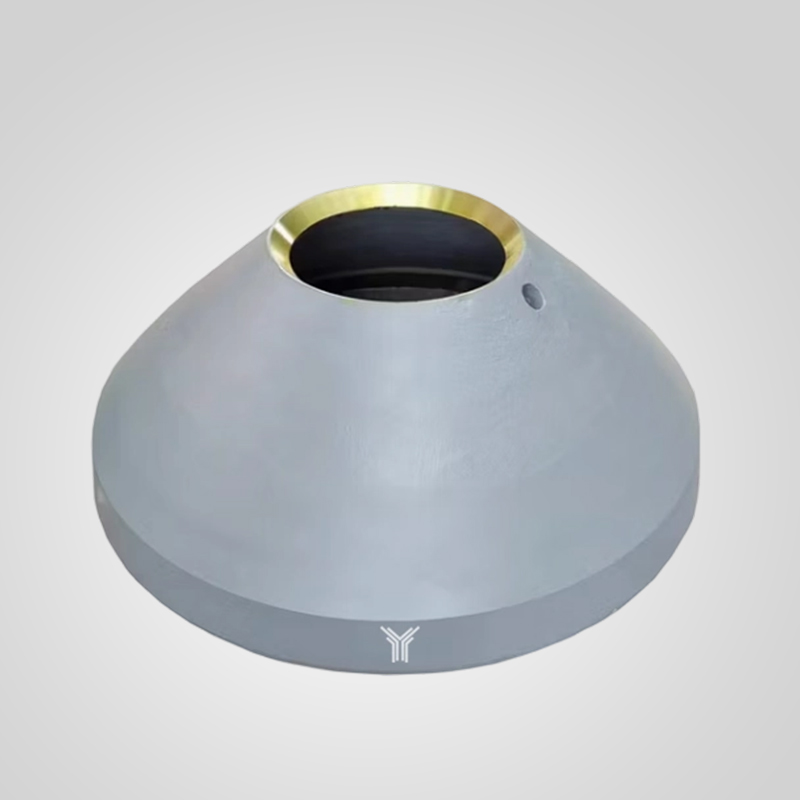
Preventing Head Spin and Mantle Seat Failure in Mobile Crushing Circuits with the 483kg Replacement 552-003-063
Part Number 552-003-063
Machine Model McCloskey C38 / C38R Cone Crusher
Component Name Mantle (Moving Cone)
Cast Weight 483 kg (Approx. ±3%)
Material Grade Mn18Cr2 (Austenitic Manganese Steel)
Hardness (Initial) 210 – 230 HBW
Hardness (Work Hardened) > 500 HBW
Machining Tolerance ISO 2768-m (Medium Class)
Engineering Integrity in Mobile Crushing The 552-003-063 Mantle
A mobile cone crusher like the McCloskey C38 operates under dynamic loads that stationary plants rarely experience. With a 200-300 TPH throughput capacity often handling variable feed—from demolition concrete with rebar to abrasive river stone—the stress placed on the mantle 552-003-063 is exponential. When this 483kg component rotates at 350 RPM under a crushing pressure exceeding 380 MPa, structural integrity is not optional. A casting defect or a deviation in the manganese-to-carbon ratio doesn’t just mean faster wear; it means catastrophic plastic deformation that can seize the head assembly or shear the locking nut, resulting in weeks of downtime.
For fleet managers and maintenance engineers, procuring the correct replacement for the C38 mantle requires a deep understanding of metallurgy and tribology. This analysis dissects the technical specifications, installation physics, and failure prevention strategies for the 552-003-063 wear part.
Metallurgical Specification The Mn18Cr2 Standard
The operational success of part 552-003-063 relies on the Austenitic Manganese Steel’s ability to work-harden. We utilize a strictly controlled Mn18Cr2 (ASTM A128 Grade C) alloy matrix.
The Hardening Mechanism:
The casting is delivered with a solution-annealed hardness of approximately 210-230 HBW. This ductility is deliberate. It allows the mantle to absorb the high-impact shock of uncrushable materials (tramp iron) without shattering. As rock impacts the surface, the austenitic lattice structure deforms, causing a phase transformation at the surface layer. This increases the hardness to over 500 HBW (52 HRC), creating a wear-resistant skin while the core remains tough and ductile (Impact Toughness > 100 J/cm²).
Chromium’s Role:
The “Cr2” in the specification refers to a 2% Chromium addition. In the McCloskey C38 application, Chromium is vital for increasing the initial yield strength. Without it, the high crushing forces would cause the manganese steel to flow plastically too easily, leading to “mushrooming” at the mantle base, which makes removal impossible without thermal lancing.
Failure Mode Analysis: Why Mantles Fail Prematurely
We analyze discarded 552-003-063 mantles to improve casting geometry. Three primary failure modes dominate the mobile crushing sector:
1. Plastic Flow (Mushrooming)
If the mantle material has a Carbon content below 1.1%, it lacks the yield strength to support the crushing load. The metal flows downward, expanding the diameter of the mantle base. This expansion locks the mantle onto the head and often destroys the torch ring. Our castings maintain a Carbon ratio between 1.15% and 1.25% to mitigate this flow.
2. Galling and Spinning
A mantle that spins on the head is a maintenance nightmare. This is caused by poor fitment tolerance. If the internal machined surface of the 552-003-063 part exceeds a roughness of Ra 6.3 μm or has circularity deviations > 0.5mm, it will not seat firmly. Under load, it shifts, breaking the backing compound bond. The resulting metal-on-metal friction (galling) ruins the expensive cone head.
3. Spalling (Flaking)
In high-silica applications, if the heat treatment was improper (e.g., slow quenching), carbides precipitate at the grain boundaries. This makes the steel brittle. Under impact, large flakes of steel peel off, drastically reducing the wear life.
Case
“I was on a site in Queensland inspecting a C38 utilized for crushing recycled concrete. The operator complained that the mantle locking nut kept loosening every 48 hours. We pulled the mantle 552-003-063 and found the internal seating surface had high spots—it wasn’t fully machined. The mantle was’rocking’ on these high spots during the crushing cycle, creating vibration that backed off the nut. We replaced it with a precision-machined Mn18Cr2 mantle, verified the seating with blueing paste, and the nut stayed torqued for the entire 600-hour wear cycle.”
Installation Protocols: Managing the 483kg Mass
Installing the 552-003-063 mantle requires strict adherence to procedure to ensure the crusher head is protected.
Step 1: Surface Preparation
The cone head must be cleaned to bare metal. Remove all traces of old backing compound. Any debris left on the head acts as a stress riser, which can crack the new mantle vertically. Apply a thin layer of light oil or release agent to the head to ensure the next removal is possible.
Step 2: The Backing Compound
Standard epoxy backing is required. For the C38 mantle, the gap must be completely filled.
Critical Check: The compressive strength of the cured backing must exceed 90 MPa. Low-grade backing will pulverize under the 300-ton crushing force, leaving the mantle unsupported.
Pouring: Pour from one side only to prevent air entrapment. A void behind the mantle allows the steel to flex into the empty space, leading to fatigue cracking within 100 hours of operation.
Step 3: Torque and Burn-In
Tighten the locking nut to the OEM specified torque (typically requiring a slugging wrench or hydraulic torque tool). However, the job is not done. Run the crusher for 4 hours with light feed. The heat generated will cure the backing and seat the manganese. Stop and retighten. This second tightening is where you gain the clamping force that prevents spinning.
Preventative Maintenance via Oil Analysis
The McCloskey C38 hydraulic and lubrication systems are sensitive indicators of wear part performance. Routine oil sampling can save your machine.
- High Copper (Cu) Levels (>50 ppm): This indicates that the eccentric bushing is wearing. This is often caused by an unbalanced mantle 552-003-063 or one that has been installed off-center, creating a wobble that point-loads the bearing.
- High Silicon (Si) Levels: If silica spikes, check the dust seal. A worn-out mantle that has exceeded its thickness limit often compromises the geometry of the dust seal, allowing abrasive rock dust to enter the oil sump.
Total Cost of Ownership (TCO) Analysis
In the competitive mobile crushing market, the cost per ton is the only metric that matters. Let’s compare a generic “budget” mantle versus a premium Mn18Cr2 OEM-spec mantle.
Scenario: McCloskey C38 processing River Gravel at 250 TPH.
- Budget Mantle: Cost $2,000. Life: 350 Hours.Cost per hour: $5.71. Change-outs per year (2000 hrs): 5.7.
- Premium 552-003-063 Mantle: Cost $2,600. Life: 550 Hours.Cost per hour: $4.72. Change-outs per year: 3.6.
The Hidden Cost of Downtime
Each change-out requires a crane, 2 technicians, and 8 hours of downtime.
Lost Production: 250 TPH * 8 hours * $15/ton (product value) = $30,000 revenue loss per event.
By using the premium mantle and eliminating 2 change-outs per year, you save $60,000 in lost production revenue, dwarfing the $600 difference in part price.
Technical Specifications Table
| Technical Parameter | Specification Value |
|---|---|
| Part Number | 552-003-063 |
| Machine Model | McCloskey C38 / C38R Cone Crusher |
| Component Name | Mantle (Moving Cone) |
| Cast Weight | 483 kg (Approx. ±3%) |
| Material Grade | Mn18Cr2 (Austenitic Manganese Steel) |
| Hardness (Initial) | 210 – 230 HBW |
| Hardness (Work Hardened) | > 500 HBW |
| Machining Tolerance | ISO 2768-m (Medium Class) |
Pro-Tip
“Always keep the Torch Ring (Burn Ring) in stock. Part number 552-003-063 sits directly on top of this ring. When you cut the old mantle off, 9 times out of 10, the torch ring is damaged or warped from heat. If you reuse a warped torch ring, the new mantle won’t sit flat. This creates a gap where backing compound leaks out, and you’ll never get the locking nut tight enough. It’s a cheap part that saves the expensive head.”
Frequently Asked Questions (FAQ)
Q1: Can I use a Mn22 (22% Manganese) mantle on my McCloskey C38?
While Mn22 offers better wear resistance in highly abrasive, low-impact applications (like sand making), it is riskier for mobile crushers.
The C38 often encounters uncrushable tramp iron (steel, digger teeth) in recycling applications. Mn22 has lower impact toughness than Mn18Cr2 and is more prone to cracking under these shock loads.
For general quarrying and recycling, the Mn18Cr2 alloy specified for part 552-003-063 provides the safest balance between wear life and fracture toughness.
Q2: How do I calculate the amount of backing compound needed for part 552-003-063?
The volume of backing depends on the wear of the cone head, but generally, the C38 mantle cavity requires approximately 10kg to 15kg of epoxy compound.
Always over-order slightly. Running out of backing mid-pour creates a “cold joint” or weak layer in the epoxy.
If this layer shatters during operation, the mantle will loosen.
Ensure the backing is mixed at a temperature between 15°C and 25°C for optimal flow and curing.
Q3: What is the recommended wear limit for this mantle?
You should plan to change the mantle when the wall thickness wears down to approximately 20mm to 25mm at the thinnest point.
Running it thinner than this is dangerous; the remaining steel may split, damaging the cone head underneath.
Additionally, as the mantle wears, the cavity profile changes, potentially reducing throughput by up to 15% due to a loss of nip angle efficiency.
All manufacturer names, part numbers, model numbers, and descriptions are used for reference and identification purposes only, they are owned by the respective machine manufacturer, including but not limited to FLSmidth®, Metso®, thyssenkrupp®, and Sandvik®. All parts supplied are manufactured and warranted by yonsmen and are not manufactured by or purchased from the Original Equipment Manufacturer. yonsmen has no association with the OEM and does not intend to give this impression.
Reviews
There are no reviews yet.