
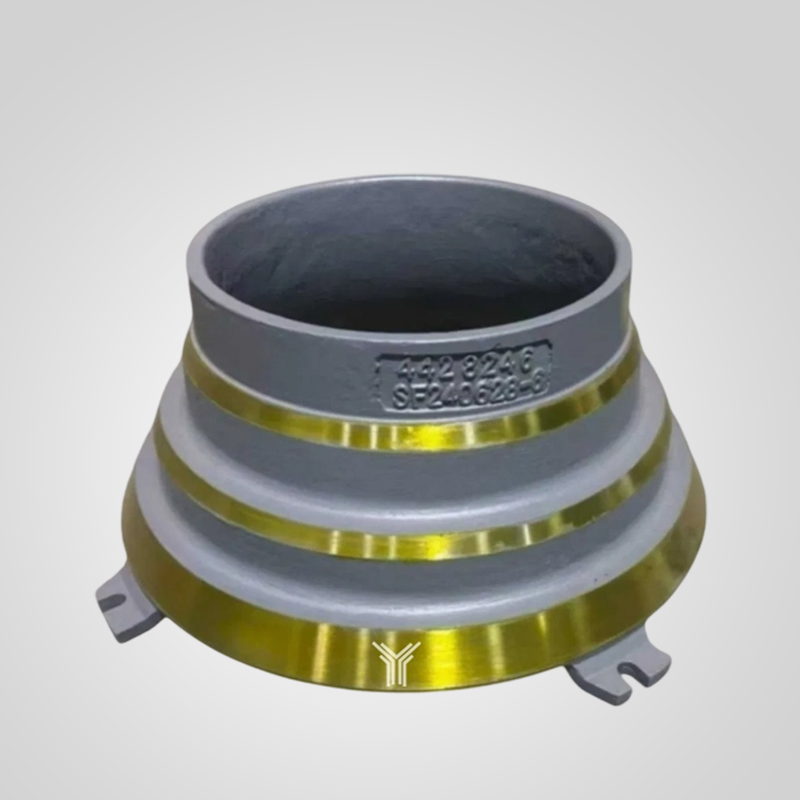
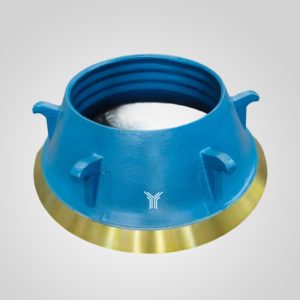
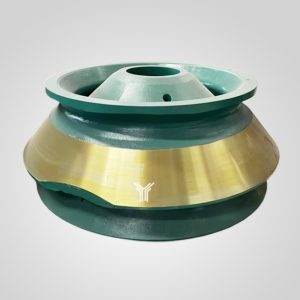
Stabilizing Hydroset Pressure in CH430 Crushers with Mn21Cr2 Alloy Concave 442.8246-02
Part Number: 442.8246-02 / MM1328160
Crusher Compatibility :CH430 / H3800
Chamber Type: MF (Medium Fine)
Net Weight :618.45 kg (± 2%)
Material Grade :21MNCR (Mn21Cr2 – High Alloy)
Surface Hardness (Initial) :210 – 240 HBW
Surface Hardness (Work Hardened): > 550 HBW
Mounting Type : Top Shell Support (Spider)
Hydraulic Stability and Metallurgical Evolution in CH430 Crushers
The operational efficiency of a CH430 (formerly H3800) cone crusher relies entirely on the stability of its Hydroset system. When the crushing force exceeds 3.5 MPa during the comminution of hard ores like taconite or granite, the reaction forces are transmitted directly through the mantle and into the stationary concave. If the replacement concave, specifically part number 442.8246-02, lacks the requisite yield strength or dimensional circularity, the Hydroset pressure will fluctuate violently. This pulsation triggers ASRi (Automatic Setting Regulation) alarms, forcing the computer to open the Closed Side Setting (CSS) to protect the mainframe, thereby destroying your product gradation and increasing recirculation loads.
For plant managers and reliability engineers, the procurement of this 618.45kg component is not a commodity purchase. It is a decision that dictates the mechanical availability of the tertiary circuit. This analysis explores the superior metallurgy of 21MNCR (Mn21), the geometry of the Medium Fine (MF) chamber, and the critical installation protocols required to prevent catastrophic “spin” failures.
The Shift to Mn21Cr2
Standard aftermarket suppliers often cast this component in Mn13 or Mn18 to save costs. However, for the high-pressure environment of a CH430, these alloys often reach their work-hardening saturation point too late. The 442.8246-02 component referenced here utilizes a Mn21Cr2 (21% Manganese, 2% Chromium) chemistry. This is a deliberate metallurgical upgrade.
The Carbide Advantage
The addition of Chromium (Cr) to the 21% Manganese matrix creates ultra-hard chromium carbides precipitated within the austenitic grain boundaries. While the bulk material remains ductile (Charpy V-Notch > 120 J), these carbides provide immediate resistance to micro-ploughing.
Yield Strength Dynamics
Standard Mn18 has a yield strength of approximately 350-380 MPa. The Mn21Cr2 alloy pushes this to over 450 MPa. In a CH430, where “tramp pressure” spikes are common, this higher yield strength prevents the concave from physically deforming (mushrooming) at the lower seating flange. A mushroomed concave is notoriously difficult to remove, often requiring 12+ hours of thermal lancing, damaging the top shell in the process.
The “MF” (Medium Fine) Profile
The code MM1328160 corresponds to a Medium Fine crushing chamber. This profile is engineered for a specific feed gradation, typically accepting top-size material around 100mm to 135mm (depending on CSS). The “Fine” aspect refers to the length of the parallel zone at the bottom of the liner.
The Parallel Zone Criticality
The 442.8246-02 concave features an extended parallel zone compared to Coarse (C) or Extra Coarse (EC) liners. This zone ensures that every particle undergoes multiple compression events before discharge, guaranteeing high cubicity (flakiness index < 10%). If a low-quality casting deviates from the OEM profile by even 3mm in this zone, the inter-particle crushing action is lost. The result is “slivers” or flaky product that fails Superpave specifications for asphalt aggregates.
Case
“We supported a quarry in Norway crushing abrasive gneiss with a CH430. They switched to a cheaper Mn18 concave to save budget. Within 250 hours, the ASRi system started throwing’High Pressure’ alarms, but the motor power was low. We investigated and found the concave had deformed plastically at the intake, effectively choking the feed. The Mn18 couldn’t handle the localized stress of the gneiss. We installed the 21MNCR (Mn21) concave 442.8246-02. The higher yield strength held the intake geometry, the feed flowed smoothly, and they got 950 hours of wear life compared to 250 hours.”
Installation: The Physics of the 618.45kg Mass
Installing a concave in a top-support spider design like the CH430 is fundamentally different from bottom-support crushers. The concave hangs. This makes the backing compound application critical.
1. The Support Ring Interface
The concave rests on a filler ring (or support ring). Before lowering the 618.45kg concave, this ring must be inspected for flatness. A warped ring causes point-loading. The torque on the mounting bolts (fixing the concave to the top shell) must be uniform, typically requiring a pre-load torque of 250 Nm followed by a final torque sequence.
2. Backing Compound Strategy
The gap between the concave and the top shell must be filled with epoxy.
Calculated Volume For the 442.8246-02, the annular volume requires approximately 20-25kg of backing (depending on casting tolerances).
The Risk of Voids If the backing is poured too fast, air pockets form. In a CH430, the crushing force attempts to expand the concave radially. If there is a void behind the steel, the concave flexes into that void. After 10,000 cycles, the casting fatigues and cracks vertically. We recommend a slow, continuous pour from two opposite points to allow air to escape.
Technical Specifications and Tolerance Data
The following parameters define the engineering standard for this replacement component.
| Parameter | Specification Value |
|---|---|
| Part Number | 442.8246-02 / MM1328160 |
| Crusher Compatibility | CH430 / H3800 |
| Chamber Type | MF (Medium Fine) |
| Net Weight | 618.45 kg (± 2%) |
| Material Grade | 21MNCR (Mn21Cr2 – High Alloy) |
| Surface Hardness (Initial) | 210 – 240 HBW |
| Surface Hardness (Work Hardened) | > 550 HBW |
| Mounting Type | Top Shell Support (Spider) |
Total Cost of Ownership (TCO) Analysis
The purchase price of the 442.8246-02 represents a fraction of the operational cost. The true cost driver is the “change-out interval.”
- Standard Mn18 Liner: Costs $X. Lasts 500 Hours. Requires 4 changes/year (2000 hrs ops).
- Premium Mn21 Liner: Costs $1.3X. Lasts 800 Hours. Requires 2.5 changes/year.
The Savings:=
Eliminating just one change-out saves:
1. Crane rental ($1,500)
2. Maintenance Crew (12 man-hours)
3. Backing Compound ($300)
4. Crucially 8 hours of lost production. On a CH430 running 180 TPH, that is 1,440 tons of lost aggregate.
The Mn21Cr2 alloy is an investment in uptime, not just a spare part.
Preventative Maintenance via Oil Analysis
The CH430 Hydroset system shares fluid with the lubrication system (in some configurations) or operates closely with it. Monitoring the main lube oil is essential.
Copper (Cu) Spikes If you see Copper rising > 25 ppm, check the concave wear pattern. An unevenly worn concave (oval wear) causes the mainshaft to wobble (“nutation”), stripping the eccentric bushing.
Chromium (Cr) Spikes Since this liner contains 2% Chromium, extremely high levels of fine Cr dust in the oil suggest the dust seal is failing, allowing crushed metal fines from the liner to enter the sump.
Pro-Tip
“When installing the 442.8246-02 concave, pay close attention to the plastic filler blocks or clay used to seal the pouring holes. I’ve seen crews rush this, and the liquid epoxy leaks down into the crushing chamber, curing on the mantle. When they start the crusher, that hardened epoxy chunk acts like tramp iron and can cause an immediate pressure spike. Spend the extra 10 minutes to seal the bottom of the gap properly.”
Frequently Asked Questions (FAQ)
Q1: Can I use this MF (Medium Fine) concave with an EC (Extra Coarse) Mantle?
Technically, yes, it will physically fit, but it is highly discouraged. Mixing chamber profiles (e.g., MF Concave with EC Mantle) creates a mismatched crushing angle. This usually results in a “hook” wear pattern where the feed opening wears out prematurely while the parallel zone remains unused, or vice versa. For optimal performance and wear life, match the concave and mantle profiles as per the OEM chamber selection guide.
Q2: Why is the 21MNCR alloy better for the CH430 than standard Mn13?
The CH430 is a high-performance machine with a high reduction ratio. Mn13 (Hadfield Steel) is too soft. Under the intense crushing force of the CH430, Mn13 tends to deform (flow) rather than chip away. This deformation causes the liner to expand and get stuck in the top shell. Mn21Cr2 has higher tensile strength and yield strength, resisting this deformation while providing superior abrasion resistance in hard rock.
Q3: What is the recommended discard point for the 442.8246-02 concave?
You should plan to replace the concave when the wall thickness at the wear zone reaches approximately 20mm-25mm. Do not run it until it cracks. More importantly, monitor the ASRi system. If the system can no longer maintain the desired CSS without the mainshaft bottoming out (or reaching the top of its stroke), the liner geometry is exhausted, regardless of remaining thickness.
All manufacturer names, part numbers, model numbers, and descriptions are used for reference and identification purposes only, they are owned by the respective machine manufacturer, including but not limited to FLSmidth®, Metso®, thyssenkrupp®, and Sandvik®. All parts supplied are manufactured and warranted by yonsmen and are not manufactured by or purchased from the Original Equipment Manufacturer. yonsmen has no association with the OEM and does not intend to give this impression.
Reviews
There are no reviews yet.