
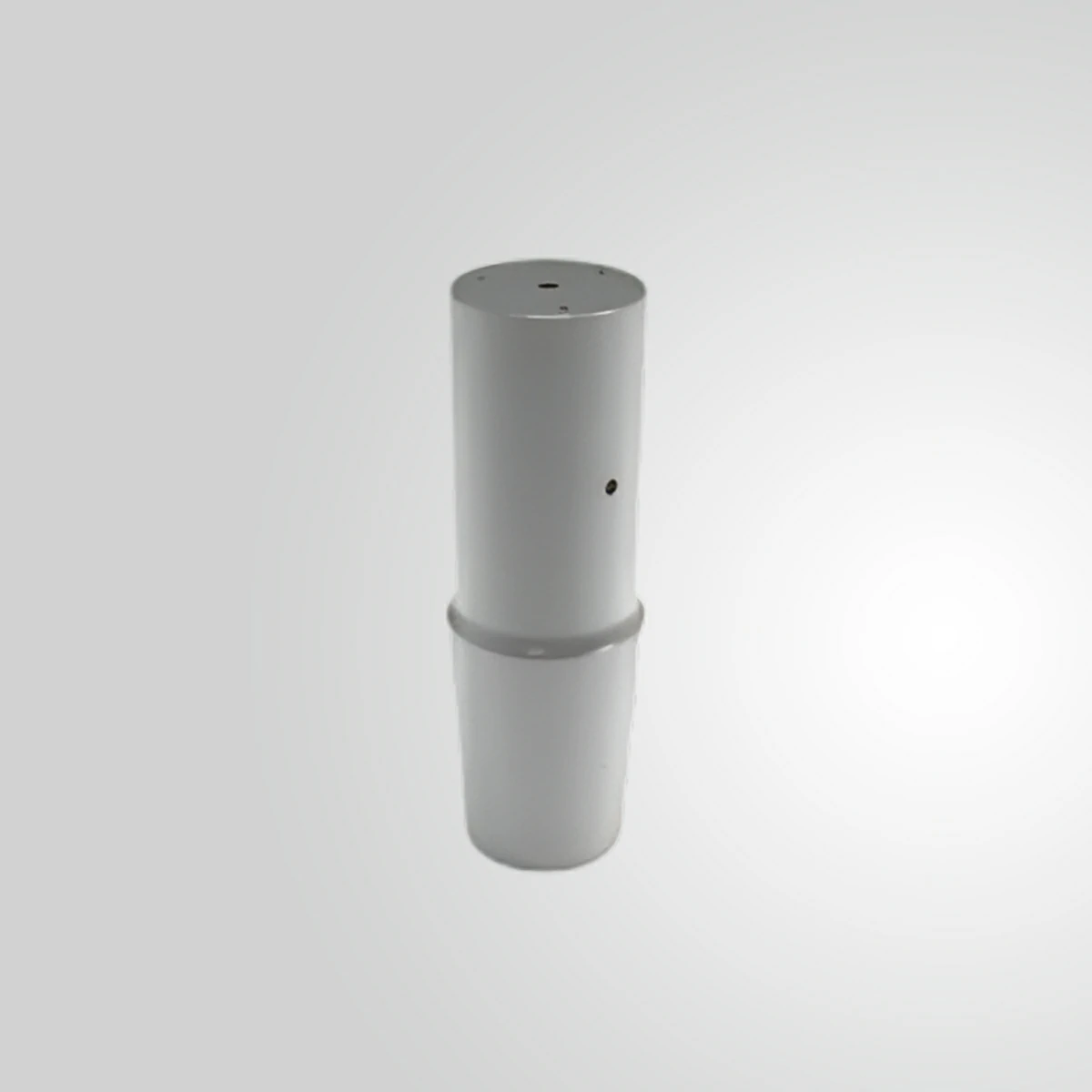
FLSmidth Raptor XL 300 Main Shaft: Vacuum-Degassed 34CrNiMo6 Forged Alloy Steel
Product Name Cone Crusher Main Shaft
Compatible Model FLSmidth Raptor XL 300
Material Grade 34CrNiMo6 / AISI 4340 Vacuum Degassed Forged Alloy Steel
Forging Reduction Ratio \> 4:1 (Guarantees longitudinal grain alignment and density)
Core Hardness (Q\&T) 280 \– 320 HBW (Optimized balance of yield strength and ductility)
Minimum Yield Strength 850 MPa
Minimum Tensile Strength 1000 MPa
Engineered to withstand extreme cyclical bending moments and severe compressive loads during high-tonnage hard rock reduction, the FLSmidth Raptor XL 300 Main Shaft is manufactured from vacuum-degassed 34CrNiMo6 (AISI 4340 equivalent) forged alloy steel. Featuring a rigorously controlled Quench and Temper (Q\&T) core hardness of 280-320 HBW and a minimum yield strength of 850 MPa, this central structural component guarantees maximum resistance to transverse fatigue. Precision-ground bearing journals with an Ra \≤ 0.8&μm finish ensure rapid hydrodynamic oil film generation, while 100% ultrasonic testing to ASTM A388 Class 2 standards guarantees a flawless, inclusion-free metallurgical matrix.
Detailed Introduction
Combating Extreme Bending Moments in the Crushing Chamber
Catastrophic fracture of the main shaft represents one of the most severe failure modes in any crushing circuit, resulting in weeks of unscheduled downtime, extensive peripheral damage to the eccentric assembly, and massive production losses. Within the kinetic architecture of the FLSmidth Raptor XL 300, the main shaft acts as a massive oscillating lever arm. It is subjected to constant, severe bending moments created by the crushing forces at the mantle, counteracted by the radial thrust of the eccentric bushing at the lower journal. The FLSmidth Raptor XL 300 Main Shaft is explicitly engineered to absorb these brutal alternating stresses, safely transmitting crushing forces without permanently yielding or propagating microscopic fatigue cracks during tramp iron shock-loading events.
Metallurgical Purity: Vacuum-Degassed 34CrNiMo6 Forged Steel
The operational longevity of a component subjected to continuous alternating tensile and compressive stress is fundamentally dictated by its metallurgical purity and internal grain structure. The FLSmidth Raptor XL 300 Main Shaft is forged from high-grade 34CrNiMo6 alloy steel. This specific Nickel-Chromium-Molybdenum matrix is selected for its exceptional deep hardenability and superior notch toughness. During the initial continuous casting phase, the molten steel undergoes strict vacuum degassing. This critical purification step extracts dissolved hydrogen and oxygen gases, eliminating the risk of hydrogen embrittlement and internal flaking. Furthermore, the shaft is pressed utilizing a forging reduction ratio greater than 4:1. This aggressive thermo-mechanical reduction aligns the internal grain flow perfectly parallel to the longitudinal load path of the shaft, drastically increasing its resistance to transverse shear forces.
Heat Treatment and Structural Toughness
A frequent failure mode in heavily loaded drivetrain components is a mechanical imbalance between surface hardness and core ductility. A main shaft that is too brittle will snap under the sudden stall of an uncrushable object, while a shaft that is too soft will suffer from rapid journal deformation and thread stretching. The FLSmidth Raptor XL 300 Main Shaft resolves this via a highly controlled Quench and Temper (Q\&T) protocol. The entire raw forging is uniformly heat-treated to establish a tough, homogenous core hardness of 280-320 HBW. This specific thermal profile provides the massive yield strength (minimum 850 MPa) required to process abrasive, high-compressive-strength ores, while retaining the critical ductility needed to flex microscopically and absorb shock loads without fracturing.
Geometric Optimization and Stress Riser Elimination
Mechanical engineering failure analysis consistently demonstrates that main shaft fractures rarely initiate in the straight sections of the forging; they originate at the dimensional transitions, known as stress concentrators. The FLSmidth Raptor XL 300 Main Shaft features generously proportioned, highly polished fillet radii at every dimensional step, particularly at the transition between the head center seating taper and the lower bearing journal. These radiused designs effectively dissipate localized bending stresses over a much wider geometric area, significantly lowering the stress concentration factor (Kt) and increasing the infinite fatigue limit of the shaft. Additionally, these critical transition zones are machined utilizing high-speed carbide tooling to prevent localized work-hardening, ensuring the structural integrity of the steel remains entirely uncompromised.
Tribological Interface: Journal Surface Finish
The lower section of the main shaft interfaces directly with the inner bronze eccentric bushing, creating a highly loaded journal bearing. The transition from boundary lubrication to full hydrodynamic lubrication is the most critical phase for preventing galling. To facilitate the immediate generation of a stable, load-bearing oil wedge, the critical journal surfaces of the FLSmidth Raptor XL 300 Main Shaft are CNC ground to an exacting surface finish of Ra \≤ 0.8\μm. By minimizing microscopic asperities, the fluid film thickness generated by the ISO VG 150 or 220 EP gear oil easily exceeds the composite surface roughness of the bushing and the shaft, entirely eliminating destructive metal-to-metal contact during steady-state eccentric rotation.
Step Bearing Interface and Axial Load Distribution
The entire vertical weight of the main shaft, the mantle, and the dynamic crushing load is supported by the step bearing assembly at the base of the crusher. The absolute bottom face of the FLSmidth Raptor XL 300 Main Shaft is precision-machined perfectly perpendicular to its longitudinal axis and polished to a mirror finish. This ensures perfectly even contact across the bronze or polymer step bearing plates. An uneven thrust face would cause edge-loading, rapidly destroying the hydrostatic oil film and causing the step plates to wipe and seize within hours of operation. The strict perpendicularity of this thrust face guarantees uniform axial load distribution, stabilizing the operating temperature of the main lubrication return oil.
Rigorous Non-Destructive Testing (NDT) Protocol
To guarantee zero catastrophic structural failures upon field commissioning, every FLSmidth Raptor XL 300 Main Shaft undergoes an exhaustive Non-Destructive Testing (NDT) regimen prior to final machining and dispatch. The raw heat-treated forgings are 100% ultrasonically tested in strict accordance with ASTM A388 (Class 2). This deep-penetration acoustic scanning detects microscopic subsurface anomalies, such as shrinkage cavities, forging bursts, or non-metallic inclusions, which could silently act as nucleation sites for fatigue cracks. Furthermore, all machined transition radii and the locking threads at the top of the shaft are subjected to Magnetic Particle Inspection (MPI) to verify the absolute absence of any superficial machining micro-fissures.
Technical Specifications
| Parameter | Specification / Standard |
| Product Name | Cone Crusher Main Shaft |
| Compatible Model | FLSmidth Raptor XL 300 |
| Material Grade | 34CrNiMo6 / AISI 4340 Vacuum Degassed Forged Alloy Steel |
| Forging Reduction Ratio | \> 4:1 (Guarantees longitudinal grain alignment and density) |
| Core Hardness (Q\&T) | 280 \– 320 HBW (Optimized balance of yield strength and ductility) |
| Minimum Yield Strength | 850 MPa |
| Minimum Tensile Strength | 1000 MPa |
| Journal Surface Finish | Ra \≤ 0.8\μm (Critical for hydrodynamic oil film stability) |
| Thrust Face Perpendicularity | Maximum deviation 0.05mm (Prevents step bearing edge-loading) |
| Dimensional Tolerance Standard | ISO 2768-mK |
| Concentricity (TIR) | Maximum Deviation 0.02mm |
| Non-Destructive Testing (NDT) | 100% Ultrasonic Testing (ASTM A388 Class 2), MPI on all transition radii |
| Estimated Component Weight | \~1,850 kg (Standard configuration) |
| Operating Lubrication | ISO VG 150 / ISO VG 220 EP Gear Oils |
All manufacturer names, part numbers, model numbers, and descriptions are used for reference and identification purposes only, they are owned by the respective machine manufacturer, including but not limited to FLSmidth®, Metso®, thyssenkrupp®, and Sandvik®. All parts supplied are manufactured and warranted by yonsmen and are not manufactured by or purchased from the Original Equipment Manufacturer. yonsmen has no association with the OEM and does not intend to give this impression.

Reviews
There are no reviews yet.