
The Real Reason Cone Crusher Bronze Bushings Cannot Tolerate a Low Wear Resistance Coefficient
A cone crusher eccentric bushing that fails at the 900-hour mark instead of the expected 4,000 hours does not fail because of bad luck. In most field cases I have investigated, the root cause traces back to a single procurement decision: sourcing a copper alloy whose wear resistance coefficient was chosen for a standard rotating journal bearing, not for the specific tribological hell that exists inside the eccentric cavity of a 200-ton gyratory cone crusher. The two operating environments are not comparable, and treating them as equivalent is an engineering error with a direct dollar cost.
This article explains, from a materials and tribology standpoint, exactly why the wear resistance requirements for crusher copper alloys are so demanding—and what happens inside the metal when those requirements are not met.
The Tribological Environment Inside a Cone Crusher Is Not a Normal Bearing Condition
Most engineers who have not worked directly on cone crushers assume that a bronze bushing in this application functions like a standard hydrodynamic journal bearing: the shaft rotates continuously, an oil film builds up, and the metal-to-metal contact is minimal. That assumption is incorrect, and understanding why reveals the entire rationale for extreme wear resistance requirements.
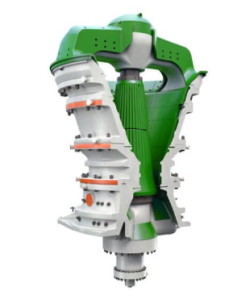
The eccentric bushing in a cone crusher does not rotate. It oscillates. The mantle shaft (main shaft) precesses around the eccentric at a gyration angle of 1.5° to 3°, generating a continuous reciprocating micro-slip at the bushing interface. At a typical eccentric speed of 280–350 RPM and a journal diameter of 380–520 mm, the sliding velocity at the contact surface cycles between near-zero and approximately 1.2–2.4 m/s dozens of times per revolution. This is the classic condition for boundary lubrication failure: the velocity is too intermittent for a stable hydrodynamic oil wedge to form, yet the contact pressure—measured consistently at 14–26 MPa on the eccentric bushing in 200–400 kW cone crushers—is high enough to collapse any marginal oil film immediately.
Under these conditions, the bushing material is not protected by hydrodynamic action. It must survive through its own material properties: its hardness, its self-lubricating microstructure, its ability to embed abrasive particles rather than score the mating surface, and its resistance to adhesive wear (galling). This is the baseline reason why a standard bearing bronze is insufficient and why the wear resistance coefficient specification for crusher bronze bushings is set at levels that initially seem excessive to engineers from other industries.
Quantifying the Wear Resistance Demand: PV Limits and Archard’s Wear Coefficient
In classical bearing tribology, a material’s suitability is often evaluated by its PV limit—the product of contact pressure (P, in MPa) and sliding velocity (V, in m/s). Standard C93200 (SAE 660) bronze, the most common general-purpose bearing alloy, is rated for a continuous PV limit of approximately 1.75 MPa·m/s under lubricated conditions. At 14 MPa contact pressure and 1.5 m/s sliding velocity, the eccentric bushing in a mid-size cone crusher is operating at a PV value of 21 MPa·m/s—twelve times higher than the C93200 continuous PV rating.
The Archard wear equation gives further precision. Wear volume W is proportional to the dimensionless wear coefficient k, the normal load F, and the sliding distance d, and inversely proportional to the material hardness H. For a cone crusher eccentric bushing completing a 4,000-hour service interval on hard granite ore (silica content above 65%), the acceptable volumetric wear loss on a 480 mm diameter, 420 mm long bushing is typically less than 8,000 mm³ total. Back-calculating the required wear coefficient k places the target in the range of 1×10⁻¹⁴ to 5×10⁻¹⁴ m²/N. This is two to three orders of magnitude tighter than what a standard C93200 bushing can reliably deliver in boundary lubrication. Achieving this requires a specific alloy composition and microstructure.
Why C93800 High-Leaded Tin Bronze Is the Standard for Eccentric Bushings
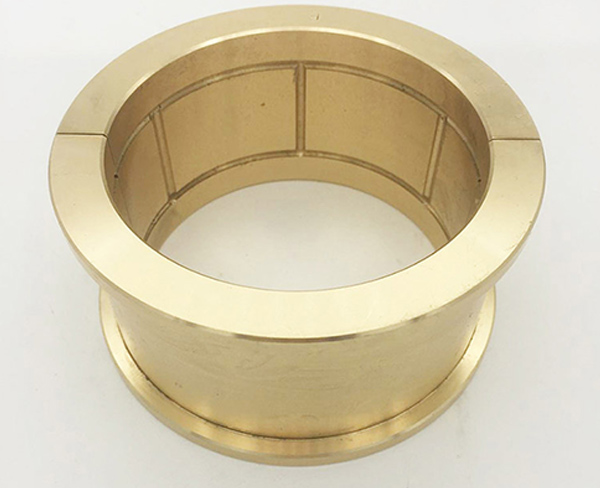
The alloy most consistently specified for cone crusher eccentric bushings is C93800 per ASTM B505, with a nominal composition of Cu 75–79%, Sn 6–8%, and Pb 13–16%. The lead content, which would be considered excessive for any structural application, is the functional core of the material’s wear resistance in this specific context.
Under boundary lubrication conditions, the lead phase—present as soft, dispersed globules averaging 15–50 μm in diameter in a properly cast centrifugal bushing—performs two critical functions simultaneously. First, it smears onto the mating steel journal surface under contact pressure, forming a continuous, low-shear-strength transfer film that reduces the coefficient of friction from approximately 0.18 (bronze-on-steel, boundary lubricated) to approximately 0.06–0.09. This dramatically reduces the frictional heat input that would otherwise accelerate wear and risk thermal seizure. Second, the soft lead matrix allows fine abrasive particles—silica fines that penetrate past the lip seals in quarry environments—to embed beneath the surface rather than remaining as free three-body abrasives that score both the bushing bore and the journal. This embedability mechanism is measurable: a properly formulated C93800 bushing with Ra ≤ 1.6 μm bore finish can embed and neutralize abrasive particles up to approximately 20 μm in diameter.
The tin in C93800 serves an entirely different function. At the composition range of 6–8%, tin promotes the formation of the intermetallic compound Cu₆Sn₅ (epsilon phase), which precipitates as a hard, fine dispersion within the copper matrix. These particles, with microhardness typically in the range of 400–500 HV, act as load-bearing islands that reduce the actual contact area between the bushing and journal under high pressure, preventing the macro-plastic deformation (mushrooming) that destroys bore geometry in softer alloys. The bulk hardness of a correctly heat-treated C93800 casting runs 55–70 HBW—soft enough to conform under load without seizing, hard enough to resist abrasive grooving from ore fines.
Three Failure Modes That Reveal Insufficient Wear Resistance
When a crusher bronze bushing with inadequate wear resistance is installed, the failure typically follows one of three recognizable patterns, each with a distinct forensic signature.
Galling (adhesive wear): The bushing bore develops irregular longitudinal scoring marks 0.5–3 mm deep, often accompanied by welded metallic transfer zones where bronze has cold-welded to the steel journal. This occurs when the PV value exceeds the alloy’s capacity to maintain the lead transfer film, typically within 200–400 operating hours. When I pull a galled bushing, the bore has a characteristic torn appearance—not a smooth wear surface—and the journal often requires regrinding to Ra ≤ 0.8 μm before a replacement bushing can be installed.
Abrasive grooving (three-body abrasion): Circumferential grooves, 0.1–0.5 mm deep and evenly spaced around the bore, indicate that hard particles (silica, iron ore fines above 40 μm) could not be embedded and acted as free abrasives. The bore diameter increases asymmetrically, concentrating load on the upper and lower contact bands. In this failure mode, the journal surface shows matching groove marks but remains otherwise undamaged, which confirms that the problem is bushing material hardness, not contamination alone.
Fatigue spalling (contact fatigue): In high-impact applications—secondary cone crushers processing shot rock or ROM material with frequent tramp iron events—sub-surface fatigue cracks initiate at lead-phase boundaries and propagate to the bore surface, releasing irregular flakes 2–8 mm in diameter. This failure mode is particularly dangerous because the flakes contaminate the lubrication oil circuit, accelerating wear on every other lubricated surface in the crusher simultaneously. An oil analysis showing copper (Cu) content above 150 ppm and lead (Pb) content above 80 ppm in the crusher lube oil is the earliest reliable indicator of active spalling in the eccentric bushing.
Field Case: The Cost of Substituting C93200 for C93800 in a Granite Quarry Application
In a granite quarry operation running a 4-foot cone crusher on 65% SiO₂ granite, a procurement team substituted C93200 (SAE 660) eccentric bushings for the specified C93800 grade, citing a 22% lower unit cost. The C93200 alloy differs critically: lead content drops to 6–8% (versus 13–16% in C93800), reducing the self-lubricating capacity precisely when boundary lubrication is most critical. The first set of C93200 bushings showed measurable galling damage at the 600-hour oil change inspection—bore ovality had reached 0.45 mm against an allowable tolerance of 0.25 mm. Replacement at 900 hours cost approximately 4.2× the initial unit price savings when unplanned downtime, crane mobilization, bushing procurement lead time, and journal regrinding were fully costed. The operation reverted to C93800 specification in the subsequent purchase order.
Pro-Tip from field experience: When receiving a new centrifugal-cast C93800 bushing, always request the mill certificate confirming centrifugal casting (not static casting). Centrifugal casting at 600–900 RPM produces a lead-phase distribution with ≤ 5% porosity and grain size ASTM 4–6, compared to static-cast bushings that frequently exhibit lead segregation toward the outer diameter, leaving the bore-side contact surface lead-depleted and effectively operating as a lower-grade alloy from first contact.
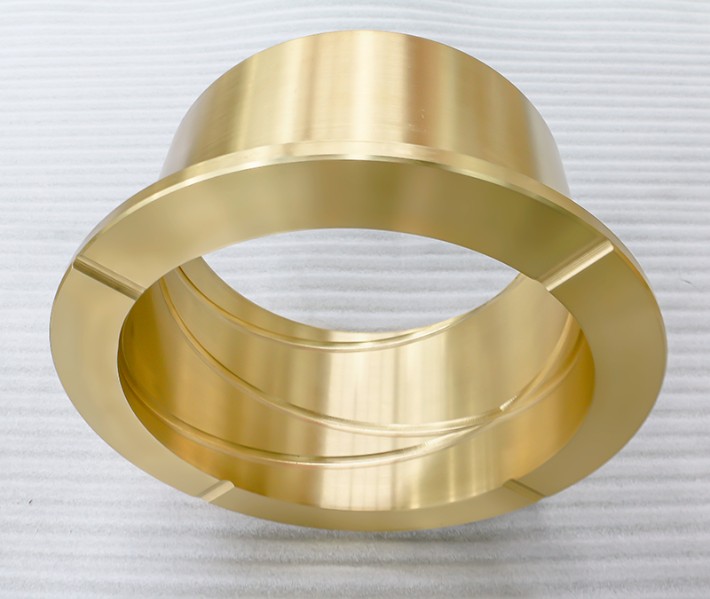
Alloy Comparison for Crusher Bronze Bushing Applications
| Alloy | Standard | Pb Content (%) | Sn Content (%) | Hardness (HBW) | Approx. PV Limit (MPa·m/s) | Recommended Application |
|---|---|---|---|---|---|---|
| C93800 | ASTM B505 | 13–16 | 6–8 | 55–70 | Up to 21+ (boundary lubricated) | Eccentric bushing, socket bushing |
| C93200 (SAE 660) | ASTM B505 | 6–8 | 6.3–7.5 | 60–75 | ~1.75 (continuous) | General bearings, NOT eccentric duty |
| C86300 (Mn Bronze) | ASTM B505 | < 0.2 | < 0.2 | 160–200 | High load, low speed only | Thrust washers, counter-shaft bushings |
| C95400 (Al Bronze) | ASTM B505 | < 0.05 | < 0.1 | 150–180 | Moderate (no self-lubricating) | Frame bushings (low-slip zones) |
Installation Parameters That Directly Affect Wear Rate from Day One
Even the correct alloy will fail prematurely if installation tolerances are ignored. The bore-to-journal diametral clearance for a C93800 eccentric bushing must be held within 0.10–0.20 mm on a correctly sized application (verify against OEM drawing—this value scales with journal diameter). A clearance below 0.10 mm starves the oil film at startup, generating immediate boundary wear. A clearance above 0.25 mm allows the journal to impact the bushing bore at each gyration cycle, initiating fatigue cracking at the bore surface within 300–500 hours.
The interference fit between the bushing outer diameter and the eccentric housing bore must be maintained at 0.05–0.12 mm (check OEM tolerance stack for your specific machine). Under-interference allows fretting corrosion at the housing contact, which ejects fine iron oxide particles directly into the eccentric lubrication circuit—these 1–5 μm particles are small enough to pass most oil filters and large enough to accelerate abrasive wear at the bore surface. During installation, heat the eccentric housing to 80–100°C (do not exceed 120°C, which risks dimensional distortion) and use a dead-blow mallet or hydraulic press with a full-face driver plate. Never use an impact hammer directly on the bushing end face—the compressive shock propagates as a tensile wave at the opposite end, initiating circumferential cracking in the lead-tin matrix that becomes visible as spalling after 400–600 hours.
Predictive Maintenance: Reading the Oil Analysis Data for Bushing Wear
A crusher lubrication oil analysis program that monitors copper (Cu) and lead (Pb) concentrations provides a continuous, non-intrusive signal of eccentric bushing wear rate. Establish a baseline at the 250-hour first sample on a new bushing set. Normal wear-in generates Cu concentrations of 20–60 ppm and Pb concentrations of 15–45 ppm at the 250-hour mark, declining to steady-state levels of 10–30 ppm Cu and 8–25 ppm Pb by the 500-hour sample.
A rate-of-rise in Cu above 15 ppm per 250-hour interval, or a sudden spike in Pb above 100 ppm at any sample, indicates active boundary wear or early spalling respectively. Either condition justifies a bore inspection at the next scheduled maintenance window. Iron (Fe) concentrations above 50 ppm alongside elevated Cu and Pb confirm that the mating journal surface is also wearing—meaning the bushing wear has progressed to a stage where journal regrinding will be required regardless of whether the bushing is replaced immediately or allowed to run to the next planned interval.
Total Cost of Ownership: Why the Higher Wear Resistance Coefficient Pays for Itself
| Cost Category | Low-Cost Aftermarket (C93200 grade) | OEM-Spec C93800 (Centrifugal Cast) |
|---|---|---|
| Unit bushing cost (eccentric set) | $1,800 (baseline) | $2,340 (+30%) |
| Average service life (granite, 65% SiO₂) | 900–1,200 hours | 3,500–4,500 hours |
| Replacement frequency per 4,000 hours | 3–4 sets | 1 set |
| Unplanned downtime events | 2–3 (galling failures) | 0–1 (scheduled only) |
| Journal regrinding cost (per event) | $2,200–$4,500 (frequent) | $0–$2,200 (rare) |
| Estimated 4,000-hour TCO | $14,000–$19,500 | $4,500–$6,800 |
The wear resistance coefficient of a crusher bronze bushing alloy is not a marketing specification. It is the numerical expression of whether a material can survive a tribological environment that is categorically more severe than any standard bearing application. The oscillating boundary lubrication conditions, the contact pressures between 14 and 26 MPa, the abrasive contamination from ore fines, and the shock loads from tramp iron events collectively demand a material—specifically a high-leaded tin bronze such as C93800 per ASTM B505, centrifugally cast to ASTM grain size 4–6, with bore finish Ra ≤ 1.6 μm—whose wear resistance coefficient is engineered at the microstructural level. Substituting a lower-specification alloy to reduce the line-item purchase cost is a documented path to higher total operating cost, shorter journal life, and unplanned production stoppages.