A 120mm Journal Worn to 118.3mm — That’s When You Start Asking Hard Questions About Your Supplier
I walked into a copper mine in Inner Mongolia in the spring of 2019, and the HP500 had been down for 11 days. The eccentric bushing had failed at under 3,000 operating hours — roughly a third of what it should have delivered. When we pulled the part, the alloy composition told the whole story: the phosphorus content in the bronze was sitting near 0.08%, well below the C93800 specification that mandates a tin content of 7–8% and lead of 13–15% for heavy-load sliding surfaces. Someone had sourced a cheap substitute, and the operation paid for it in downtime costs that dwarfed any savings on the original purchase.
That experience is exactly why procurement decisions for cone crusher parts cannot be reduced to a price-per-kilogram comparison. This guide is written for engineers and purchasing managers who need a structured framework for evaluating Chinese suppliers — one that goes beyond catalog claims and focuses on verifiable technical, metallurgical, and logistical criteria.
Why China Remains the Dominant Source for Cone Crusher Parts
China’s foundry and machining ecosystem has matured significantly over the past two decades. Several manufacturers now operate ISO 9001:2015-certified facilities with spectroscopic alloy verification equipment, CNC vertical lathes capable of holding tolerances of ±0.05mm, and heat treatment furnaces with automated atmosphere control. For wear parts such as the mantle and bowl liner, Mn18Cr2 high-manganese steel — conforming to ASTM A128 Grade E-1 — is now produced routinely at competitive prices, with hardness values post-work-hardening exceeding 450 HBW in service.
The challenge is not whether quality cone crusher parts exist in China. They do. The challenge is identifying which suppliers consistently produce to specification and which ones rely on documentation that looks correct on paper but does not reflect the actual casting.
Key Criteria for Evaluating a Chinese Cone Crusher Parts Supplier
1. Material Authenticity and Traceability
The first question to ask any supplier is not “What is your price?” but “Can you provide a mill certificate and third-party spectroscopic analysis report for this batch?” For manganese steel wear parts, the certificate should confirm Mn content between 17–19% and Cr between 1.5–2.5%, consistent with Mn18Cr2 grade. For bronze bushings used in the eccentric and frame, C93800 or equivalent should show Sn at 7–8%, Pb at 13–15%, and Cu as the remainder, with hardness around 60–65 HRB.
Suppliers who cannot produce batch-level traceability documents are, in my experience, not worth further evaluation regardless of how attractive their pricing appears.
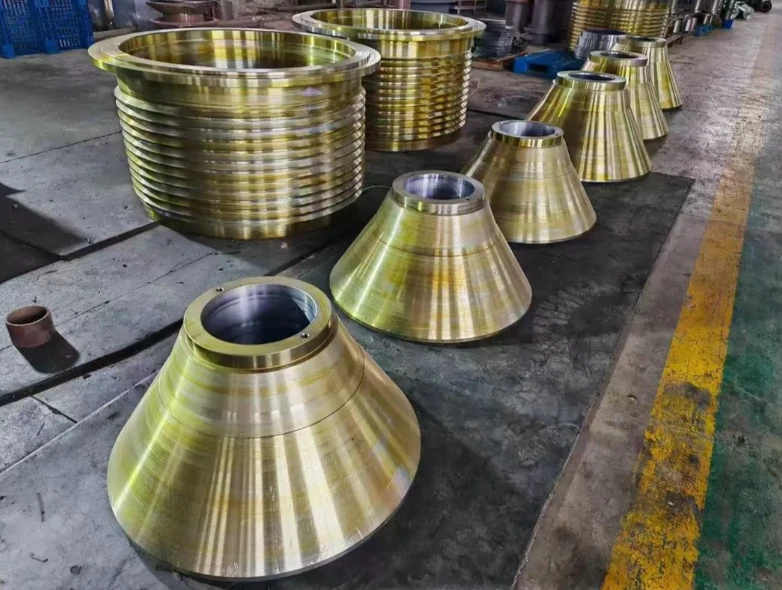
2. Casting Technology: Centrifugal vs. Static Casting for Bushings
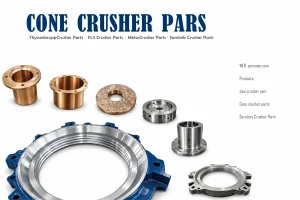
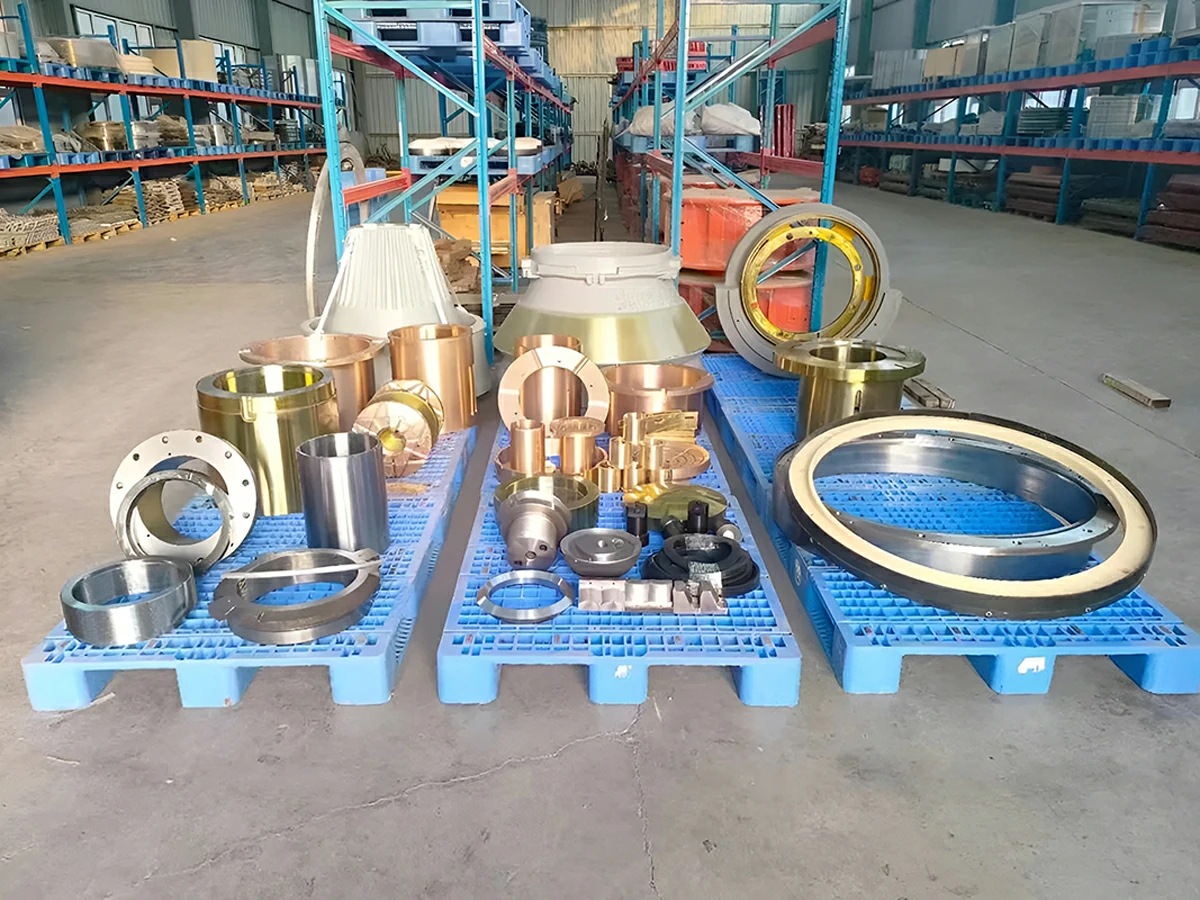
One of the most meaningful differentiators for bronze cone crusher parts — particularly the eccentric bushing and frame bushing — is whether the supplier uses centrifugal casting or conventional static sand casting. Centrifugal casting applies rotational forces during solidification, which forces denser metallic phases outward and drives gas porosity toward the inner bore where it can be machined away. The result is a bushing with a surface grain structure that is 15–20% denser near the outer diameter, improving load-bearing capacity under the 180 MPa impact stresses typical of a GP550 or HP400 operating on hard granite.
Static-cast bushings may appear dimensionally identical, but their internal structure often contains distributed microporosity. Under cyclic loading, this porosity becomes the initiation site for galling — a failure mode where micro-welding occurs between the bronze and the mating steel shaft surface, typically visible as smeared metallic transfer marks on the journal at disassembly.
| Property | Centrifugal Cast Bushing | Static Cast Bushing |
|---|---|---|
| Microporosity | Low (concentrated at bore, machined out) | Distributed throughout cross-section |
| Hardness (typical) | 62–65 HRB | 55–60 HRB |
| Fatigue resistance | High | Moderate |
| Galling risk | Low | Moderate to High |
| Typical service life | 8,000–12,000 hours | 3,000–6,000 hours |
3. Machining Precision and Surface Finish
For cone crusher parts that involve sliding or rotating contact — eccentric bushing bore, socket liner inner surface, main shaft sleeve — the surface roughness specification matters as much as the alloy composition. The bore surface of an eccentric bushing should achieve Ra ≤ 1.6 μm, ideally Ra ≤ 0.8 μm for high-speed eccentrics. Any supplier claiming compliance should be able to provide surface profilometer readings from production samples, not just stated in a catalog.
Dimensional accuracy for bore diameters should be held to H7/h6 fit tolerances as a minimum, which for a 300mm eccentric bore translates to a tolerance band of approximately +0.052mm / 0 on the hole and 0 / -0.033mm on the shaft. When these tolerances are exceeded — as they frequently are with low-cost aftermarket cone crusher parts — the resulting clearance variations cause oil film instability, temperature spikes, and accelerated wear.
4. Product Range Depth and Cross-Brand Coverage
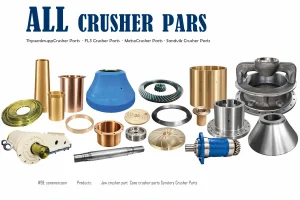
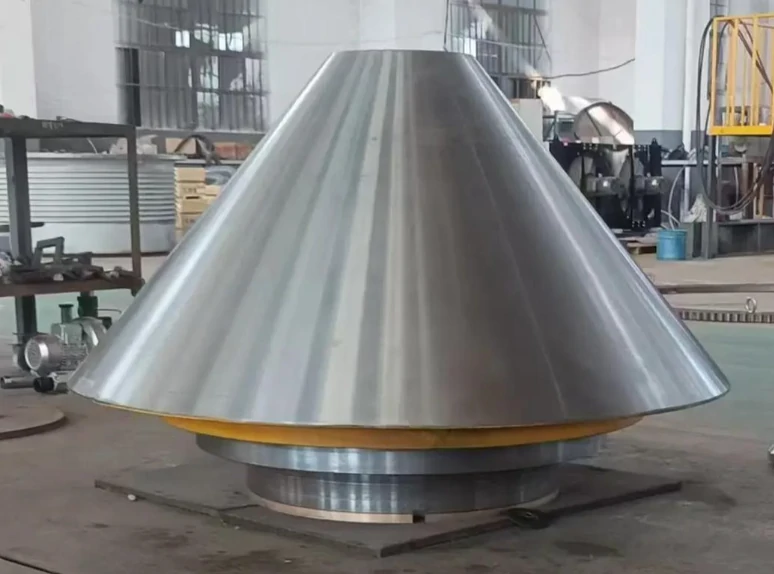
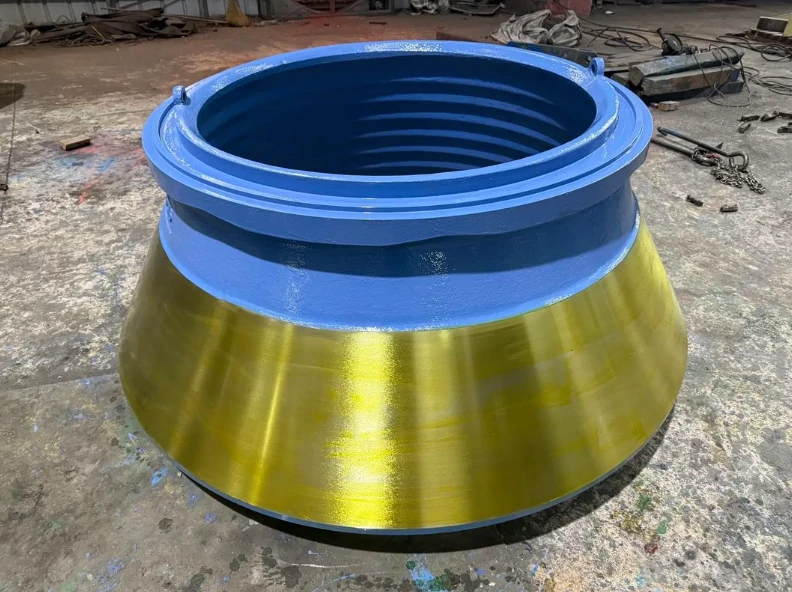
A supplier worth building a long-term relationship with should carry cone crusher parts across multiple major OEM references: Sandvik (CH/CS series), Metso (HP/GP/MP series), Terex Finlay, and Telsmith at a minimum. This cross-brand capability indicates that the supplier maintains engineering drawings and tooling for diverse geometries rather than producing a single product line opportunistically.
5. Lead Time and Inventory Structure
Unplanned downtime costs in primary crushing circuits typically run between USD 8,000 and USD 25,000 per day depending on plant capacity and commodity price. A supplier who quotes 60–90 days lead time for standard mantle and concave sets is not a viable partner for operations that require emergency response capability. The best Chinese cone crusher parts suppliers maintain finished goods inventory for the highest-demand wear part SKUs and can ship standard items within 3–7 business days via air freight.
Pro-Tip from the Field: I always ask a prospective supplier one specific question during vetting: “If I place an emergency order today for a Sandvik CH440 mantle in M grade, what is your earliest confirmed ship date?” Their answer — and how quickly they can give it — tells me more about their actual inventory position than any stock availability claim on their website. A supplier who hesitates, needs to “check with the warehouse,” or quotes 30+ days for a common part like this is likely running a made-to-order operation with limited buffer stock.
Field Installation Guidelines for Cone Crusher Wear Parts
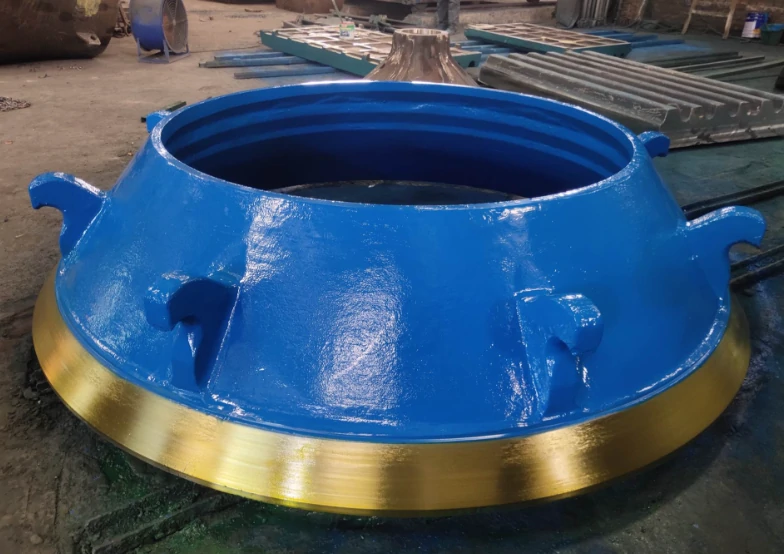
Mantle and Bowl Liner Installation
- Clean the head and bowl frame contact surfaces to bare metal. Residual epoxy from the previous fill can create high spots that cause rocking and uneven seating.
- Apply zinc-rich backing compound or epoxy backing material in a consistent layer, targeting a final cured thickness of 12–18mm. Avoid voids, particularly near the upper and lower contact bands.
- Allow epoxy to cure for a minimum of 24 hours at ambient temperature above 15°C before loading the crusher.
- On initial startup, run the cone crusher empty for 30 minutes and verify oil temperature stabilizes below 55°C at the return line before introducing feed material.
Eccentric Bushing Replacement
- Measure the mating eccentric journal diameter at three axial positions before installing a new bushing. Record all readings. If any taper or out-of-round condition exceeds 0.10mm, the journal must be reground before the new bushing is installed.
- Verify bore clearance after installation. For most HP-series eccentrics, the design clearance is 0.15–0.25mm. Clearance below 0.12mm risks oil starvation during thermal expansion at operating temperature.
- Apply a thin coat of assembly lubricant (not grease) to the bushing bore during installation to prevent galling on initial startup before the lubrication circuit reaches full pressure and flow.
Preventive Maintenance: Using Oil Analysis to Protect Cone Crusher Parts
Oil analysis is underutilized in crushing circuit maintenance, yet it provides the earliest available warning for bushing wear before any dimensional measurement is possible. A copper (Cu) concentration above 80 ppm in a lube oil sample from a cone crusher indicates active bronze bushing wear. At 150 ppm Cu, I recommend scheduling an inspection within the next 200 operating hours. At 300 ppm or above, pull the machine from service and inspect immediately — continued operation risks journal scoring that will require shaft grinding or replacement in addition to new cone crusher parts.
Iron (Fe) levels above 100 ppm in the oil sample indicate mainframe or eccentric steel wear, often associated with inadequate clearance or contaminated lube oil. Particle count analysis (ISO 4406) should target cleanliness at 18/16/13 or better for long component life.
Total Cost of Ownership: Chinese OEM-Grade vs. Low-Cost Aftermarket
| Cost Category | OEM-Grade Chinese Supplier | Low-Cost Aftermarket |
|---|---|---|
| Unit purchase price (eccentric bushing, HP400) | USD 1,800–2,400 | USD 900–1,200 |
| Average service life | 9,000 hours | 3,500 hours |
| Replacements per 18,000 hours | 2 | 5 |
| Labor cost per change (USD) | USD 600 | USD 600 |
| Unplanned downtime risk | Low | High (1–2 events per 18,000 hrs) |
| Estimated TCO over 18,000 hours | USD 6,000 | USD 13,500+ |
The TCO analysis above does not include potential secondary damage costs — journal regrinding at USD 4,000–8,000 or mainframe repair — which almost exclusively occur as a consequence of low-quality cone crusher parts failing prematurely. When those events are factored in, the real cost differential widens further.
FAQ: Common Questions About Sourcing Cone Crusher Parts from China
Q1: How do I verify that a Chinese supplier is actually using Mn18Cr2 and not a lower manganese grade?
Request a third-party spectrographic analysis certificate (OES test report) from an accredited lab such as SGS or Bureau Veritas, issued for your specific order batch — not a generic certificate from a previous production run. The report should show Mn between 17–19% and Cr between 1.5–2.5%. If a supplier refuses this request or offers only an in-house test report, treat that as a disqualifying response.
Q2: What is the correct installation torque for the locking bolt on a cone crusher mantle?
This varies by crusher model. As a general reference, for a Sandvik CH440 the locking nut torque is typically 1,500–1,800 Nm applied in stages. Always consult the OEM service manual for your specific machine. Undertorquing allows the mantle to spin on the head under load, which will destroy the backing compound and score the head bronze within hours of operation.
Q3: How should cone crusher bronze bushings be packaged for long-distance sea freight?
Bushings should be individually wrapped in VCI (vapor corrosion inhibitor) film, then placed in wooden crates with foam padding to prevent any surface-to-surface contact during transit. The bore surface is the most critical area — any impact damage to the bore will compromise the running clearance and may not be visible without precise measurement at incoming inspection. Request that bore plugs be installed by the supplier before crating.
Q4: My cone crusher is running hotter than normal after installing new parts — what should I check first?
Check the eccentric bushing clearance first. Insufficient clearance — below 0.12mm for most HP-series machines — restricts oil film development and causes thermal buildup. Also verify that the lube oil circuit flow rate and pressure are within specification: typically 30–45 L/min return flow at a supply pressure of 2.5–3.5 bar. If the clearance is correct and the lubrication system is functioning, pull an oil sample and check for elevated Cu or Fe particle counts, which may indicate a material or surface finish issue with the installed cone crusher parts.
Q5: What is a realistic lead time for custom-profile mantles from a Chinese supplier, and how can it be shortened?
Custom profile mantles — particularly for non-standard closed-side settings or special feed arrangements — typically require 25–45 days from pattern approval to shipment if the supplier needs to produce new tooling. This can be shortened to 15–20 days for suppliers who maintain a library of pattern equipment for common OEM profiles. To minimize future lead times, establish a blanket order arrangement with your preferred supplier at the start of each operating year, committing to a minimum annual volume in exchange for guaranteed stock priority and fixed pricing.