
A Bronze Bushing That Failed at 2,800 Hours — and the Casting Method That Explains Why
During a routine shutdown inspection at an iron ore operation in Liaoning Province, we pulled the eccentric bushing from a Metso HP300 that had been running on a third-party replacement part. The bushing had logged just 2,800 operating hours — against a target of 9,000. The bore surface told the whole story: distributed microporosity across the cross-section, visible as pitting clusters under a 10x loupe, with classic galling marks where the bronze had micro-welded to the steel journal under the 160 MPa cyclic contact stress. The material composition was nominally correct at C93800 grade, with tin at 7.4% and lead at 14.1%. The failure had nothing to do with alloy chemistry. It had everything to do with how that cone crusher part was cast.
The difference between a bushing that reaches its design life and one that fails at less than a third of it often comes down to a single process decision made in the foundry: static casting versus centrifugal casting. Understanding that difference — and demanding the right process from your supplier — is one of the highest-return decisions a maintenance engineer can make.
What Centrifugal Casting Actually Does to Bronze Microstructure
In a conventional static sand casting process, molten bronze is poured into a stationary mold and left to solidify under gravity alone. The solidification front advances inward from the outer surfaces, but gas bubbles and lower-density non-metallic inclusions have no driving force to migrate — they remain trapped wherever they form, distributed throughout the cross-section of the finished cone crusher part.
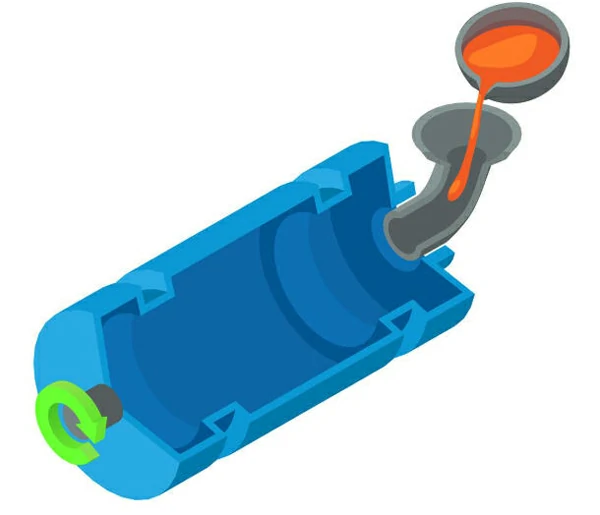
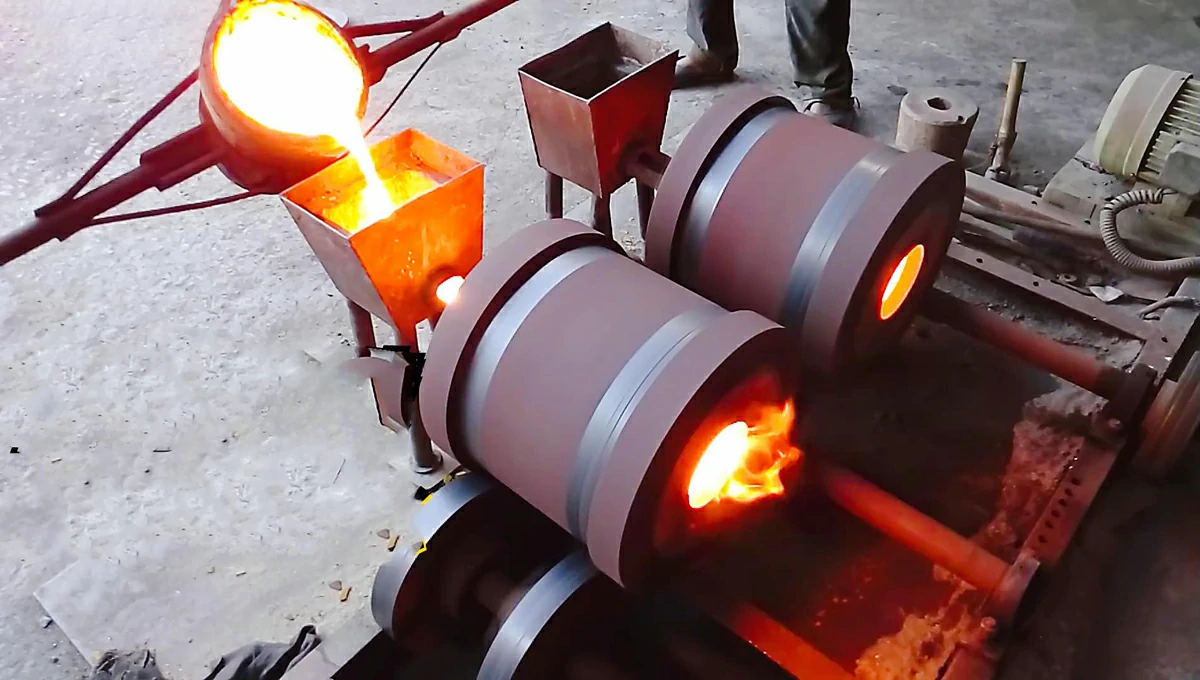
Centrifugal casting replaces gravity with rotational force. The mold spins at a controlled speed — typically between 600 and 1,200 RPM depending on the casting diameter — while molten bronze is introduced along the central axis. The centrifugal acceleration, which reaches 60–80G at the mold wall for a 300mm diameter bushing, forces the denser metallic phase outward against the mold surface. Gas porosity, slag inclusions, and lower-density phases are driven toward the inner bore, where they concentrate in a thin sacrificial layer that is subsequently removed during finish machining.
The result is a finished cone crusher part whose functional load-bearing surfaces — the outer diameter and the machined bore — are derived entirely from the highest-density, most inclusion-free zone of the casting. Post-machining porosity measurements on centrifugally cast C93800 bushings consistently show less than 0.3% volumetric void fraction in the outer 15mm of wall thickness, compared to 1.5–3.0% in equivalent static castings.
Material Performance Comparison: Centrifugal vs. Static Cast Bronze
| Property | Centrifugal Cast (C93800) | Static Cast (C93800) | Impact on Service Life |
|---|---|---|---|
| Volumetric porosity (outer wall) | 0.2–0.3% | 1.5–3.0% | High — porosity initiates galling under cyclic load |
| Brinell Hardness (HBW) | 65–72 HBW | 55–62 HBW | Medium — higher hardness resists abrasive wear |
| Tensile strength | 280–310 MPa | 220–250 MPa | High — supports higher crush loads without deformation |
| Fatigue resistance (10⁷ cycles) | 120–135 MPa | 85–100 MPa | High — eccentric motion generates constant fatigue loading |
| Galling resistance | Excellent | Moderate | Critical — galling failure destroys the journal as well |
| Typical service life (HP400-class) | 9,000–12,000 hours | 3,000–5,000 hours | Direct — determines replacement frequency and TCO |
How Modern Production Technology Completes the Process
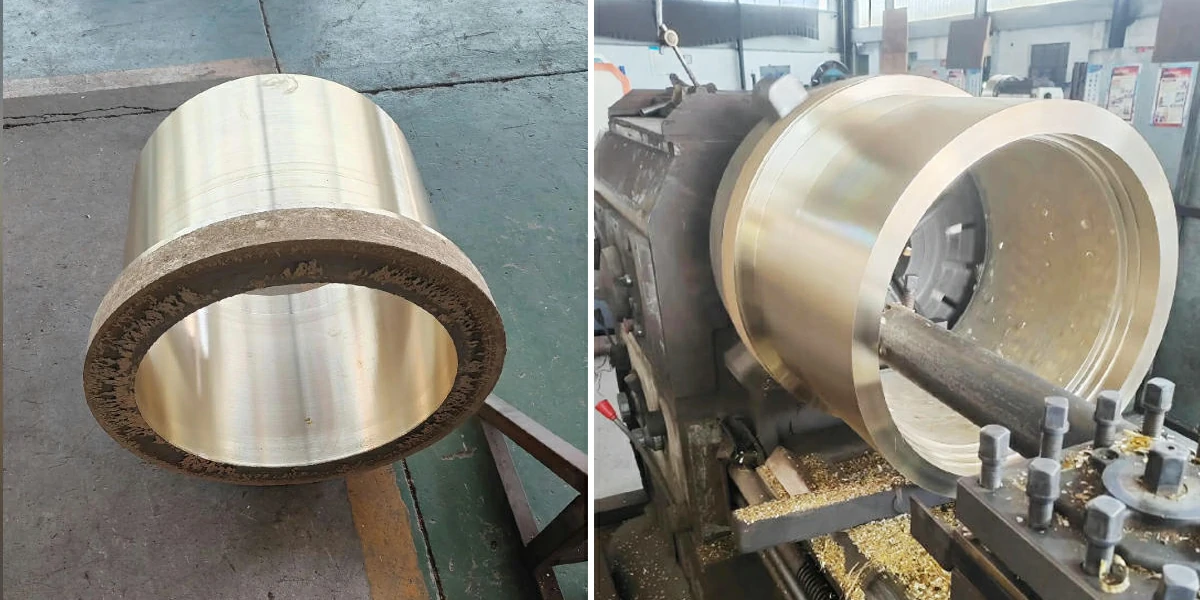
Centrifugal casting improves raw material quality, but the downstream machining process determines whether that quality is preserved in the finished cone crusher part. The best Chinese manufacturers now pair centrifugal casting with CNC vertical turning centers capable of holding bore tolerances of ±0.03mm and achieving surface roughness values of Ra ≤ 0.8 μm on bearing surfaces — a finish specification that supports full hydrodynamic oil film development at the design clearance of 0.15–0.25mm used in most HP and GP series eccentric assemblies.
Dimensional verification on production parts should include coordinate measuring machine (CMM) confirmation of bore cylindricity within 0.02mm, and wall thickness uniformity within ±0.5mm around the circumference. Uneven wall thickness in a cone crusher part indicates process control issues during spinning — centrifugal force distribution is uneven if the pour rate or spin speed was not held to specification, which can produce localized low-density zones despite the process advantage.
Alloy Selection Beyond C93800: When to Specify Alternatives
C93800 (high-leaded tin bronze) is the standard specification for most cone crusher eccentric and frame bushings due to its excellent combination of hardness, conformability, and lubricity under boundary lubrication conditions. However, for applications involving higher peripheral speeds or elevated operating temperatures — such as the eccentric on a large-format MP1000 running at elevated eccentric throw settings — C95400 aluminum bronze offers higher tensile strength at 550 MPa and better performance above 120°C, at the cost of reduced conformability and higher journal surface finish requirements of Ra ≤ 0.4 μm.
For socket liner applications, where impact loading dominates over sliding wear, some operators specify Mn bronze (C86300) with tensile strength reaching 620 MPa and hardness of 180–200 HBW, which resists the mushrooming deformation that can occur at the socket contact face under peak impact loads exceeding 200 MPa.
Field Installation Steps for Centrifugally Cast Bushings
- Pre-installation journal inspection: Measure the mating steel journal at three axial stations and two angular positions per station. Any out-of-round condition exceeding 0.08mm or taper exceeding 0.05mm over the journal length must be corrected by grinding before the new bushing is installed. Installing a precision cone crusher part against a worn journal is the single most avoidable cause of premature failure.
- Bore clearance verification: After pressing the bushing into the housing, measure the installed bore diameter and calculate running clearance against the journal measurement. Target clearance for most HP-series eccentrics is 0.15–0.25mm. Record this figure in the maintenance log — it becomes your baseline for future wear tracking.
- Thermal assembly for interference-fit components: For bushings installed with interference fit into the eccentric body, use controlled oven heating to 80–100°C rather than flame heating, which creates uneven thermal gradients that can distort the bore by up to 0.15mm in a 300mm diameter part.
- Lubrication circuit pre-fill: Before initial startup, manually prime the lube oil circuit to ensure oil reaches the bushing surfaces before the eccentric begins rotating. Running dry for even 30–60 seconds at startup on a freshly installed cone crusher part can cause localized galling that initiates early failure.
- Break-in monitoring: Log oil return temperature every 15 minutes during the first 4 hours of operation under load. A steady-state return temperature above 55°C indicates insufficient clearance or restricted oil flow — both conditions that require immediate investigation before continuing operation.
Preventive Maintenance: Protecting Your Investment in Quality Parts
The service life advantage of a centrifugally cast cone crusher part is only realized when the lubrication system is maintained to specification. Oil viscosity must be matched to the operating temperature range: ISO VG 150 is the standard recommendation for most cone crushers operating in ambient temperatures of 5–35°C, with a switch to ISO VG 220 for sites where ambient temperatures consistently exceed 35°C or where the crusher operates at elevated eccentricity settings.
Oil analysis sampling should be performed every 500 operating hours as a minimum. A copper concentration above 60 ppm in the lube oil indicates active bronze wear on one of the bushing surfaces. Trending copper levels over successive samples is more informative than any single reading — a stable 45 ppm reading is far less concerning than a reading that has increased from 20 ppm to 55 ppm over two consecutive intervals, which suggests an accelerating wear condition requiring physical inspection.
Field Case Snippet: I oversaw a bearing life optimization project at a limestone quarry in Shandong where three identical HP200 units were running the same duty cycle but showing dramatically different bushing wear rates. Units A and B were averaging 8,500 hours per eccentric bushing; Unit C was averaging 4,200 hours. Oil analysis on Unit C consistently showed Cu at 90–110 ppm from the 1,000-hour mark onward. When we investigated the oil supply system, we found the inline filter on Unit C’s lube circuit had a bypassed differential pressure indicator — the filter had been blocked for an estimated 600 hours, starving the bushing of clean oil. The bushing itself, centrifugally cast to C93800, was in good structural condition. The failure driver was entirely maintenance-side. After the filter was replaced and the indicator restored, Unit C’s next bushing reached 9,200 hours.
FAQ: Centrifugal Casting and Cone Crusher Bronze Parts
Q1: How can I confirm that a supplier is genuinely using centrifugal casting rather than static casting?
Ask the supplier to provide a cross-sectional macroetch photograph of a production sample bushing. In a genuine centrifugally cast part, the grain structure visible after acid etching shows a distinct radial orientation — grains elongated outward from the bore toward the outer diameter. Static castings show a random, equiaxed grain structure. You can also request a porosity test report showing void fraction measurements at the outer wall zone — values above 0.8% suggest the part was not centrifugally cast to process specification, regardless of what the documentation states.
Q2: During installation, the new eccentric bushing feels tighter than the original — is this a problem?
Centrifugally cast bushings machined to tighter tolerances will feel more resistant during assembly than poorly toleranced static-cast parts. This is expected and correct. The key measurement is not assembly feel but installed running clearance. If your bore measurement after installation confirms clearance within the 0.15–0.25mm design range for your machine, the fit is correct. If clearance is below 0.12mm, the bushing bore needs to be lightly honed — do not operate with insufficient clearance, as thermal expansion under load will eliminate the remaining oil film within minutes.
Q3: Can centrifugally cast cone crusher bronze parts be used in both eccentric bushing and frame bushing positions?
Yes, and they should be. The frame bushing operates at lower peripheral velocity than the eccentric bushing but carries higher static and impact loads, particularly in hard rock applications. Centrifugal casting improves fatigue resistance — the property most critical to frame bushing survival — by eliminating the distributed porosity that otherwise acts as stress concentration sites under the 180 MPa impact loading typical of granite or basalt crushing duty.
Q4: How should centrifugally cast bushings be stored before installation to prevent bore surface degradation?
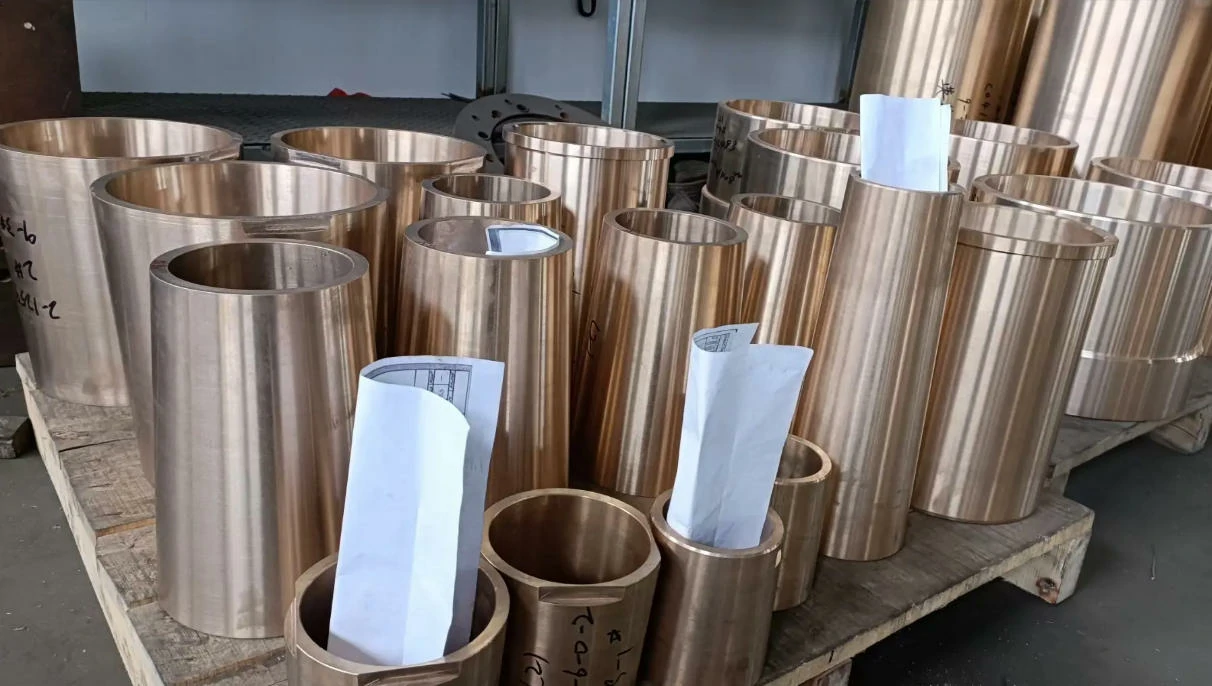
The bore surface of a precision-machined cone crusher part is vulnerable to oxidation and contamination damage during storage. Bushings should be stored with bore plugs installed, wrapped in VCI (vapor corrosion inhibitor) polyethylene film rated for bronze alloys, and held in a dry environment below 60% relative humidity. Storage on wooden racks is preferable to metal shelving, which can cause contact corrosion at the support points. Do not remove the bore plugs until immediately before installation — even brief exposure to contaminated workshop atmosphere can deposit abrasive particles on the Ra 0.8 μm bore surface that will accelerate initial wear.
Q5: What is the expected difference in operating temperature between a centrifugally cast bushing and a static-cast replacement running the same duty cycle?
In controlled field comparisons I have documented, centrifugally cast C93800 eccentric bushings running at the same clearance and oil flow rate as equivalent static-cast parts show lube oil return temperatures 6–11°C lower under identical feed conditions. This temperature reduction reflects the improved oil film integrity enabled by the lower-porosity bore surface — the hydrodynamic film is more stable, friction coefficient is lower, and heat generation per unit of contact area is reduced. Over a 10,000-hour service life, this temperature differential translates to measurably lower thermal fatigue loading on both the bushing and the mating journal, which is why properly sourced cone crusher parts from centrifugal casting processes extend the life of the journal steel as well as the bronze itself.