Engineering High-Load Bronze Components: The Shift to Centrifugal Casting
Radial forces inside a high-capacity crushing chamber routinely exceed 400,000 pounds during peak operation, transferring massive kinetic energy directly into the eccentric assembly. Under these extreme boundary lubrication conditions, a subpar bronze bushing acts as a fatal weak link, leading to catastrophic bearing failure, eccentric shaft scoring, and unplanned plant shutdowns. The manufacturing methodology behind a replacement bronze cone crusher part dictates the entire operational uptime of a processing plant. Consequently, metallurgical engineering has shifted aggressively away from traditional static sand casting toward advanced centrifugal casting techniques, fundamentally altering the grain structure and mechanical resilience of these critical components.

Material Composition Analysis: Overcoming Static Casting Limitations
The operational environment of an eccentric bushing requires an alloy that balances high compressive strength with exceptional lubricity. Heavy-duty crushers predominantly rely on high-leaded tin bronzes, such as C93800 or C93200, which contain specific ratios of copper, tin, and lead. The tin matrix provides the necessary hardness and load-bearing capacity, while the lead remains dispersed throughout the alloy to provide emergency dry-lubrication when hydrodynamic oil films momentarily collapse during severe shock loads, such as tramp iron events.
When a manufacturer produces a cone crusher part using traditional static sand casting, the cooling process is slow and multi-directional. This lack of controlled thermal dynamics results in a coarse, inconsistent grain structure. More critically, static cooling traps microscopic gas bubbles and allows localized shrinkage, creating internal porosity. These microscopic voids act as stress concentrators. Under continuous cyclic loading, a static-cast cone crusher part will develop micro-fractures originating from these voids, ultimately culminating in premature spalling or total structural fatigue.
Conversely, centrifugal casting transforms the alloy’s microstructure at a fundamental level. By pouring molten bronze into a die spinning at high velocities, the metal is subjected to gravitational forces exceeding 100 Gs. This extreme pressure forces the heavier, denser molten metal outward against the die wall, while lighter impurities, oxides, and trapped gases are forced to the inner diameter, which is subsequently machined away. Furthermore, the chilled die induces rapid, directional solidification from the outside in. This unidirectional cooling drastically reduces dendrite arm spacing, creating a highly refined, tightly packed molecular grain structure.
Comparative Performance Metrics
The mechanical advantages of this controlled solidification are measurable and significant. A centrifugally cast component exhibits dramatically higher resistance to deformation and wear compared to its sand-cast equivalent.
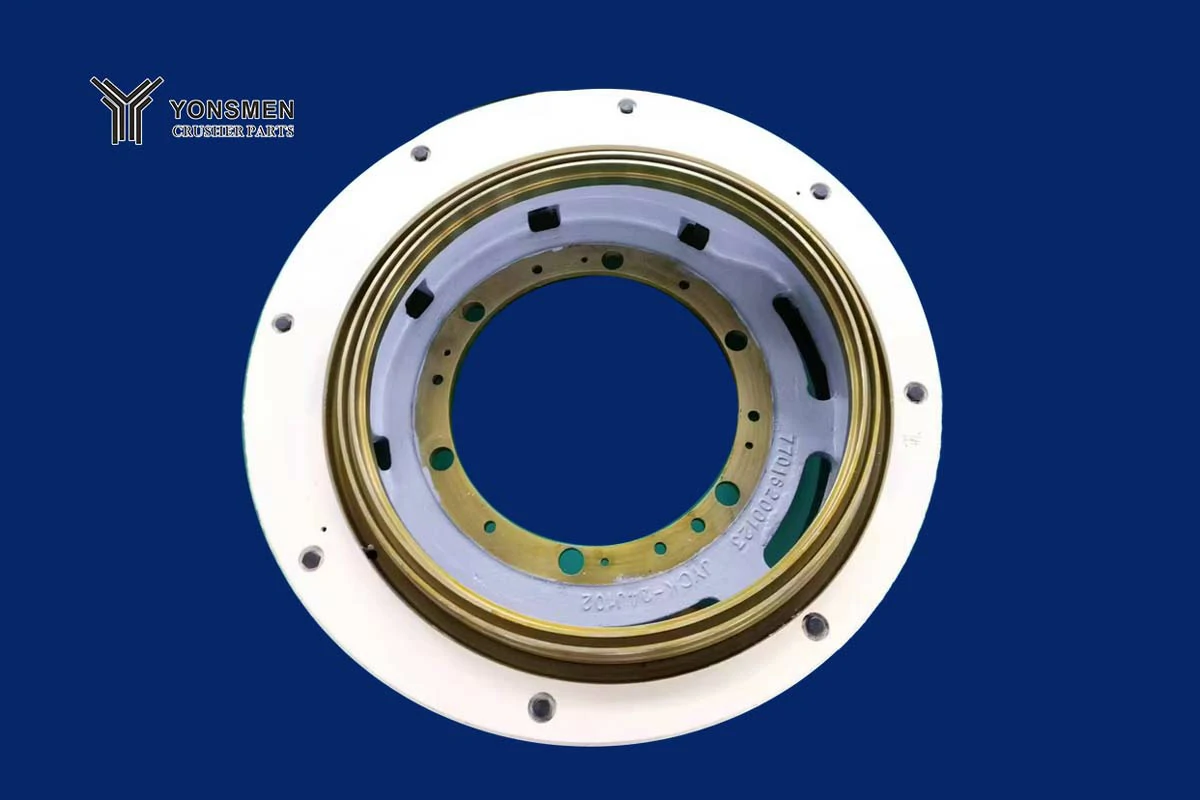
| Mechanical Property | Static Sand Casting (C93800) | Centrifugal Casting (C93800) | Operational Impact on Component |
| Tensile Strength | 25,000 psi | 35,000+ psi | Higher resistance to tearing under heavy radial loading. |
| Yield Strength | 14,000 psi | 19,000+ psi | Prevents permanent dimensional distortion of the bore. |
| Brinell Hardness (HB) | 55 – 60 | 75 – 85 | Reduced abrasive wear from microscopic silica particles in oil. |
| Elongation | 10% | 15% | Better absorption of shock loads without catastrophic cracking. |
[Field Case Snippet]: Surviving Tramp Iron in a High-Yield Copper Mine
Back in 2021, I was consulting at a Tier-1 copper operation in the Chilean Andes where the primary gyratory and secondary cones were constantly battling un-crushable tramp metal from broken excavator teeth. Their maintenance team was replacing a critical bronze cone crusher part in the eccentric assembly every 800 hours due to severe wiping and cracking. I sectioned one of the failed bushings and immediately identified gross porosity inherent to cheap sand casting. We replaced the entire inventory with centrifugally cast C93800 bushings. Three months later, a massive piece of tramp iron stalled the secondary crusher. Historically, this event would have shattered the sand-cast bushing, requiring a 48-hour tear-down. Instead, the centrifugally cast cone crusher part absorbed the kinetic shock. We found minor scoring that was easily polished out, and that exact bushing went on to clear 3,200 operating hours. The dense grain structure quite literally saved them a quarter-million dollars in lost production.
Precision Field Installation Protocol
Even the highest-quality alloy will fail if installed incorrectly. An eccentric bronze bushing relies on a precise interference fit within the cast steel eccentric to prevent spinning and maintain proper oil flow geometry. The following procedures are mandatory for field engineers.
- Dimensional Verification: Before any thermal manipulation, use a calibrated inside micrometer to measure the bore of the steel eccentric and an outside micrometer for the new bronze component. Calculate the actual interference fit. It must align strictly with the OEM tolerance specifications to ensure the part does not compress the inner bore diameter upon installation.
- Thermal Contraction: Never use a hydraulic press to force a bronze component into the eccentric at ambient temperatures, as this shears metal and compromises the fit. Submerge the bronze bushing in a bath of liquid nitrogen or pack it thoroughly in dry ice for a minimum of four hours. The extreme cold shrinks the overall diameter of the part, allowing it to drop freely into the steel housing.
- Rapid Seating and Alignment: Once removed from the cooling medium, the engineer has a very narrow time window. Drop the part smoothly into the eccentric bore, ensuring the alignment pins or dowel holes index perfectly before the bronze begins to absorb ambient heat and expand. Use a dead-blow hammer and a specialized driving block to ensure the flange seats fully flush against the eccentric body.
- Clearance Checking: Once the assembly reaches ambient temperature, use feeler gauges and telescoping bore gauges to verify the inner running clearances against the main shaft. An improperly seated component will show uneven clearances, leading to immediate localized overheating upon startup.
Advanced Preventive Maintenance Guidelines
To maximize the lifespan of a newly installed cone crusher part, maintenance teams must transition from reactive repairs to predictive monitoring. The lubrication system is the lifeblood of the bronze components.
- Spectrographic Oil Analysis: Implement a rigorous oil sampling program, pulling samples from the return line every 250 hours. Monitor for spikes in copper, tin, and lead parts-per-million (PPM). A sudden elevation in lead PPM indicates boundary lubrication conditions where the emergency lubricating properties of the bronze are actively being consumed.
- ISO Cleanliness Codes: Bronze is highly susceptible to three-body abrasive wear. Maintain the lubricating oil cleanliness to at least an ISO 18/16/13 standard. Utilize offline kidney-loop filtration systems with absolute-rated beta filters to remove abrasive silica dust that bypasses the dust seal assembly.
- Thermal Delta Monitoring: Track the temperature differential between the oil supply line and the oil return line. A delta exceeding standard baseline parameters indicates abnormal friction generation within the eccentric assembly, suggesting that a clearance is closing or a bearing surface is degrading.
- Coast-Down Timing: Record the time it takes for the crusher to come to a complete stop after power is cut while running empty. A decreasing coast-down time is a strong mechanical indicator of increased internal friction and impending bearing distress.

Frequently Asked Questions (FAQ)
1. How do I know if my replacement bushing is centrifugally cast or sand cast?
You can often tell by examining the non-machined surfaces, but the most definitive method is requesting a material certification and ultrasonic test report from the supplier. Centrifugally cast parts will show a highly uniform density on ultrasonic scans, whereas sand-cast parts will frequently register scattered acoustic returns indicating micro-porosity. Additionally, the machined surface of a spun-cast part will take on a much higher, mirror-like finish due to the tight grain structure.
2. Why is my newly installed bronze bushing overheating immediately upon startup?
Immediate overheating is almost always a clearance issue or an oil starvation issue. If the thermal shrinkage process was rushed and the bushing did not seat completely flat, the inner bore will distort. This distortion creates a pinch point against the main shaft, destroying the necessary gap required for the hydrodynamic oil wedge to form. Always verify running clearances with a micrometer after the part normalizes to room temperature.
3. Can we weld or repair a cracked bronze eccentric bushing?
No. Once a highly stressed bronze cone crusher part develops a structural crack, it must be scrapped. Attempting to weld high-leaded tin bronze destroys the metallurgical integrity, vaporizes the lead content, and introduces massive thermal stresses that warp the precise geometry of the component. Operating with a repaired bushing is a severe risk to the entire eccentric assembly and main shaft.
4. What is the recommended storage procedure for spare bronze components?
Bronze is softer than the surrounding steel components and must be protected from both impact and corrosion. Store the parts vertically if possible, resting on wooden pallets rather than directly on concrete to prevent moisture wicking. Apply a thick layer of cosmoline or a heavy rust-preventative grease to all machined surfaces, and keep the parts wrapped in heavy VCI (Vapor Corrosion Inhibitor) plastic until the day of installation.
5. How does extreme cold weather affect the shipping and handling of these parts?
While the bronze alloy itself is stable in freezing temperatures, extreme cold makes the metal slightly more brittle to impact. When unloading these heavy components from freight trucks in sub-zero conditions, ensure rigging straps are properly rated and avoid any sharp impacts with steel forks or concrete floors. Allow the part to acclimate inside the maintenance shop for 24 hours before attempting any precise dimensional measurements prior to installation.