
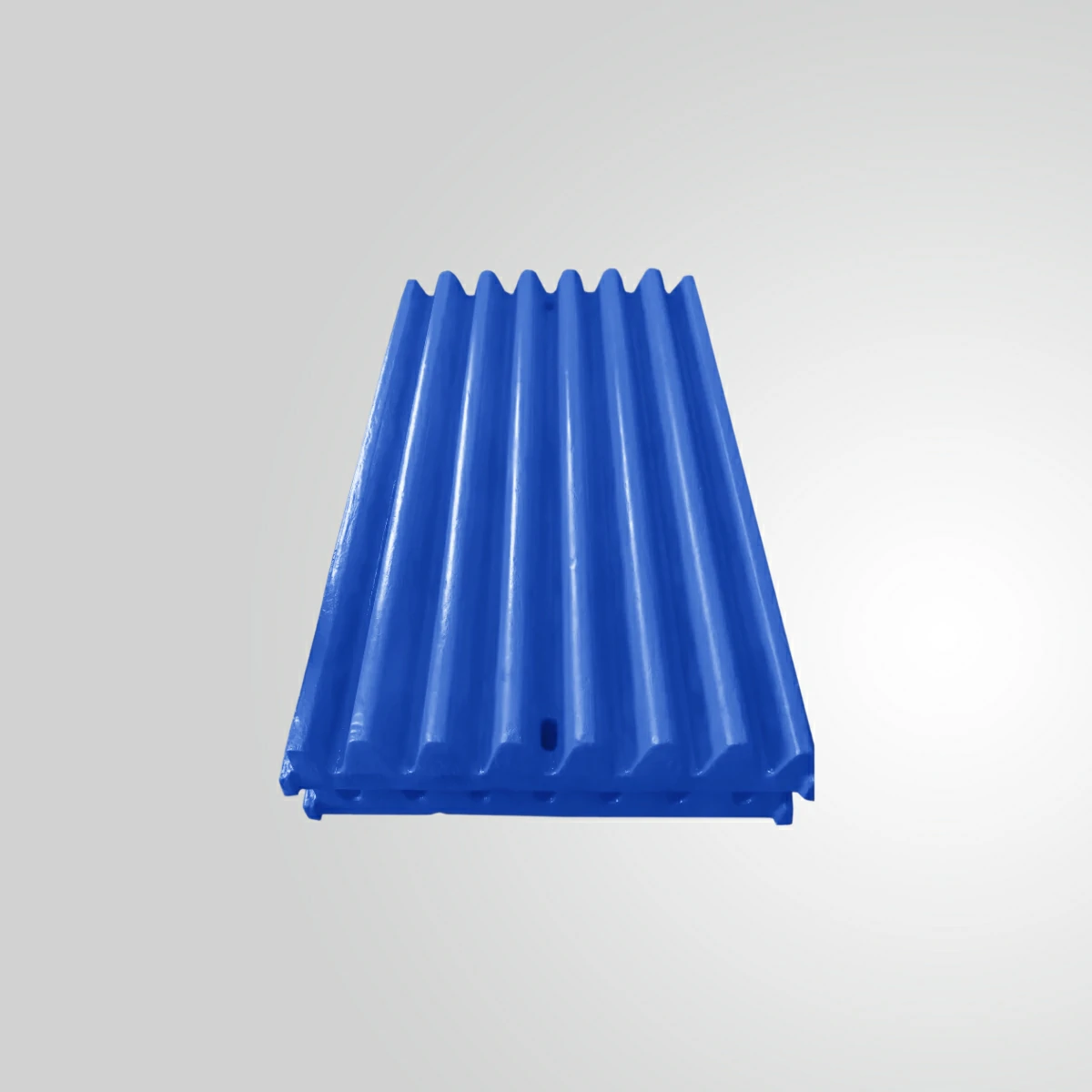
| Parameter | Specification |
|---|---|
| Part Number | 400.1101-002 |
| Compatible Equipment | Sandvik CJ211 / J11 Single-Toggle Jaw Crusher |
| Verified Mass | 1128.75 kg |
| Base Material Grade | Mn18Cr2 (Austenitic Manganese Steel with 2% Chromium) |
| Initial Hardness (As Cast & Quenched) | 220 – 240 HBW |
| Maximum Work-Hardened State | 450 – 500 HBW |
| Yield Strength | ≥ 380 MPa |
| Tensile Strength | ≥ 750 MPa |
| Impact Toughness (AKv) | ≥ 120 J/cm² |
| Machining Tolerance (Mounting Faces) | ISO 2768-mK |
| Heat Treatment Protocol | Water Toughening (Solution Annealing at 1050°C – 1100°C) |
Why Mn18Cr2 Dominates High-Compression Crushing
Premature failure in heavy-duty primary crushing does not stem from unpredictable variables; it originates from a mismatch between the mechanical forces of the crusher and the metallurgical properties of the wear material. The Sandvik CJ211 J11 400.1101-002 Jaw Plate, weighing exactly 1128.75kg, relies on a highly controlled Mn18Cr2 alloy structure to survive the intense gouging abrasion and compressive stresses inherent to hard rock mining and aggregate processing.
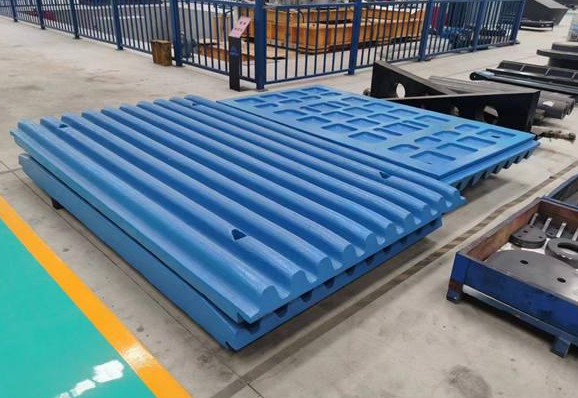
Standard Hadfield steel (Mn13) often lacks the initial yield strength required for processing highly abrasive, high-compressive-strength ores like granite, basalt, or quartzite. Under extreme point-loading, a lower-grade manganese plate will undergo plastic deformation, often referred to as mushrooming, before the work-hardening mechanism can fully activate. By alloying the base manganese steel with 2% Chromium (Mn18Cr2), the 400.1101-002 plate achieves a higher initial hardness of 220-240 HBW. The chromium forms dispersed carbides within the austenitic matrix during the casting process. When subjected to the water toughening treatment—heating the 1128.75kg casting to over 1050°C and rapidly quenching it in water—these carbides dissolve, locking the steel into a tough, single-phase austenitic structure.
As the CJ211 pitman cycles and ore is crushed against the plate, the extreme mechanical impact triggers a phase transformation at the surface layer. The austenite converts into hard martensite, driving the surface hardness up to 500 HBW. As this hardened microscopic layer wears away, the impact of the rock immediately hardens the newly exposed alloy beneath it. This continuous self-renewing wear surface is what allows the 400.1101-002 to maintain its tooth profile significantly longer than lower-alloy alternatives.
Dimensional Accuracy and the Prevention of Flexural Fatigue
A jaw plate is not simply a piece of cast iron thrown into a crushing chamber; it is a precision-engineered component that must transmit hundreds of tons of force into the crusher frame without experiencing internal flex. Poorly manufactured jaw crusher parts frequently fail not from face wear, but from flexural fatigue caused by improper seating against the pitman or the front frame.The 400.1101-002 jaw plate undergoes rigorous CNC machining on its rear mounting faces to adhere to ISO 2768-mK tolerances. If a plate weighing 1128.75kg is cast with severe bowing or warping, it will create localized air gaps between the rear of the plate and the crusher frame. During the crushing stroke, the highest points of contact act as fulcrums. The massive hydraulic forces exerted by the rock will cause the heavy casting to micro-flex over these fulcrums hundreds of times per minute. Within a few hundred operating hours, this cyclical bending initiates transverse fatigue cracks that propagate through the entire thickness of the plate.By ensuring strict dimensional accuracy on the mounting interface, the 400.1101-002 distributes the crushing load evenly across the entire surface area of the frame. This precision reduces localized stress concentrations and prevents the sudden, catastrophic failure that brings production to an unscheduled halt.
Kinematic Optimization for the CJ211/J11 Chamber
The Sandvik CJ211 is a single-toggle jaw crusher, meaning the moving jaw plate travels in an elliptical trajectory. At the top of the chamber, the motion is highly vertical, designed to grab and pull large boulders down. At the bottom of the chamber (the nip angle), the motion becomes more horizontal, maximizing the compressive force to fracture the rock to the desired closed side setting (CSS).
This elliptical motion inherently induces a sliding, abrasive action on the lower third of the jaw plate. The specific tooth profile and corrugation depth of the 400.1101-002 are mathematically modeled to manage this slip-crush action. The peaks of the corrugations penetrate the rock, causing tensile fracture (which requires less force than pure compression), while the valleys allow crushed fines to evacuate rapidly. If fines are not evacuated, the lower chamber experiences packing. Chamber packing spikes the power draw, stresses the toggle plate, and accelerates abrasive wear exponentially. The exact geometric profile of this plate ensures efficient material flow, keeping the power consumption per ton within optimal OEM parameters.
Installation Integrity and Backing Compound Protocols
Even the most perfectly cast plate will fail if installation protocols are ignored. Securing a mass of 1128.75kg requires strict adherence to torque specifications on the upper and lower wedge bolts. After the initial installation and backing compound cure, the crusher must be run under load for roughly 4 to 8 hours. The wedges must then be re-torqued. The dynamic forces of the first few hours will always cause minor seating and compound compression; failing to re-tension the hardware will lead to the plate walking in the chamber, shearing the lateral locating keys.
Total Cost of Ownership and Procurement Predictability
Mine managers and procurement teams often face pressure to source the lowest-cost consumables. However, evaluating wear components solely on a price-per-kilogram basis ignores the cascading costs of premature wear. When inferior jaw crusher parts require early replacement, the operation incurs the direct cost of crane mobilization, the labor cost of maintenance crews, and most critically, the opportunity cost of lost crushing hours.
By standardizing on heavily verified, high-tolerance Crusher Wear Parts like the 400.1101-002, operations gain predictability. The consistent Mn18Cr2 metallurgy and strict dimensional controls mean that wear rates become linear and forecastable based on tonnages and silica content. This allows maintenance planners to schedule liner changes during planned plant outages, rather than reacting to emergency plate cracking mid-shift. Ultimately, investing in the correct metallurgical grade and machining precision drives down the total cost per ton of material processed, maximizing the mechanical availability of the Sandvik CJ211 asset.
Reviews
There are no reviews yet.