A worn liner tells the truth about a crushing plant. It shows whether the feed is centered, whether the chamber is packed correctly, whether the closed side setting is stable, whether tramp metal protection is working, and whether the maintenance team changes parts by condition or by panic. After more than two decades around primary jaws, secondary cones, tertiary cones, impactors, and gyratory crushers, I have seen the same pattern in many mines. Plants that treat wear parts as simple consumables usually replace them too early, too late, or after avoidable damage. Plants that manage wear parts as engineered components get longer service life, safer shutdowns, better product shape, and lower cost per tonne.
Extending wear life does not begin with buying the hardest casting. It begins with understanding how the crusher, the rock, and the part interact under load. A manganese jaw plate, a cone mantle, a concave ring, a cheek plate, a blow bar, or an apron liner survives longer when material flow, chamber pressure, metallurgy, fit, and inspection discipline are controlled together. The target is not simply to make one part last longer. The real target is to keep the crusher operating within its design window while protecting the frame, shaft, bearings, wedges, hydraulic system, and drive components.
Start with the Rock Before Blaming the Part
The first field question should always be about the material being crushed. Granite at 180 MPa compressive strength, basalt with high silica content, wet river stone, copper ore, iron ore, limestone, and recycled concrete all attack wear surfaces differently. A jaw crusher handling 500 mm blasted granite will not wear the same way as a secondary cone receiving 80 mm material from a scalping screen. A high chrome blow bar may perform well in clean limestone but fail quickly when tramp steel enters the chamber. A manganese liner may need strong impact to work harden, while a softer feed can leave the surface underworked and wearing faster than expected.
For hard and abrasive rock, the feed should be measured regularly. Many mines design the primary stage for a maximum feed size of 600 mm to 900 mm, but actual oversize from poor blasting can exceed that range. Oversize pieces create point loading, bridging, jaw plate edge breakage, and uneven liner wear. In a cone crusher, poor feed control can cause ring bounce, high motor load, and local hot spots on the liner surface. When operators say a liner is poor, the inspection should include feed gradation, moisture level, clay content, tramp iron records, and crusher amperage trends.
Control the Chamber Instead of Chasing Wear Life Only
Crusher chamber condition has a direct effect on wear rate. A jaw crusher with a correct nip angle pulls rock downward and crushes through compression. If the fixed jaw and movable jaw profiles are worn flat, the machine loses grip and starts rubbing instead of breaking. This increases heat, vibration, power draw, and cheek plate wear. On many medium size jaw crushers, a closed side setting between 70 mm and 150 mm may be normal for primary duty, but the correct setting depends on feed size, product requirement, toggle design, and downstream capacity.
For cone crushers, choke feeding is one of the most important practices. A half empty chamber allows material to drop through unevenly and strike one side of the mantle and concave. This creates localized wear, poor product shape, high recirculating load, and unstable adjustment ring movement. A well fed cone should maintain a consistent material column, steady power draw, and limited surge. In many secondary cone applications, a closed side setting of 18 mm to 35 mm is common. In tertiary duty, the setting may be closer to 8 mm to 18 mm. Running too tight without enough feed control can shorten liner life and overload bearings.
Choose Metallurgy for the Application
Material selection should follow the crushing duty. Manganese steel remains common for jaw plates, cone liners, and gyratory crusher liners because it work hardens under impact. Common grades include Mn13Cr2, Mn18Cr2, and Mn22Cr2. A typical new manganese casting may show hardness near 180 HB to 220 HB before work hardening. Under correct crushing pressure, the working surface can reach about 450 HB to 550 HB. If the liner never receives enough impact, it may wear away before developing its best surface hardness.
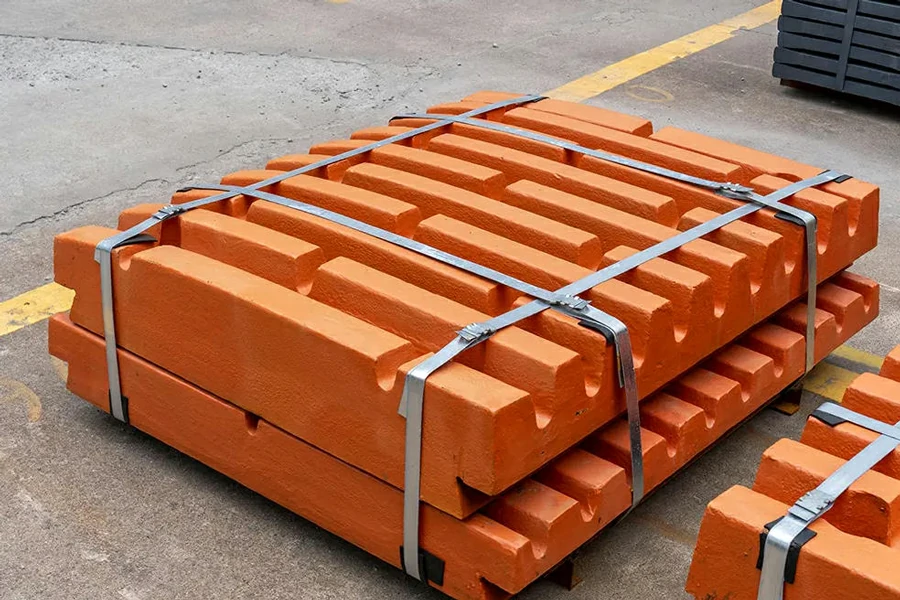
Mn22Cr2 jaw plates
High manganese is not automatically better. Mn22Cr2 can be useful for very abrasive and high impact applications, but it may not always outperform Mn18Cr2 in moderate duty. For impact crushers, high chrome blow bars around 58 HRC to 62 HRC can deliver strong wear resistance in clean stone. Martensitic steel around 45 HRC to 50 HRC can handle more impact and limited contamination. Ceramic insert designs may extend service life in abrasive applications, but they require stable feed size, proper rotor speed, and careful tramp metal control. A good selection process compares impact load, abrasion, feed contamination, and expected changeout interval before choosing the alloy.
Fit Accuracy Protects More Than the Wear Part
Poor fit is one of the fastest ways to destroy a good casting. A jaw plate that does not seat properly can move under load, loosen wedges, damage the support surface, and crack at bolt holes. A cone mantle with poor taper contact can create high stress on the head and reduce bearing life. A concave segment with uneven seating can shift during crushing and damage the top shell. Even when the material chemistry is correct, bad contact surfaces can reduce service life dramatically.
Before installation, maintenance teams should check seating faces, bolt hole alignment, lifting points, casting weight, profile symmetry, and contact marks. For machined components such as sleeves, bushings, pinions, and bearing housings, tolerances can be much tighter, often within 0.03 mm to 0.08 mm depending on the component. Surface finish, oil groove accuracy, hardness depth, and concentricity should be verified by inspection report rather than visual judgment alone. This is why serious mines work with technically capable crusher parts suppliers rather than choosing only by lowest unit price.
Use Correct Installation Practice
Many premature failures begin during installation. Dirt under a jaw plate, old backing left behind a cone liner, incorrect tightening sequence, damaged wedges, or insufficient curing time for backing compound can all shorten wear life. A liner change is not just a lifting job. It is a precision maintenance task performed on heavy components under risk.
For jaw crushers, the support surfaces should be cleaned before the new fixed jaw and swing jaw are installed. Wedges and bolts should be inspected for stretch, thread damage, and seating wear. For cone crushers, the head, bowl, threads, torch ring area, and seating surfaces should be checked before the mantle and concave are fitted. Backing compound should be mixed according to temperature conditions and allowed to cure before full load operation. In cold environments, curing can be slower, while in hot climates working time can be shorter. Ignoring these details can lead to liner movement, cracking, and unsafe removal during the next shutdown.
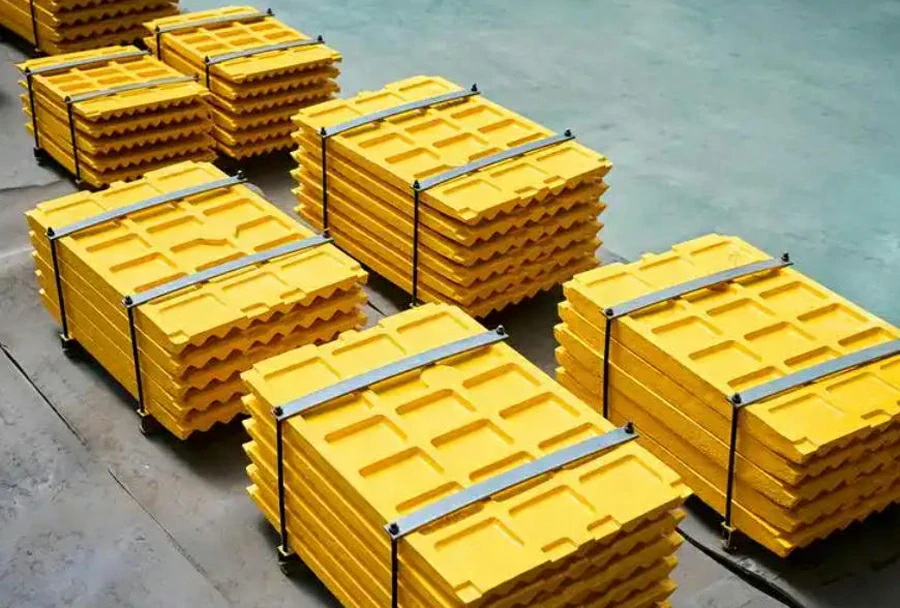
Parts For jaw crushers
Track Wear with Measured Data
Mining Wear Parts should be managed with records, not memory. A practical tracking sheet should include installation date, removal date, operating hours, tonnes processed, feed source, closed side setting, crusher speed, motor load, lubrication temperature, vibration observations, product size, and reason for removal. Photos should be taken from the same angle at fixed intervals such as 100 hours, 300 hours, and 600 hours where practical.
Thickness measurements should be taken at repeatable points. For jaw plates, measure upper, middle, and lower zones on both sides. For cone liners, measure the feed opening zone, crushing zone, and discharge zone. For impact bars, measure leading edge wear, rear face damage, and rotor balance condition. A liner that appears acceptable from the outside may already have lost the profile needed to maintain product shape. Recording the wear pattern helps identify off center feed, poor distribution, wrong liner profile, or incorrect crusher setting.
Keep the Feed Consistent
Consistent feed improves both production and wear life. Surge bins, variable speed feeders, level sensors, and proper screen management help stabilize the crushing chamber. A vibrating grizzly ahead of a jaw crusher can remove fines and sticky material, reducing packing and unnecessary abrasive rubbing. In cone circuits, feed segregation is a common hidden problem. Coarse material on one side and fine material on the other side cause uneven liner loading and poor shape.
Conveyor transfer points should be checked for material drop position. A simple deflector adjustment can improve feed centerline and reduce one sided liner wear. In mobile plants, uneven ground setup can also affect feed angle and crusher performance. A plant may use the right liner and still lose wear life because the feed is hitting one side of the chamber all day. Good operators watch the feed stream, motor load, sound, vibration, and discharge pattern instead of relying only on the control panel.
Avoid Overusing Worn Liners
Running liners too long can be more expensive than changing them on time. A severely worn jaw plate can damage the base seat and reduce nip angle. A cone liner used beyond its effective profile can increase recirculating load, raise power consumption, and produce flaky material. In some cases, the crusher keeps running but the plant loses saleable product quality. The cost is hidden in extra screening, rehandling, fuel, and customer complaints.
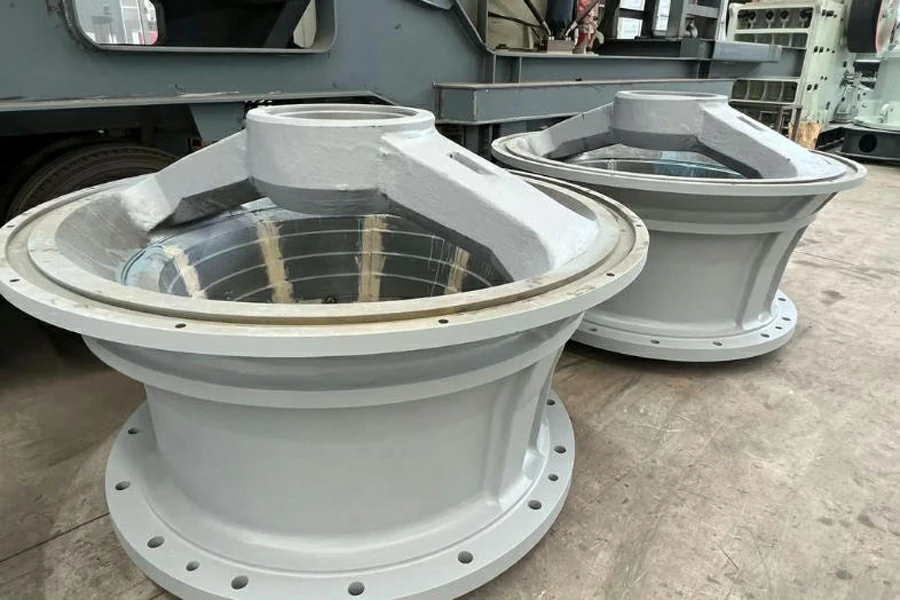
A good liner change decision considers remaining thickness, profile condition, power draw, product shape, throughput, vibration, and safety. When liner thickness approaches the minimum safe level recommended for the machine, the risk of cracking or difficult removal increases. Torch cutting badly worn liners can create extra hazards during shutdown. Planned replacement at the right time is usually cheaper than emergency removal after failure.
Protect the Crusher from Tramp Metal
Tramp metal is one of the fastest ways to shorten wear part life. Drill bits, bucket teeth, loader edges, rail pieces, and rebar can damage jaws, mantles, blow bars, aprons, shafts, and hydraulic systems. Metal detectors, magnets, and disciplined loader operation are simple but powerful protections. In recycled concrete applications, rebar control is especially important because impact crusher blow bars can crack if the wrong material enters at high speed.
Tramp events should be logged. If a cone crusher shows repeated relief system activity or sudden power spikes, the maintenance team should inspect the chamber and upstream belt. If a jaw crusher has unusual knocking after a tramp event, check the toggle area, cheek plates, jaw dies, and wedge condition before returning to full load. One unrecorded tramp event can lead to weeks of unexplained wear problems.
Build a Spare Parts Strategy Around Risk
Spare parts planning should match site risk, not only purchase price. Remote mines should keep critical wear parts on hand because freight delays can stop the whole circuit. A practical stock plan may include one complete jaw plate set for the primary crusher, one mantle and concave set for the secondary cone, key cheek plates, wedges, torch rings, backing compound, bolts, seals, filters, and fast moving small parts. For high tonnage mines running 16 to 24 hours per day, stockouts can cost far more than the inventory value.
When evaluating alternatives, do not compare only the invoice price. Compare cost per operating hour, tonnes processed per set, labour time, freight, safety exposure, product quality, and downtime. Mining Wear Parts can deliver better value when metallurgy, fit, profile, and delivery reliability are proven through controlled field trials. The best trial changes one component group at a time and records results under similar feed and operating conditions.
Train Operators to See Early Warning Signs
Operators are the first defense against abnormal wear. They hear changes in crusher sound, see feed surges, notice belt mistracking, and recognize when product shape begins to change. Training should cover basic wear patterns, unsafe bridging, high amperage behavior, lubrication alarms, hydraulic pressure changes, and the importance of reporting tramp events. A good operator can prevent damage before a mechanic opens the crusher.
Daily checks should include feed condition, discharge flow, oil temperature, unusual vibration, loose guard panels, leaking hydraulic lines, blocked screens, and visible liner movement. Weekly checks should include setting verification, bolt condition, wear measurements where accessible, and review of power trend data. Monthly reviews should compare production tonnes with liner wear progress. This routine turns maintenance from reaction into control.
Longer wear life comes from disciplined operation, not luck. Select the right alloy, verify fit, install correctly, feed the chamber evenly, protect against tramp metal, track operating data, and replace liners before they become a risk to the machine. A crusher is a system, and every wear surface reflects how that system is being operated. When Mining Wear Parts are managed with field data and mechanical discipline, mines can reduce unplanned shutdowns, improve product consistency, and lower the true cost per tonne without compromising equipment safety.