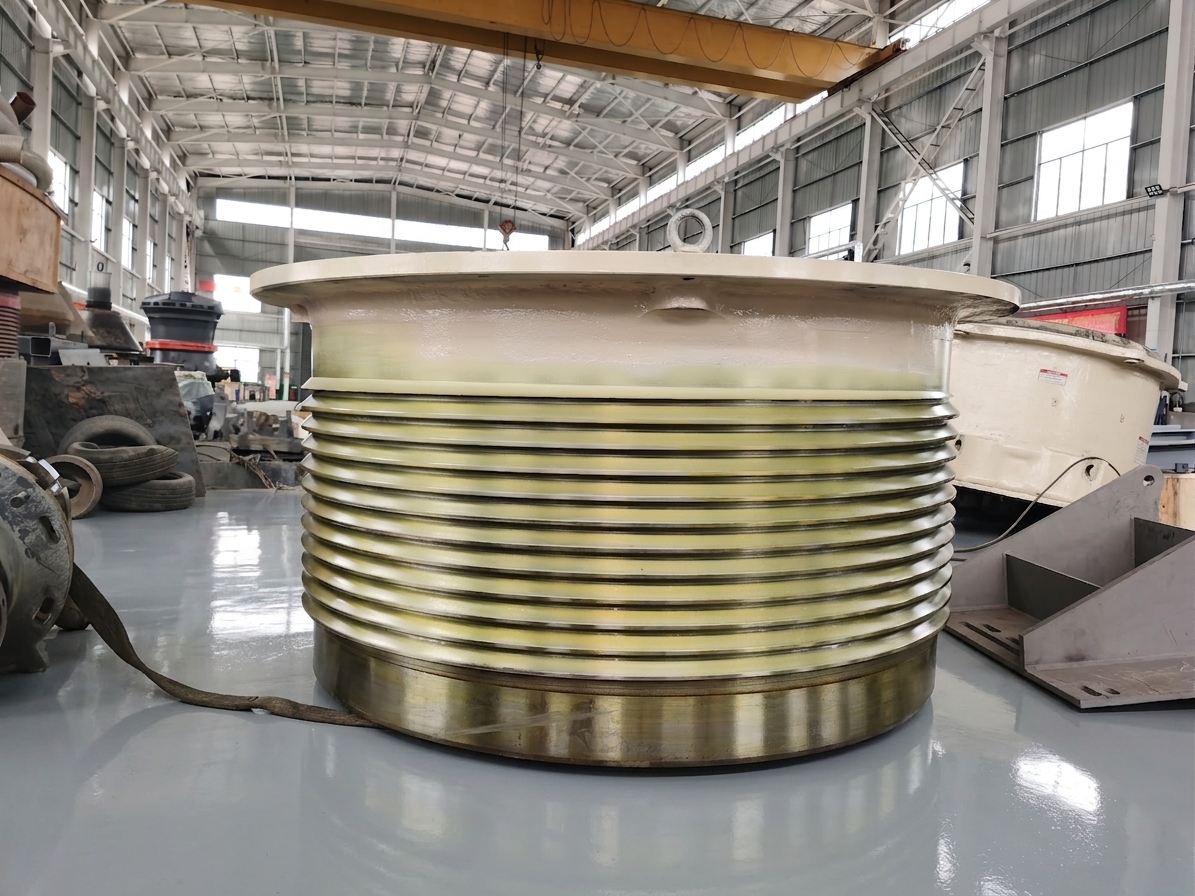
Sixteen weeks. That was the OEM delivery quote received by a platinum concentrator in South Africa’s Bushveld Complex for a replacement Mn18Cr2 bowl liner for a Raptor XL900 cone crusher. The existing liner had failed at week nine of an expected twelve-week service cycle following a feed segregation event that concentrated oversize material against the lower concave zone. A second machine on the same circuit was running a mantle with visible tooth loss across the upper crushing zone. Sixteen weeks was not a maintenance window — it was a production stoppage being executed in slow motion. That sequence of events, recurring in variations at copper operations, iron ore mines, and aggregate quarries globally, is the practical context for understanding why the procurement and specification of FLSmidth crusher parts demands the same engineering rigour applied to the grinding circuits those crushers feed.
Two Equipment Families and Their Distinct Wear Demands
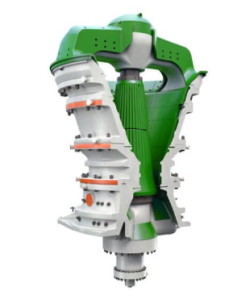
FLSmidth’s crusher portfolio relevant to hard-rock mining centres on two families with fundamentally different wear-part profiles. The Raptor cone crusher series — covering the XL300, XL400, XL500, XL900, and XL1100 models — serves secondary and tertiary crushing in copper, gold, iron ore, and platinum circuits. The Fuller-Traylor gyratory crusher series handles primary crushing at high-tonnage operations where feed sizes exceed 800 to 1,200 mm and throughput requirements measured in thousands of tonnes per hour preclude any other configuration. While both families are compression crushers, the FLSmidth crusher components they consume differ sharply in geometry, mass, alloy grade, and replacement frequency.
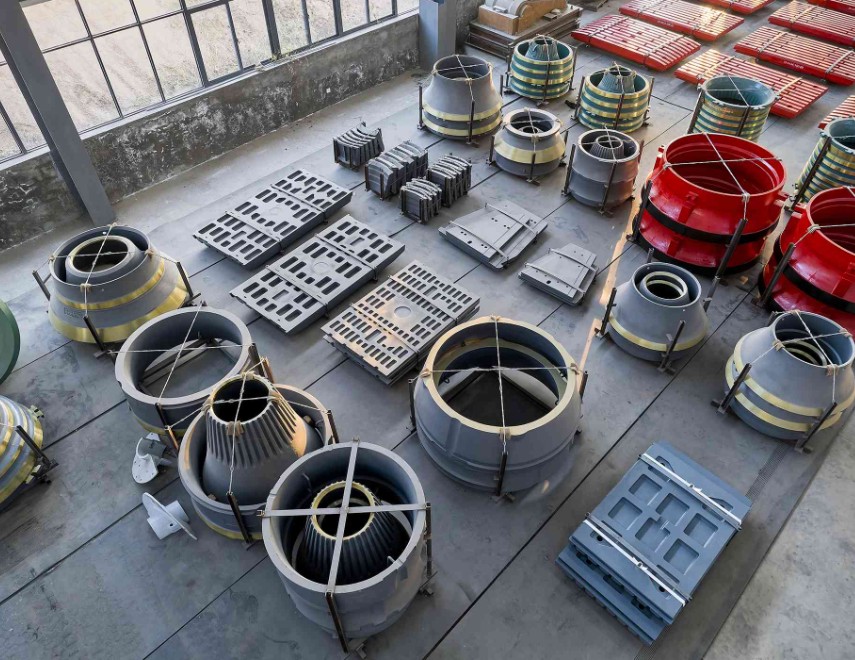
Raptor cone crushers generate recurring demand for bowl liners, mantles, eccentric bushings, head bushings, socket liners, and feed cones on schedules set by feed hardness and abrasion index. Fuller-Traylor gyratories drive demand for mantles, multi-row concave segments, mainshaft sleeves, and eccentric bushing assemblies that cycle on longer intervals but carry substantially higher unit costs per replacement. The economic leverage of procurement decisions is highest on the high-frequency wear surfaces — bowl liners and mantles — where even a modest improvement in unit cost delivers a measurable annual budget variance across a multi-crusher fleet, and where a procurement failure translates within weeks into a production shortfall.
Bowl Liner and Mantle Specifications for the Raptor Series
Bowl liners and mantles for Raptor cone crushers are specified in Mn18Cr2 austenitic manganese steel under ASTM A128 Grade E-1. This grade requires manganese at 16 to 19 percent by weight, chromium at 1.5 to 2.5 percent, carbon at 1.05 to 1.35 percent, silicon below 1.0 percent, and both sulphur and phosphorus held below 0.05 percent. In the solution-annealed and water-quenched condition — solution treatment at 1,050 to 1,100 °C followed by immediate water quenching — the alloy delivers tensile strength in the range of 850 to 950 MPa, elongation exceeding 25 percent, and Charpy impact toughness above 180 J/cm².
As-cast surface hardness sits at HB 180 to HB 220. The mechanism that gives austenitic manganese steel its wear resistance in cone crusher service is work hardening under cyclic compressive loading. As the crushing cycle processes feed material, the near-surface austenitic matrix progressively transforms, raising surface hardness toward HB 480 to HB 550. This transformation requires sufficient impact energy per crushing event to sustain the hardening reaction across the full liner face. In very fine or soft feed conditions, the work-hardening response is incomplete, wear rates exceed the estimates that standard manganese steel field data would predict, and liner life data from higher-energy applications becomes misleading as a procurement reference.
Dimensional compliance on seating surfaces is as critical as alloy specification. Back-face flatness on machined bowl liner seating areas must be held within 0.8 mm across the full seating width. Surface roughness on contact faces is specified at Ra 1.6 to 3.2 μm. The bore diameter on the headnut thread must match the Raptor model-specific drawing tolerance, typically within ±0.10 mm on the major diameter. A casting that clears all alloy parameters but ships with a seating surface flatness error of 2 to 3 mm generates localized contact stress under operating load, initiates fretting fatigue in the head centre assembly, and reduces service life by a margin far disproportionate to the apparent magnitude of the dimensional non-conformance.
Eccentric Bushing and Head Bushing Material Requirements
Eccentric bushings in Raptor cone crushers operate under simultaneous radial and axial loads while rotating against a hardened steel eccentric journal at operating speed. The standard material for this application is high-leaded tin bronze conforming to ASTM B22 Alloy C93700, with nominal composition of 80 percent copper, 10 percent tin, and 10 percent lead. This alloy delivers Brinell hardness of HB 55 to HB 70 and a compressive yield strength of approximately 90 MPa. The dispersed lead phase in the microstructure acts as a solid-phase lubricant at the journal contact surface during boundary lubrication conditions at machine start-up, before hydrodynamic oil film pressure has fully established across the bearing interface.
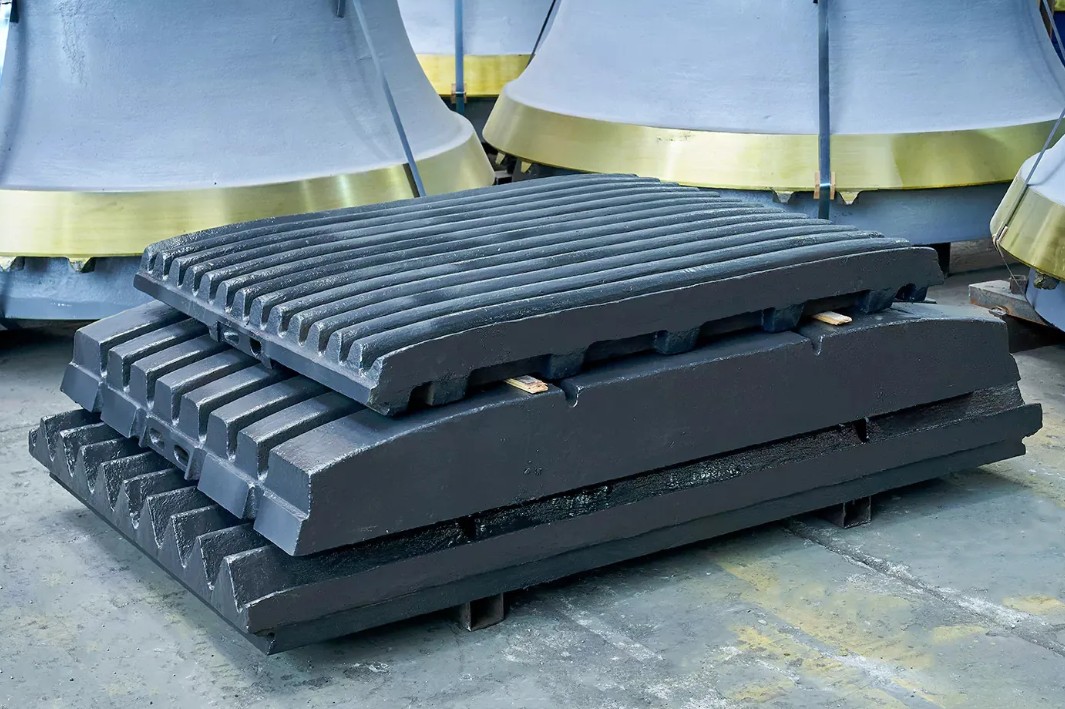
The head bushing is produced from the same alloy family, with internal oil groove geometry machined to the FLSmidth model-specific engineering drawing. Oil groove depth, width, and angular position are calculated to maintain the required film thickness and oil volume in the contact zone at steady-state operating temperatures of 40 to 60 °C at the bushing-journal interface. These FLSmidth crusher components on the drive side are not consumable in the short-cycle sense of bowl liners and mantles, but their failure mode — thermal seizure of the eccentric journal followed by scoring damage to the mainframe bore — generates repair costs and downtime duration that exceed a full liner change campaign by an order of magnitude. Sourcing them without reference to the drawing-specified groove geometry is the single most common cause of premature bushing failure in the Raptor series.
Fuller-Traylor Gyratory Crusher Wear Part Specifications
Mantles and concave segments for Fuller-Traylor gyratory crushers are specified in Mn14Cr2 austenitic manganese steel under ASTM A128 Grade D, which covers manganese at 11.5 to 14 percent, chromium at 1.5 to 2.5 percent, and carbon at 0.7 to 1.3 percent. The lower manganese content relative to Mn18Cr2 yields a modestly reduced work-hardening response but improves resistance to thermal cracking in primary gyratory applications, where large feed blocks deliver high-energy impact events that generate significant heat pulses at the liner surface. Tensile strength in this grade runs 800 to 900 MPa with elongation above 20 percent and Charpy impact toughness above 160 J/cm².
Concave segments are installed in two to four tiers on larger gyratory models, each profiled to maintain the designed crushing chamber geometry through the full depth of the crushing zone. The back-fit clearance between the rear face of a concave segment and the gyratory frame shell must not exceed 2 mm across the seating surface. Clearances above this threshold introduce local bending stress concentrations under crushing load that initiate cracking in the segment casting and progressive loosening of the retaining system. Dimensional verification against the FLSmidth engineering drawing before installation is not optional on primary gyratory crushers, where a premature concave failure in service extends the repair event by the additional time required to inspect and potentially restore the shell contact surface beneath the failed component.
Technical Specification Reference for Key Wear Components
| Component | Machine Family | Material Grade | Key Performance Parameter |
|---|---|---|---|
| Bowl Liner | Raptor Cone Crusher | Mn18Cr2 — ASTM A128 E-1 | Tensile 850–950 MPa, impact ≥180 J/cm², elongation ≥25% |
| Mantle | Raptor Cone Crusher | Mn18Cr2 — ASTM A128 E-1 | Work-hardened surface HB 480–550, seating Ra 1.6–3.2 μm |
| Mantle | Fuller-Traylor Gyratory | Mn14Cr2 — ASTM A128 Grade D | Tensile 800–900 MPa, impact ≥160 J/cm² |
| Concave Segments | Fuller-Traylor Gyratory | Mn14Cr2 — ASTM A128 Grade D | Back-fit gap ≤2 mm, profile tolerance ±2 mm |
| Eccentric Bushing | Raptor Cone Crusher | ASTM B22 Alloy C93700 (Cu 80%, Sn 10%, Pb 10%) | HB 55–70, compressive yield ~90 MPa |
| Head Bushing | Raptor Cone Crusher | ASTM B22 Alloy C93700 | Oil groove geometry per FLSmidth model drawing |
| Socket Liner | Raptor Cone Crusher | High-chrome white iron | HRC 58–64 surface hardness |
| Feed Cone | Raptor Cone Crusher | Mn13Cr2 or AR400 wear steel | AR400 as-supplied HB 370–430 |
Qualifying a Source for FLSmidth Wear Parts
Procurement of FLSmidth wear parts that performs consistently requires three verification layers applied to any supplier before volume commitments are made. The first is material compliance. For Mn18Cr2 and Mn14Cr2 castings, a heat-specific material test report from an ISO 17025-accredited third-party laboratory must confirm chemical composition by element, tensile strength, elongation, and impact toughness. A certificate that covers a production batch rather than individual heat numbers is insufficient for austenitic manganese steel castings, where deviations in carbon or chromium content within a batch alter the work-hardening behaviour in service and produce inconsistent liner life across a single change cycle. Self-certification from the foundry’s in-house laboratory does not satisfy this requirement on safety-critical wear components.
The second layer is dimensional verification. A qualified source should provide an inspection report referenced to the FLSmidth drawing number, covering seating surface flatness, bore roundness and diameter for bushing fits, liner thickness consistency across the casting face to within ±2 mm, and mounting hole position tolerance. The third layer is field performance data. Wear life expressed in tonnes processed per millimeter of liner consumed, from the same crusher model running feed material of comparable hardness and silica content, is more operationally predictive than any laboratory abrasion test result. Two complete change cycles of parallel comparison data — running the candidate source against an established benchmark on identical crushing duties — is the minimum standard that converts a supplier trial into a validated qualification result.
Inventory Strategy and Total Cost of Ownership
A Raptor XL500 processing copper porphyry at a Bond Work Index of 13 to 15 kWh per short ton typically achieves bowl liner service life of 700 to 1,000 operating hours. At 18 operating hours per day, the change cycle runs 39 to 56 calendar days. Holding two complete liner sets in warehouse stock provides a minimum 39-day procurement buffer. In high-silica quartzite with a Bond Work Index above 18 kWh per short ton, liner life drops to 250 to 350 hours and the same two-set inventory provides only 14 to 20 calendar days of protection. Managing inventory for FLSmidth wear parts at that change frequency requires either a three to four-set strategic stock or a transition to composite liners with tungsten carbide pin reinforcement at the highest-wear bowl positions to extend the change interval and reduce the safety stock burden simultaneously.
The total cost argument for qualified aftermarket sourcing of FLSmidth crusher parts rests on two measurable variables. An OEM-supplied bowl liner for a Raptor XL900 carries a list price of USD 18,000 to USD 28,000 depending on configuration and carries a lead time of eight to sixteen weeks from standard distribution. A qualified aftermarket equivalent from a foundry with documented alloy control, third-party material certification, and dimensional compliance to drawing specification typically prices at 55 to 70 percent of that figure and delivers from regional stock in two to five weeks. For a two-crusher operation replacing bowl liners every five weeks, the combined annual saving on unit cost and reduced minimum safety stock level can approach USD 220,000 — without accepting any reduction in the engineering quality that protects the eccentric drive assembly, the head centre, and the mainframe from the failure modes that an undersized or off-specification liner introduces into every crushing cycle.