
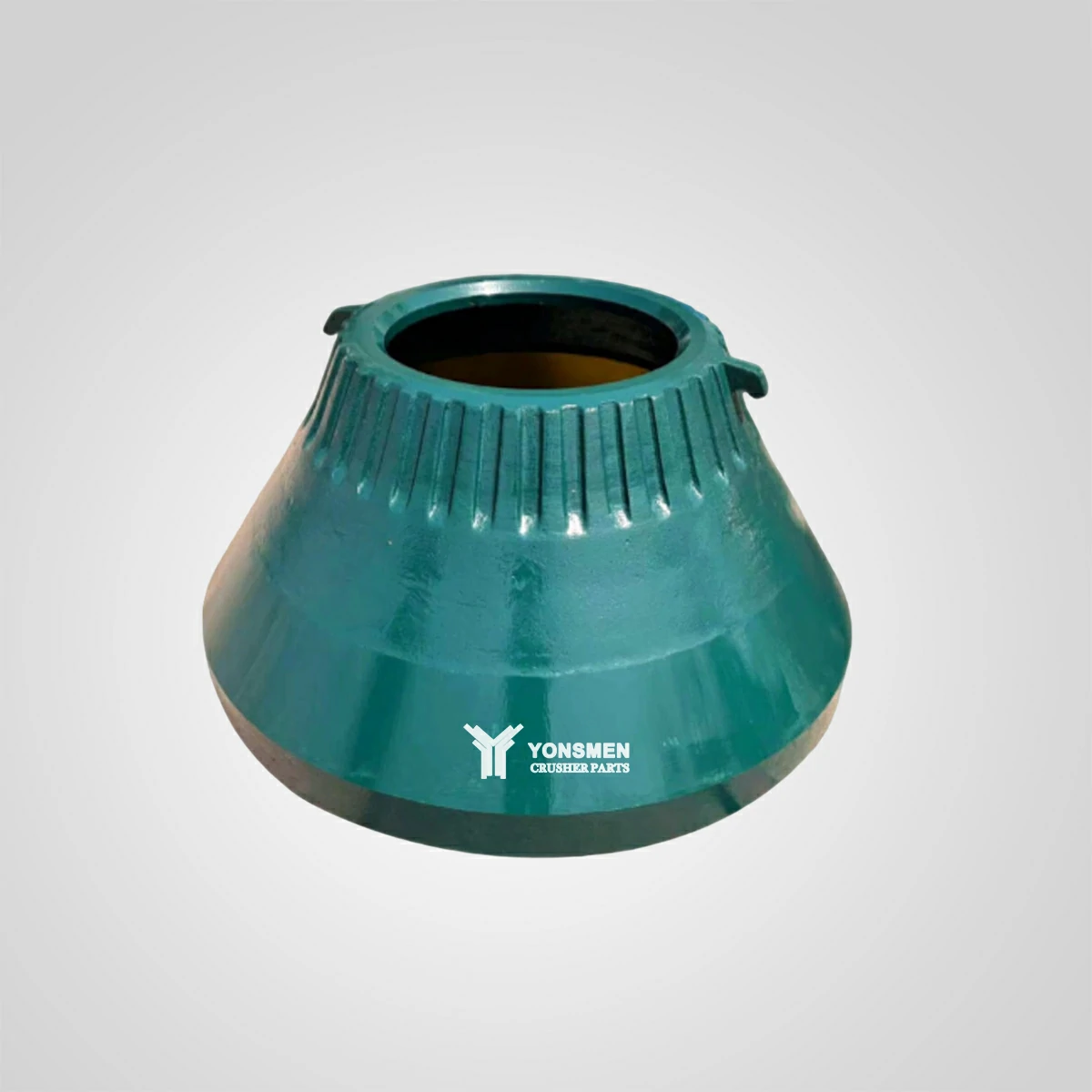
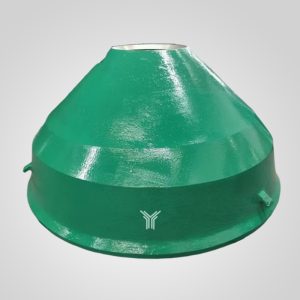
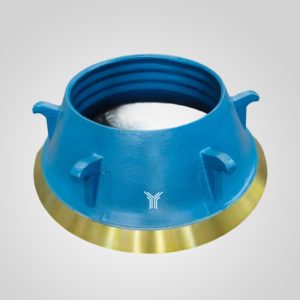
Cone Crusher Mantle 814390490400 for Metso GP100 EF Cavity
Product Name : Cone Crusher Mantle
Part Number : 814390490400
Cavity Profile : EF (Extra Fine)
Reference Code : 0861-511
Application : Metso GP100 Cone Crusher
Net Weight : 284.71 kg
Material Grade : High Manganese Steel Mn18Cr2 (reference ASTM A128 Grade C)
Casting Process : Sand casting, water toughening heat treatment
As-Cast Hardness : 200-230 HB
Work-Hardened Surface Hardness: 450-550 HB after service impact
| Item | Specification |
|---|---|
| Product Name | Cone Crusher Mantle |
| Part Number | 814390490400 |
| Cavity Profile | EF (Extra Fine) |
| Reference Code | 0861-511 |
| Application | Metso GP100 Cone Crusher |
| Net Weight | 284.71 kg |
| Material Grade | High Manganese Steel Mn18Cr2 (reference ASTM A128 Grade C) |
| Casting Process | Sand casting, water toughening heat treatment |
| As-Cast Hardness | 200-230 HB |
| Work-Hardened Surface Hardness | 450-550 HB after service impact |
| Core Toughness | Impact value ≥120 J |
| Tensile Strength | approximately 850-900 MPa |
| Elongation | 30-35 percent |
| Machining Tolerance | ±0.5 mm on seating taper; concentricity ≤0.3 mm |
| Locking Nut Torque | As per Metso GP100 service manual, typically 400-450 N·m equivalent clamping force |
| Backing Compound Gap | 3-5 mm uniform, epoxy resin or zinc-based alloy |
| Minimum Wear Limit | Throat thickness ≤20-25 mm requires replacement |
| Recommended Duty | Fine crushing stage, compressive strength ≤300 MPa |
| Cavity Profile Range Available | C, M, F, EF for GP100 series |
| Casting Standard Reference | ASTM A128 Grade C, GB/T 26652 |
| Inspection | Shot blasting, dimensional check, dye penetrant inspection on wear zones |
| Packaging | Steel pallet with fumigated wooden crate, export grade |
A GP100 That Choked on Fines Because the Cavity Profile Was Wrong
A crushed stone plant running a Metso GP100 in a tertiary fine crushing stage started seeing recirculating load climb steadily over two weeks, with the closed circuit screen sending back nearly a third of total throughput. The operator assumed the screen deck was blinding, but the actual cause was a cone crusher mantle installed with the wrong cavity profile for that application. A standard fine profile had been fitted where an EF, extra fine, profile was specified in the original crusher configuration, and the mismatch left the crushing chamber unable to close down to the target product size no matter how tight the closed side setting was adjusted. Once the correct EF profile mantle, part number 814390490400, was installed, recirculating load dropped back to normal within the first shift.
This case illustrates something that gets overlooked more often than material grade or hardness figures, the cavity profile of a cone crusher mantle determines what the crusher is physically capable of producing, independent of how well the liner is made or how hard its wear surface tests. The 814390490400 mantle is cast specifically to the EF cavity profile for the Metso GP100, matched to reference code 0861-511, and finished to a net weight of 284.71 kg consistent with the original equipment specification for this crusher size.
Why Cavity Profile Selection Comes Before Material Selection
Cone crushers rely on the geometric relationship between the mantle and the concave to define the crushing cavity, and each cavity profile, whether coarse, medium, fine, or extra fine, is engineered around a specific feed opening and discharge setting range. Fitting a coarser profile mantle into an application designed for fine or extra fine crushing forces the crusher to run near the bottom of its adjustment range just to approach the target setting, which increases stress on the hydraulic adjustment ring and accelerates wear on both the mantle and concave simultaneously. The EF profile on this GP100 mantle is designed to hold a smaller nominal setting range while maintaining adequate feed opening for fine stage duty, which is precisely why cavity profile has to be confirmed against the production stage before ordering any replacement liner.
Material Composition Behind the Wear Surface
The manganese steel used in this cone crusher mantle follows a Mn18Cr2 chemistry rather than standard Mn13, a distinction that matters more in fine crushing applications where impact energy per particle is lower but the number of load cycles per hour is significantly higher.
| Element | Standard Mn13 (%) | Mn18Cr2 Used in 814390490400 (%) |
|---|---|---|
| Carbon (C) | 1.05-1.35 | 1.10-1.20 |
| Manganese (Mn) | 11.0-14.0 | 17.0-19.0 |
| Chromium (Cr) | ≤0.5 | 1.5-2.5 |
| Silicon (Si) | 0.30-0.80 | 0.30-0.60 |
| Sulfur (S) | ≤0.05 | ≤0.03 |
| Phosphorus (P) | ≤0.09 | ≤0.06 |
In fine crushing stages, particle size is small enough that impact energy per cycle rarely reaches the level needed to fully work harden a standard Mn13 surface, leaving it softer and more abrasion prone than it would be in a coarse crushing application. The added chromium in Mn18Cr2 raises the achievable hardness even under these lower impact conditions, reaching 450 to 550 HB at the wear face while the core retains an impact toughness above 120 J, which keeps the liner from cracking under the higher cycle count typical of fine crushing duty.
Machining Tolerances and Installation Fit
Because the GP100 EF cavity is designed to hold a tighter setting range, dimensional accuracy on the mantle seating taper matters more here than it does on coarser profiles. The 814390490400 casting is machined to a seating taper tolerance of ±0.5 mm with concentricity held to 0.3 mm or better, checked against the Metso GP100 head assembly specification before shipment. The backing compound gap is held to a uniform 3 to 5 mm across the circumference, since an uneven gap in a fine crushing application shows up immediately as inconsistent product gradation rather than only as accelerated wear.
Field Installation Steps for This Mantle
The following sequence reflects standard practice for fitting a replacement cone crusher mantle on a GP100 in the field.
- Confirm the cavity profile marked on the new casting matches the application stage before removing the old liner, since a coarse or fine profile installed in the wrong stage cannot be corrected by adjustment alone.
- Clean the head assembly seating surface completely, removing any residue from the previous backing compound before dry-fitting the new mantle.
- Check the seating gap at four points around the circumference with feeler gauges to confirm the 3 to 5 mm tolerance prior to pouring backing compound.
- Pour epoxy resin or zinc-based backing compound in a continuous motion to avoid trapped air, then allow full cure time per the product data sheet before applying any load.
- Tighten the locking nut to the torque or clamping force specified in the Metso GP100 service manual, following the recommended sequence rather than a single continuous pull.
- Run the crusher under reduced feed for the first shift, monitoring amperage draw and product gradation closely, since this fine cavity profile will show setting or fitment errors faster than a coarse profile would.
An Engineer’s Perspective From Fine Crushing Applications
I have worked on enough GP series crushers to know that fine crushing stage failures rarely come from bad material, they come from someone assuming any mantle of the right diameter will work regardless of cavity profile. In my experience, the EF profile is one of the more commonly mismatched liners on site because operators reach for whatever mantle is in stock rather than checking the reference code against the crusher configuration sheet. I have seen a correctly profiled 814390490400 mantle hold consistent gradation for months in a fine crushing duty where a mismatched profile had produced fluctuating product size within days. The lesson I keep repeating to younger technicians is that cavity profile is a specification, not a guideline, and it deserves the same attention as material grade or hardness rating.
Preventive Maintenance Recommendations
Liner thickness on fine crushing applications should be checked more frequently than on coarse stages, since the higher cycle count means wear can progress faster in absolute hours even though impact energy per cycle is lower. Once throat thickness approaches the 20 to 25 mm minimum wear limit, replacement should be scheduled proactively rather than waiting for product gradation to drift out of specification, since a fine cavity profile has very little margin before undersized crushing settings become physically impossible to hold.
Frequently Asked Questions
How is the correct cavity profile confirmed before ordering this mantle
The cavity profile should be verified against the crusher configuration sheet or the reference code stamped on the original liner, since ordering by crusher model alone without confirming the profile code can result in a mismatch similar to the case described above.
What documentation is provided with this mantle for procurement records
Each shipment includes a mill test certificate covering chemical composition and hardness results, along with dimensional inspection records for the seating taper, giving procurement teams verifiable data to match against purchase specifications.
How is this mantle packaged for international shipment
The casting is secured on a steel pallet base and enclosed in a fumigated wooden crate meeting export packaging requirements, protecting the machined seating surface from impact during transit and supporting standard customs documentation.
All manufacturer names, part numbers, model numbers, and descriptions are used for reference and identification purposes only, they are owned by the respective machine manufacturer, including but not limited to FLSmidth®, Metso®, thyssenkrupp®, and Sandvik®. All parts supplied are manufactured and warranted by yonsmen and are not manufactured by or purchased from the Original Equipment Manufacturer. yonsmen has no association with the OEM and does not intend to give this impression.
Reviews
There are no reviews yet.