


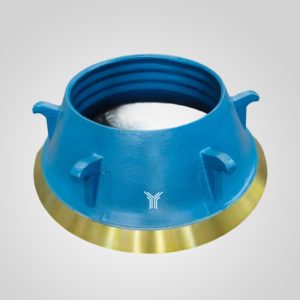
The Symons 4 1/4″ Short Head socket liner is one of those components that many buyers notice only after a failure has already stopped production. It is not as visible as the mantle, concave, bowl liner, or adjustment ring, but it works directly under the crushing head where load, sliding movement, lubrication pressure, and heat meet at the same time. In a short head cone crusher, the machine often runs with a tighter closed side setting, a finer product target, and a higher circulating load than a standard head unit. That operating condition makes the socket liner a critical bearing interface rather than a simple bronze replacement item.
This socket liner is designed for the Symons 4 1/4 Short Head cone crusher, supporting the spherical movement of the head assembly during secondary, tertiary, and fine crushing applications. When the crusher is processing granite, basalt, quartzite, iron ore, copper ore, river stone, or hard limestone, the crushing force does not pass through the machine in a perfectly smooth line. It fluctuates with feed size, chamber filling level, moisture, tramp material, and liner wear. The socket liner helps absorb and stabilize this movement by providing a controlled contact surface between the head ball and the socket area.
Why the Socket Liner Matters in a Short Head Cone Crusher
A short head chamber is usually selected when the plant needs a smaller discharge size and better particle shape. Typical closed side settings may range from 6 mm to 25 mm depending on chamber profile, feed gradation, crusher speed, and final product requirement. Under these tighter settings, the crusher head experiences concentrated pressure and frequent micro-movement. If the socket liner wears unevenly or loses its oil-film support, the head may begin to ride incorrectly. The symptoms can appear as unstable amperage, rising return oil temperature, bronze powder in the filter, uneven product size, abnormal vibration, or a knocking sound during load changes.
The socket liner performs three important jobs at once. It supports the head assembly, allows controlled sliding movement, and helps maintain a lubricating oil film across the contact surface. This cone crusher part must therefore combine strong compressive capacity with good anti-friction performance. A hard but poorly matched material can score the mating surface. A soft or porous casting can deform, wear rapidly, and contaminate the lubrication system. For this reason, both material quality and machining accuracy must be controlled carefully before the part is delivered to site.

Engineering Parameters and Product Reference
| Compatible model | Symons 4 1/4″ Short Head cone crusher |
| Component function | Head support, spherical sliding contact, and oil-film bearing interface |
| Typical material | High-lead tin bronze or equivalent bearing bronze, commonly controlled around HB 80-120 |
| Machining focus | Spherical contact surface, seating face, oil grooves, and key dimensions normally checked within drawing tolerance |
| Application condition | Fine crushing circuits with 6-25 mm CSS, 160-220 kW class drive power, and continuous quarry or mining duty |
Material Selection for a Wear-Resistant Bearing Interface
A good socket liner is commonly manufactured from bearing bronze with controlled chemical composition, casting density, hardness, and surface finish. High-lead tin bronze or equivalent copper alloy is often selected because it provides embedability, seizure resistance, and stable sliding behavior under heavy load. In actual crushing plants, lubrication oil is rarely perfect. Dust, water, fine metal particles, and degraded oil can enter the system if sealing and maintenance are poor. A properly selected bronze material can tolerate small contaminants better than many harder materials, but it cannot survive long-term oil starvation or heavy abrasive contamination.
For this Symons 4 1/4 Short Head socket liner, the functional surface should be machined smoothly and inspected before packing. A typical bearing surface finish target may fall around Ra 1.6 to 3.2 microns, depending on drawing requirement and customer specification. Oil grooves must be clean, continuous, and free from burrs. If the groove depth is too shallow, the contact surface may not receive enough lubricant under load. If the groove area is excessive or incorrectly positioned, the effective bearing area becomes smaller and local pressure increases. These details are easy to overlook in procurement, but they often decide whether the part runs for months or fails after several shifts.
Field Failure Review from Practical Maintenance
In my own site experience, one of the most expensive socket liner failures I inspected did not begin with a bad casting. The crusher was a 4 1/4 ft short head machine working in a hard stone circuit. The maintenance team had replaced the socket liner during a planned shutdown, but they reused contaminated oil pipes and did not flush the return line. After restart, the crusher ran normally for the first day. On the third day, the return oil temperature started climbing above the normal trend. By the end of the week, bronze particles were visible in the filter screen, and the head support area showed scoring marks.
The first assumption was that the new socket liner was defective. After disassembly, the real cause was clearer. Fine abrasive particles from the old failure had remained inside the lubrication circuit. Those particles damaged the new bearing surface before a stable oil film could protect it. We cleaned the tank, cooler, pump line, return line, and filter housing, then checked the contact pattern with blue marking compound before final assembly. After the second installation, the crusher returned to stable operation. That failure taught the plant a simple lesson: a socket liner must be treated as part of a system, not as an isolated spare part.
Manufacturing and Quality Control Expectations
An Aftermarket parts supplier should understand that interchangeability is not only about outside shape. The socket liner must match the correct crusher model, short head configuration, mating surface condition, and installation requirement. For older Symons-style machines, this is especially important because many units have worked for decades, and previous repairs may have changed the real fit inside the crusher. A responsible supplier should ask for the machine model, part number if available, application material, photos of the old liner, and any abnormal failure history before confirming production.
Quality control should include material certificate review, hardness testing, dimensional inspection, oil groove verification, visual surface inspection, and protective packing. The machined bearing surface should not be exposed to impact during transport. Even a small dent or raised edge can become a high-pressure point after installation. For export orders, moisture protection, anti-rust treatment on non-bronze related surfaces, and strong wooden packing are practical details that protect the customer’s shutdown schedule.
Installation Recommendations for Longer Service Life
Before installing a new socket liner, the maintenance team should clean the socket seat, inspect the mating spherical surface, check oil passages, verify filter condition, and confirm that the lubrication pump can deliver stable pressure and flow. The old liner should be examined carefully because its wear pattern often tells the real story. Heavy wear on one side may indicate poor seating, head ball damage, misalignment, or uneven chamber loading. Deep scoring usually points to contaminated oil, oil starvation, or failed sealing.
During assembly, direct hammering on the bronze surface should be avoided. The liner must sit evenly in its seat without burrs, trapped debris, or raised metal underneath. After installation, the crusher should be started without load first so the operator can observe oil pressure, return oil flow, temperature trend, vibration, and sound. Feed should be introduced gradually during the first hours of operation. When the return oil temperature rises abnormally, the safest decision is to stop and inspect instead of forcing the crusher to finish one more shift.
Value for Quarry and Mining Operations
The Symons 4 1/4 Short Head socket liner helps protect more expensive assemblies by maintaining stable head support and reducing destructive metal-to-metal contact. For a plant manager, the value is not only the price of the bronze part. The real value is reduced emergency downtime, more predictable maintenance planning, and better protection for the head, socket, eccentric assembly, mantle, and concave. One unplanned shutdown can cost more than several properly inspected replacement parts, especially when crane access, labor, lost tonnage, and delayed orders are considered.
This cone crusher part is suitable for maintenance teams that want dependable fit, stable lubrication performance, and clear inspection standards. When supplied by an experienced Aftermarket parts supplier, the socket liner can be matched to the application instead of treated as a generic casting. The best result comes from combining correct alloy selection, accurate machining, clean oil, proper installation, and disciplined start-up inspection. When those steps are followed, the Symons 4 1/4 Short Head crusher can keep producing fine aggregate or ore product with fewer surprises and a longer service interval.
- Recommended use: Replacement and rebuild service for Symons 4 1/4 Short Head cone crushers.
- Primary benefit: Supports stable head movement and controlled bearing contact under fine-crushing load.
- Inspection point: Check contact pattern, oil groove condition, seating face, and mating spherical surface before assembly.
- Maintenance advice: Flush the lubrication system after any bronze scoring, overheating, or abnormal wear event.
- Ordering suggestion: Provide crusher model, old part photos, working material, CSS range, and previous failure details for accurate supply.
Reviews
There are no reviews yet.