
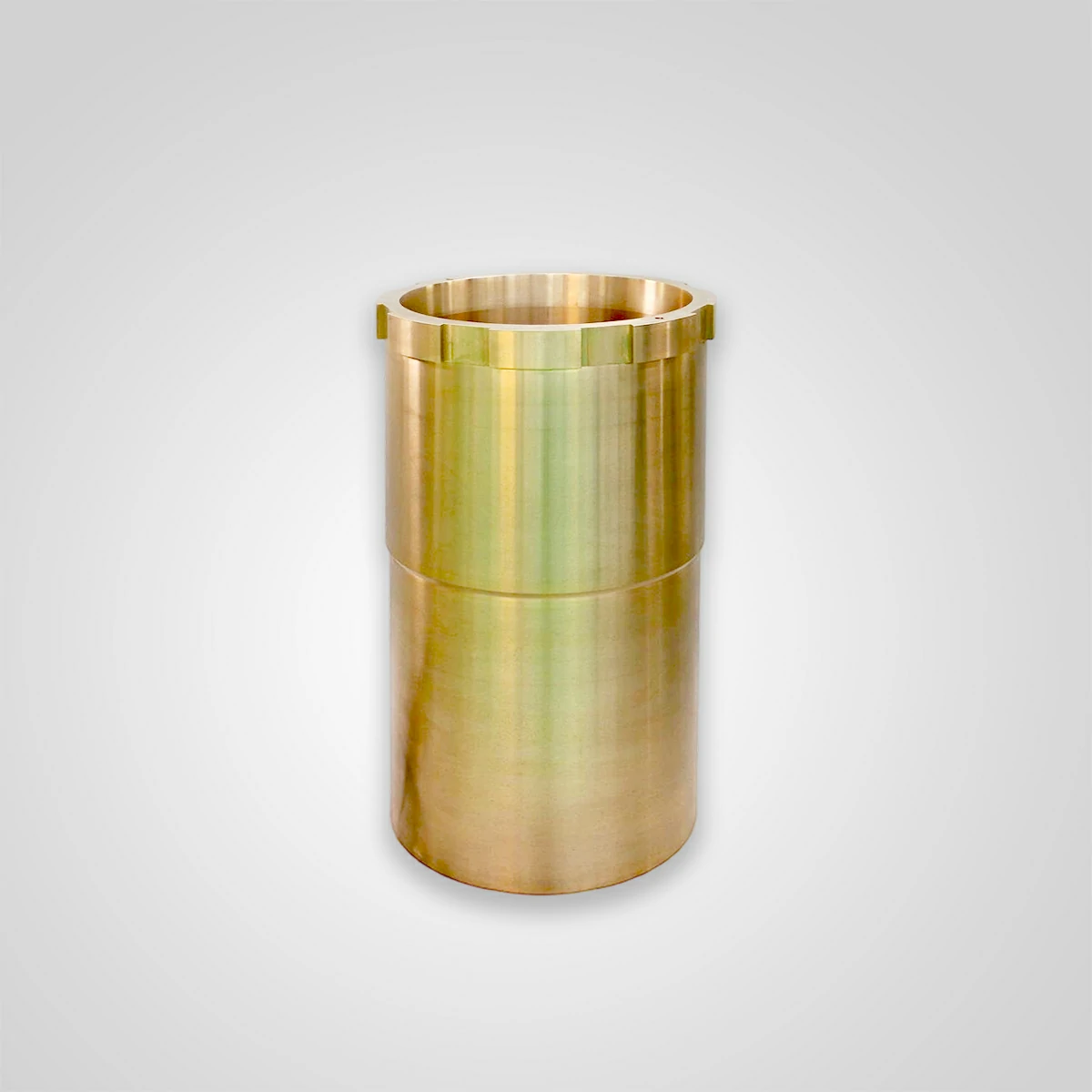
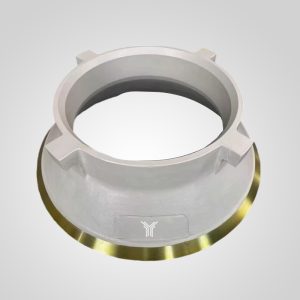
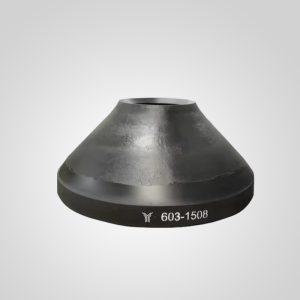
Cone Crusher Bronze Part 2214-5885 Outer Eccentric Bushing for Symons 4-1/4 Ft
OEM Reference Part Number :2214-5885
Part Name : Outer Eccentric Bushing (Frame Bushing / Straight Bronze Bushing)
Compatible Machine :Symons / Nordberg 4-1/4 Ft (4.25 Ft) Cone Crusher — Standard and Shorthead
Net Weight :155.4 kg
Material Grade: High-Lead Bronze — C93800 / C93700 (centrifugal casting grade)
Manufacturing Process: Centrifugal casting + CNC finish machining
Surface Hardness :75 – 95 HBW
Dimensional Tolerance (OD / Bore) :±0.015 mm (ISO h6)
Surface Finish (Bore / OD Mating Face): Ra ≤ 1.6 μm
Part 2214-5885 Outer Eccentric Bushing — Symons 4-1/4 Ft Cone Crusher: Technical Specifications
| OEM Reference Part Number | 2214-5885 |
| Part Name | Outer Eccentric Bushing (Frame Bushing / Straight Bronze Bushing) |
| Compatible Machine | Symons / Nordberg 4-1/4 Ft (4.25 Ft) Cone Crusher — Standard and Shorthead |
| Net Weight | 155.4 kg |
| Material Grade | High-Lead Bronze — C93800 / C93700 (centrifugal casting grade) |
| Manufacturing Process | Centrifugal casting + CNC finish machining |
| Surface Hardness | 75 – 95 HBW |
| Dimensional Tolerance (OD / Bore) | ±0.015 mm (ISO h6) |
| Surface Finish (Bore / OD Mating Face) | Ra ≤ 1.6 μm |
| Running Clearance (Bore vs. Eccentric Sleeve OD) | 0.10 – 0.18 mm (industry standard for 4.25 Ft class) |
| Interference Fit (OD vs. Frame Bore) | 0.03 – 0.07 mm at operating temperature |
| Maximum Frame Bore Wear Limit | +0.10 mm from nominal bore diameter before remachining required |
| Wall Thickness Replacement Threshold | Replace when bore wear exceeds 0.10 mm above nominal running clearance |
| Maximum Operating Temperature | 180°C |
| Lubrication Requirement | ISO VG 150 gear oil, continuous pressurized supply |
| Inspection Interval | Bore diameter measurement every 500 operating hours |
| Recommended Paired Replacement | Replace with inner eccentric bushing P/N 2214-3930 simultaneously |
| Applicable Standards | ASTM B584, ISO 9001:2015 |
| Machine Rated Capacity (4.25 Ft) | 170 – 350 TPH |
| Machine Drive Power (4.25 Ft) | 149 kW (200 HP) |
| Eccentric Speed (4.25 Ft) | Approximately 435 RPM |
The Frame Bushing That Determines Whether Your Lower Frame Bore Survives the Next 10,000 Hours — and Why Most Plants Discover It Too Late
The outer eccentric bushing — OEM part number 2214-5885, weighing 155.4 kg — is pressed into the lower frame bore of the Symons 4-1/4 Ft cone crusher and forms the bearing surface against which the eccentric sleeve rotates at approximately 435 RPM. Every rotation transfers a radial load from the eccentric sleeve through the bushing bore into the lower frame casting. At 149 kW and 170–350 TPH throughput on hard rock, the peak specific pressure at the bushing bore surface routinely exceeds 5 MPa during normal operation and can spike above 9 MPa when oversize feed or moisture-packed material creates momentary hydraulic locking in the crushing chamber. This cone crusher bronze part is the only component separating those pressure spikes from the lower frame’s cast steel bore. When the bushing fails — through cracking, rotation within the frame, or gradual bore wear that opens the clearance beyond the 0.10–0.18 mm operating band — the frame bore receives direct contact load from the rotating eccentric steel. A lower frame bore that has been scored or deformed by a failed bushing requires precision remachining at a typical cost of USD 15,000–25,000 on a 4.25 Ft machine, plus the production loss of at least six days of unplanned downtime.
In three Symons 4.25 Ft installations I have assessed, the lower frame bore damage was not caused by a suddenly failed bushing — it was caused by a bushing that had been slowly rotating within the frame bore for hundreds of hours before anyone noticed the iron particle count in the oil sample had risen above 150 ppm. The bushing had insufficient interference fit at its OD — in each case, the result of installing a replacement part without measuring the actual frame bore diameter, which had grown beyond nominal due to fretting from the previous bushing. A correctly dimensioned frame bore receiving a correctly dimensioned bushing does not allow bushing rotation. A frame bore that has grown 0.12 mm beyond nominal receiving a nominal-dimension replacement bushing has zero interference — the bushing rotates freely, and the bore fails within 300 hours.
Component Position and Load Path: What the Outer Eccentric Bushing Actually Does
The Symons cone crusher eccentric assembly consists of a steel eccentric sleeve that gyrates around the fixed main shaft, driven by the bevel gear set at the base of the assembly. The outer eccentric bushing lines the lower frame bore — the bore that receives the eccentric sleeve’s outer diameter. It is a straight cylindrical bushing (not tapered), pressed into the frame bore with an interference fit of 0.03–0.07 mm at operating temperature, and its inner bore maintains a running clearance of 0.10–0.18 mm against the rotating eccentric sleeve OD.
The bushing performs three simultaneous functions: it provides the bearing surface for the eccentric sleeve’s rotational motion; it absorbs the radial reaction loads from the crushing force that are transmitted through the eccentric sleeve; and it protects the lower frame’s cast steel bore from direct contact with the rotating steel eccentric. The third function — frame protection — is the most consequential, because the lower frame is a structural casting that cannot be replaced without a complete machine rebuild. The bushing is the replaceable sacrificial element. It is designed to wear before the frame does. When the wrong material, wrong geometry, or wrong interference fit causes the bushing to fail non-sacrificially — by rotating, by cracking, or by seizing against the eccentric sleeve — the frame bore absorbs damage that the bushing was supposed to prevent.
Material Specification: Why C93800 High-Lead Bronze Is Required for This Position
C93800 high-lead bronze contains approximately 15% lead, 7% tin, and balance copper. In the outer eccentric bushing application, the lead content serves a different primary function than in a plain sliding bearing. Because the bushing OD is pressed into the frame and does not slide against the frame bore under normal conditions, the lead at the OD interface is not providing dynamic lubrication. Instead, it contributes to the alloy’s ability to conform slightly under compressive load, improving the actual contact area between the bushing OD and the frame bore machined surface — a critical factor in achieving the interference fit’s designed clamping force without galling the bore surface during installation.
At the inner bore surface, where the eccentric sleeve OD rotates at 435 RPM, the lead performs its conventional self-lubricating function. The hydrodynamic oil film between the bushing bore and the eccentric sleeve OD — maintained by pressurized ISO VG 150 oil supplied through the lubrication circuit — has a design thickness of approximately 0.08–0.12 mm under full load. Under boundary lubrication conditions — cold-start, temporary oil supply interruption, or oil pressure drop below the minimum circuit pressure — the lead particles in the C93800 matrix smear onto the eccentric sleeve surface and provide an emergency anti-galling film. A bushing manufactured from a tin-bronze alloy without adequate lead content, such as C90500 or C90700 at less than 4% lead, cannot provide this emergency film and scores the eccentric sleeve surface within minutes of any lubrication interruption.
The centrifugal casting process is non-negotiable for a 155.4 kg bushing of this geometry. Gravity sand casting of a bushing this size produces lead segregation — lead-rich pools at the outer radius of the casting and lead-depleted zones at the inner radius — because lead’s higher density causes it to concentrate toward the outer wall during slow solidification. In the finished bushing, the lead-depleted bore surface has inadequate self-lubrication capacity and the lead-rich OD may have reduced structural strength. Centrifugal casting eliminates segregation by maintaining uniform centrifugal force on all particles during solidification, producing a homogeneous microstructure from bore to OD. Require a manufacturing process certificate confirming centrifugal casting for every bushing ordered to this specification.
Failure Mode Analysis: Four Ways Part 2214-5885 Fails and the Conditions That Cause Each
Failure Mode 1 — Bushing Rotation Within the Frame Bore (Loss of Interference Fit)
This is the most damaging failure mode and the one that causes lower frame bore damage. It occurs when the effective interference between the bushing OD and the frame bore falls below zero — meaning the bore is larger than the bushing OD. This condition arises from three sources: a frame bore that has grown beyond nominal due to fretting from a previous bushing (the most common cause); a replacement bushing supplied to nominal OD dimensions without measuring the actual frame bore; or thermal cycling that causes differential dimensional change between the bronze bushing and the cast steel frame over extended operating periods.
At 435 RPM, a 155.4 kg bronze bushing with zero interference in a 300+ mm diameter frame bore develops significant rotational momentum within the first 30 minutes of operation. The sliding contact between the bronze OD and the steel frame bore generates iron and copper particles that contaminate the lubrication circuit and, if the rotation persists, machine both surfaces into a degraded geometry that no longer accepts a standard replacement bushing without frame bore remachining. Oil iron content above 150 ppm without a corresponding elevation in copper content suggests eccentric sleeve wear rather than bushing rotation — but a simultaneous rise in both iron and copper above their respective action thresholds is the diagnostic signature of bushing rotation in the frame bore.
Failure Mode 2 — Longitudinal Cracking from Casting Porosity
A bushing produced by gravity casting contains subsurface porosity concentrated at mid-radius — the last region to solidify during static casting. Under the cyclic radial loading of 435 RPM eccentric rotation, these voids concentrate stress and initiate fatigue cracks that propagate longitudinally through the bushing wall. Because the outer eccentric bushing is a structural element — restrained by the frame bore on its OD — a longitudinal crack does not immediately release fragments the way an inner bushing crack does. Instead, the cracked bushing continues to carry load as its two halves are held in position by the frame bore. This masks the failure from routine inspection. The crack only becomes apparent when the eccentric assembly is removed for a scheduled overhaul, by which time the crack has often propagated the full length of the bushing and the fragments have begun to fret against the eccentric sleeve, producing the copper and iron contamination signature in the oil sample.
Failure Mode 3 — Bore Wear Leading to Clearance Exceedance
Normal service wear on the inner bore surface gradually increases the running clearance between the bushing bore and the eccentric sleeve OD. The design clearance of 0.10–0.18 mm provides sufficient film thickness for hydrodynamic lubrication at 435 RPM and the specified oil viscosity. As the bore wears and clearance grows beyond 0.20 mm, two effects combine to accelerate degradation. First, the oil film becomes thicker but less stable — the pressure gradient that maintains the film depends on a specific ratio between clearance and journal diameter, and an oversized clearance shifts the operating point outside the stable hydrodynamic range. Second, the eccentric sleeve begins to experience micro-impacts against the bushing bore at each revolution as the film pressure periodically collapses and reforms. These micro-impacts generate iron particles from the eccentric sleeve surface and copper particles from the bushing bore, both of which become abrasive contaminants in the lubrication circuit and accelerate wear of every other bronze component in the machine.
Failure Mode 4 — Galling and Seizure from Lubrication Interruption
Cold-start conditions on the Symons 4.25 Ft in ambient temperatures below 5°C create a window of boundary lubrication vulnerability between machine start and the establishment of full hydrodynamic film pressure. ISO VG 150 oil at 5°C has a kinematic viscosity that can exceed 500 cSt — more than three times its operating viscosity — which reduces the volumetric flow rate through the lubrication circuit and delays full film formation at the outer eccentric bushing bore by 2–4 minutes after startup. During this window, the lead particles in the C93800 alloy provide the only protection against metal-to-metal contact. A bushing with inadequate lead content — or a lead distribution compromised by gravity casting segregation — galls the eccentric sleeve surface during this window. A single galling event on a 4.25 Ft eccentric sleeve costs USD 12,000–20,000 in sleeve reconditioning or replacement, not counting the bushing itself or the downtime to access the eccentric assembly.
Installation Protocol: Frame Bore Measurement, Press Fit, and Clearance Verification
Installing part 2214-5885 without first measuring the frame bore is the single most common error in outer eccentric bushing replacement on the Symons 4.25 Ft. The frame bore grows over time through fretting between the old bushing OD and the cast steel bore. Do not assume the frame bore is at nominal dimension. Measure it at three axial positions and four radial orientations — twelve measurements — before ordering the replacement bushing. If the bore diameter exceeds nominal by more than 0.10 mm, source an oversize bushing manufactured to the actual bore dimension, or have the bore remachined to an oversize standard and source the bushing to match.
- Clean the frame bore to bare metal. Remove all fretting oxide, old bronze transfer deposits, and lubrication residue. Inspect the bore surface for scoring. Any score depth exceeding 0.3 mm requires remachining before bushing installation.
- Measure the frame bore ID and the new bushing OD at operating temperature (or apply a thermal correction factor to room-temperature measurements). The bushing OD must exceed the frame bore ID by 0.03–0.07 mm to achieve the specified interference fit at operating temperature.
- Install the bushing using a hydraulic press with a correctly dimensioned pressure plate that distributes load uniformly across the full bushing face. Do not drive the bushing in with impact tools — impact installation cracks the bronze and introduces residual stress that promotes early fatigue cracking.
- For a 155.4 kg bushing of this diameter, cryogenic pre-cooling of the bushing to approximately −40°C using dry ice reduces the effective OD by approximately 0.10–0.14 mm, allowing controlled press installation without exceeding the press capacity. Confirm dimensional recovery after temperature equalization to ambient.
- After installation, measure the inner bore diameter at twelve points and calculate the actual running clearance against the eccentric sleeve OD. Target: 0.10–0.18 mm. If clearance is below 0.08 mm, hone the bore to specification. If above 0.22 mm, the bushing interference fit is suspect — verify that the frame bore measurement was correct before proceeding.
- Replace the inner eccentric bushing (P/N 2214-3930) simultaneously. Installing a new outer bushing against a worn inner bushing — or vice versa — produces mismatched running clearances at the eccentric sleeve OD that accelerate wear on the new component from day one of operation.
Condition Monitoring: Oil Analysis and Bore Measurement Schedule
The outer eccentric bushing is not accessible for visual inspection without removing the eccentric assembly. Condition monitoring between scheduled overhauls relies on two tools: oil elemental analysis and eccentric assembly temperature monitoring.
Oil analysis from the main lubrication circuit at 250-hour intervals provides the earliest warning of outer bushing degradation. The following thresholds apply specifically to Symons 4.25 Ft machines where the outer bushing condition is under monitoring:
- Copper (Cu): Action level 50 ppm; shutdown-and-inspect level 120 ppm. Rising copper in the absence of elevated iron suggests the bushing bore is wearing against the eccentric sleeve without frame bore damage — investigate clearance at the next scheduled access.
- Iron (Fe): Action level 100 ppm; shutdown-and-inspect level 200 ppm. A simultaneous rise in iron and copper above their respective action levels is the diagnostic signature of bushing rotation within the frame bore. Shut down immediately and inspect.
- Particle count (ISO 4406): Target 17/15/12. Particle count rising above 19/17/14 without a clear elemental cause suggests bearing surface roughening rather than uniform wear — the oil film is breaking down intermittently.
- Return oil temperature: A sustained rise of more than 8°C above established baseline at constant production rate indicates increased friction at the bushing bore — caused by clearance closure from bore deformation or inadequate lubrication flow.
At every scheduled liner replacement — the practical access opportunity for the eccentric assembly on the Symons 4.25 Ft — remove the eccentric assembly and measure the outer bushing bore diameter at twelve points. Record the measurements and compare against the previous inspection to calculate the wear rate. At the measured rate, project the remaining operating hours to the 0.22 mm clearance exceedance threshold and schedule the next bushing replacement before that threshold is reached under production load.
Total Cost Comparison: Specified C93800 vs. Gravity-Cast Unverified Supply
| Parameter | Unverified Gravity-Cast Aftermarket | Centrifugal-Cast C93800 to Specification |
|---|---|---|
| Typical unit price | USD 700 – 1,100 | USD 1,800 – 2,800 |
| Average service life (correct clearance, clean oil) | 1,200 – 3,000 hours | 6,000 – 12,000 hours |
| Frame bore rotation damage rate (field estimate) | 18 – 30% of installations | < 2% (with correct bore measurement before installation) |
| Cost per 10,000 operating hours (parts only) | USD 2,300 – 9,200 | USD 1,500 – 4,700 |
| Lower frame bore remachining cost (if rotation occurs) | USD 15,000 – 25,000 | Not applicable with correct fit and measurement protocol |
| Downtime if frame bore damage occurs | 6 – 12 production days | Not applicable |
The price difference between an unverified bushing and a correctly specified cone crusher bronze part is USD 700–1,700 per unit. The frame bore remachining cost triggered by a bushing rotation event is USD 15,000–25,000 — 10 to 35 times the price differential. The cost arithmetic does not require a complex calculation: specify the correct alloy, require the centrifugal casting certificate, measure the frame bore before installation, and verify the interference fit before pressing. These four steps, applied consistently, eliminate the bushing rotation failure mode entirely.
Documentation Requirements: What to Demand Before the Bushing Leaves the Supplier
A supplier correctly fulfilling an order for part 2214-5885 should provide, without being asked twice, the following with each shipment: a material mill certificate confirming C93800 or C93700 chemistry with actual measured values for lead (minimum 14%), tin, copper, and all other reportable elements; a manufacturing process certificate confirming centrifugal casting as the blank production method; a dimensional inspection report showing OD at a minimum of four axial positions, bore diameter at a minimum of four axial positions, overall length, and surface finish (Ra) at both the bore and OD mating surfaces; and a batch or heat number traceable from the inspection report to the physical compon
All manufacturer names, part numbers, model numbers, and descriptions are used for reference and identification purposes only, they are owned by the respective machine manufacturer, including but not limited to FLSmidth®, Metso®, thyssenkrupp®, and Sandvik®. All parts supplied are manufactured and warranted by yonsmen and are not manufactured by or purchased from the Original Equipment Manufacturer. yonsmen has no association with the OEM and does not intend to give this impression.
Reviews
There are no reviews yet.