

High Manganese Mn18cr2 Mn13cr2 Jaw Crusher Parts Jaw Plate
OEM Part Number :N11952794
Material Specification :Mn18Cr2 / ASTM A128 Grade E-1
Component Net Weight :1808.04kg
Machining Precision :±0.05 mm on critical fit dimensions
Surface Roughness (Back) :Ra ≤ 1.6 μm
Initial Hardness :200 – 230 HBW
Technical Performance and Structural Integrity of High-Manganese Jaw Crusher Parts
The operational efficiency of a primary crushing circuit is fundamentally tied to the sacrificial wear rate of the installed Jaw Crusher Parts. In heavy-duty mining applications, the cost of a Jaw Plate failure extends far beyond the price of the replacement casting; it encompasses unplanned downtime, potential damage to the pitman, and the risk of frame cracking due to improper energy absorption. For the N11952794 fixed plate, which has a substantial net weight of 1808.04kg, the engineering focus must be on the controlled transformation of the austenitic matrix under high-impact stress. Without a precise metallurgical balance of Mn18Cr2, the component will either brittle-fracture under extreme compressive loads or wear prematurely due to insufficient work-hardening.
Metallurgical Analysis: The Role of Mn18Cr2 in Impact Resistance
Selecting the correct alloy for Jaw Crusher Parts requires a deep understanding of the feed material’s hardness and the crusher’s eccentric throw. While ASTM A128 Grade B-3 (Mn13Cr2) remains a viable option for softer limestone, hard rock applications involving basalt, granite, or iron ore necessitate the enhanced yield strength of Mn18Cr2 (ASTM A128 Grade E-1). The addition of 2% Chromium is not merely for corrosion resistance; it significantly improves the initial yield strength and the overall stability of the Manganese-Carbon ratio.
In a standard Mn18Cr2 Jaw Plate, the as-cast hardness typically ranges around 200 to 220 HBW. However, the true value of these Jaw Crusher Parts lies in their kinetic response. Under continuous impact, the surface layer undergoes a phase transformation, increasing the surface hardness to over 500 HBW, while the core remains ductile at 220 HBW to absorb shock. This gradient is essential. If the Manganese-to-Carbon ratio falls outside the optimal 10:1 or 12:1 range, undissolved carbides can precipitate at the grain boundaries, leading to catastrophic snapping during the crushing of uncrushable tramp metal.
| Chemical Element | Mn13Cr2 Percentage | Mn18Cr2 (N11952794 Standard) | Mn22Cr2 High-Impact |
|---|---|---|---|
| Manganese (Mn) | 12.00 – 14.00% | 17.00 – 19.00% | 21.00 – 24.00% |
| Carbon (C) | 1.10 – 1.30% | 1.10 – 1.40% | 1.05 – 1.35% |
| Chromium (Cr) | 1.50 – 2.50% | 1.50 – 2.50% | 1.50 – 2.50% |
| Silicon (Si) | 0.30 – 0.80% | 0.30 – 0.80% | 0.30 – 0.80% |
| Phosphorus (P) | ≤ 0.06% | ≤ 0.05% | ≤ 0.04% |
Engineering Precision and Machining Tolerances
High-quality Jaw Crusher Parts are distinguished by their dimensional accuracy as much as their metallurgy. For a 1808.04kg component like the N11952794, even a minor deviation in the back-surface flatness can lead to uneven stress distribution. Professional engineering standards require the mounting surface of the Jaw Plate to be machined to a surface roughness of Ra ≤ 1.6 μm. This ensures 100% contact with the backing material or the crusher’s front frame. If the surface remains in its “as-cast” state, localized high spots will concentrate the crushing force, eventually leading to fatigue cracks in the main frame of the machine.
Furthermore, the wedge grooves and bolt hole locations must adhere to strict tolerances of ±0.05 mm. During my 20 years of field experience, I have witnessed countless installations where Jaw Crusher Parts failed because the wedge angle did not perfectly match the frame’s taper. A mismatch of just 0.5 degrees creates an installation gap that allows the plate to vibrate. This vibration acts as a high-frequency hammer, shearing off mounting bolts and destroying the C93800 bronze bushings in the pitman due to the resulting erratic movement of the eccentric shaft.
Field Insight: A Lesson in Installation Gaps
I recall a specific project at a copper mine in the Andes, where the site engineers were experiencing recurring bolt failures on their primary jaw. They were using a generic Jaw Plate that lacked the precision-machined back surface. Upon inspection of the failed Jaw Crusher Parts, I measured a 2.0 mm gap between the center of the plate and the frame. The lack of a machined Ra ≤ 1.6 μm finish meant the plate was only supported at the edges. Every time the crusher reached its peak torque value, the plate would flex slightly. We replaced the liners with Mn18Cr2 N11952794 plates that were CNC-machined on all contact surfaces and ensured the backing compound was applied at the correct ambient temperature. The bolt failures ceased immediately, and the customer saw a 15% increase in throughput because the machine was no longer losing energy through plate movement.
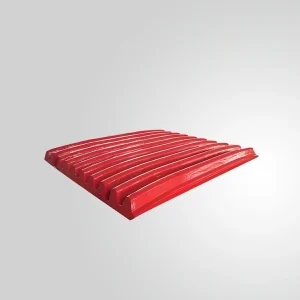
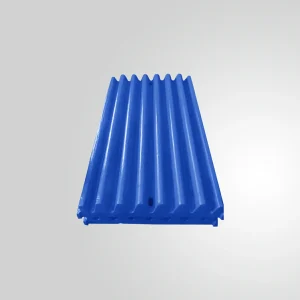
N11952794 Fixed Jaw Plate Specifications
| Component Description | Fixed Jaw Plate (High Manganese) |
| OEM Part Number | N11952794 |
| Material Specification | Mn18Cr2 / ASTM A128 Grade E-1 |
| Component Net Weight | 1808.04kg |
| Machining Precision | ±0.05 mm on critical fit dimensions |
| Surface Roughness (Back) | Ra ≤ 1.6 μm |
| Initial Hardness | 200 – 230 HBW |
| Work-Hardened Hardness | 480 – 540 HBW (Application Dependent) |
| Heat Treatment Process | Full Solution Annealing at 1050°C – 1100°C |
Preventive Maintenance and Wear Life Optimization
To maximize the service life of Jaw Crusher Parts, operators must move beyond a “run-to-fail” mentality. The wear life of a Jaw Plate is not just determined by its metallurgy, but by the maintenance protocols followed during its operational cycle. For the N11952794, monitoring the tooth profile is critical. Once the tooth height is reduced by 60%, the nip angle of the crusher changes, leading to material “slipping.” This slipping causes accelerated wear at the bottom of the plate and increases the heat generated, which can soften the work-hardened layer.
- Torque Management: Always tighten the mounting bolts to the manufacturer’s specified torque value using a calibrated hydraulic torque wrench. For these heavy Jaw Crusher Parts, it is essential to re-check the torque after the first 8 hours, 24 hours, and 100 hours of operation. Manganese steel is prone to initial “seating,” which can loosen the bolts and lead to plate movement.
- Backing Compound Integrity: Ensure that the epoxy backing compound is fully cured before restarting the crusher. This compound fills any microscopic voids between the Jaw Plate and the frame, providing a uniform support structure that prevents localized stress risers.
- Rotation Schedule: For fixed liners, flipping the plate (top-to-bottom) can extend the total wear life by 20-30%. This should be done before the wear at the bottom reaches the wear limit. Waiting too long makes the rotation ineffective as the “nip angle” will already be compromised.
- Feed Control: Ensure the feed size does not exceed 80% of the gape. Over-sized rocks cause localized impact at the top of the Jaw Crusher Parts, which can lead to cracking or “mushrooming” of the teeth, even in high-grade Mn18Cr2 alloys.
Engineer Tips for Procurement and Quality Control
When sourcing Jaw Crusher Parts, the “lowest price per kilogram” is often a deceptive metric. A cheap Jaw Plate might save $1,000 upfront but cost $50,000 in lost production if it snaps or wears out 30% faster than a premium Mn18Cr2 casting. Always demand a solution-annealing chart to ensure the heat treatment was performed correctly. If the quenching process is too slow, the austenite will not be fully retained, resulting in a brittle part.
Furthermore, inspect the grain structure of the Jaw Crusher Parts if possible. A fine-grained austenitic structure is the hallmark of high-quality casting and provides much better resistance to fatigue cracking. Finally, keep an eye on your peripheral components. If the toggle plate is worn or the C93800 bushings are showing signs of copper flaking, it indicates that the mechanical geometry of the crusher is off. This will cause uneven wear on your Jaw Plate regardless of how high the material quality is. A holistic approach to maintenance is the only way to truly lower your cost-per-ton.
All manufacturer names, part numbers, model numbers, and descriptions are used for reference and identification purposes only, they are owned by the respective machine manufacturer, including but not limited to FLSmidth®, Metso®, thyssenkrupp®, and Sandvik®. All parts supplied are manufactured and warranted by yonsmen and are not manufactured by or purchased from the Original Equipment Manufacturer. yonsmen has no association with the OEM and does not intend to give this impression.
Reviews
There are no reviews yet.