

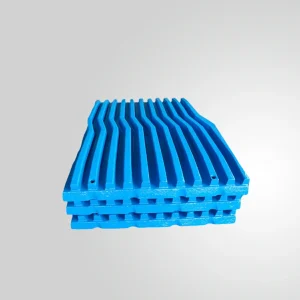
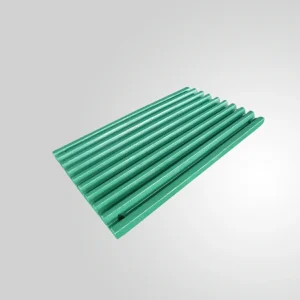
Jaw plate wear parts for ThyssenKrupp Jaw crusher HEB 16-12
Compatible Model : ThyssenKrupp HEB 16-12
Part Category : Jaw Crusher wear Parts
Material Specification : High Manganese Mn18Cr2 (ASTM A128 Grade E-1)
Casting Tolerance : ISO 8062 CT10 – CT12
Machining Tolerance : ±0.05 mm on mounting points
Back Surface Finish : Precision Machined Ra ≤ 1.6 μm
Hardness (Work-Hardened) : 480 – 540 HBW
Technical Performance and Structural Integrity of Jaw Crusher wear Parts
The operational reliability of a ThyssenKrupp HEB 16-12 primary crusher is fundamentally dependent on the metallurgical stability of the installed Jaw Crusher wear Parts. In heavy-duty mining environments, the failure of a jaw plate is rarely a localized event; it is a systemic failure that often originates from improper material selection or a lack of precision in the mounting interface. For an HEB 16-12 unit, which handles high-tonnage feed, the transition of the austenitic matrix into a work-hardened surface is the primary defense against erosive wear. If the component fails to develop the necessary surface hardness due to poor alloy chemistry, the resulting plastic flow can jam the toggle seat or cause catastrophic stress transfer to the pitman, leading to costs that far exceed the price of the wear parts themselves.
Achieving the correct work-hardening rate requires more than just a high manganese percentage. It demands a precise Mn18Cr2 composition that adheres to ASTM A128 Grade E-1 standards. When Jaw Crusher wear Parts are subjected to the intense compressive forces of basalt or granite processing, the surface must rapidly transform from an as-cast hardness of approximately 220 HBW to an operational hardness exceeding 500 HBW. This gradient is essential: the hard surface resists abrasion, while the ductile core absorbs the shock, preventing the brittle fractures that plague lower-quality castings.
Mn13Cr2 vs. Mn18Cr2 for HEB 16-12 Systems
In the selection of Jaw Crusher wear Parts, the “one-size-fits-all” approach to metallurgy is a recipe for maintenance disaster. For the ThyssenKrupp HEB 16-12, the choice between Mn13Cr2 and Mn18Cr2 must be based on the compressive strength of the feed material and the kinetic energy of the crushing stroke. Mn13Cr2 remains a standard for medium-hard rock, but for high-silica or high-strength ores, the enhanced yield strength of Mn18Cr2 is non-negotiable.
The addition of 2% Chromium in Mn18Cr2 alloys is critical for stabilizing the carbides during the solution annealing process at 1050°C to 1100°C. This prevents the precipitation of brittle carbides at the grain boundaries, which is the primary cause of cracking in high-impact applications. Furthermore, the higher Manganese content ensures a more stable austenite at room temperature, providing a higher safety margin during the initial commissioning phase when the Jaw Crusher wear Parts have not yet achieved their full work-hardened state.
| Chemical/Mechanical Property | Mn13Cr2 (Standard Grade) | Mn18Cr2 (Premium Grade) |
|---|---|---|
| Manganese (Mn) Content % | 12.0% – 14.0% | 17.0% – 19.0% |
| Carbon (C) Content % | 1.10% – 1.35% | 1.15% – 1.40% |
| Chromium (Cr) Content % | 1.5% – 2.5% | 1.8% – 2.5% |
| Initial Hardness (HBW) | 180 – 210 HBW | 210 – 240 HBW |
| Yield Strength (MPa) | ≥ 350 MPa | ≥ 390 MPa |
| Tensile Strength (MPa) | ≥ 680 MPa | ≥ 780 MPa |
Dimensional Integrity and Ra ≤ 1.6 μm Surface Finish
A frequent oversight in the procurement of Jaw Crusher wear Parts is the emphasis on weight over dimensional accuracy. For a ThyssenKrupp HEB 16-12 jaw plate, the rear mounting surface is a vital engineering interface. If this surface is left in an “as-cast” state, the surface roughness can exceed Ra 12.5 μm, resulting in minimal contact area with the frame. Professional-grade components must be machined to a surface roughness of Ra ≤ 1.6 μm on all contact faces. This ensures uniform stress distribution and prevents the formation of localized stress risers that can initiate fatigue cracks in the crusher’s main frame.
Furthermore, the mounting bolt holes and wedge grooves must be CNC-machined to a tolerance of ±0.05 mm. In my 20 years of field experience, I have seen numerous instances where Jaw Crusher wear Parts failed not because the material was poor, but because the wedge angle was off by a fraction of a degree. This mismatch creates an installation gap that allows the plate to vibrate during the 450-RPM operational cycle. This vibration acts as a high-frequency hammer, eventually shearing the high-tensile mounting bolts or causing the C93800 bronze bushings in the pitman to overheat due to the resulting erratic movement.
The Hidden Cost of “Generic” Wear Parts
I recall a specific site audit at a limestone quarry where the maintenance manager was frustrated by recurring frame damage on their primary jaw. They had switched to a generic supplier for their Jaw Crusher wear Parts to save 15% on upfront costs. Upon inspecting the discarded liners, I measured a back-surface flatness deviation of nearly 3.2 mm across the width of the plate. This is an engineering catastrophe. Because the plates were only supported at the edges, they were flexing like a leaf spring with every crushing stroke.
The localized heat generated by this friction was so intense it had started to “peen” the frame seat, requiring an expensive on-site milling repair. By switching to Mn18Cr2 plates with a precision-machined Ra ≤ 1.6 μm finish and ensuring a 100% surface contact through the use of an epoxy backing compound, the mine eliminated the vibration issues. The wear life increased from 600 hours to over 950 hours, proving that quality Jaw Crusher wear Parts are the most effective way to lower the total cost of ownership (TCO).
Step-by-Step Field Installation Suggestions
To ensure your Jaw Crusher wear Parts perform to their theoretical maximum, the installation process must be treated as a precision assembly rather than a simple replacement. Follow these guidelines for the HEB 16-12:
- Frame Preparation: Use a wire wheel or pneumatic grinder to remove all old backing material, rust, and burrs from the frame seat. A flat, clean seat is essential for even support.
- Dimensional Verification: Before lifting the plate into position, verify that the bolt hole centers and wedge grooves are within the ±0.05 mm tolerance specification.
- Backing Material Application: Always use a high-compressive-strength epoxy backing compound. This material fills any microscopic voids between the jaw plate and the frame, acting as a shock absorber.
- Torque Management: Tighten all mounting bolts to the specified torque value using a calibrated hydraulic wrench. Do not rely on impact guns for final tensioning.
- The 24-Hour Re-Check: Manganese steel tends to “seat” or flow slightly during its initial work-hardening phase. It is mandatory to stop the machine and re-verify the bolt torque after the first 8 to 24 hours of operation.
Engineering Tips for Preventive Maintenance
The most profitable way to manage Jaw Crusher wear Parts is to monitor the wear profile daily. One of the most critical indicators is the tooth height. Once the tooth height is reduced by 70%, the “nip angle” of the crusher increases, leading to material slippage and a significant drop in throughput. This slipping creates massive amounts of localized heat, which can soften the work-hardened surface of the Manganese steel.
Another tip is to monitor the temperature of the pitman bearings and the condition of the C93800 bushings. If you notice copper flakes in the lubrication oil or a sudden spike in bearing temperature, it is often a sign that the Jaw Crusher wear Parts are loose or unevenly worn, causing an unbalanced load on the eccentric shaft. Rotating the fixed jaw plate (top-to-bottom) when the bottom wear reaches 50% can extend the total service life by as much as 20% in many HEB 16-12 applications.
Product Specification Table: HEB 16-12 Jaw Plate
| Compatible Model | ThyssenKrupp HEB 16-12 |
| Part Category | Jaw Crusher wear Parts |
| Material Specification | High Manganese Mn18Cr2 (ASTM A128 Grade E-1) |
| Casting Tolerance | ISO 8062 CT10 – CT12 |
| Machining Tolerance | ±0.05 mm on mounting points |
| Back Surface Finish | Precision Machined Ra ≤ 1.6 μm |
| Hardness (Work-Hardened) | 480 – 540 HBW |
| Heat Treatment | Full Solution Annealing (1050°C – 1100°C) |
| Quenching Medium | High-Volume Circulating Water |
The ROI of Engineering Excellence
In the high-stakes environment of mineral processing, Jaw Crusher wear Parts are not simple consumables; they are engineered assets that determine the health of your primary crusher. By insisting on Mn18Cr2 metallurgy, Ra ≤ 1.6 μm surface finishes, and rigorous installation protocols, maintenance teams can significantly reduce unplanned downtime and optimize their cost-per-ton. Precision fitment today is the only way to avoid catastrophic mechanical failure tomorrow. High-quality wear parts provide the stability required to maintain consistent production in even the most abrasive conditions.
All manufacturer names, part numbers, model numbers, and descriptions are used for reference and identification purposes only, they are owned by the respective machine manufacturer, including but not limited to FLSmidth®, Metso®, thyssenkrupp®, and Sandvik®. All parts supplied are manufactured and warranted by yonsmen and are not manufactured by or purchased from the Original Equipment Manufacturer. yonsmen has no association with the OEM and does not intend to give this impression.
Reviews
There are no reviews yet.