
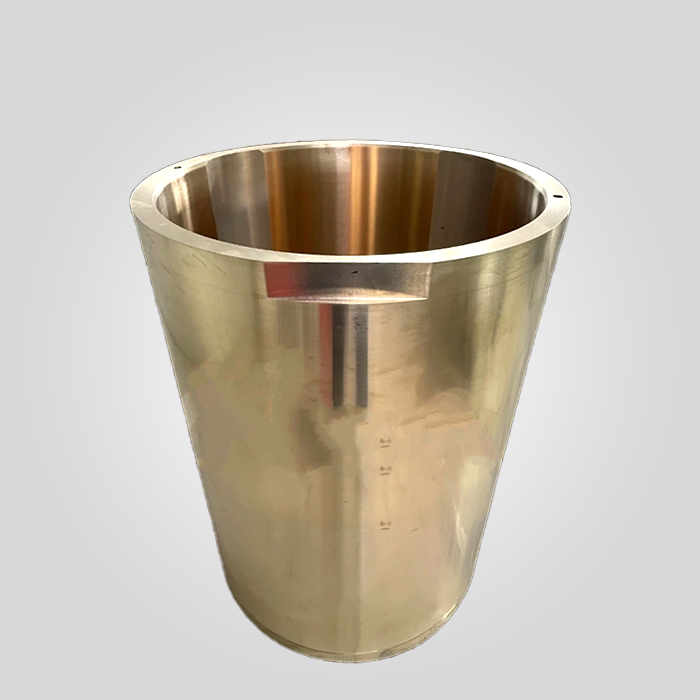
KB63-89 Eccentric Insert Glass For Gyratory Crusher 4350787-E22
Part Number: 4350787-E22
Part Name: Eccentric Insert Glass
Crusher Model :KB63-89
OEM Manufacturer :ThyssenKrupp (equipment now supported by FLSmidth)
Component Location :Eccentric Assembly — inner bearing liner between eccentric body and main shaft
Where This Part Sits and Why Getting It Wrong Stops Your Primary Circuit
The eccentric assembly in a KB63-89 primary gyratory crusher converts continuous rotation from the drive into the gyratory pendulum motion that drives crushing. At the center of that mechanism sits the eccentric insert — a precision bronze bearing element that lines the eccentric body and carries the radial loads generated between the eccentric and the main shaft during every rotation cycle. Part number 4350787-E22 is the eccentric insert glass for this machine: a term used in ThyssenKrupp internal part nomenclature to designate the specific inner bearing liner variant identified by the E22 configuration suffix.
When this insert wears beyond its serviceable limit, the eccentric clearance opens, the main shaft begins to run with increased radial play, and the crushing head describes an irregular stroke. Product size distribution shifts, power draw increases, and bearing temperature rises — usually in that sequence. By the time a site identifies the symptom as an eccentric problem rather than a liner wear issue or a feed change effect, the insert surface is typically past recovery and the surrounding eccentric body may also need inspection for bore scoring.
Confirmed Part Data
The table below lists only parameters that are verifiable from public part records or from the confirmed function of this component class. Dimensional data for 4350787-E22 — including outer diameter, inner diameter, length, and eccentricity geometry — is not publicly released by FLSmidth or ThyssenKrupp. Buyers must confirm all dimensions against original drawings, a worn part sample, or direct site measurement before issuing a production order to any gyratory crusher part supplier.
| Parameter | Confirmed Value / Status |
| Part Number | 4350787-E22 |
| Part Name | Eccentric Insert Glass |
| Crusher Model | KB63-89 |
| OEM Manufacturer | ThyssenKrupp (equipment now supported by FLSmidth) |
| Component Location | Eccentric Assembly — inner bearing liner between eccentric body and main shaft |
| Material Family | Bronze (specific alloy grade to be confirmed per OEM drawing or sample analysis) |
| Suffix Designation | E22 — variant identifier; exact eccentricity or design revision to be confirmed per crusher serial number |
| Outer Diameter | Not publicly available — confirm by drawing or sample measurement |
| Inner Diameter | Not publicly available — confirm by drawing or sample measurement |
| Part Length / Height | Not publicly available — confirm by drawing or sample measurement |
| Listed Weight | Not publicly available — confirm by drawing or sample measurement |
| Lubrication Method | Forced oil circulation, ISO VG 320 or VG 460 depending on site specification |
| Application | Primary hard rock gyratory crushing — ore, granite, basalt duty |
Understanding the E22 Suffix and “Glass” Designation
ThyssenKrupp gyratory crusher part numbering for eccentric inserts uses suffix codes to distinguish variants within the same base part family. The suffix E22 most likely identifies a specific eccentricity value or a revised design iteration applied to a particular production series of the KB63-89. Because ThyssenKrupp and FLSmidth do not publish part drawing revisions or suffix tables in the public domain, buyers ordering this component must confirm which suffix applies to their specific crusher by serial number. Two machines of the same model designation can carry different eccentricity values depending on their commissioning date and any post-commissioning modifications to the drive configuration.
The term “Glass” in the part name is a ThyssenKrupp internal nomenclature term for a specific liner geometry or surface treatment variant of the eccentric insert. It does not refer to a non-metallic material. The component is a bronze bearing insert. Ordering a replacement part described only as “eccentric insert KB63-89” without confirming the E22 suffix and the Glass variant designation risks receiving an insert with a different bore geometry, a different eccentricity profile, or a different oil groove pattern — any of which can alter the stroke of the crushing head and shift the closed-side setting away from the calibrated operating point.
Bronze Alloy Requirements for the Eccentric Insert Position
The inner bearing surface of the eccentric insert operates under combined radial load and sliding motion relative to the main shaft. As the eccentric rotates, the main shaft does not rotate with it — instead, the shaft tends to counter-rotate at a speed determined by the ratio of crusher head diameter to eccentric throw. This creates a sliding condition at the inner bore of the insert that is not pure rotation. The bronze must carry this mixed-motion load through all phases of operation, including start-up when the oil film has not yet fully developed, and tramp iron events when impact load spikes occur within the eccentric cycle.
High-leaded tin bronze in grades such as CuPb15Sn8 or ZCuPb20Sn5 is the conventional material for this position in large primary gyratory eccentric inserts. Lead content in the 15–20% range by mass provides the emergency lubricity and particle embeddability needed to tolerate brief boundary lubrication events without scoring the mating main shaft surface. The tin fraction at 5–10% maintains matrix compressive strength. For sites operating with consistently clean oil at ISO 4406 cleanliness level 17/15/12 or better, aluminium bronze in the CuAl10Fe3 grade — with compressive yield strength typically above 260 MPa — is a viable alternative that offers extended service life under continuous full-film lubrication conditions.
A gyratory crusher part supplier providing 4350787-E22 must be able to state the specific alloy grade by designation — not by the generic term “bronze” — and must supply a heat-specific chemical composition certificate listing copper, lead, tin, zinc, and controlled residual maxima. Hardness measured on the finished bore surface should be confirmed and reported. For a bronze insert in this application, hardness below 55 HBW on the running face indicates insufficient tin content or incomplete solidification control. Hardness above 85 HBW in a leaded bronze suggests alloy substitution toward a harder, lower-lead grade that may not tolerate boundary lubrication episodes without damaging the shaft.
Industry Pain Point: The Eccentricity Confirmation Failure That Costs Two Shutdowns
A maintenance team at a copper concentrator replaced the eccentric insert in their KB63-89 after oil analysis showed a sustained copper trend rising from 9 ppm to 61 ppm across three consecutive monthly samples. The replacement insert was sourced from a supplier who confirmed the base part number 4350787 but did not verify the E22 suffix or the Glass variant designation against the machine’s serial number plate and commissioning record.
After installation and recommissioning, the crusher’s closed-side setting drifted 8 mm from the calibrated setpoint within the first 200 operating hours. The drive power draw was 4–6% above the pre-replacement baseline. Vibration signature at the eccentric frequency showed a 0.7 mm/s increase in the dominant spectral peak. The plant shut down the crusher for inspection and discovered the replacement insert had a bore geometry with 2 mm less eccentricity than the design specification — a difference that changed the throw at the crushing head, shifted the product curve, and increased the circulating load on the secondary circuit by an estimated 12% during the 200-hour operating period.
The second shutdown for correct-part installation, with the associated production loss, cost more than four times the price of the original insert. The root cause was not a bad part — it was an incomplete part identification that did not account for the suffix code. Every gyratory crusher part supplier who cannot confirm the suffix and variant designation before manufacturing should be required to provide that confirmation as a condition of the purchase order, not after delivery.
Pro-Tip: Before removing the worn eccentric insert, use a depth micrometer to measure the exposed shaft at three axial positions and record the diametral clearance relative to the insert bore at each position. Photograph the oil groove condition and the distribution of contact marking on the bronze surface. These measurements define the wear profile of the current insert and allow the replacement supplier to confirm whether their part matches the correct geometry — rather than simply matching the nominal drawing dimension, which may have been updated across production revisions of the KB63-89.
Casting and Machining Quality Criteria
The eccentric insert is a centrifugally cast or static-cast bronze cylinder that is then precision-machined to the bore and OD dimensions. For an insert serving the KB63-89 eccentric — a machine in the 63-inch primary gyratory class — the casting must be free of shrinkage porosity, lead segregation zones, and trapped slag inclusions in the bore wall. These defects do not appear on the outer surface and are not detectable by visual inspection of the finished part. Ultrasonic testing of the bore-wall zone, performed after rough machining and before finish machining, is the accepted method for confirming casting soundness in heavy bronze bearing components.
After finish machining, the inner bore surface finish should be Ra ≤ 0.8 µm to support oil film formation under the mixed-motion shaft contact. The OD surface that contacts the eccentric body housing requires Ra ≤ 1.6 µm with no spiral tool marks that could serve as oil escape paths under the press or transition fit. Oil grooves in the bore must have transition radii at the groove edges — a sharp corner at Ra transition carries a stress concentration factor that initiates fatigue cracking parallel to the groove under cyclic radial loading, typically in the 5,000–8,000-hour range for a primary gyratory running continuous three-shift operations.
Concentricity of the inner bore axis relative to the outer diameter axis must be confirmed to within 0.05 mm TIR for an insert in this application. A concentricity error produces a predictable asymmetric wear pattern — the insert contacts the shaft preferentially on one arc, runs hotter on that arc, and loses lead from the high-contact zone before the opposite side shows any measurable wear. The asymmetric oil analysis trend — rising copper and lead while the copper appears to stabilise, followed by a sudden spike — is the characteristic signature of this failure mode.
Procurement Requirements for Qualified Gyratory Crusher Part Suppliers
Because FLSmidth does not release dimensional drawings for KB63-89 gyratory crusher parts in the public domain, a gyratory crusher part supplier quoting 4350787-E22 must declare their dimension source before a purchase order is issued. Acceptable sources are: a reverse-engineered drawing developed from a measured worn part, a drawing obtained under a licensed supply arrangement, or a confirmed OEM drawing archive. A supplier who cannot state their dimension source should not receive a production order for a component where a 2 mm eccentricity error — as described above — can shift the primary circuit operating point and trigger a second unplanned shutdown.
The minimum technical documentation package from any supplier should include: a chemical composition certificate with heat number; a hardness test result measured on the finished bore surface; a dimensional inspection sheet covering OD, ID, length, bore concentricity, and oil groove geometry; an NDT record confirming casting soundness in the bore-wall zone; and a weight confirmation for the finished part. Suppliers who provide only a “material certificate” stating “bronze — meets requirements” without a heat number and element-by-element chemistry report are not providing controlled material documentation. They are providing assurance language, which is not the same thing.
Frequently Asked Questions
Why does the E22 suffix matter when ordering the eccentric insert, and can the base part number 4350787 alone be used for procurement?
The base number 4350787 identifies the eccentric insert family for the KB63-89. The E22 suffix designates a specific variant within that family — most likely a defined eccentricity value or a design revision applied to a specific production range of the crusher. Two KB63-89 machines from different production years or with different drive configurations can require different suffix variants. Ordering by base number alone, without confirming the suffix against the machine’s serial number and commissioning record, introduces the risk of receiving an insert with a different bore geometry that changes the stroke at the crushing head. Any gyratory crusher part supplier who accepts an order based on the base number without confirming the suffix with the buyer is not applying adequate part identification discipline for a component of this functional significance.
What oil system checks should be completed before installing the new eccentric insert to protect it during the run-in period?
Before installation, flush the oil gallery and eccentric housing until return oil from the flush shows no metallic particles above ISO 4406 cleanliness level 18/16/13 in a filter comparison check. Verify that the oil cooler is clean and that cooler bypass temperature is within 3°C of the design setpoint. Check filter element differential pressure against the baseline recorded before the previous insert failed — a differential pressure that has risen from 0.8 bar to 1.4 bar at the same flow rate indicates a partially blocked element that will restrict oil delivery to the new insert during the critical first 200-hour run-in period. Confirm that the oil pump output pressure at the eccentric feed port meets the design specification at operating temperature before applying load to the crusher. A new bronze insert in boundary lubrication during run-in, combined with restricted oil supply due to a fouled cooler or a partially blocked filter, produces a surface wiping pattern in the first shift that permanently reduces the service life of the insert regardless of subsequent correct lubrication.
How should the worn eccentric insert be evaluated before disposal to inform procurement of the replacement?
A worn insert provides more useful information than any new part can communicate about what the machine actually experienced. Before disposal, measure the bore diameter at six positions — three axial heights, each measured at two diametrically opposite points — to document the wear profile. An elliptical bore pattern, where one diameter measures 1.5–2 mm larger than the perpendicular diameter, indicates the shaft has been running with a contact preference on one arc, which suggests either misalignment, an uneven oil groove distribution, or a previous insert with incorrect concentricity. Photograph the bore surface and the oil groove condition under adequate lighting. Identify any heat-discoloured zones, cracking adjacent to groove edges, or embedded hard particle tracks on the bronze surface. These observations, shared with the replacement gyratory crusher part supplier along with the part number, crusher serial number, and oil analysis history, allow the supplier to confirm that their replacement part addresses the actual failure mechanism rather than reproducing the same part into the same failure environment.
All manufacturer names, part numbers, model numbers, and descriptions are used for reference and identification purposes only, they are owned by the respective machine manufacturer, including but not limited to FLSmidth®, Metso®, thyssenkrupp®, and Sandvik®. All parts supplied are manufactured and warranted by yonsmen and are not manufactured by or purchased from the Original Equipment Manufacturer. yonsmen has no association with the OEM and does not intend to give this impression.
Reviews
There are no reviews yet.