
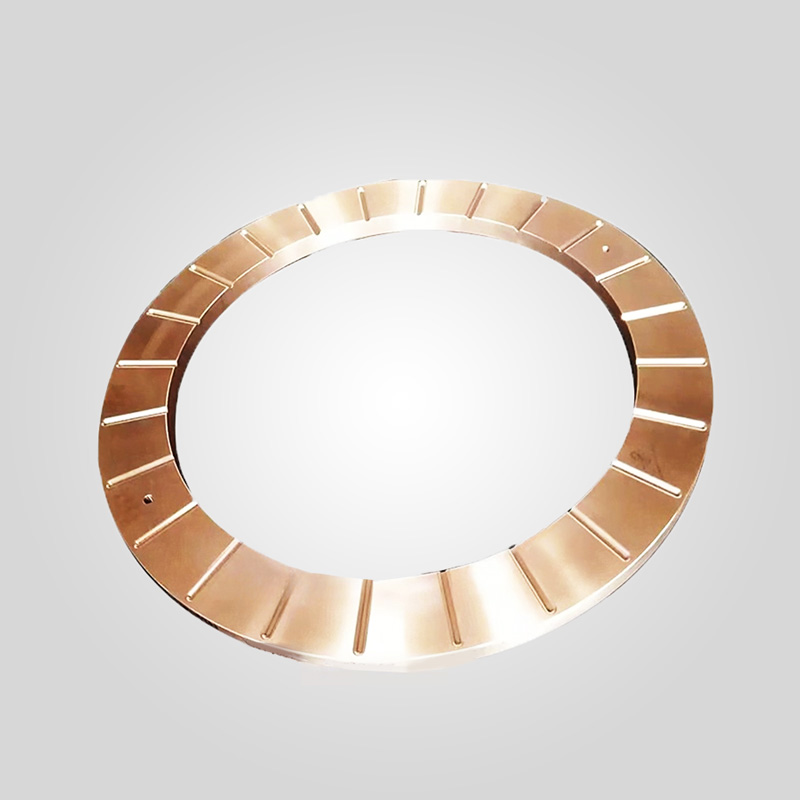
KB63-89S Axial Bearing Ring 2080727591 Gyratory Crusher part
Product Name: KB63-89S Axial Bearing Ring
Part Number: 2080727591
Part Category :Axial bearing ring, bronze thrust bearing component, gyratory crusher spare part
Compatible Equipment :Thyssenkrupp KB63-89S gyratory crusher; related KB-series compatibility must be confirmed by drawing before order
Function :Supports axial load from the main shaft assembly and maintains the lubricated thrust interface
Listed Weight :314.2 kg
Listed Material Options: ZCuPb20Sn5, ZCuPb10Sn10, ZCuPb24Sn5 high-leaded bronze
Preferred Material Reference :ZCuPb20Sn5 high-leaded tin bronze for axial thrust bearing service
| Parameter | Specification |
|---|---|
| Product Name | KB63-89S Axial Bearing Ring |
| Part Number | 2080727591 |
| Part Category | Axial bearing ring, bronze thrust bearing component, gyratory crusher spare part |
| Compatible Equipment | Thyssenkrupp KB63-89S gyratory crusher; related KB-series compatibility must be confirmed by drawing before order |
| Function | Supports axial load from the main shaft assembly and maintains the lubricated thrust interface |
| Listed Weight | 314.2 kg |
| Listed Material Options | ZCuPb20Sn5, ZCuPb10Sn10, ZCuPb24Sn5 high-leaded bronze |
| Preferred Material Reference | ZCuPb20Sn5 high-leaded tin bronze for axial thrust bearing service |
| Copper Content Reference | Balance, approximately 72 percent to 76 percent for ZCuPb20Sn5 reference practice |
| Lead Content Reference | 18 percent to 23 percent for ZCuPb20Sn5 reference practice |
| Tin Content Reference | 4 percent to 6 percent for ZCuPb20Sn5 reference practice |
| Hardness Reference | 65 to 80 HBW, industry reference for embeddability and anti-seizure behavior |
| Tensile Strength Reference | Minimum 200 MPa, industry reference for high-leaded tin bronze bearing parts |
| Elongation Reference | Minimum 7 percent, industry reference for cast bronze bearing parts |
| Density Reference | Approximately 9.3 g/cm³ for high-leaded bronze reference material |
| Casting Process Reference | Centrifugal casting or controlled bronze casting with material certificate and chemical analysis |
| Machining Requirement | CNC finish machining after casting, with oil grooves matched to the mating thrust surface and lubrication design |
| Critical Running Surface Finish | Ra 0.4 µm reference for machined bearing surface; mating steel face should not exceed Ra 0.8 µm unless drawing states otherwise |
| General Machining Tolerance Reference | ISO 2768-mK reference when no customer drawing tolerance is supplied |
| Plain Bearing Material Standard Reference | ISO 4382-1:2021 for cast copper alloys used in solid and multilayer thick-walled plain bearings |
| Continuous Casting Standard Reference | ASTM B505/B505M reference for copper alloy continuous castings when continuous-cast feedstock is used |
| Inspection Items | Chemical composition, hardness, ultrasonic inspection where required, dimensional inspection, surface roughness, oil groove profile, packing protection |
| Data Basis | Part number, model, material options, and weight are from public product listings; non-public dimensions must be confirmed by drawing or measured sample |
What Actually Fails First — And Why the Bronze Is Not the Problem You Think It Is
A rising copper trend in your oil analysis is not a material failure. It is a system signal. When a KB63-89S axial bearing ring begins releasing Cu and Pb into the return oil, the question is not whether the bronze wore — bronze is designed to wear. The question is whether it wore controllably, or whether boundary lubrication conditions allowed the contact surface to wipe. Those two outcomes look similar in the filter but have entirely different root causes and repair costs.
The axial bearing ring in the FLSmidth KB63-89S primary gyratory crusher carries combined vertical loads from the crushing head, the main shaft weight, eccentric rotation forces, and impact from oversized feed. That load path passes through a bronze ring whose job is not to resist wear indefinitely, but to accept sacrificial wear, maintain an oil wedge under axial pressure, and prevent direct contact between the eccentric steel assembly and the fixed support structure. When it works correctly, you replace bronze. When it fails incorrectly, you resurface or replace hardened steel.
Material Grade Is Not Interchangeable: ZCuPb20Sn5, ZCuPb10Sn10, and ZCuPb24Sn5 Are Not the Same Part
The publicly listed material candidates for this bearing ring — ZCuPb20Sn5, ZCuPb10Sn10, and ZCuPb24Sn5 — cover a range of lead content from approximately 10% to 24% by mass. That range exists because operating conditions are not uniform. Higher lead content improves emergency lubricity and embeddability. Lead-rich phases allow fine silica dust and metallic fines to embed into the bronze matrix rather than cutting the mating steel counterface. Tin in the 5–10% range strengthens the copper matrix without making the alloy brittle under compressive thrust load.
A supplier offering a generic “high-leaded bronze” without specifying which grade to within ±2% Pb and ±1% Sn is not offering a controlled bearing material. For procurement of gyratory crusher parts from any crusher parts supplier, the certificate of conformity must list copper, lead, tin, zinc, and controlled residual element maxima — not just the alloy family name. Hardness on a finished face for ZCuPb20Sn5-equivalent material should fall in the range of 55–75 HBW. A result above 85 HBW after machining suggests incorrect alloy chemistry or excessive cold work that reduces the material’s ability to embed abrasive particles.
Casting Soundness and What It Means for a 314.2 kg Bronze Ring
A bearing ring at 314.2 kg listed mass is not a machined-from-bar component. It is a casting, and casting soundness is an engineering requirement, not a quality-control formality. Lead segregation in high-Pb bronze is a known phenomenon during solidification. If the casting is cooled too quickly at the outer diameter while the core remains liquid, lead can concentrate unevenly. A running face cut from a lead-lean zone of a segregated casting behaves differently from a face cut from a correctly distributed zone — the anti-seizure benefit disappears exactly where you need it most.
For this reason, responsible crusher parts manufacturers for heavy gyratory bronze components use centrifugal casting or controlled sand casting with feeding risers sized to reduce shrinkage cavities. Ultrasonic inspection at the finished thickness confirms internal soundness before machining begins. Any crusher parts supplier quoting from adapted stock — a ring poured for a different diameter then remachined — should be asked to provide wall thickness maps and ultrasonic scan records at the running-face zone.
Machining Tolerances and Surface Finish: The Parameters That Control Oil Film Formation
The running face of the bearing ring must achieve Ra ≤ 0.4 µm to support hydrodynamic film formation under normal ISO VG 320 or VG 460 circulating oil at operating temperature. A face that inspects visually clean but carries directional machining marks from a worn tool — typically showing Ra 0.8–1.2 µm when measured — disrupts the oil wedge at the moment of highest axial load.
Oil groove geometry is equally critical. Groove depth for this class of bearing is typically 3–6 mm depending on flow rate design, with transition radii at groove edges no sharper than R0.5 mm. A sharp tool mark at a groove edge creates a local stress concentration that, under axial fatigue cycling from tramp iron events, can initiate a surface crack parallel to the groove. Once the crack propagates across the running face, the ring can spall rather than wear — releasing hard bronze fragments into the lubricant that then damage the steel counterface and the oil system downstream.
Inner and outer locating diameters require positional tolerance typically within ±0.05 mm to ensure even seating. An uneven seating condition creates a rocking interface under axial load — the ring contacts on one arc and lifts on the opposite arc, concentrating pressure and heat into the contact zone rather than distributing it across the full face area.
Pro-Tip: Before accepting a replacement axial bearing ring from any crusher parts manufacturer, apply a thin coat of Prussian blue layout dye to the mating steel thrust face and do a dry seating check with the new bronze ring under controlled hand pressure. The contact pattern should cover at least 70% of the annular face area and show no arc-shaped gaps wider than 15 mm. If you see a single high-contact arc — typically a sign of a tapered or out-of-flat steel face — correct the steel before installing. Installing a correctly machined bronze ring against a damaged steel face produces the same failure pattern as a bad ring, and the blame almost always falls on the bronze supplier.
Oil Analysis Trending: Reading the System Before Shutdown Damage Becomes Visible
A single oil sample showing elevated copper is not a maintenance action trigger. A three-sample trend showing Cu rising from 12 ppm to 28 ppm to 51 ppm across 500 operating hours is. When lead rises in parallel with copper in a high-leaded bronze bearing, the combination indicates the contact is moving into boundary or mixed lubrication. The lead phase is doing its emergency lubricity function — which means the hydrodynamic film is not fully established. This condition must be investigated against oil temperature, oil pressure, cooler fouling records, and filter differential pressure rather than treated as normal run-in behavior.
A sudden copper spike following a liner change, feed change, or oil system maintenance is almost always traceable to a contamination event — dirt introduced during assembly — or a brief lubrication interruption that left the running face in contact before the oil wedge was restored. Documenting baseline Cu, Pb, Fe, and Cr concentrations immediately before and after bearing ring replacement allows the maintenance team to distinguish normal run-in wear from abnormal distress within the first 200 hours.
Procurement Checklist for Gyratory Crusher Spare Parts: What to Require Before Issuing a Purchase Order
| Item | Minimum Requirement | Rejection Criterion |
|---|---|---|
| Chemical Composition Certificate | Heat-specific, listing Cu, Pb, Sn, Zn, residuals | Generic “bronze alloy” certificate, no heat number |
| Hardness Report | 55–75 HBW measured on finished running face zone | Missing, or value above 85 HBW without explanation |
| Dimensional Inspection Sheet | OD, ID, thickness, groove depth, Ra measurement | Visual inspection only, no measured values |
| Casting Method Statement | Centrifugal or controlled sand casting with riser design | Adapted stock from unrelated casting, no casting record |
| NDT Record (for parts above 200 kg) | Ultrasonic scan at running face zone, no indications > 2 mm | No NDT performed, or scan done before finish machining |
| Weight Confirmation | Weighed finished part, ±2% of nominal 314.2 kg | Estimated weight only |
| Packing Record | Running face protected, no direct contact with packing timber | Bare bronze face against wood or steel crating surface |
Installation Sequence and Commissioning Confirmation
Clean the housing bore and all oil passages before ring installation. Any abrasive residue — blast media, machining chips, hardened oil deposits — left in the housing or oil feed galleries will be distributed across the new bronze running face within the first hour of operation. Burrs on oil groove edges must be stoned before assembly. A raised edge as small as 0.1 mm can create a local high-pressure contact zone that wipes the bronze in a crescent pattern directly adjacent to the groove.
Bring the lubrication system online and confirm oil pressure, flow rate, and return temperature before the crusher is loaded. Verify filter differential pressure is within baseline. After the first 100–200 hours of operation on the new bearing ring, pull a fresh oil sample and compare Cu and Pb against the pre-installation baseline. A normal run-in shows a modest elevation — typically Cu below 30 ppm — that stabilizes. An abnormal result requires immediate investigation of oil temperature, mating surface condition, and groove geometry before further operation.
The Cost Logic That Most Procurement Departments Miss
The KB63-89S axial bearing ring 2080727591 is a fraction of the cost of the main shaft it protects. A correctly made and correctly installed bearing ring that runs for its full design life — typically 12,000–18,000 operating hours depending on application and oil discipline — costs less per operating hour than a single unplanned primary crusher shutdown requiring main shaft inspection, surface grinding of the steel counterface, and repeat crane work for re-installation.
The failure mode that produces the highest repair cost is not a ring that wears quickly. It is a ring with incorrect bronze chemistry that scores the steel counterface during a boundary lubrication event, followed by a replacement ring installed against that scored surface, followed by a second ring failure within 2,000 hours. This cycle continues until the steel face is corrected. Evaluating cone crusher wear parts suppliers on documented material chemistry, measurable surface finish, and casting quality records is not excessive due diligence — it is the minimum technical standard that protects the economics of primary crushing throughput.
From the Desk of a Field Engineer: I have reviewed crusher failures where the bronze ring looked acceptable on receipt, passed a visual check during installation, and then wiped within 800 hours. In every one of those cases, the post-failure investigation found either a lead-lean zone in the casting caused by solidification segregation, or a mating steel face with Ra above 1.6 µm that was accepted without roughness measurement. Neither failure was the supplier’s fault alone. The procurement process did not ask for the right data, and the installation process did not verify the mating interface. Both corrections cost nothing compared to the downtime they prevent.
All manufacturer names, part numbers, model numbers, and descriptions are used for reference and identification purposes only, they are owned by the respective machine manufacturer, including but not limited to FLSmidth®, Metso®, thyssenkrupp®, and Sandvik®. All parts supplied are manufactured and warranted by yonsmen and are not manufactured by or purchased from the Original Equipment Manufacturer. yonsmen has no association with the OEM and does not intend to give this impression.
Reviews
There are no reviews yet.