When the Accumulator Fails, the Crusher Pays for It
At a granite crushing plant in Guangdong, a Metso GP500S secondary crusher suffered a catastrophic main frame crack after only 800 hours of operation on a newly installed liner set. The machine had been running hard feed — granite with unconfined compressive strength exceeding 180 MPa — but the frame was rated for exactly this application. The investigation eventually traced the failure not to the liner, not to the feed gradation, but to a hydraulic accumulator that had lost its nitrogen pre-charge entirely. The tramp relief system had been operating without functional pressure storage for an estimated three to four months. Every time an uncrushable object entered the chamber, instead of absorbing the pressure spike and allowing the bowl to lift, the hydraulic circuit transmitted the full shock load directly into the frame. Over hundreds of events, the cumulative fatigue damage finally crossed the fracture threshold.
The accumulator had been visually inspected at every scheduled stop. It looked fine on the outside. No one had checked the pre-charge pressure. That single omission cost the plant a main frame, a full production shutdown of sixteen days, and an emergency freight bill for crusher replacement parts that amounted to more than the accumulator service program would have cost over ten years.
What a Cone Crusher Accumulator Actually Does
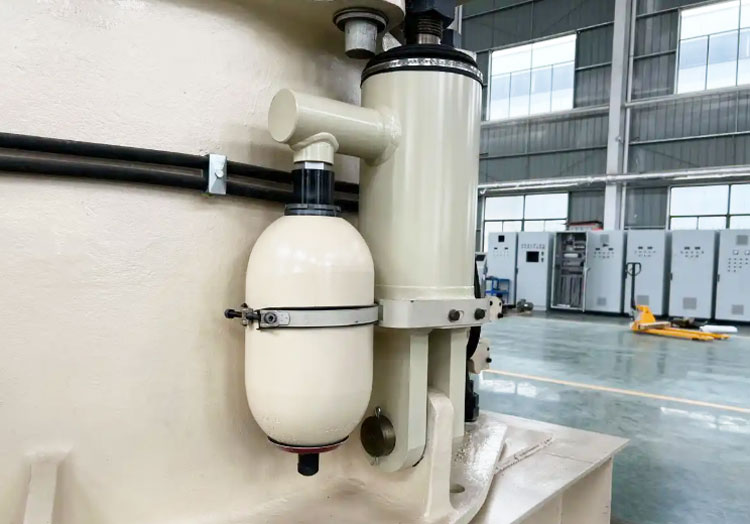
Most operators understand the accumulator as part of the tramp iron relief system, which is accurate but incomplete. The accumulator serves three distinct engineering functions, and understanding all three is necessary to appreciate why its failure creates risks across multiple crusher subsystems simultaneously.
Function 1 — Tramp Iron Relief and Chamber Clearing
When an uncrushable object — tramp metal, a steel tooth from a loader bucket, a dense mineral nodule — enters the crushing chamber, it generates a pressure spike in the hydraulic cylinder circuit that supports the bowl assembly. The accumulator, pre-charged with dry nitrogen to a specified pressure — typically 55 to 65% of the system working pressure, which in most mid-range cone crushers falls between 100 and 210 bar depending on model — absorbs this spike and stores the energy. The bowl lifts, the object passes through, and the stored energy in the accumulator drives the bowl back to its set position within one to two seconds. Without a functional accumulator, the bowl cannot return to position reliably, the crusher stalls or trips on overload, and the unabsorbed shock load transfers directly to the frame, eccentric assembly, and drive components.
Function 2 — Setting Retention Under Variable Load
The hydraulic cylinder in a cone crusher is not merely a relief device — it maintains the bowl at the correct height to hold the specified closed side setting. Feed material exerts fluctuating downward forces on the bowl throughout each crushing cycle. The accumulator provides compliant pressure support that allows the bowl to respond to these fluctuations without triggering constant pump cycling. A depleted accumulator forces the hydraulic pump to work continuously to maintain system pressure, accelerating pump wear and creating erratic CSS behavior that degrades product gradation.
Function 3 — Controlled Cavity Clearing After a Stall
When a cone crusher stalls under a packed chamber — a common event during uneven feed or power interruption — the operator must clear the material before restarting. On crushers equipped with a properly functioning accumulator, the stored hydraulic energy allows the bowl to be raised under load without running the pump against a static, compacted bed of rock. This controlled cavity-clearing function protects the bowl threads, the locking ring, and the frame from the asymmetric loading that occurs when trying to force a packed chamber open against pump pressure alone.
How Accumulator Failure Translates into Crusher Risk
Accumulator failure is rarely sudden and rarely visible. The nitrogen pre-charge bleeds down gradually through microscopic leaks at the gas valve, through bladder or diaphragm permeation, or through fatigue cracking in the bladder material. The hydraulic oil circuit continues to function. The crusher continues to run. The failure is silent until its consequences are not.
Risk 1 — Progressive Frame Fatigue
As described in the Guangdong case, each tramp event without a functional accumulator transmits an unattenuated pressure spike — potentially exceeding the system relief valve setting of 280 to 350 bar on larger crushers — directly into the structural steel of the main frame and adjustment ring. High-strength cast steel in ZG270-500 grade, with tensile strength of 500 MPa and yield strength of 270 MPa, is designed with fatigue margins that assume the hydraulic relief circuit is absorbing these transient loads. When it is not, fatigue crack initiation at stress concentration points — thread roots, fillet radii, inspection ports — occurs far earlier than the design life predicts.
Risk 2 — Eccentric Assembly Damage
The eccentric bushing and main shaft journal operate within a designed radial clearance of 0.15 to 0.35 mm and depend on a continuous hydrodynamic oil film for load support. Repeated shock loads from unabsorbed tramp events impose radial impulses on the shaft journal that exceed the film capacity and cause metal-to-metal contact. I have seen eccentric bushings in Cu-Sn10-P tin bronze scored across 30% of their bearing surface within 400 hours on a crusher running without accumulator pre-charge — a component that should have lasted 8,000 hours under normal conditions.
Risk 3 — Bowl Thread and Locking Ring Damage
The bowl assembly is retained by a threaded ring with a coarse Acme or buttress thread profile. Each unabsorbed shock event applies an upward impulse to the bowl that the thread flanks must resist. Repeated high-amplitude impulses cause fretting at the thread contact faces, accelerating thread wear and eventually creating enough play that the bowl rotates during operation — a condition known as bowl spin — that rapidly destroys the thread form and requires replacement of both the bowl and the adjustment ring as crusher replacement parts.
Risk 4 — Hydraulic Pump and Valve Overloading
With the accumulator unable to store and release energy, the hydraulic pump must respond directly to every pressure fluctuation in the circuit. Gear pumps and piston pumps rated for steady-state or moderate cyclic duty experience accelerated wear when subjected to the rapid pressure transients that the accumulator is designed to absorb. Pressure relief valves, sized and set for a system with compliant energy storage, may chatter or crack open repeatedly — a condition that causes valve seat erosion and eventually requires replacement of the entire valve assembly as part of a larger crusher replacement parts order.
Daily and Scheduled Inspection — What Maintenance Personnel Must Not Skip
The accumulator is the most under-inspected component in the cone crusher hydraulic circuit, largely because it has no moving parts visible from the outside and its failure produces no immediate alarm. The following inspection protocol is the minimum standard I apply on every crusher I supervise.
Every-Shift Check (8-Hour Interval)
- Visual inspection of accumulator body and connections: Check for oil weeping at the lower hydraulic port, corrosion on the shell, and any mechanical damage to the nitrogen valve cap. A wet oil port on a bladder accumulator is the first sign of bladder failure — oil has reached the gas side, which means the bladder has ruptured and the accumulator has zero functional capacity.
- System pressure gauge reading at rest: With the crusher stopped and the pump off, the hydraulic circuit pressure should stabilize at a value close to the accumulator pre-charge pressure. A reading that drops to zero within 60 seconds of pump shutdown indicates the accumulator is not holding charge.
- Bowl return speed after manual relief test: On crushers with a manual bowl-raise function, time the bowl return to set position after a short raise event. A return time exceeding 3 to 4 seconds longer than the commissioned baseline is a reliable indicator of reduced accumulator capacity.
Monthly Inspection (200 to 250 Operating Hours)
- Nitrogen pre-charge pressure verification: Isolate the accumulator from the hydraulic circuit, release system oil pressure fully, and connect a calibrated nitrogen charging kit to the gas valve. Measure the pre-charge pressure and compare to the OEM specification — typically 55 to 65% of maximum working pressure. A deviation of more than 10% below specification requires re-charging with dry nitrogen (purity ≥ 99.5%). Never use compressed air or oxygen — the adiabatic compression temperature rise during a pressure spike can exceed 200°C and ignite oil vapor with compressed air, or cause detonation with oxygen.
- Bladder condition assessment: On bladder-type accumulators, a simple field test can indicate bladder integrity. After releasing oil-side pressure and checking gas pre-charge, slowly re-pressurize the oil side. If the nitrogen pre-charge reading drops as oil pressure rises, the bladder has failed and oil is mixing into the gas chamber. This accumulator must be removed from service immediately and replaced as a priority crusher replacement parts item.
- Shell and weld inspection: Accumulators are pressure vessels. Inspect the shell exterior for pitting, corrosion, mechanical damage, and any indication of weld seam distress. Shells showing corrosion penetration beyond 0.5 mm of surface material should be condemned regardless of current pressure test status.
Annual Inspection and Pressure Test
- Hydrostatic pressure test: In most jurisdictions, pressure vessels including hydraulic accumulators require periodic hydrostatic testing at 1.25 to 1.5 times the maximum allowable working pressure (MAWP). Confirm the applicable local regulation and ensure the accumulator test record is current. An accumulator without a valid pressure test certification is a liability in any incident investigation.
- Bladder or diaphragm replacement: Regardless of apparent condition, I recommend replacing the bladder on a defined service interval — typically every 3 to 5 years or every 10,000 operating hours, whichever comes first — on crushers handling hard or abrasive feeds where tramp relief events are frequent. The cost of a replacement bladder as a planned crusher replacement parts item is a fraction of the cost of a main frame crack or eccentric bushing failure caused by an undetected bladder rupture.
Accumulator Inspection Reference Table
| Inspection Item | Interval | Method | Accept Criteria |
|---|---|---|---|
| Oil port and shell visual check | Every shift (8 hr) | Visual | No oil weeping at gas-side port; no shell corrosion or mechanical damage |
| System pressure at rest | Every shift (8 hr) | Gauge reading after pump shutdown | Pressure stable within 5% over 2 minutes |
| Bowl return time | Weekly (50 hr) | Stopwatch on manual bowl raise/release | Within 3 seconds of commissioned baseline |
| Nitrogen pre-charge pressure | Monthly (200 hr) | Calibrated N2 charging kit, oil side fully depressurized | 55 to 65% of system MAWP; within 10% of OEM specification |
| Bladder integrity test | Monthly (200 hr) | Cross-pressure test: oil pressure rise vs gas pressure stability | Gas pre-charge stable as oil pressure applied; no cross-migration |
| Shell hydrostatic test | Annual or per local regulation | Certified test facility; 1.25 to 1.5 x MAWP | No deformation, weeping, or pressure decay over test hold period |
| Bladder or diaphragm replacement | Every 3 to 5 years or 10,000 hr | Full disassembly; replace with OEM-equivalent elastomer element | New bladder installed; shell internally inspected and cleaned before reassembly |
What to Verify When Purchasing Accumulator Crusher Replacement Parts
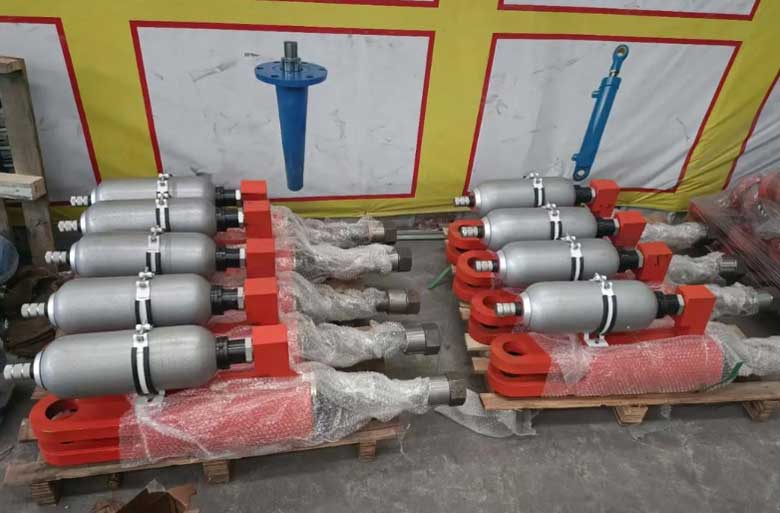
The accumulator market contains a significant volume of non-compliant and substandard components, and the consequences of installing an under-rated or incorrectly specified unit on a cone crusher hydraulic circuit are severe. The following criteria are non-negotiable when evaluating a supplier of accumulator crusher replacement parts.
Pressure Rating and Certification Compliance
The accumulator shell must carry a certified maximum allowable working pressure that meets or exceeds the system design pressure of the crusher hydraulic circuit. For most mid-range secondary and tertiary cone crushers, this falls between 210 and 350 bar. The MAWP must be permanently marked on the shell, along with the manufacturer’s name, serial number, test date, and applicable pressure vessel standard — EN 14359 in Europe, ASME Section VIII Division 1 in North America, or GB 150 in China. An accumulator without a traceable pressure vessel certification is not a pressure vessel — it is an unclassified pressure hazard. Do not install it regardless of price.
Bladder Material Compatibility
The bladder or diaphragm is the only component in contact with both the hydraulic fluid and the nitrogen charge. It must be chemically compatible with the specific hydraulic oil in the crusher circuit — most commonly ISO VG 46 or VG 68 mineral oil, but some modern installations use fire-resistant fluids or synthetic esters that are incompatible with standard NBR (nitrile butadiene rubber) bladders. Confirm the bladder elastomer specification before purchasing. NBR bladders are suitable for mineral oil service up to approximately 80°C and offer a Shore A hardness of 60 to 70, which balances flexibility and pressure resistance. For higher-temperature circuits or synthetic fluids, FKM (Viton) bladders — Shore A hardness 65 to 75, compatible up to 150°C — are the correct specification. A supplier who cannot confirm the bladder compound and its compatibility data sheet should not be trusted with this component.
Dimensional and Port Compatibility
Accumulator replacement in the field is time-sensitive. A unit that arrives with incorrect port thread specification — SAE, BSP, or metric, all of which appear across different crusher OEM hydraulic circuits — requires fabrication of adapter fittings that introduce additional leak points into a high-pressure circuit. Confirm the hydraulic port thread standard, the gas valve thread standard, and the mounting flange or bracket dimensions before ordering. Request a dimensional drawing from the supplier and verify it against the installed unit before the replacement ships.
Traceability and Material Documentation
A credible supplier of accumulator crusher replacement parts provides a material certificate for the shell forging or seamless tube — typically carbon steel SA-372 or equivalent, with specified minimum tensile strength and impact toughness at operating temperature — along with weld procedure qualification records for welded port connections, and a hydrostatic test certificate for the completed assembly. These documents are not optional extras for a pressure vessel. They are the minimum evidence that the component was manufactured to a known standard and tested before leaving the factory. In the event of any future incident involving the accumulator, these records are the first documents a safety regulator will request.
Supplier Track Record in Crusher Applications
A general industrial accumulator supplier and a supplier with documented experience in mining and aggregate crusher hydraulic systems are not equivalent. Crusher hydraulic circuits experience frequent high-amplitude pressure transients — the exact service condition that accelerates bladder fatigue and gas valve wear. Ask the supplier for references from cone crusher applications of comparable model and duty cycle. A supplier who cannot provide application-specific references is selling you a component they have not validated in your operating environment.
The Accumulator Is Not a Passive Component
After more than two decades of working on cone crusher installations, the most consistent observation I can offer about accumulator management is this: every plant that treats the accumulator as a set-and-forget component eventually pays for that assumption. The accumulator is an active energy storage device operating in one of the most mechanically demanding environments in the crushing plant. It absorbs energy that would otherwise destroy structural and bearing components, and it does so silently, without feedback, until it can no longer do so at all.
A properly maintained accumulator — with verified pre-charge, confirmed bladder integrity, and current pressure vessel certification — costs almost nothing to keep in service. The crusher replacement parts required to repair a main frame, an eccentric assembly, or a bowl thread damaged by accumulator neglect cost orders of magnitude more. The inspection protocols in this guide are not conservative overhead — they are the minimum discipline required to keep a cone crusher running at the throughput and reliability the operation depends on.