A Cone Crusher That Lost Eighteen Percent Throughput Overnight
On a granite quarry running a standard cone crusher, the crew noticed a steady climb in amperage draw over three shifts, moving from a normal 185 amps up toward 210 amps without any change in feed rate or gradation. The operator assumed the crusher itself was failing. What had actually happened was that the crusher parts mantle had worn unevenly past its recommended limit, letting the closed side setting drift open on one side of the chamber by nearly 8 millimeters. The crusher kept running, but it was producing an oversized product that the downstream screen rejected at almost double the normal rate, cutting saleable tonnage by roughly eighteen percent for the rest of that week. Nobody noticed until the liner was pulled and measured.
What a Mantle Does Inside the Crushing Chamber
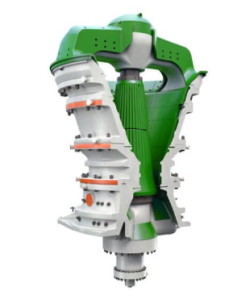
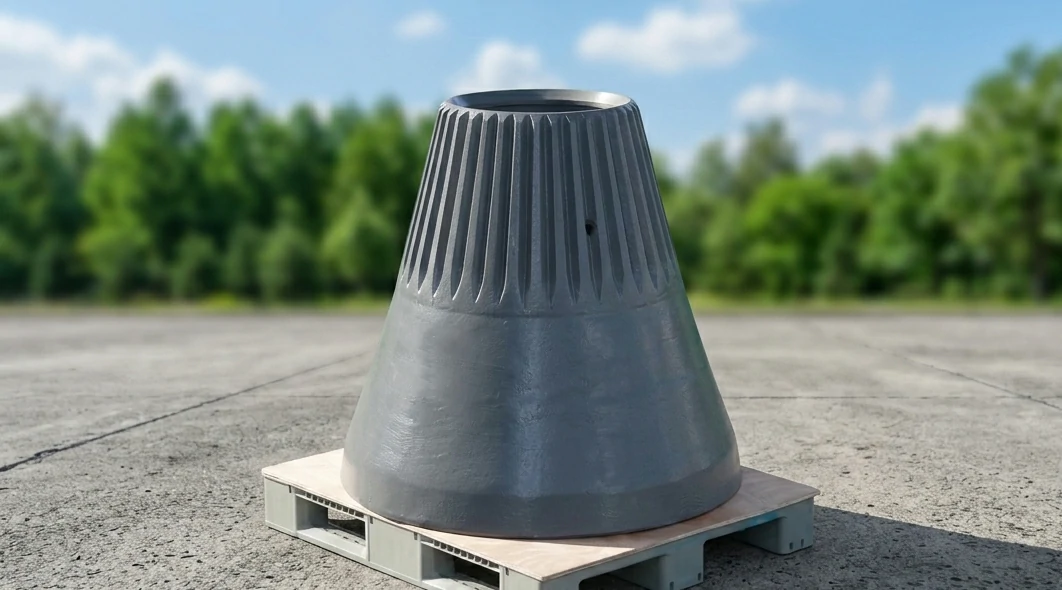
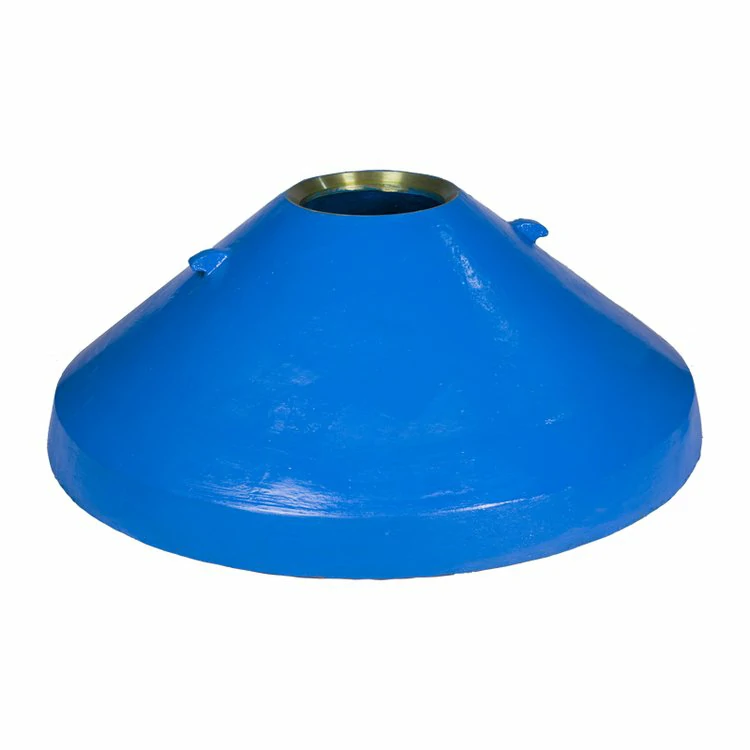
The mantle is the moving wear liner mounted on the main shaft head of a cone crusher, working opposite the fixed concave to compress and reduce rock as material passes through the crushing cavity. Every pass of feed through that cavity removes a small amount of manganese steel from the working surface, and the geometry of that surface is what actually controls the finished product size. As the liner thins, the crushing cavity opens, the closed side setting increases beyond its design value, and particle size distribution shifts toward the coarse end regardless of what the crusher hydraulic setting indicates on the control panel.
Material Properties Behind Wear Life
Most mantles are cast from austenitic manganese steel, commonly grade Mn13 under the Hadfield steel family, or a chromium-modified Mn18Cr2 variant used in higher-abrasion duty. Both alloys share the same core mechanism, they arrive from the foundry relatively soft, then work harden at the wear surface under repeated impact loading from the rock itself.
| Property | Mn13 Manganese Steel | Mn18Cr2 Manganese Steel |
|---|---|---|
| Chromium content | below 0.5 percent | 1.5 to 2.5 percent |
| As-cast hardness | 200 to 230 HB | 200 to 230 HB |
| Work-hardened surface hardness | up to 450 HB | 450 to 550 HB |
| Tensile strength | approximately 800 MPa | approximately 850 to 900 MPa |
| Elongation | 35 to 40 percent | 30 to 35 percent |
| Typical duty | medium abrasion, softer rock | high abrasion, hard rock such as granite and basalt |
The chromium addition in Mn18Cr2 raises the achievable surface hardness after work hardening, which matters directly in high silica ores where abrasive wear dominates over impact fracture. A crusher parts mantle cast in the wrong alloy for its feed material will either wear too fast, as happens when a Mn13 casting runs hard granite, or crack prematurely from insufficient toughness, as happens when an overly hard alloy runs softer, stickier material at high impact energy.
Reading the Wear Limit Before It Reads You
Manufacturers typically specify a minimum remaining wall thickness at the throat of the liner, often somewhere near one third of the original new casting dimension, below which continued operation risks metal to metal contact with the head assembly. Once thickness approaches that limit, wear accelerates rapidly because the work-hardened case, which is only a few millimeters deep, has already been worn through in the thinnest zones, exposing softer core material underneath. This is why wear curves for manganese steel liners are not linear. The final ten percent of usable liner life often wears away in a fraction of the time the first eighty percent took.
Feed Hardness and Wear Rate
Compressive strength of the feed material has an outsized effect on how quickly a liner reaches that limit. A crusher processing limestone under 100 MPa compressive strength might run a single liner set for several thousand hours, while the same crusher on granite or basalt above 250 MPa compressive strength can burn through a mantle in a fraction of that time. Closed side setting, eccentric throw, and feed gradation all compound this effect, which is why two identical crushers on the same site can show very different liner replacement intervals.
How Mantle Wear Shows Up in Production Numbers
The production symptoms of a worn mantle rarely announce themselves clearly. Power draw creeps upward as the crusher works harder to reduce material through an enlarged cavity. Product gradation shifts, sending more oversize material back through a closed circuit and increasing recirculating load on conveyors and screens. Throughput per hour drops even though the crusher appears to be running normally, simply because more of its cycle time is spent processing material a second or third time. In several operations, this hidden recirculating load has cost more in energy and screen wear than the eventual liner replacement itself. Bearing temperature can also drift upward as uneven wear shifts loading away from the crusher center line, which is a symptom operators often chase for hours before checking the liner profile.
A Field Note From Twenty Years of Liner Changes
I have pulled worn mantles that still looked structurally sound from a distance but had lost so much thickness at the throat that the crushing profile was no longer close to its original shape. My rule after two decades on the crushing floor is simple, measure the liner at three points, the feed opening, the mid cavity, and the throat, on a fixed schedule rather than waiting for a production complaint. A five minute thickness check with calipers has saved more downtime on my sites than any other single maintenance habit, because it catches the wear curve before it goes vertical instead of after.
Working With a Reliable Supplier for Mantle Replacement
Because wear rate depends so heavily on matching alloy chemistry to feed hardness, the sourcing decision matters as much as the maintenance schedule. A crusher parts supplier that can document chemical composition, hardness testing results, and casting standard compliance for each batch gives a maintenance team the information needed to predict wear life rather than guess at it. Working with the same crusher parts supplier over multiple liner cycles also builds a wear history specific to that site feed material, which is far more useful for planning replacement timing than generic manufacturer wear charts alone.
A Practical Checklist for Scheduling Replacement
- Measure throat thickness against the manufacturer minimum at every planned maintenance stop, not only when performance drops
- Track closed side setting drift over time rather than relying on a single measurement
- Compare product gradation reports week over week to catch early signs of an opening crushing cavity
- Log power draw and bearing temperature trends, since a gradual rise often precedes visible liner failure by weeks
- Keep a spare liner set on hand once wear approaches sixty to seventy percent of usable life, since accelerated wear near the limit leaves little planning window
Closing Technical Note
A crusher parts mantle is a consumable by design, but treating it purely as a reactive replacement rather than a monitored wear component is what turns a routine liner change into an unplanned production loss. The alloy chemistry, the thickness measurement discipline, and the sourcing relationship all feed into the same outcome, predictable replacement timing instead of a surprise stoppage during a production shift.