A Blow Bar That Survives Granite Can Wear Out Fast on Basalt With No Quartz at All
Basalt contains no free quartz, the mineral most operators blame first when a liner wears out ahead of schedule. Yet a jaw plate or cone liner moved from a granite contract to a basalt quarry often shows faster wear rather than slower, even though basalt sits on the same general hardness band and lacks the sharp quartz crystals that make granite so punishing. The reason has less to do with what basalt is made of and more to do with how much force it takes to break it apart in the first place.
The Misleading Assumption About Basalt Wear
Granite owes its abrasiveness to free quartz, a mineral sitting at Mohs 7 that shows up as visible crystals throughout the rock. Basalt is classified as a basic igneous rock, dominated by ferromagnesian minerals rather than quartz, and reference tables built for aggregate engineers list it as having no free quartz content at all. What basalt has instead is an extremely dense, fine grained, tightly interlocking crystal texture, and that texture alone is enough to place basalt in a Mohs 6 to 7 range, matching or exceeding granite despite the mineral composition being almost entirely different. Industry reference data puts basalt at a Bond Work Index of roughly 20 plus or minus 4 kilowatt hours per tonne, noticeably higher than granite’s 16 plus or minus 6, with uniaxial compressive strength in the 300 to 400 megapascal range compared to granite’s 200 to 300 megapascals. Basalt is, by the numbers, simply harder to break than granite, and that extra resistance is exactly where the added wear comes from.
Where That Extra Energy Actually Goes
A higher Bond Work Index means more energy has to be delivered into every tonne of rock to reduce it to the target product size. In a compression crusher, that energy is transmitted through direct contact between the wear part and the rock, so a tougher feed does not simply take longer to break, it applies more force through the jaw plate or cone liner surface for every crushing cycle before the particle finally fails. Basalt’s dense interlocking texture also resists fracturing along the first plane of weakness the way a quartz rich granite often does, meaning particles frequently need repeated compressive cycles rather than breaking cleanly on first contact. Each of those extra cycles is additional contact time and additional stress on the same wear surface, so the total mechanical dose absorbed by a liner per tonne of finished basalt aggregate runs higher than the raw hardness number alone would suggest.
Material Grades That Actually Hold Up on Basalt
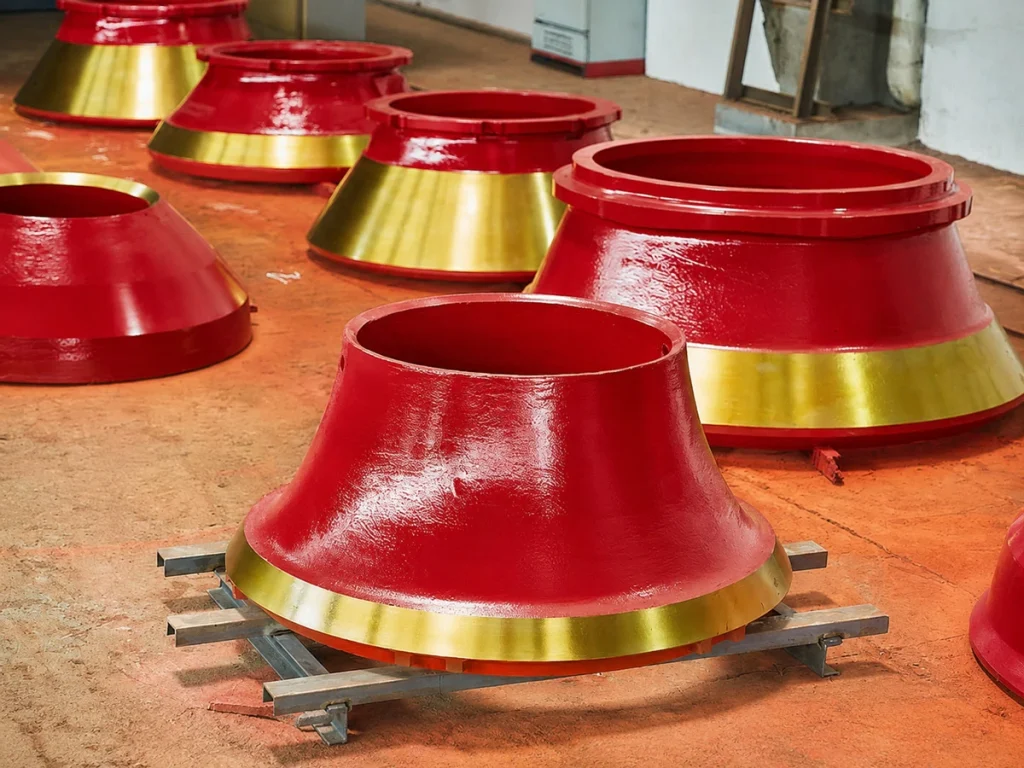
Jaw plates on basalt duty still rely on Hadfield manganese steel, typically an eighteen percent manganese grade rather than the leaner fourteen percent standard, since the lower grade starts around 230 Brinell and only reaches roughly 400 Brinell under work hardening, insufficient for the sustained compressive load basalt generates. The eighteen percent grade climbs from a similar starting hardness up to 450 to 550 Brinell in service, giving it the surface hardness needed to survive repeated high force cycles without excessive plastic deformation. Cone crusher mantles and concaves generally default to Mn18Cr2 manganese steel, broadly equivalent to ASTM A128 Grade C, work hardening from around 200 Brinell as cast to 500 to 550 Brinell in operation, with high chromium white iron in the 18 to 22 percent chromium range reserved for the most abrasive secondary and tertiary zones where sliding wear starts to dominate over pure impact. Dimensional accuracy still carries real weight on basalt duty, sand cast liners produced to ISO 8062-3 grade CT8 to CT10 seat correctly against the head and bowl, avoiding the uneven contact that concentrates stress exactly where a high compressive strength rock is least forgiving of a poor fit.
| Rock Property | Basalt | Granite | Effect on Wear Parts |
|---|---|---|---|
| Free quartz content | None | Present, Mohs 7 | Basalt relies on texture rather than quartz for abrasiveness |
| Bond Work Index | 20 plus or minus 4 kWh per tonne | 16 plus or minus 6 kWh per tonne | Higher energy demand per tonne increases stress per cycle |
| Uniaxial compressive strength | 300 to 400 MPa | 200 to 300 MPa | Greater force needed to fracture each particle |
Field Practices to Slow Basalt’s Wear Curve
- Track power draw per tonne closely on basalt duty, since the higher baseline Wi means small deviations often signal a chamber or setting problem rather than normal variation.
- Maintain a full, choke fed chamber at all times, since basalt’s toughness makes it especially sensitive to unsupported, direct impact against bare liner surface.
- Confirm motor and crusher sizing against basalt’s actual Work Index rather than a generic hard rock rating, since undersized power leads to stalling and repeated re-crushing that adds unplanned load cycles.
- Inspect jaw plates and cone liners for plastic deformation rather than waiting for visible thinning, since high compressive load can flow the surface before it wears away entirely.
- Review casting tolerance documentation on incoming liners, since a poor seating fit concentrates the already high contact stress basalt generates into a smaller area.
Sourcing Crusher Parts Built for Basalt’s Higher Energy Demand
Basalt does not need a harder alloy than granite because it is more abrasive, it needs one because it demands more energy and more repeated force per tonne to break, and that difference shows up as wear even where the mineralogy looks less aggressive on paper. This is why crusher parts rated well against granite can still wear faster than expected once the same crusher moves to basalt duty without a review of alloy grade and casting tolerance. Yonsmen casts jaw plates, cone mantles, concaves, and full liner sets to the Mn18, Mn18Cr2, and high chromium specifications covered here, with chemistry and hardness documentation supplied against every batch.
A crusher wear part sized against granite’s energy demand is frequently undersized for what basalt actually requires, which is why reviewing Work Index and compressive strength data before ordering matters as much as reviewing hardness numbers. Send us your feed strength data and current wear pattern and we can recommend the grade and profile best suited to your basalt line.