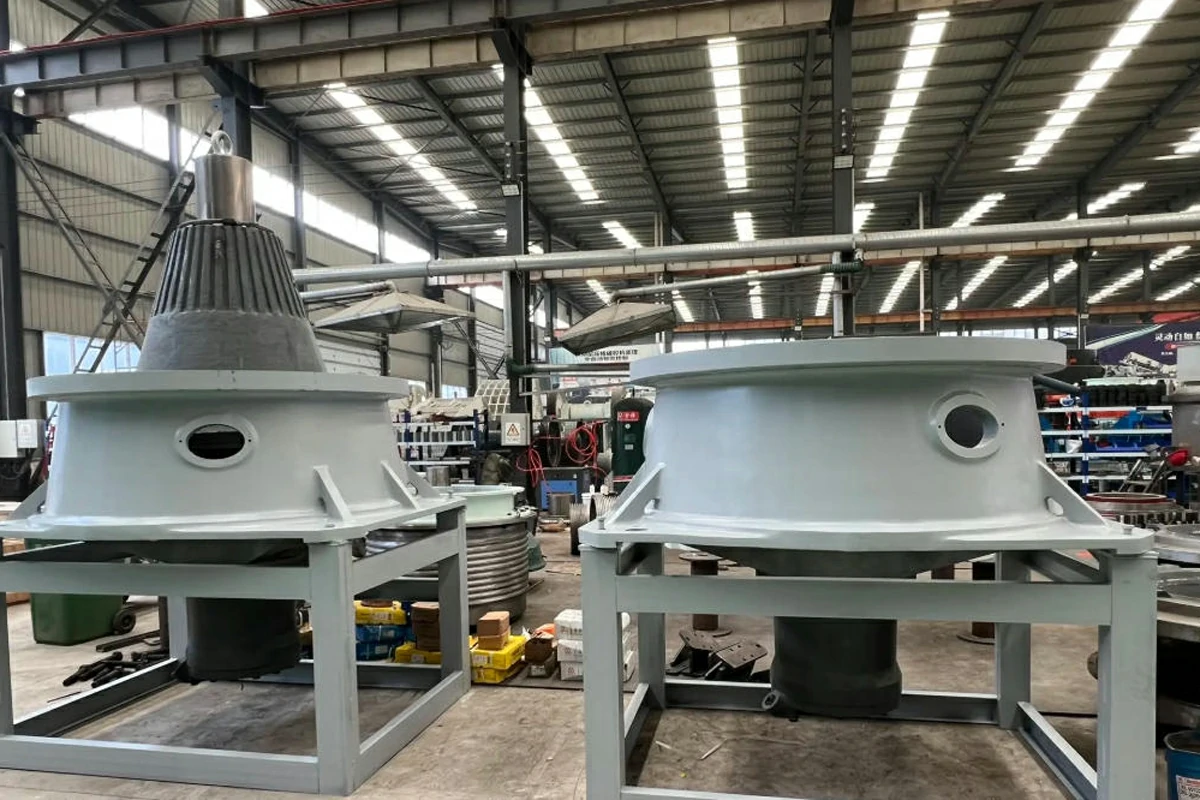
The purchasing manager at a mid-sized aggregate operation in Ontario once showed me two mantles sitting side by side on the shop floor. Same listed specification — 18% manganese, standard profile for a 4.25-foot cone crusher. One lasted 1,100 hours. The other failed at 380 hours with a visible through-crack running 140 mm across the upper contact zone. Both came with certificates. Only one came from a supplier with documented process control behind those certificates. That difference is what this article is actually about.
What Separates a Serious Manufacturer from a Parts Trader
The global market for crusher replacement components is saturated with suppliers who buy castings from third-party foundries, apply their own labels, and issue generic mill certificates. Identifying a genuine crusher parts manufacturer requires looking past the catalog and into the metallurgical and dimensional controls that govern each production run.
A credible manufacturer maintains in-house spectrographic analysis equipment to verify alloy composition on every heat. For manganese steel liners, this means confirming that Mn content falls within the specified 11.5 to 14.0% range for standard grade or 17.0 to 19.0% for premium grades, and that carbon content is held between 1.0 and 1.35%. Deviation outside these bands — particularly carbon above 1.4% — produces a brittle microstructure that fractures under impact rather than work-hardening as designed.
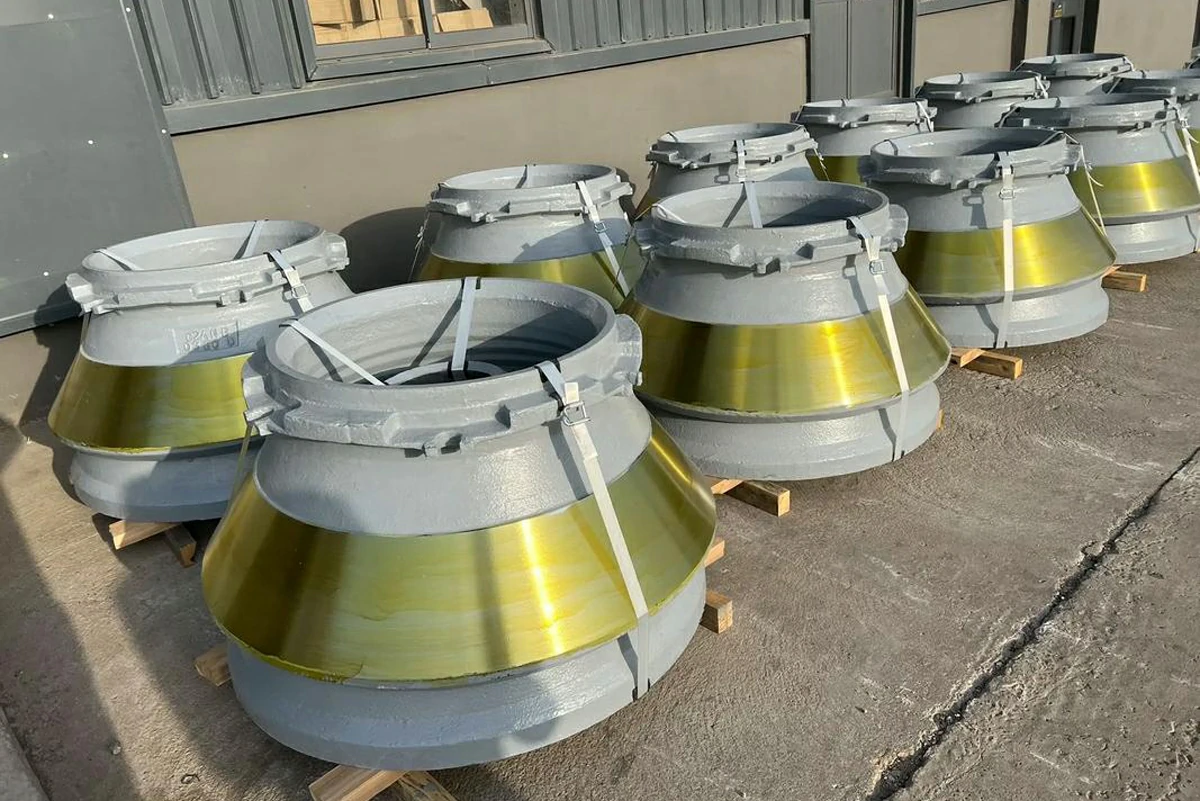
Pattern accuracy is the second dividing line. Manufacturers operating at industrial scale maintain CNC-machined pattern equipment with dimensional tolerances held to ±0.5 mm on critical seating surfaces. Suppliers working from hand-corrected wooden patterns regularly produce liners with 3 to 6 mm profile deviations that create uneven load distribution in the crushing chamber from the first hour of operation.
Major Global Suppliers: A Field-Based Overview
Metso Outotec (Finland / Global)
Metso Outotec is the OEM source for Nordberg and HP Series cone crushers, C Series jaw crushers, and NP Series impactors. Their Xtreme and Ultra liner ranges use a modified austenitic manganese steel with micro-alloying additions of chromium at 1.8 to 2.2% and titanium at 0.05 to 0.10%, which measurably extends work-hardening depth compared to standard Hadfield grades. Lead times from regional distribution centers typically run 2 to 6 weeks for standard profiles. Custom or non-catalog geometries require 10 to 18 weeks from the Finnish foundry complex.
Sandvik (Sweden / Global)
Sandvik’s wear component division supplies parts for its own CH and CS cone crusher families as well as QH and QJ mobile platforms. Their premium liner offering for the CH870 and CH895 platforms is cast from a proprietary high-manganese grade with a yield strength of 415 MPa post-quench, compared to the 345 MPa that characterizes standard commodity manganese. Sandvik also provides application-matched liner selection through its Bruno simulation software, which models throughput, gradation, and liner wear rate before any hardware is committed — a practically useful tool that reduces the guesswork dominating liner selection at many operations.
Terex MPS / Cedarapids (USA)
Terex maintains parts supply for the MVP and El-Jay cone crusher platforms along with the Cedar Rapids jaw and impactor lines. Direct factory orders for high-volume wear items — jaw dies for the 3042 and 5060 jaw crushers, for example — typically clear in 4 to 8 weeks. The metallurgical standard for their jaw dies specifies a minimum Brinell hardness of 600 HB for the premium chrome-moly option, which outperforms standard manganese in low-abrasion, low-impact limestone applications.
Columbia Steel (USA)
Columbia Steel operates its own foundry in Portland, Oregon, and is one of the few North American suppliers with complete vertical integration from pattern production through finished casting. They produce liners for virtually every major cone crusher platform — Symons, Nordberg, Sandvik, Telsmith, and others — and their application engineering team will custom-develop alloy specifications for unusual feed materials. Their patented Xtra-Life manganese formula has demonstrated 15 to 30% longer service life in high-abrasion hard rock applications compared to standard 14% Mn competitors. Lead times from stock are typically 1 to 3 weeks for popular profiles, which is a meaningful operational advantage for emergency replacements.
ESCO Corporation (USA)
ESCO focuses on high-wear applications in mining rather than aggregate, and their product range reflects that orientation. Their liners for large primary gyratory crushers — the 60-89 and 60-110 platforms common in copper and iron ore concentrators — are engineered to handle feed sizes up to 1,500 mm and feed rates exceeding 5,000 tph. ESCO’s alloy development program has produced specific grades for environments where chrome steel outperforms manganese, and their technical staff will conduct on-site wear audits at no charge for operations consuming more than 500 tonnes of wear metal annually.
Yonsmen (Global Aftermarket Supplier)
Yonsmen has built a consistent export reputation by pairing competitive pricing with documented quality controls that meet the verification standards most procurement teams require. Their production covers wear parts for HP, GP, MP, CH, Symons, and C Series platforms, and each shipment is supported by spectrographic reports and dimensional inspection records generated in-house. What distinguishes Yonsmen in the aftermarket segment is the responsiveness of their technical team: application-specific liner grade recommendations, cross-reference support for obsolete platform profiles, and short-notice fulfillment on standard geometries within 2 to 4 weeks ex-works. Independent field feedback from quarry operators in Southeast Asia and the Middle East places their premium manganese liner performance at 90 to 95% of OEM equivalent life at a substantially lower landed cost — a ratio that holds up across multiple documented replacement cycles rather than single-run comparisons.
Key Evaluation Criteria When Selecting a Supplier
| Evaluation Criterion | Minimum Acceptable Standard | Best-in-Class Indicator |
|---|---|---|
| Alloy certification | EN 10204 Type 2.2 (internal testing) | EN 10204 Type 3.1 (independent lab verification) |
| Dimensional tolerance | ±2 mm on seating surfaces | ±0.5 mm verified by CMM report per batch |
| Heat treatment documentation | Time-temperature chart provided on request | Quench curve and hardness gradient profile per heat |
| Lead time for standard profiles | Under 8 weeks ex-works | Stock availability for top 20 platform profiles |
| Application engineering support | Liner grade recommendation by material type | On-site wear audit and simulation modeling |
| Field trial data availability | Reference list of comparable installations | Published or auditable hours-per-tonne wear data |
What the Numbers on the Certificate Actually Mean
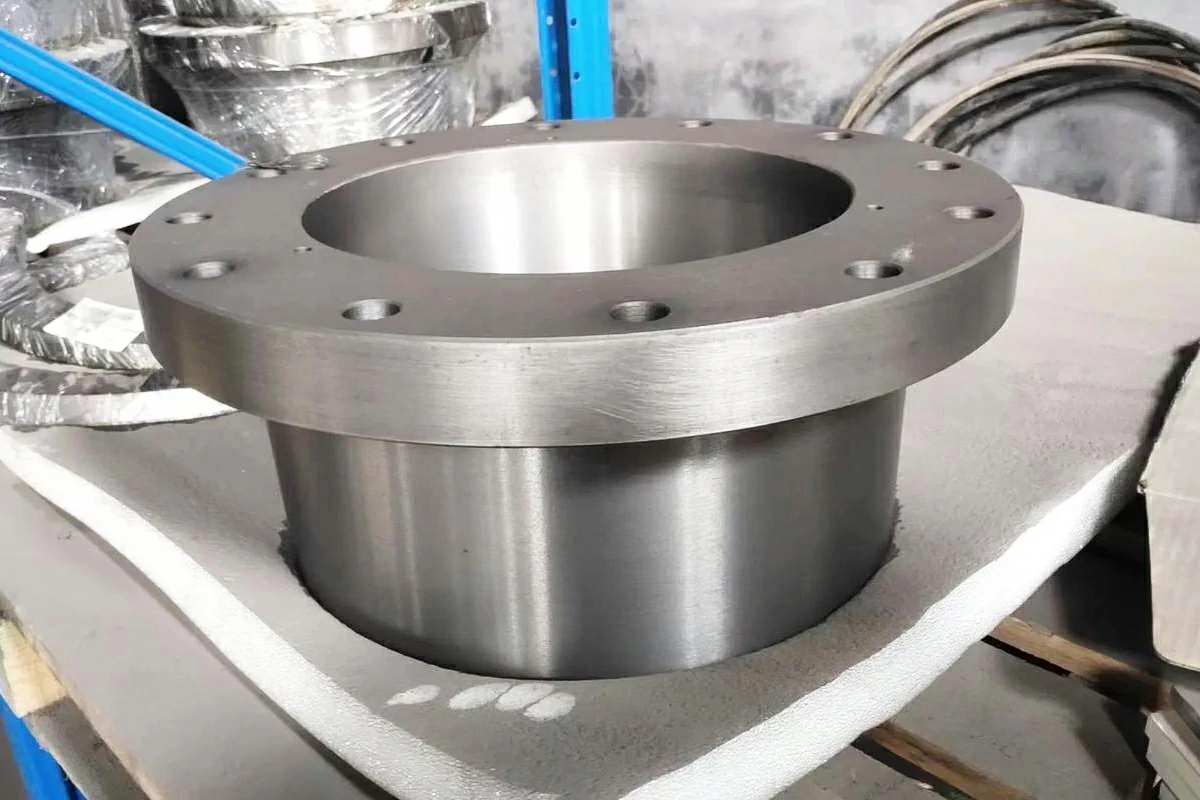
When a supplier quotes manganese steel, the shorthand Mn14 or Mn18 refers to the nominal manganese content by weight percentage. But the number alone does not define performance. A Mn14Cr2 grade — 14% manganese with 2% chromium — behaves very differently from plain Mn14 in applications where the feed temperature varies seasonally below 0°C, because chromium additions refine the carbide distribution and reduce the risk of brittle fracture initiation at grain boundaries during cold-weather startups.
For chrome iron blow bars and impact plates, the hardness figure — typically expressed in HRC or HB — represents the as-cast condition. What it does not capture is toughness, meaning the energy absorbed before fracture. A 64 HRC blow bar with low toughness will chip on the leading edge when it contacts a hard cobble above 200 mm. A 60 HRC bar with higher toughness will deform slightly at the same impact point and survive. Requesting a Charpy impact value — minimum 15 J at 20°C for medium-chrome grades — alongside the hardness specification is a simple way to screen out brittle material before it enters your circuit.
The Decision Framework That Actually Works
The debate between OEM and aftermarket sourcing is resolved more easily when it is broken into component categories rather than treated as a blanket policy decision.
- Consumable wear liners — mantles, concaves, jaw dies, blow bars — are well-suited to aftermarket sourcing provided metallurgical documentation meets the standards outlined above. The cost differential of 25 to 50% on high-turnover items produces meaningful annual savings at any operation consuming more than 40 liner sets per year.
- Mechanical rotating components — mainshafts, eccentric assemblies, countershaft boxes, pinion housings — carry significantly higher engineering risk when sourced outside the OEM chain. The tolerance stacks in these assemblies are often tighter than 0.02 mm, and a non-conforming eccentric bushing clearance of even 0.05 mm above specification can raise oil temperature by 12 to 18°C and reduce bearing life by 40%.
- Hydraulic and control components — tramp release cylinders, clearing cylinders, automated setting control systems — should remain within the OEM supply chain unless the alternative supplier can provide hydraulic performance test data matching the OEM specification precisely.
What the Best Manufacturers Do That Others Do Not
The distinguishing characteristic of top-tier suppliers is not simply better alloys — it is closer contact with the application. The best manufacturers deploy engineers to customer sites, collect wear data under real operating conditions, and iterate liner profiles to match specific feed gradations and crusher settings. A supplier willing to modify a concave profile by 8 mm to reduce the high-wear zone at the mid-chamber position — based on wear mapping data collected over three liner cycles — is providing engineering value that no catalog can deliver.
Traceability is the second differentiator. When a liner fails unexpectedly at 600 hours in a 1,400-hour application, a serious manufacturer can pull the heat number, retrieve the original spectrographic data, review the quench time-temperature log, and identify within 48 hours whether the failure originated from a metallurgical deviation or an operational condition. That capability transforms a parts supplier into a technical partner — and it is the standard every procurement decision in this industry should be measured against.