Premature failure of critical crusher components costs the global mining industry an estimated $12 billion annually in unplanned downtime and lost production. For maintenance engineers managing cone, jaw, and impact crushers, the challenge is not simply replacing parts but optimizing the tribological system where metallurgy meets geology. Understanding the specific wear mechanisms of high-manganese steel, contract-manufactured custom alloys, and specialized stainless steel components is essential for extending service intervals beyond the industry average of 450-600 operating hours.
This technical guide analyzes the distinct service life characteristics of standard wear parts, engineered contract components, and corrosion-resistant stainless steel variants, providing data-driven strategies to reduce total cost of ownership (TCO).
Wear Kinetics in Standard Manganese Steel Components
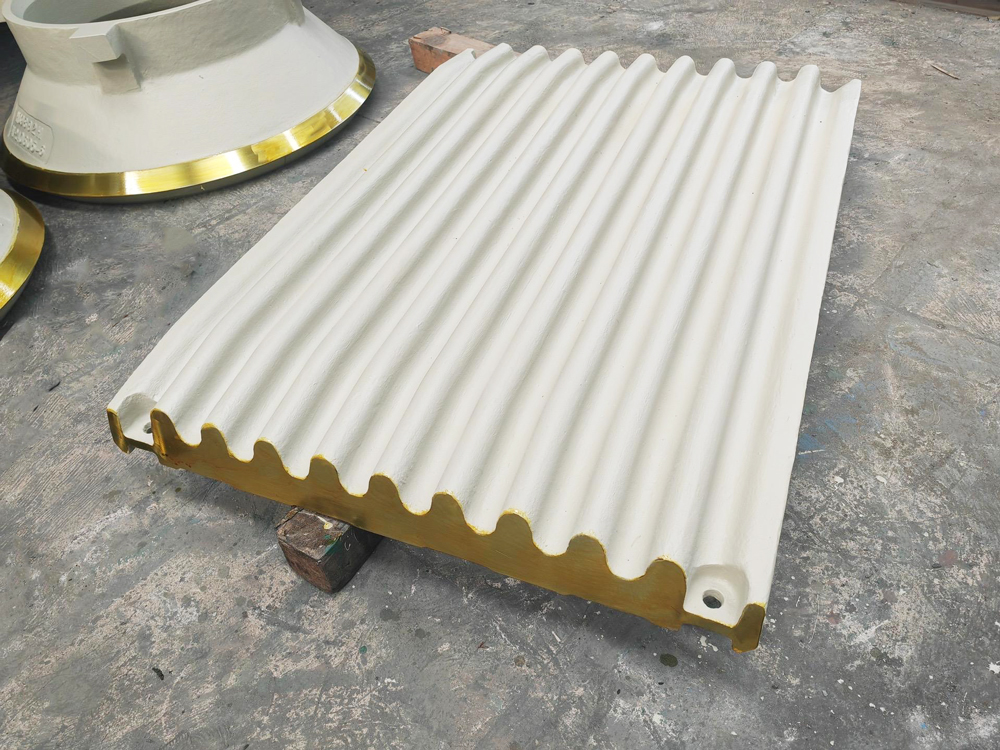
The service life of primary wear components—jaw plates, mantles, and concaves—is governed by the work-hardening rate of the austenitic manganese steel substrate relative to the feed material’s abrasiveness.
Metallurgical Performance Thresholds
Standard ASTM A128 Grade C (Mn13Cr2) wear parts perform optimally only when impact energy is sufficient to trigger the transformation from austenite (220 HBW) to martensite (500-600 HBW) on the wear surface. In low-impact abrasion scenarios, such as processing sand or river gravel, these components often fail to work-harden, resulting in rapid wash-out wear.
| Component Type | Material Grade | Typical Hardness (As-Cast) | Work-Hardened Potential | Service Life (Granite, 220 MPa) |
|---|---|---|---|---|
| Jaw Plates | Mn18Cr2 (18% Mn, 2% Cr) | 220-235 HBW | 550-600 HBW | 800 – 1,200 hours |
| Cone Mantles | Mn22Cr2 (22% Mn, 2% Cr) | 230-250 HBW | 600-650 HBW | 1,500 – 2,200 hours |
| Blow Bars | High Chrome Iron (27% Cr) | 600-650 HBW (HRC 58-62) | N/A (Through-hardened) | 400 – 800 hours |
Operational Variables Influencing Wear Rates
- Feed Compression Strength: Materials exceeding 280 MPa compressive strength accelerate micro-cracking in carbide inclusions.
- Moisture Content: Feed moisture >4% creates abrasive slurry, increasing wear rates by 15-25% in cone crushers due to “grinding compound” effect.
- Choke Feeding: Operating below 70% chamber capacity reduces inter-particle crushing, directing all abrasive force onto the liners and reducing lifespan by up to 40%.
Contract Manufacturing: Engineering for Predictable Lifespan
Contract parts differ from generic aftermarket replacements by strictly adhering to customer-specific engineering controls and tolerances. This “build-to-print” approach eliminates the dimensional variance that causes 25% of premature mechanical failures.
Precision Tolerancing and Fitment
Generic crusher parts often exhibit casting tolerances of ±2.0mm or greater. Contract-manufactured components for critical positions (such as eccentric bushings or mainshaft sleeves) typically hold ISO 2768-m tolerances:
- Concentricity: ≤0.05mm to prevent vibration-induced fatigue.
- Surface Finish: Ra ≤ 1.6 μm for mating surfaces to ensure proper hydraulic seal integrity.
- Interference Fit: Precisely calculated thermal expansion allowances (e.g., 0.15mm interference for bronze bushings) prevent spinning failures under load.
Custom Alloy Development
Contract manufacturing allows for micro-alloying strategies unavailable in off-the-shelf parts. For example, adding 0.5% Molybdenum to Mn18Cr2 improves yield strength and resistance to cracking in high-impact primary crushing applications, potentially extending liner life by 20-30%.
Stainless Steel Applications in Corrosive Crushing Environments
While standard manganese steel offers superior impact resistance, it is susceptible to rapid oxidation in wet or chemically active environments. Stainless steel components offer a strategic alternative for specific subsystems.
Austenitic vs. Martensitic Performance
- 316L (Austenitic): Excellent for hydraulic fittings, spray nozzles, and dust suppression system components exposed to acidic mine water (pH < 5.0). However, its low yield strength (200 MPa) makes it unsuitable for high-stress structural parts.
- 420/440C (Martensitic): Used for valve seats, shafts, and wear rings requiring both corrosion resistance and high surface hardness (HRC 50-55).
- Duplex 2205: The gold standard for structural components in wet processing, offering yield strengths >450 MPa and superior pitting resistance equivalent (PREN > 35).
Economic Justification in Wet Processing
In applications processing slag or wet recycled concrete, carbon steel fasteners and retention plates often seize due to corrosion within 200 hours. Switching to Grade A4-80 stainless steel fasteners eliminates torch-cutting during liner changes, reducing maintenance downtime by 15-20% per changeout cycle.
Comparative Service Life Analysis
| Part Category | Primary Failure Mode | Optimal Environment | Expected Lifespan Factor (Baseline = 1.0) |
|---|---|---|---|
| Standard Wear Parts | Abrasive Wear / Gouging | Dry, Hard Rock Crushing | 1.0 (Baseline) |
| Contract/Custom Parts | Fatigue / Predictable Wear | High-Precision / High-Load | 1.3 – 1.8x |
| Stainless Steel Parts | Corrosion / Erosion | Wet / Chemically Aggressive | 2.5 – 4.0x (vs. Carbon Steel in Wet Cond.) |
Strategies for Lifespan Extension
1. Validating Material Certification
Ensure every batch of manganese steel parts comes with a spectrometer report confirming Mn/C ratios >10. Lower ratios result in brittle castings prone to catastrophic cracking under impact.
2. Geometric Optimization
Monitor wear patterns using 3D scanning. If liners consistently wear through the bottom 30% while the top remains untouched, switch to a modified chamber profile (e.g., changing from “Coarse” to “Extra Coarse”) to distribute crushing forces more evenly.
3. Electrochemical Protection
For crushers operating in coastal or high-salinity areas, applying sacrificial zinc anodes to non-moving structural components can prevent galvanic corrosion of critical machined surfaces.
Pro-Tip: When installing new contract-manufactured bronze bushings, always measure the housing bore at ambient temperature (20°C). If the housing is distorted >0.08mm out of round, even the highest quality bushing will fail prematurely due to oil film pinch-out. Machining the housing back to tolerance is mandatory for ensuring component service life.