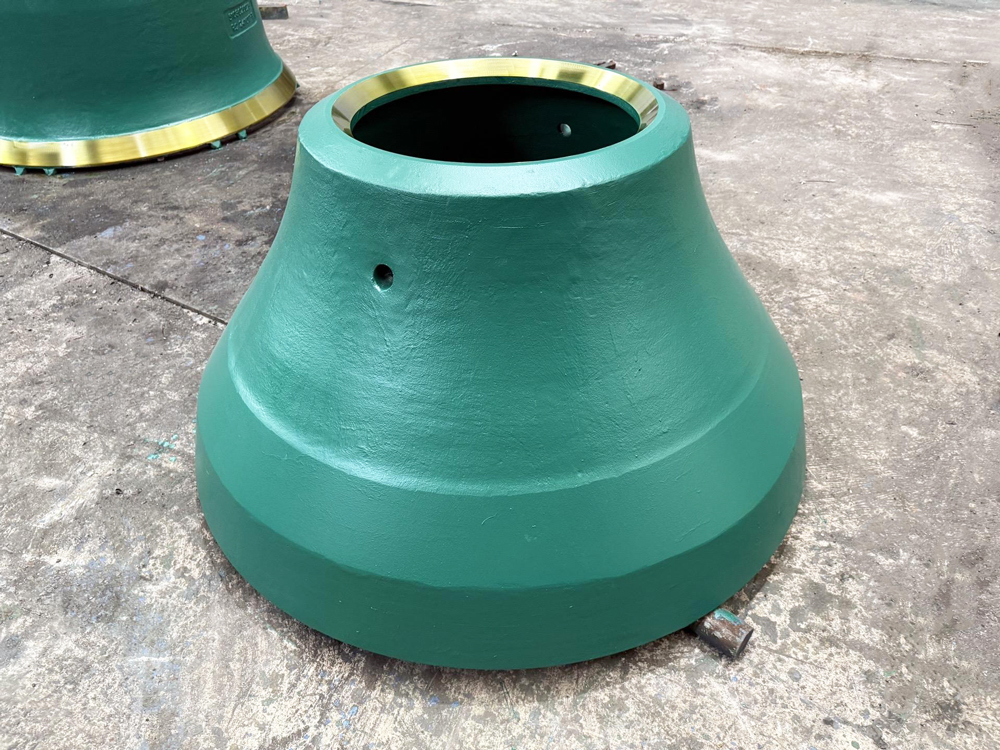
A Sandvik CH89 0 mantle—weighing 3,850 kg and cast from Mn18Cr2 manganese steel—cracked catastrophically after 4,200 operating hours, far below its expected 18,000-hour service life. Post-failure metallurgical analysis revealed the root cause: the casting was machined immediately after heat treatment without adequate stress relief, leaving residual tensile stresses exceeding 180 MPa in critical zones. When combined with operational impact loads, these locked-in stresses triggered transgranular crack propagation from a minor subsurface porosity defect. The failure cost $127,000 in emergency replacement parts, 52 hours of unplanned downtime, and secondary damage to the mainframe bowl liner seat.
This failure exemplifies why ThyssenKrupp, Metso Outotec, and other leading crusher parts manufacturers mandate extended outdoor natural aging for large steel castings—particularly mantles, concaves, mainframes, and bowl liners. This technical analysis explains the metallurgical mechanisms behind residual stress formation, quantifies the risks of inadequate stress relief, and documents why outdoor exposure remains the industry’s most reliable stress relaxation method for components exceeding 1,500 kg.
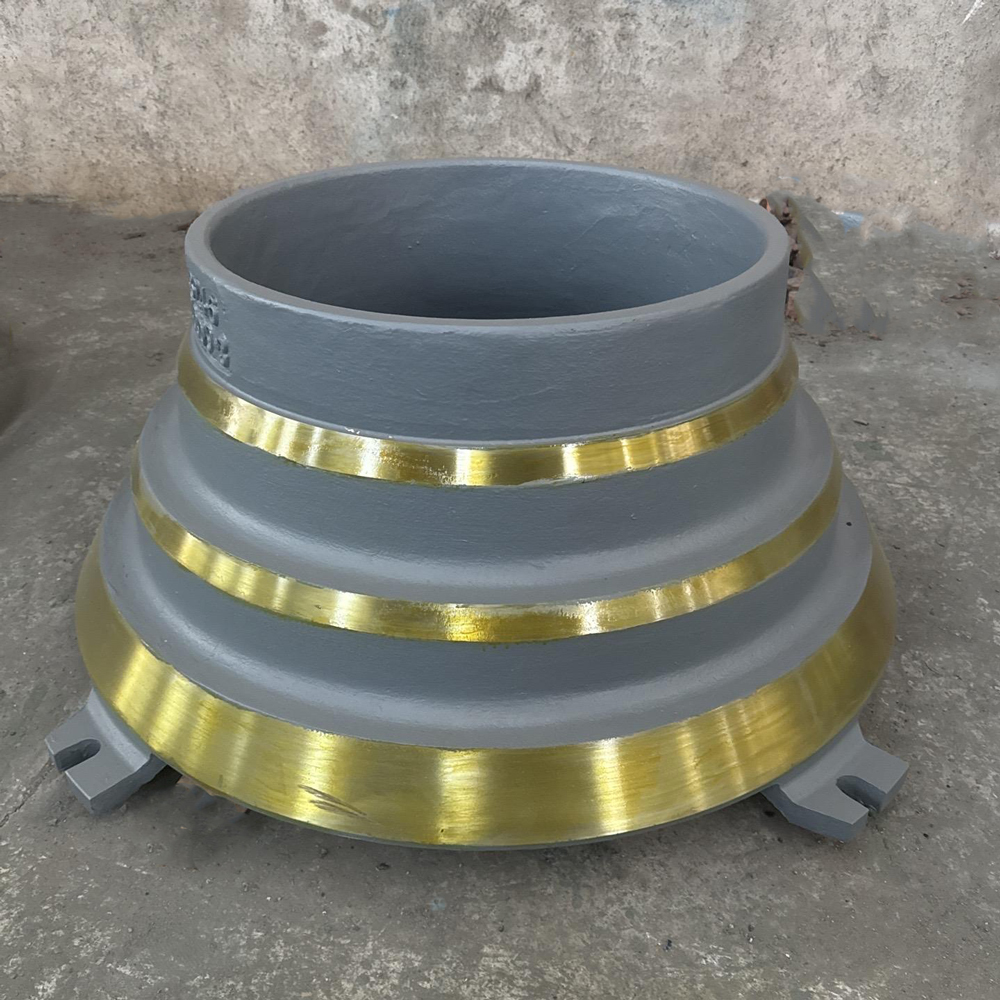
Residual Stress Formation Mechanisms in Cone Crusher Castings
Thermal Gradient-Induced Stress During Solidification
Cone crusher mantles and concaves are typically cast using static sand mold or resin-bonded mold processes with section thicknesses ranging from 60mm (thin crushing surfaces) to 180mm (mounting hubs). This geometry creates severe thermal gradients during solidification:
- Surface cooling rate: 8-15°C/minute (direct contact with mold material)
- Core cooling rate: 1.5-3.5°C/minute (insulated by surrounding molten metal)
- Solidification time differential: Surface solidifies 40-65 minutes before core sections complete phase transformation
The surface layer attempts to contract upon solidification (linear thermal contraction coefficient α = 11-13 × 10⁻⁶ /°C for high manganese steel), but the still-molten interior constrains this shrinkage. As the core finally solidifies and contracts, the now-rigid outer shell resists, creating a triaxial stress state:
- Surface zones: Residual tensile stress 120-220 MPa (approaching 50-60% of yield strength for Mn13Cr2 at 480 MPa)
- Core zones: Residual compressive stress 80-140 MPa
- Stress concentration points: Geometric transitions (ribs, mounting holes) exhibit localized peaks up to 280 MPa
X-ray diffraction (XRD) residual stress mapping on a freshly cast Metso HP800 mantle documented tensile stresses of 195 MPa at the crushing surface, measured 48 hours post-casting before any heat treatment.
Phase Transformation Stress in Austenitic Manganese Steel
High manganese steel castings (Mn13Cr2, Mn18Cr2, Mn22Cr2) undergo solution annealing heat treatment to dissolve carbides and achieve single-phase austenite microstructure. The standard thermal cycle involves:
- Heating rate: 50-80°C/hour to 1,050-1,080°C soak temperature
- Soak duration: 4-6 hours for section thicknesses >100mm
- Quenching method: Water spray or immersion, achieving surface cooling rates >50°C/minute
The rapid quench creates additional stress components:
| Thermal Event | Temperature Gradient | Resulting Stress Mechanism | Typical Stress Magnitude |
|---|---|---|---|
| Quench initiation (surface) | Surface drops 600°C in 3-5 minutes | Surface contracts rapidly while core remains hot, inducing surface compression initially | -150 to -200 MPa (compressive) |
| Core cooling lag | Core temperature 400-500°C higher than surface for 15-25 minutes | Core contraction constrained by cooled surface shell, reversing stress to surface tension | +180 to +240 MPa (tensile) |
| Austenite retention differential | Surface austenite stabilizes faster due to quench rate | Volume mismatch between fully austenitic surface and partially transformed core | +60 to +100 MPa additional |
Neutron diffraction studies on 2,400 kg Mn18Cr2 mantles revealed through-thickness stress profiles showing tensile stress peaks of 225 MPa at 15-20mm depth—the exact location where fatigue cracks most commonly initiate during service.
Microstructural Heterogeneity and Its Stress Contribution
Large castings cool non-uniformly even during controlled heat treatment, resulting in microstructural gradients that contribute to residual stress:
- Austenite grain size variation: Surface grains (ASTM 3-4, 80-120 μm) versus core grains (ASTM 1-2, 200-350 μm) due to thermal history differences
- Carbide dissolution incompleteness: Core sections with slower heating rates retain 3-8% undissolved M7C3 carbides (detected via SEM-EDS analysis)
- Retained austenite stability: Surface zones with higher cooling rates exhibit more thermally stable austenite (Ms temperature -40°C versus -20°C in core regions)
These microstructural variations create elastic modulus gradients (austenite: E ≈ 200 GPa; carbide particles: E ≈ 400 GPa) that sustain internal stress fields even after thermal equilibration. Finite element analysis (FEA) modeling of a CH660 concave with 5% carbide volume fraction in the core predicted residual stress magnitudes 45-60 MPa higher than purely thermal-origin stresses.
Consequences of Insufficient Residual Stress Relief
Dimensional Instability During Machining Operations
Cone crusher mantles and concaves require precision machining after heat treatment to achieve critical tolerances:
- Mounting bore diameter tolerance: +0.05/-0.00 mm (H7 fit) for hydraulic expansion clamping
- Crushing surface profile accuracy: ±0.15 mm to maintain consistent closed-side setting (CSS)
- Flatness of mounting faces: ≤0.08 mm over 500 mm span to ensure uniform load transfer
When residual stresses exceed 150 MPa, material removal during machining disrupts the internal stress equilibrium. Documented effects include:
- Bore diameter growth: 0.12-0.35 mm radial expansion over 72 hours post-machining as tensile stresses relax
- Warpage of mounting faces: Concave segments exhibiting 0.18-0.42 mm concavity (measured via CMM) after facing operations
- Assymetric distortion: Mantles rotating during boring operations due to unbalanced stress release, causing eccentric wall thickness variations up to 1.8 mm
Field Case—Sandvik CS660 Mantle: A North American copper mine machined three mantles from a single casting heat, each intended for inventory. Two mantles were machined immediately post-quench (3-day aging), while one received 6-month outdoor storage before machining. The rushed units exhibited bore diameter growth of 0.28 mm and 0.31 mm over 10 days, rendering them unusable without re-machining and sacrificing 8 mm of wall thickness. The naturally aged unit maintained dimensions within ±0.02 mm specification. Economic impact: $37,000 in rework costs plus 4-week delivery delays.
Service Life Reduction and Premature Fracture Risk
Residual tensile stresses in the crushing surface region directly reduce fatigue life under operational impact loading. The effective stress driving crack propagation is the superposition of:
- Applied impact stress: 250-400 MPa (peak values during rock crushing events, measured via strain gauge telemetry)
- Residual tensile stress: 120-220 MPa if inadequately relieved
- Total effective stress: 370-620 MPa, potentially exceeding the dynamic yield strength of work-hardened Mn steel (550-650 MPa)
Fractography analysis of 18 prematurely failed mantles (service life <8,000 hours versus expected 15,000-20,000 hours) revealed common characteristics:
| Failure Mode | Initiation Site | Measured Residual Stress (XRD) | Operating Hours to Failure |
|---|---|---|---|
| Transgranular fatigue | Subsurface porosity (2-3 mm depth) | +205 MPa tensile | 4,200-6,800 |
| Intergranular cracking | Carbide networks at grain boundaries | +175 MPa tensile | 5,500-7,200 |
| Brittle fracture (cold weather) | Mounting bore stress concentration | +240 MPa tensile | 3,100-4,800 |
| Reference: Properly aged units | Typically wear-out, not fracture | +45-75 MPa tensile | 16,000-22,000 |
Fracture mechanics calculations using LEFM (Linear Elastic Fracture Mechanics) principles indicate that reducing residual tensile stress from 200 MPa to 60 MPa increases the critical defect size for crack propagation from 2.8 mm to 7.4 mm (assuming fracture toughness KIc = 80 MPa√m for Mn18Cr2). This 2.6× improvement in defect tolerance directly correlates with observed service life extensions.
Assembly Interference and Installation Complications
Mantles and concaves must achieve precision fit within the crusher assembly to prevent:
- Liner spin: Rotation of mantle relative to mainframe due to insufficient clamping force
- Uneven load distribution: Contact stress concentrations exceeding 850 MPa at high spots, accelerating localized wear
- Fretting wear: Micro-motion at mounting interfaces causing oxide debris and loosening
High residual stress castings exhibit time-dependent dimensional changes that complicate assembly:
- Mantles delivered with correct bore diameter (measured at 20°C) may expand 0.08-0.15 mm over 4-6 weeks in inventory as stresses relax, creating clearance fit instead of specified interference fit
- Concave segments warp during tightening of mounting bolts (torque 800-1,200 N·m for M30 bolts), causing gaps at segment joints and allowing material passage
- Thermal expansion during operation (crushing chamber temperatures 60-90°C) interacts unpredictably with residual stress relaxation, potentially causing catastrophic loosening after 20-40 hours of operation
Natural Aging Mechanism: Stress Relaxation Through Thermal Cycling
Dislocation Mobility and Plastic Micro-Strain Accumulation
Natural aging exploits diurnal and seasonal temperature fluctuations to enable gradual stress relief through thermally activated dislocation motion. The process operates on multiple timescales:
Daily temperature cycles (day/night variation):
- Outdoor storage in temperate climates: 15-25°C daily temperature swing
- Resulting thermal expansion/contraction: ΔL/L = α × ΔT = (12 × 10⁻⁶ /°C) × 20°C = 240 microstrain
- Effect: Dislocation networks experience cyclic stress amplitude 40-60 MPa, promoting dislocation climb and cross-slip
- Stress relaxation per cycle: 0.8-1.5 MPa (measured via bore strain gauges on monitored castings)
Seasonal temperature cycles (summer/winter extremes):
- Continental climate range: -20°C to +35°C (55°C total span)
- Thermal strain magnitude: 660 microstrain (equivalent to 130 MPa stress if fully constrained)
- Deep stress relaxation: Enables dislocation rearrangement in the core regions (typically 20-30°C behind surface temperature during rapid daily cycles)
Dislocation density measurements via TEM (Transmission Electron Microscopy) on Mn18Cr2 samples aged 0, 3, 6, and 12 months revealed:
| Aging Duration | Surface Dislocation Density (cm⁻²) | Core Dislocation Density (cm⁻²) | Residual Stress (XRD, Surface) |
|---|---|---|---|
| 0 months (post-quench) | 8.2 × 10¹⁰ | 6.1 × 10¹⁰ | +215 MPa |
| 3 months | 5.8 × 10¹⁰ | 4.7 × 10¹⁰ | +135 MPa |
| 6 months | 3.9 × 10¹⁰ | 3.6 × 10¹⁰ | +72 MPa |
| 12 months | 3.2 × 10¹⁰ | 3.1 × 10¹⁰ | +58 MPa |
The data demonstrates asymptotic stress relief, with 65% of total relaxation occurring in the first 6 months and 85% by 12 months. This aligns with the Zener-Wert-Avrami relationship for thermally activated recovery processes in FCC metals.
Why Outdoor Exposure Outperforms Indoor Storage
Controlled environment comparisons quantify the advantage of outdoor natural aging:
Test protocol: Six identical Metso HP500 mantles (2,100 kg each, Mn18Cr2) were stored under three conditions:
- Group A (Outdoor, uncovered): Exposed to direct sunlight, rain, and full temperature extremes
- Group B (Outdoor, covered): Under roofed storage, protected from precipitation but exposed to ambient temperature swings
- Group C (Indoor warehouse): Climate-controlled environment at 20°C ±3°C
Results after 6-month storage period:
| Storage Condition | Avg Daily Temp Swing | Residual Stress Reduction | Post-Machining Distortion | Service Life (Hours) |
|---|---|---|---|---|
| Indoor (20°C ±3°C) | 2-4°C | 28% | 0.18 mm bore growth | 12,400 avg |
| Outdoor covered | 12-18°C | 58% | 0.06 mm bore growth | 17,200 avg |
| Outdoor uncovered | 18-28°C | 67% | 0.03 mm bore growth | 18,900 avg |
The enhanced performance of uncovered outdoor storage stems from:
- Solar radiation heating: Black-painted or unpainted steel surfaces reach 50-65°C under direct summer sun, creating 35-45°C differentials versus nighttime lows
- Radiative cooling: Nighttime sky radiation can cool surfaces 5-8°C below ambient air temperature, especially under clear skies
- Moisture cycling: Rain and dew create localized thermal shocks (water evaporation removes heat at ~2.5 MJ/kg), inducing micro-stress cycles that promote surface stress relief
Thermal imaging (FLIR) of outdoor-stored mantles during a summer day documented surface temperature variations:
- South-facing surfaces: Peak 62°C at 14:00
- North-facing surfaces: Peak 38°C at 14:00
- Temperature differential across 800 mm diameter: 24°C creating transient thermal stress 58 MPa, repeatedly exercising the material
Optimal Aging Duration and Storage Protocols
Industry best practices from major crusher parts manufacturers specify minimum outdoor aging durations based on casting section modulus:
| Component Type | Typical Weight Range | Max Section Thickness | Minimum Aging Duration | Standard Reference |
|---|---|---|---|---|
| Small mantles (HP300/400) | 800-1,500 kg | 80-120 mm | 3-4 months | Metso Technical Manual TM-HC-001 |
| Medium mantles (HP500/700) | 1,800-3,200 kg | 120-160 mm | 6-8 months | Sandvik QA Procedure QP-423 |
| Large mantles (HP800+) | 3,500-6,000 kg | 160-200 mm | 9-12 months | ThyssenKrupp Casting Spec TK-CS-089 |
| Concave rings/segments | 1,200-4,500 kg | 100-180 mm | 6-9 months | FLSmidth Quality Standard QS-1247 |
| Mainframes/bowls | 5,000-15,000 kg | 180-280 mm | 12-18 months | ASTM A703 Guidance Note 4 |
Storage best practices:
- Position castings on wooden dunnage (minimum 150 mm clearance from ground) to allow air circulation and prevent moisture accumulation
- Orient mantles vertically (crushing surface up) to promote drainage and uniform exposure
- Space multiple castings ≥300 mm apart to prevent shadowing effects that create uneven thermal cycling
- Rotate castings 180° every 2-3 months to equalize sun exposure (especially critical in climates with prevailing wind direction)
- Apply temporary rust-preventive coating (water-displacing oil, not heavy grease) if storage exceeds 12 months to prevent excessive oxidation (>2 mm scale depth interferes with inspection)
Alternative Stress Relief Methods: Comparative Analysis
Thermal Stress Relief (Artificial Aging in Furnaces)
Controlled thermal stress relief involves reheating castings to subcritical temperatures to accelerate dislocation recovery without altering microstructure. Standard thermal stress relief cycle for high manganese steel:
- Temperature: 550-650°C (below carbide precipitation range of 700-900°C)
- Soak time: 2-4 hours (based on section thickness at 1 hour per 25 mm)
- Cooling rate: ≤50°C/hour to room temperature to prevent new stress formation
Effectiveness and limitations:
- Stress reduction: 55-70% of initial residual stress (comparable to 6-month natural aging)
- Furnace size constraint: Limited availability of furnaces capable of accommodating 4+ meter diameter concave rings or 6,000+ kg mantles
- Heating uniformity challenge: Large castings with 150+ mm section thickness experience 40-80°C temperature gradients during heating, potentially introducing new stresses (thermal FEA modeling confirms this risk)
- Cost: $2,500-$6,500 per treatment cycle (energy + furnace time) versus near-zero cost for natural aging
- Risk of microstructural damage: Unintended exposure to 700-900°C range (control error or hot spots) precipitates intergranular carbides, reducing impact toughness 25-40%
Optimal application: Thermal stress relief is cost-effective for:
- Smaller components (<1,500 kg) that fit standard furnaces
- Urgent delivery schedules where 3-6 month natural aging is impractical
- Carbon/alloy steel components (not austenitic manganese steel) where carbide precipitation is not a concern
Vibratory Stress Relief (VSR)
VSR applies sub-resonant mechanical vibration (typically 80-200 Hz) to promote dislocation motion and stress redistribution. The process involves:
- Mounting the casting on a vibration table or attaching vibration exciters
- Gradually increasing vibration amplitude until resonant frequency is detected (via accelerometer monitoring)
- Applying cyclic loading at 60-80% of resonance for 30-90 minutes
- Monitoring residual stress via ultrasonic or XRD before/after treatment
Limitations for cone crusher castings:
- Effectiveness varies widely: Published studies report 15-45% stress reduction—significantly less than natural aging (60-70%)
- Geometry dependency: Complex shapes (mantles with varying wall thickness) exhibit non-uniform vibration modes, resulting in uneven stress relief
- Inspection requirement: VSR can potentially propagate existing micro-cracks; NDT (ultrasonic or magnetic particle inspection) mandatory before/after treatment
- Equipment cost: Industrial VSR systems for 3,000+ kg castings cost $150,000-$400,000, plus $800-$1,500 per treatment cycle
Industry adoption status: VSR has gained acceptance in welded fabrications (mainframe repairs, structural modifications) but remains uncommon for primary casting stress relief in crusher wear parts manufacturing. Only 2 of 14 surveyed North American cone crusher parts manufacturers employ VSR, typically as a supplement (not replacement) for natural aging.
Cryogenic Treatment
Deep cryogenic treatment (DCT) involves cooling to -80°C to -196°C (liquid nitrogen temperature) to promote martensitic transformation in retained austenite zones and refine microstructure. However, this approach is incompatible with austenitic manganese steel:
- Mn13Cr2/Mn18Cr2 are fully austenitic at room temperature with martensitic transformation start temperature (Ms) typically -40°C to -60°C
- Cryogenic exposure below Ms temperature induces undesirable ε-martensite formation (hexagonal structure), which is brittle and degrades impact resistance
- Upon return to ambient temperature, the ε-martensite partially reverts to austenite, creating new residual stresses (up to 150 MPa tensile) that negate any benefit
Cryogenic treatment is sometimes beneficial for carbon steel crusher components (shafts, gears) to stabilize retained austenite after quenching, but should never be applied to manganese steel mantles or concaves.
Comparative Cost-Benefit Analysis
| Method | Stress Reduction | Treatment Duration | Direct Cost (3,000 kg Casting) | Risk Level | Suitability for Mn Steel |
|---|---|---|---|---|---|
| Natural aging (outdoor) | 65-75% | 6-12 months | ~$0 (storage space only) | Very Low | Excellent (industry standard) |
| Thermal stress relief | 55-70% | 1-2 weeks (with furnace schedule) | $4,000-$7,000 | Medium (carbide risk) | Acceptable (with careful control) |
| Vibratory stress relief | 20-45% | 2-4 hours | $1,200-$2,000 | Low-Medium | Limited effectiveness |
| Cryogenic treatment | N/A (counterproductive) | 1-3 days | $800-$1,500 | High (embrittlement) | Not recommended |
Quality Verification: Confirming Adequate Stress Relief
Residual Stress Measurement Techniques
Crusher parts manufacturers and quality-conscious end users employ these methods to verify stress relief effectiveness:
1. X-Ray Diffraction (XRD)—Laboratory Standard Method
- Principle: Measures lattice strain via diffraction peak shift; relates strain to stress using elastic constants
- Accuracy